
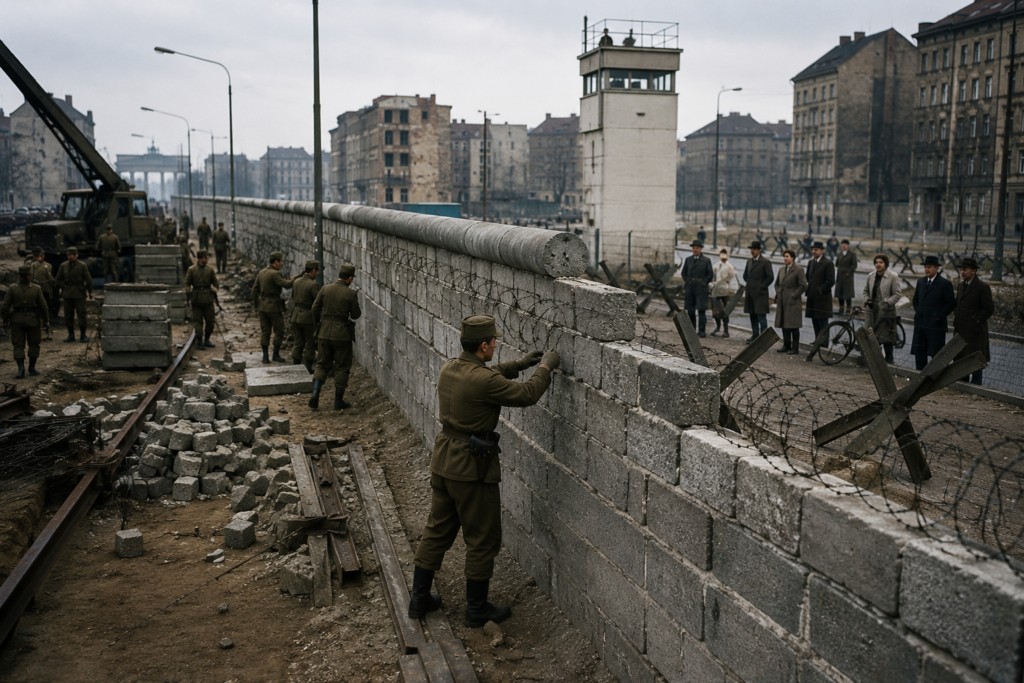
Image Credits: 1961 East Germany Seals Berlin as Construction of the Berlin Wall Begins. AI-generated illustration created by Open Chronicle using ChatGPT (OpenAI). August 2026. This image is illustrative and does not depict a real-world scene.
By Open Chronicle
13 August 1961
In the early hours of 13 August 1961, East German authorities began sealing the border between East and West Berlin, abruptly cutting streets, railway lines and neighbourhoods that had remained connected despite the division of Germany after the Second World War. Soldiers and police rolled out barbed wire, erected barricades and blocked crossing points across the city.
What initially appeared to be an emergency security operation quickly developed into one of the most powerful symbols of the Cold War: the Berlin Wall.
For nearly three decades, the barrier would divide families, communities and an entire city. It became the physical frontier between two competing political systems and a stark representation of the wider division between the communist East and democratic West.
A City Divided by the Cold War
Berlin’s unusual political status originated in the aftermath of Nazi Germany’s defeat in 1945.
Germany was divided into four occupation zones controlled by the United States, Soviet Union, United Kingdom and France. Berlin, although located deep inside the Soviet occupation zone, was itself divided into four sectors administered by the same Allied powers.
As relations between the Soviet Union and the Western Allies deteriorated, these occupation zones developed into separate political states.
In 1949, the western zones became the Federal Republic of Germany, commonly known as West Germany. The Soviet zone became the German Democratic Republic, or East Germany.
Berlin remained divided.
West Berlin became a Western-controlled enclave surrounded by East German territory, creating one of the most politically sensitive locations in the world.
The Escape Route Through Berlin
The division presented East Germany with a serious problem.
Although the border between East and West Germany had become increasingly fortified during the 1950s, movement between East and West Berlin remained comparatively accessible.
East Germans could travel to East Berlin and then cross into West Berlin. From there, they could reach West Germany.
Millions did exactly that.
Between 1949 and 1961, approximately 2.7 million people left East Germany, many travelling through Berlin.
The departures created a serious demographic and economic crisis for the East German government.
Many of those leaving were young and professionally trained. Doctors, engineers, teachers, technicians, skilled workers and university graduates were among those seeking better economic opportunities and greater political freedom in the West.
East German leaders described the exodus as a dangerous loss of skilled labour.
The survival of the state itself appeared increasingly threatened.
The Berlin Crisis
By the late 1950s, Berlin had become a central confrontation point between the Soviet Union and the Western powers.
Soviet leader Nikita Khrushchev repeatedly demanded changes to West Berlin’s political status and threatened to transfer control over Allied access routes to East Germany.
Western governments refused to abandon the city.
American President John F. Kennedy, who entered office in January 1961, made clear that the United States would defend its presence in West Berlin.
Meanwhile, the number of East Germans leaving through Berlin continued to rise.
During the summer of 1961, the refugee crisis reached extraordinary levels.
Thousands were crossing into West Berlin every day.
East German leader Walter Ulbricht and his government concluded that drastic action was necessary.
Operation Rose
The plan to close the border was prepared in secrecy.
The operation became known as Operation Rose.
Late on Saturday, 12 August 1961, East German security forces received orders to move into position.
Shortly after midnight, thousands of soldiers, police officers and workers began closing the border.
Streets were torn up.
Railway connections were interrupted.
Subway and suburban railway services crossing the dividing line were restricted.
Barbed wire was stretched across roads and pavements.
Concrete blocks appeared at major intersections.
East German troops stood guard with weapons.
When Berliners awoke on the morning of 13 August, their city had been transformed.
Families Divided Overnight
The sudden closure produced extraordinary scenes.
People who had crossed the sector boundary the previous day discovered that they could no longer return normally.
Families living only streets apart were separated.
Workers found themselves unable to reach their jobs.
Friends and relatives gathered on opposite sides of the barriers, sometimes close enough to see one another but unable to cross.
Buildings located directly beside the border created particularly dramatic situations.
In some locations, residents of East Berlin apartments jumped from windows into West Berlin before authorities could seal the buildings.
East German security forces soon blocked windows and doorways facing the West.
The division became increasingly permanent.
From Barbed Wire to Concrete
The first barriers consisted largely of barbed wire and temporary obstacles.
Within days, construction crews began replacing them with more substantial structures.
Concrete walls appeared.
Over time, the Berlin Wall developed into a sophisticated border system extending approximately 155 kilometres around West Berlin.
The barrier was not simply a single wall.
It eventually included multiple fences, patrol roads, watchtowers, lighting systems, anti-vehicle barriers and heavily controlled crossing points.
Between the main barriers lay an exposed area commonly known in the West as the death strip.
East German border guards were tasked with preventing unauthorised crossings.
The border became one of the most heavily guarded frontiers in Europe.
Checkpoint Charlie
A limited number of crossing points remained available for authorised travel.
The most famous became Checkpoint Charlie, located on Friedrichstraße between the American and Soviet sectors.
Only weeks after construction of the Wall began, Checkpoint Charlie became the scene of a dangerous Cold War confrontation.
In October 1961, American and Soviet tanks faced one another across the border following a dispute over Allied access rights.
For approximately sixteen hours, heavily armed forces from the world’s two nuclear superpowers stood only a short distance apart.
Eventually, both sides withdrew.
The confrontation demonstrated how Berlin could potentially trigger a much larger conflict.
Attempts to Escape
Despite the increasingly sophisticated border system, many East Germans continued trying to reach the West.
Some climbed or crossed the barriers during the Wall’s early days.
Others dug tunnels beneath the border.
People hid inside specially modified vehicles, travelled through underground passages or attempted to cross rivers and canals.
Some escapes were remarkably ingenious.
Others ended tragically.
One of the most famous victims was Peter Fechter, an 18-year-old bricklayer who attempted to cross the Wall in August 1962. East German guards shot him as he tried to escape.
He fell near the Wall and remained wounded in the border zone before dying.
His death became an international symbol of the human cost of Berlin’s division.
At least 140 people are documented as having died at the Berlin Wall or in circumstances directly connected with the East German border regime in Berlin, although historical definitions and totals vary.
A Symbol of the Cold War
The Berlin Wall rapidly became more than a border.
For Western governments, it represented the failure of communist authorities to retain their own population without physical barriers.
For East Germany, officially, it was described as an “Anti-Fascist Protection Rampart”, supposedly necessary to defend the socialist state from Western interference.
In practice, its principal effect was to prevent East German citizens from leaving.
Berlin became one of the great political stages of the Cold War.
In June 1963, President Kennedy visited West Berlin and delivered one of the most famous speeches of his presidency.
Standing before an enormous crowd, he declared:
“Ich bin ein Berliner.”
The phrase became an expression of American solidarity with the isolated population of West Berlin.
More than two decades later, another American president would use the Wall as the setting for another famous Cold War speech.
Reagan at the Brandenburg Gate
On 12 June 1987, President Ronald Reagan spoke near the Brandenburg Gate.
Addressing Soviet leader Mikhail Gorbachev, Reagan issued a direct challenge:
“Mr. Gorbachev, tear down this wall!”
By then, significant changes were already occurring inside the Soviet Union.
Gorbachev had introduced policies of glasnost and perestroika, while communist governments across Eastern Europe faced increasing pressure for political reform.
The system that had created the Berlin Wall was beginning to weaken.
Few predicted how quickly it would collapse.
The Wall Falls
During 1989, communist governments across Eastern Europe came under growing pressure.
Hungary opened its border with Austria, creating another route through which East Germans could reach the West.
Large demonstrations spread across East Germany.
Thousands demanded political reform and freedom of movement.
On the evening of 9 November 1989, East German official Günter Schabowski announced new travel regulations during a televised press conference.
When asked when the rules would take effect, he appeared uncertain and replied that, as far as he understood, they applied immediately.
Thousands of East Berliners rushed toward the border crossings.
The guards had received no clear instructions for handling the crowds.
Eventually, overwhelmed border officials opened the gates.
Berliners poured across the frontier.
People climbed onto the Wall, embraced strangers and began breaking pieces from the concrete barrier with hammers and chisels.
After twenty-eight years, the Berlin Wall had effectively ceased to function.
Germany Reunited
The fall of the Wall accelerated political changes already sweeping through Eastern Europe.
Less than a year later, on 3 October 1990, East and West Germany formally reunified.
Berlin once again became the capital of a united German state.
Most of the Wall was dismantled, although sections were preserved as historical monuments.
Today, memorials, museums, pavement markers and surviving sections trace the former border through the modern city.
The Berlin Wall Memorial at Bernauer Straße preserves one of the most important surviving sections of the border complex and documents the experiences of those whose lives were transformed by the division.
The Night Berlin Was Divided
The events of 13 August 1961 changed Berlin overnight.
What began with rolls of barbed wire guarded by soldiers developed into a fortified frontier separating two political worlds.
For twenty-eight years, the Berlin Wall divided streets, neighbourhoods and families while standing at the centre of the confrontation between the United States and the Soviet Union.
Its construction demonstrated the extraordinary tensions of the Cold War.
Its fall in 1989 came to symbolise something very different: the collapse of communist rule across much of Eastern Europe and the approaching end of the Cold War itself.
Few structures in modern history have carried such enormous political meaning.
The Berlin Wall was built to prevent people from leaving.
Ultimately, its destruction became one of history’s most recognisable symbols of freedom.