
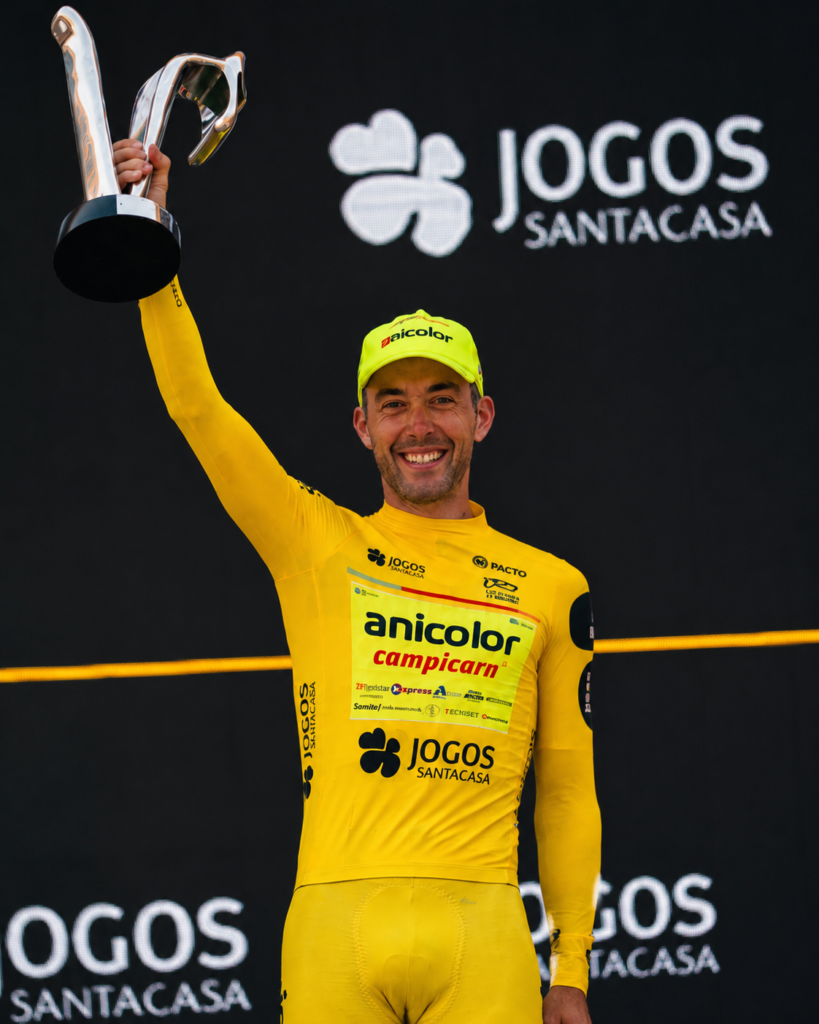
Image Credits: Volta a Portugal 2026 Race Analysis: How Alexis Guérin and Anicolor Campicarn Won the 87th Edition. AI-generated illustration created by Open Chronicle using ChatGPT (OpenAI). August 2026. This image is illustrative and does not depict a real-world scene.
By Open Chronicle Cycling
The final result of the 2026 Volta a Portugal suggests a race ultimately controlled by one team.
Alexis Guérin won. Artem Nych finished second. Anicolor Campicarn won the team classification.
But the path to that dominance was considerably more complicated.
The 87th Volta began with UAE Team Emirates XRG controlling the race against the clock, passed through an early period with Rui Oliveira in yellow, changed fundamentally on the slopes of Torre and was finally decided through a combination of Guérin’s climbing strength and Anicolor’s ability to manage the unusual tactical situation of having the two strongest general classification riders on the same team.
Guérin’s final winning margin of 1:02 over Nych does not fully explain the race. The key to understanding this Volta is identifying when Anicolor stopped chasing the Yellow Jersey and started defending it.
That moment came at Torre.
☝️What a great atmosphere at the final Stage! 🎉
🇵🇹 Volta a Portugal 2026 • Stage 1️⃣0️⃣
87th Edition
🗓️ Sunday, August 16th🚩 #Maia
🏁 #Porto
📏 136,9 km@VoltaPortugal #VoltaaPortugal #Portugal 🇵🇹 pic.twitter.com/XEMmTAvymc— Kingdom of Cycling (@Cycling_Kingdom) August 16, 2026
The Race in One Sentence
Anicolor Campicarn entered the decisive mountains with multiple options, used Guérin’s Stage 4 attack to seize control and then transformed the numerical strength of Guérin and Nych into a tactical problem their rivals could never solve.
Phase One: UAE Controls the Opening
Before Anicolor became the dominant force, UAE Team Emirates XRG had produced an almost ideal beginning.
Julius Johansen won the Lisbon prologue. Rui Oliveira finished second and was immediately positioned within striking distance of yellow.
Twenty four hours later, Francisco Campos won Stage 1, but Oliveira moved into the overall lead. He then safely negotiated the sprint into Albufeira on Stage 2, finishing sixth as Santiago Mesa narrowly defeated Daniel Cavia in the photo finish.
UAE therefore approached the first major mountains with several tactical assets.
Oliveira had yellow. Johansen had demonstrated exceptional form against the clock. Adrià Pericas offered a young climbing option.
But the character of the race was about to change.
O novo vencedor da Volta a Portugal 🏆
As declarações de Alexis Guérin depois de confirmar a conquista da 87.ª Volta a Portugal Jogos Santa Casa.#VP26 pic.twitter.com/t2Qc3Te1XT
— Volta a Portugal (@VoltaPortugal) August 16, 2026
The Decisive Move: Guérin Attacks at Torre
Stage 4 was the tactical turning point of the entire Volta.
On the brutal final ascent to Torre, Guérin did not simply follow the other general classification contenders. He attacked.
The move delivered two prizes simultaneously: the stage victory and the Yellow Jersey.
From that moment, every other team’s strategy had to change.
UAE no longer controlled the race.
Nych was no longer simply defending his status as the two time reigning champion.
And Anicolor suddenly had the most valuable tactical configuration possible in a stage race: the race leader and another genuine overall contender.
That changed everything.
Why Having Nych Behind Guérin Was So Powerful
The most interesting tactical feature of the second half of the Volta was that Guérin’s most dangerous rival was wearing the same jersey.
Nych had won the previous two editions and was pursuing a third consecutive title. He was also strong enough to reduce his deficit during the Stage 5 individual time trial.
Johansen won that time trial, his second victory of the race, while Nych took 14 seconds from Guérin. Guérin nevertheless retained yellow.
For Anicolor, this was almost an ideal outcome.
If another team attacked Guérin, Nych could follow.
If rivals concentrated on Nych, Guérin remained protected.
If Nych gained time naturally through the racing, Anicolor still had another route towards overall victory.
The team did not need to decide prematurely which rider had to win the Volta.
It needed to ensure that somebody outside Anicolor did not.
That distinction is fundamental.
Guérin Did Not Need to Dominate Every Day
One of the strongest features of Guérin’s race was restraint.
After Torre, he did not attempt to answer every movement personally.
Stage 6 demonstrated the value of allowing other tactical contests to develop. Xabier Isasa won from the surviving breakaway ahead of Rui Oliveira, while the broader general classification structure remained under control.
This is an important principle in stage racing.
Once a rider possesses a meaningful advantage, winning every battle can become counterproductive. Energy spent chasing riders who do not threaten the general classification is energy unavailable when the decisive attacks arrive.
Anicolor increasingly raced against time gaps rather than stage victories.
Until the opportunities for stage victories aligned with its GC objectives.
Pericas Creates a New Problem
Stage 7 at Termas do Gerês complicated the picture.
Adrià Pericas emerged with Guérin and Nych in the decisive selection and then defeated both Anicolor riders in the three rider sprint.
Suddenly UAE had another significant general classification presence.
Pericas represented a different threat from Oliveira.
He could climb with the principal contenders.
His youth also meant that UAE did not necessarily have to race conservatively. The team could use him aggressively while still pursuing the White Jersey.
Yet Stage 7 also demonstrated Anicolor’s underlying advantage.
Even when another rider entered the GC battle, Guérin and Nych were both there.
Pericas had to beat two riders from the same team.
That numerical imbalance would continue to shape the race.
The Tactical Equation Before Senhora da Graça
By the time the race approached its final mountain showdown, Guérin remained in yellow and Nych remained his closest challenger.
There were theoretically two races happening simultaneously.
One was Guérin versus the rest of the peloton.
The other was Guérin versus Nych.
But the second contest only mattered if the first had already been won.
That allowed Anicolor to approach Senhora da Graça with an unusually strong hand.
Other teams needed to attack.
Anicolor could react.
If somebody escaped and threatened Guérin, Nych could follow.
If Nych moved with rivals, Guérin could measure the gap.
If both Anicolor riders reached the decisive kilometres together, the team retained control regardless of which rider ultimately finished ahead.
Senhora da Graça Settles the Argument
Stage 9 eliminated any remaining uncertainty.
José Neves attacked with Guérin and Nych during the decisive part of the final climb. The three emerged at the front approximately four kilometres from the summit.
Guérin then provided the answer himself.
Inside the final 500 metres, the Yellow Jersey attacked.
He won the stage, Neves finished second and Nych third.
The tactical significance was greater than the stage victory.
Guérin had demonstrated that Anicolor did not need to transfer leadership to Nych.
The race leader was still strong enough to win on one of the Volta’s defining climbs.
His advantage over Nych increased to 1:02.
The internal hierarchy was effectively settled.
Why Anicolor’s Strategy Worked
Anicolor’s success rested on four elements.
First, the team seized yellow when the terrain suited Guérin. It did not have to spend the opening stages defending the race.
Second, it preserved Nych as a genuine secondary leader. His presence prevented rivals from concentrating exclusively on Guérin.
Third, Guérin avoided unnecessary expenditure. He defended gaps rather than trying to control every stage outcome.
Fourth, when the decisive opportunity arrived on Senhora da Graça, Guérin attacked rather than merely defending.
The result was not simply first place.
It was first and second overall, plus the team classification.
That is the clearest measure of how thoroughly Anicolor ultimately controlled the GC battle.
UAE Won a Different Race
Judging UAE Team Emirates XRG only by the General Classification would underestimate its Volta.
The WorldTeam did not win yellow, but it influenced virtually every phase of the race.
Johansen won the prologue and Stage 5 time trial.
Oliveira wore yellow early in the race.
Pericas won Stage 7 and emerged as one of the strongest young riders in the mountains.
Oliveira then won the final stage in Porto and secured the points classification, while Pericas completed the race as winner of the White Jersey and fifth overall.
The strategic difference was that UAE’s success was distributed across several objectives.
Anicolor concentrated its strength around the overall race.
Both approaches produced major rewards, but only one produced the Yellow Jersey.
The Portuguese Challenge
Pedro Silva’s third place deserves particular attention.
He did not control the race through spectacular attacks. His path to the podium was built through consistency and survival as the mountains progressively removed other contenders.
José Neves also emerged strongly during the final weekend, particularly with second place on Senhora da Graça.
The final result placed Pedro Silva third and José Neves fourth, with Tiago Antunes sixth.
For Portuguese cycling, that meant three home riders inside the final top six despite the victory going to France and Anicolor’s international leaders occupying the first two positions.
Oliveira’s Tactical Reinvention
Rui Oliveira’s race is another example of intelligent adaptation.
Early in the Volta, he was a General Classification protagonist.
He wore yellow.
Once the mountains changed that reality, continuing to race as though he remained a GC contender would have wasted opportunities.
Instead, his objectives changed.
Points became increasingly important. Stage victories became possible again.
That tactical reset ultimately produced one of the strongest endings of the race.
Oliveira won Stage 10 in Porto ahead of Daniel Cavia and Francisco Campos and secured the points classification.
His Volta therefore followed an unusual arc:
Yellow Jersey → loss of GC contention → points campaign → final stage victory → Orange Jersey.
It was an effective example of redefining objectives during a stage race rather than allowing one lost ambition to determine the remainder of the event.
The Race That Could No Longer Be Analysed Only as Sport
Any tactical assessment of the final weekend requires an important qualification.
Stage 8 was neutralised following the death of Finlay Tarling, the 19 year old NSN Development Team rider involved in a serious accident during the stage from Melgaço to Fafe. The race proceeded to Fafe without competitive racing or podium ceremonies.
NSN Development Team subsequently withdrew.
When racing resumed, the atmosphere was fundamentally different. Riders observed tributes and moments of silence, while Guérin wore a black version of the leader’s jersey on Stage 9 and dedicated his victory to Tarling.
That means the final weekend cannot reasonably be interpreted through tactics alone.
The riders were competing while processing the death of a member of their peloton.
The sporting result remains part of the record, but so does that context.
Final Tactical Verdict
The decisive moment of the 2026 Volta a Portugal was not Porto.
It was Torre.
That was where Guérin transformed himself from contender into race leader.
The decisive strategic advantage was not simply Guérin’s climbing strength.
It was Nych’s presence behind him.
Anicolor possessed two riders capable of winning the race. That forced every rival to solve two tactical problems simultaneously.
Nobody managed it.
And the decisive confirmation did not come from defensive riding.
It came when Guérin attacked on Senhora da Graça and demonstrated that the Yellow Jersey remained on the strongest rider in the race.
Porto merely confirmed the outcome.
Alexis Guérin won the 87th Volta a Portugal. Artem Nych finished second. Pedro Silva completed the podium. Rui Oliveira provided the final Portuguese celebration on Avenida dos Aliados.
For Anicolor Campicarn, the final classification was the ultimate expression of tactical control:
first overall, second overall and first in the team classification.
The 2026 Volta began with UAE dominating the clock in Lisbon.
It ended with Anicolor dominating the race.
And between those two moments, the road to victory was defined by one fundamental tactical principle: once Guérin took yellow, Anicolor always had another card to play.