
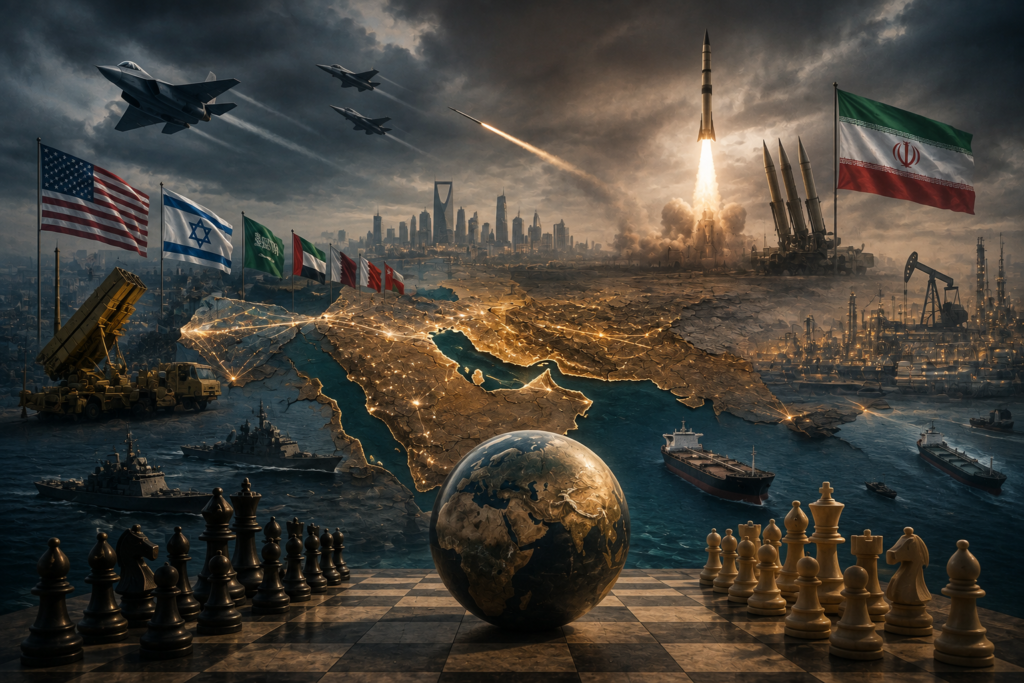
Image Credits: How the Iran War Is Reshaping the Balance of Power Across the Middle East. AI-generated illustration created by Open Chronicle using ChatGPT (OpenAI). August 2026. This image is illustrative and does not depict a real-world scene.
The Grand Strategy Institute
Research Division
The war involving Iran, Israel and the United States has moved far beyond the question of whether Tehran’s nuclear and missile capabilities can be degraded by military force. Nearly six months after the conflict began on 28 February 2026, the strategic consequences are spreading across the entire Middle East. Gulf monarchies are reassessing the value and limits of American protection, Israel is confronting the difference between military superiority and durable regional order, Iran has demonstrated that severe military punishment does not necessarily produce strategic capitulation, and Washington is discovering the costs of attempting simultaneously to deter Tehran, protect regional partners, secure global energy routes and avoid an open ended regional war.
The most important consequence may therefore be larger than any battlefield outcome. The conflict is accelerating the transition of the Middle East away from a relatively simple architecture based upon American primacy, Israeli military superiority and Iranian asymmetric resistance. What is emerging instead is a more fragmented regional system in which Gulf states seek greater strategic autonomy, Turkey and other middle powers gain relevance, maritime geography becomes an increasingly decisive source of coercive leverage and regional governments become less willing to entrust their security entirely to any single external patron.
The emerging balance of power is not yet stable. But it is already different.
Executive Assessment
The Iran war has produced five major strategic changes.
First, Iran has been weakened militarily without being strategically neutralised. Heavy American and Israeli attacks have imposed considerable costs, but Tehran has retained sufficient missile, drone and maritime capability to threaten regional infrastructure and disrupt the Strait of Hormuz. A temporary sixty day arrangement reached in June failed to resolve the underlying disputes over sanctions, missiles, enrichment and regional security, and by mid August renewed escalation was again threatening the shipping corridor.
Second, the Gulf Arab states have become direct participants in the security consequences of the confrontation, even where they sought to remain outside the war. Iranian missile and drone attacks have struck states hosting American forces and damaged civilian and energy infrastructure. The United Nations Security Council formally condemned Iranian attacks on neighbouring Gulf states in March 2026.
Third, the credibility of American security guarantees is being reassessed rather than simply abandoned. Gulf states still depend heavily upon American military capabilities, but the conflict has exposed a fundamental problem: hosting American forces can provide deterrence while simultaneously making the host state a target in a US Iran confrontation. Reuters reported early in the war that Gulf officials were increasingly questioning the assumptions underlying their security relationship with Washington.
Fourth, Israel has demonstrated formidable strike capability but not the ability to determine the regional political order alone. Military action can destroy facilities and personnel, but destroying capabilities is different from eliminating the strategic motivations that generate them.
Fifth, the Strait of Hormuz has become an active instrument of strategic coercion. By mid August, Reuters reported that shipments through Hormuz had fallen dramatically from roughly 18 million barrels per day before the crisis to around 2 million, while Middle Eastern oil exports had fallen below half of prewar levels. Brent crude closed above $91 a barrel on 18 August amid renewed confrontation.
These developments point towards a Middle East in which military power remains essential but increasingly insufficient.
The End of the Old Strategic Assumption
For decades, regional security rested upon a relatively clear strategic hierarchy.
The United States possessed overwhelming expeditionary military capability.
Israel maintained qualitative military superiority over its regional adversaries.
The Arab Gulf monarchies relied heavily upon American defence partnerships while developing sophisticated armed forces of their own.
Iran compensated for weaker conventional power by developing missiles, drones, proxy networks and asymmetric maritime capabilities.
This architecture was never entirely stable, but it created predictable strategic roles.
The 2026 war has disrupted that equilibrium.
Iran’s adversaries have demonstrated their ability to strike deeply inside Iranian territory. Tehran, however, has simultaneously demonstrated that attacks on Iran cannot necessarily be geographically contained within Iran.
By retaliating against American facilities and infrastructure across the Gulf, Tehran effectively internationalised the battlefield. Reuters reported from the first day of the war that missiles were moving across Gulf states and that regional officials interpreted Iran’s response as an effort to impose costs upon countries associated with Washington.
This produces a new deterrence equation.
The question is no longer simply whether Iran can withstand an Israeli or American attack.
It is whether the entire regional economic system can absorb Iran’s response.
Iran: Weakened, but Still Capable of Imposing Costs
The strategic position of Iran presents a paradox.
Tehran has suffered substantial military, economic and political damage. Israeli and American operations have struck nuclear facilities and military targets, while sanctions and maritime restrictions have placed severe pressure upon the Iranian economy. The International Atomic Energy Agency documented attacks on Iranian nuclear facilities during the wider conflict.
Yet the war has also demonstrated the distinction between military degradation and strategic defeat.
A state does not have to defeat its adversary conventionally to remain strategically consequential.
Iran requires only enough surviving capability to threaten outcomes that its adversaries value.
Energy infrastructure.
Commercial shipping.
American military bases.
Israeli cities.
Regional political stability.
The Strait of Hormuz.
By August, Tehran was again threatening a more offensive posture if diplomacy failed, while attacks and threats around Hormuz continued.
Iran’s deterrent position consequently rests increasingly upon the ability to impose distributed costs rather than to achieve conventional military dominance.
This is an important strategic distinction.
Iran cannot match the United States in air or naval power.
It does not need to.
If it can make the economic and political costs of continuing the war sufficiently high, then surviving the conflict itself becomes a strategic instrument.
The Gulf States Discover the Cost of Geography
Perhaps the most consequential transformation is occurring among the Arab Gulf states.
Saudi Arabia, the United Arab Emirates, Qatar, Bahrain, Kuwait and Oman possess different foreign policies, different relationships with Iran and different levels of cooperation with Washington.
But they share geography.
Their economic infrastructure lies close to Iran.
Their energy facilities are concentrated.
Their ports and airports are extraordinarily valuable.
Several host American military facilities.
Their economic models depend upon confidence that the Gulf remains a stable centre of trade, investment and transport.
The war challenges all of those assumptions simultaneously.
Reuters documented attacks affecting energy and civilian infrastructure across Saudi Arabia, Kuwait, Qatar and the UAE.
The UAE has been particularly exposed. Reuters reported in May that Iranian attacks had targeted the Emirates more heavily than several neighbouring states and that Abu Dhabi responded by strengthening cooperation with both Washington and Israel.
Saudi Arabia pursued a different balance. Riyadh warned Tehran that continued attacks could lead to retaliation while simultaneously maintaining diplomatic channels and emphasising that it had not supported American attacks from Saudi territory.
These differences matter.
The Gulf is not becoming a unified anti Iranian military bloc.
It is becoming a region of increasingly sophisticated hedging.
The Security Guarantee Paradox
The conflict has exposed a fundamental contradiction in Gulf security strategy.
American forces provide protection.
But American forces can also create targets.
A Gulf government hosting American aircraft, naval facilities or command infrastructure gains access to the world’s most powerful military network.
Yet if Washington enters a direct war with Iran, those facilities can become part of the battlefield.
That is precisely what Gulf governments have experienced.
This does not mean the region is about to abandon the United States.
No alternative power currently offers equivalent military capability across air defence, intelligence, naval operations, logistics and strategic deterrence.
But dependence is increasingly being reconsidered.
The likely result is not a simple American withdrawal from the region.
It is security diversification.
Gulf states will seek greater national military capability.
More missile and drone defence.
More redundancy in infrastructure.
More relationships with China, Europe, Turkey and other powers.
More diplomacy with Iran.
And fewer assumptions that Washington alone can guarantee regional stability.
Reuters reported after the June ceasefire arrangement that Gulf states were already recalibrating their relationships because the conflict had highlighted limits in the old security architecture.
This is strategic autonomy emerging through necessity.
Israel: Military Superiority Meets Strategic Limits
Israel entered the confrontation with significant advantages.
Advanced intelligence.
Long range strike capability.
Integrated air and missile defence.
Strong military cooperation with the United States.
Years of operational experience against Iranian aligned networks.
The conflict has reinforced Israel’s ability to project force at strategic range.
But the larger question is whether military superiority can produce a stable regional order.
That is much less certain.
Destroying a missile launcher does not eliminate Iran’s motivation to rebuild it.
Destroying a nuclear facility does not necessarily eliminate nuclear knowledge.
Weakening proxy networks does not automatically eliminate the political conditions that produced them.
Military power can alter capabilities.
Political order requires something more.
The danger for Israel is therefore a strategic version of the same problem the United States encountered in several previous Middle Eastern conflicts: battlefield dominance can produce tactical success without generating the political settlement necessary to convert that success into durable security.
If Iran remains capable of regeneration, the result may be recurrent rounds of preventive military action rather than decisive resolution.
That would leave Israel militarily dominant but strategically locked into continuous confrontation.
Washington’s Expanding Burden
The United States now faces a remarkably complex strategic burden.
It must protect Israel.
Defend American bases.
Protect Gulf partners.
Maintain freedom of navigation.
Prevent Iranian nuclear breakout.
Manage oil market disruption.
Avoid escalation into an even larger regional conflict.
And sustain military readiness for potential crises elsewhere, particularly in Europe and the Indo Pacific.
These objectives can conflict.
A more aggressive campaign against Iran may degrade Iranian capability.
But it may also generate more attacks on Gulf states and commercial shipping.
A negotiated arrangement may reduce immediate escalation.
But regional allies may fear that Washington has granted Tehran too much room to rebuild.
In June, Reuters reported that Secretary of State Marco Rubio faced precisely this difficulty when attempting to reassure Gulf allies concerned that an American deal could leave Iran strategically strengthened.
The United States is therefore confronting the classic problem of extended deterrence.
Its partners do not merely ask whether America is strong.
They ask whether Washington will use that strength in ways consistent with their own security.
Those are very different questions.
The Strait of Hormuz Becomes a Strategic Weapon
The war has dramatically reinforced the importance of maritime geography.
The Strait of Hormuz is one of the most consequential pieces of territory in the global economy.
A substantial share of internationally traded oil and liquefied natural gas normally passes through its narrow waters.
Iran cannot control global energy markets.
But its geography gives it the ability to influence them disproportionately.
By mid August 2026, Reuters estimated that daily oil shipments through the strait had collapsed from approximately 18 million barrels before the conflict to around 2 million. Overall Middle Eastern exports had fallen below half of prewar volumes.
This transforms Hormuz from a transport route into an instrument of grand strategy.
Iran can impose economic costs far beyond the immediate battlefield.
Europe suffers.
Asia suffers.
The United States suffers through fuel prices and inflation.
Gulf exporters lose revenue.
Global shipping insurance rises.
Refining margins increase.
Interest rates and political pressures can be affected thousands of kilometres away.
A weaker conventional military can therefore impose global strategic costs by threatening a geographical chokepoint.
This is asymmetric power at its clearest.
Energy Security Becomes National Security
The conflict will accelerate investments that were already underway.
Saudi Arabia and the UAE have developed export infrastructure capable of bypassing parts of the Strait of Hormuz.
Those routes now possess greater strategic importance.
Ports on the Red Sea and Arabian Sea become more valuable.
Pipeline redundancy becomes national security policy.
Strategic petroleum reserves become more important.
Energy importing states will seek broader diversification.
The result may be expensive.
But economic efficiency is no longer the only calculation.
The same transformation occurred in Europe after Russia’s invasion of Ukraine.
A cheap supply route can become strategically unacceptable if it creates excessive dependence upon a geopolitical vulnerability.
The Iran war is teaching the Gulf and Asian energy importers the same lesson.
The Arab States Are Hedging, Not Choosing Sides
One of the most important mistakes would be to interpret the regional transformation as a straightforward division into pro Iranian and anti Iranian camps.
Most Arab governments want something more complicated.
They want Iran constrained.
They do not want a permanently destabilised Iran.
They want American protection.
They do not want complete dependence upon American political choices.
They cooperate with Israel where interests align.
They remain deeply sensitive to the Palestinian issue and to regional perceptions of Israeli military behaviour.
They want economic integration.
They do not want their infrastructure converted into battlefields for larger powers.
This produces a strategy of hedging.
Saudi Arabia can maintain dialogue with Tehran while strengthening defence ties elsewhere.
The UAE can cooperate closely with Israel and the United States while still attempting to prevent uncontrolled escalation.
Oman can seek mediation.
Qatar can maintain relationships across competing blocs.
The emerging Middle East therefore resembles a multipolar regional system more than a fixed alliance structure.
States increasingly seek overlapping relationships rather than exclusive alignment.
Turkey’s Strategic Opportunity
Turkey is positioned to benefit from this transformation.
Ankara possesses several characteristics Gulf governments increasingly value.
A large military.
A growing defence industry.
Advanced drone production.
NATO membership.
Relations with Washington.
Channels to Moscow.
Economic connections across the Middle East.
And sufficient strategic autonomy to operate outside a purely American regional framework.
The Financial Times has reported signs of new regional defence arrangements involving Saudi Arabia, Turkey and Pakistan, reflecting broader experimentation with security structures beyond exclusive reliance upon Washington.
Such arrangements should not immediately be interpreted as replacements for the American alliance system.
They are better understood as insurance.
Regional powers are constructing additional layers of deterrence.
Iran’s Proxy Strategy Is Also Changing
For years, Iranian regional strategy relied heavily upon networks of aligned armed groups.
Hezbollah.
The Houthis.
Iraqi militias.
Palestinian factions.
Syrian networks.
This architecture allowed Iran to pressure adversaries while maintaining some distance from direct state on state confrontation.
The current war alters that logic.
Direct Iranian missile and drone attacks have become much more important.
The battlefield has shifted from primarily indirect competition towards increasingly open interstate confrontation.
That has two consequences.
First, Iranian proxies remain valuable, especially for creating multiple pressure points.
Second, Tehran itself is now more directly exposed to retaliation.
The strategic advantage of ambiguity has declined.
This may force Iran to decide whether its future deterrence should rely more heavily on conventional missiles, nuclear latency and maritime coercion rather than on the proxy architecture that defined previous decades.
Nuclear Deterrence May Become More Attractive, Not Less
This may be one of the most dangerous consequences.
Military attacks intended to reduce Iran’s nuclear capability could strengthen Tehran’s political argument that only a more powerful deterrent can prevent future attacks.
The strategic logic is uncomfortable but familiar.
A state observing that conventional forces cannot protect its territory may conclude that nuclear capability provides the ultimate guarantee.
This does not mean Iran will inevitably construct a nuclear weapon.
But the incentives surrounding the question may have changed.
If Tehran concludes that nuclear ambiguity failed to deter major attack, the political value of remaining close to the threshold without crossing it could decline.
The war therefore creates a proliferation risk even while attacking nuclear infrastructure.
This is the classic counter proliferation paradox.
Destroying capability can buy time.
It can also strengthen motivation.
China Watches the Energy Battlefield
China has an enormous interest in the outcome.
Beijing imports substantial quantities of Middle Eastern energy and has expanded diplomatic and economic relationships across the region.
A prolonged Hormuz disruption therefore threatens Chinese economic interests.
At the same time, American military overextension in the Middle East could have strategic implications for the Indo Pacific.
China does not need Iran to defeat the United States.
It benefits if Washington must devote more naval assets, missiles, political attention and financial resources to a prolonged Middle Eastern conflict.
The war therefore connects regional and global balances of power.
Every American interceptor, missile or ship committed to the Gulf exists within a larger force structure also responsible for deterring China and Russia.
Reuters reported in early August that American stocks of some long range precision weapons had been heavily consumed during the Iran conflict.
This does not mean American military power is exhausted.
It means munitions production and strategic prioritisation are once again central elements of great power competition.
Russia Also Benefits from Strategic Distraction
Moscow has its own reasons to observe the conflict carefully.
A prolonged Middle Eastern war can increase energy prices, absorb Western military resources and complicate political attention devoted to Ukraine.
Russia also benefits from a world in which American power appears increasingly stretched across multiple theatres.
Yet instability in global energy infrastructure can create risks for Russian exports and markets as well.
The connection between the Ukraine war and the Iran war illustrates a larger point.
Regional wars no longer remain strategically regional.
They interact through energy markets, defence industries, sanctions networks and competing alliance systems.
The contemporary international system increasingly operates as a connected strategic theatre.
The Gulf’s Next Military Revolution
The conflict is likely to accelerate one of the largest defence transformations in modern Gulf history.
The priorities will increasingly shift towards:
integrated missile defence,
counter drone systems,
hardened infrastructure,
distributed command networks,
underground facilities,
cyber defence,
maritime surveillance,
autonomous systems,
long range precision weapons,
and redundant energy logistics.
Prestige platforms alone will become less important.
A sophisticated combat aircraft is valuable.
But so is a cheap interceptor capable of destroying a mass produced drone.
The economic logic of defence is changing.
The same lesson has emerged in Ukraine.
Expensive military systems remain essential, but the ability to survive saturation attacks from relatively inexpensive weapons is becoming equally important.
The Middle East Is Becoming More Multipolar
The most important strategic transformation may therefore be political rather than military.
The old hierarchy is weakening.
The United States remains the most powerful external military actor.
But it cannot dictate every regional outcome.
Israel remains militarily powerful.
But its actions can generate strategic reactions beyond its control.
Iran remains significantly weaker conventionally than its principal adversaries.
But it can still impose enormous regional costs.
Saudi Arabia possesses growing economic and political influence.
The UAE increasingly acts as an autonomous strategic actor.
Turkey is expanding defence influence.
China is increasingly important economically.
Russia retains regional relationships.
Pakistan possesses nuclear capability and growing relevance to Gulf security thinking.
The result is a system with more centres of power.
That usually means more diplomatic flexibility.
It can also mean greater instability.
Three Possible Regional Orders
The war could ultimately produce three broad strategic outcomes.
A Reinforced American Order
If Washington succeeds in containing Iran, reopening Hormuz, reassuring Gulf partners and maintaining Israeli security without becoming trapped in permanent war, the American regional system could emerge strengthened.
Regional governments might conclude that only the United States possesses sufficient military capability to protect the Gulf.
The result would be deeper missile defence integration and greater American military presence.
A Fragmented Multipolar Order
A second outcome appears increasingly plausible.
The United States remains central but no longer exclusive.
Saudi Arabia, the UAE and Qatar diversify partnerships.
Turkey becomes more important.
China expands economic and diplomatic influence.
Regional governments maintain direct channels with Iran.
Security partnerships overlap.
No single power dominates.
This would resemble a multipolar balance rather than an alliance system.
A Permanent Regional War System
The most dangerous possibility is neither American dominance nor stable multipolarity.
It is chronic conflict.
Repeated strikes against Iran.
Iranian attacks against maritime and energy infrastructure.
Israeli preventive campaigns.
Proxy warfare.
Persistent sanctions.
Intermittent ceasefires.
Escalation around Hormuz.
Under this scenario, war becomes the normal condition of regional politics rather than an exceptional crisis.
The economic and human consequences would be profound.
Strategic Assessment
The Iran war is reshaping Middle Eastern power because it is exposing the limits of every actor’s preferred strategy.
Iran has demonstrated that asymmetric retaliation can survive enormous military pressure, but its actions have also alienated neighbouring Gulf states and exposed Iranian territory to devastating attack.
Israel has demonstrated exceptional strike capability, but military superiority has not yet produced a durable political settlement.
The United States has demonstrated unmatched regional military reach, but the conflict has exposed the enormous cost of simultaneously protecting allies, preserving maritime commerce and containing escalation.
The Gulf states have discovered that American partnership remains indispensable but no longer provides sufficient strategic insurance by itself.
The resulting regional order is therefore becoming more diversified, more militarised and more transactional.
The most consequential shift may be conceptual.
Middle Eastern governments increasingly recognise that security cannot be outsourced completely.
They will cooperate with Washington.
They will negotiate with Tehran.
They may work with Israel.
They will purchase European and Asian weapons.
They will develop domestic defence industries.
They will expand relationships with Turkey, China and other powers.
This is not the end of American influence.
It is the end of the assumption that American influence alone can organise the region.
Key Findings
- The Iran war has weakened Tehran’s military capabilities without eliminating its ability to impose strategic costs across the region.
- Iranian attacks against Gulf states have internationalised the conflict and transformed American military basing relationships into both sources of protection and sources of vulnerability.
- Gulf governments are unlikely to abandon the United States, but they are increasingly seeking diversified security relationships and greater strategic autonomy.
- Israel’s military superiority has not translated automatically into the ability to impose a stable regional political settlement.
- The Strait of Hormuz has become one of Iran’s most powerful strategic instruments, converting geography into global economic leverage.
- The conflict is accelerating investment in missile defence, drones, infrastructure resilience and alternative energy export routes across the Gulf.
- Saudi Arabia, the UAE, Qatar and Oman are pursuing distinct strategies, demonstrating that the Gulf is not becoming a unified military bloc against Tehran.
- Prolonged attacks on Iran may increase rather than eliminate Tehran’s incentives to seek stronger forms of strategic deterrence, including potentially greater nuclear latency.
- The conflict is increasing the relevance of middle powers such as Turkey while creating greater opportunities for China to expand diplomatic and economic influence.
- The emerging Middle Eastern order is likely to be more multipolar, more heavily armed, and less dependent upon a single external security guarantor.
Grand Strategy Judgment
The central strategic lesson of the Iran war is that military superiority and political control are not the same thing.
The United States and Israel possess the ability to inflict extraordinary damage upon Iran.
Iran possesses the ability to impose extraordinary costs without defeating either militarily.
The Gulf states possess enormous economic power but remain geographically vulnerable.
No actor can achieve complete security without influencing the calculations of the others.
The conflict is therefore pushing the Middle East away from a hierarchical security system and towards an increasingly complex balance of deterrence.
That balance may eventually create new diplomacy.
It may instead institutionalise permanent confrontation.
Which outcome emerges will depend less upon who can launch the largest number of missiles than upon whether the principal powers can construct a regional security architecture in which Iran can be constrained without being permanently besieged, Israel can be protected without relying upon perpetual preventive warfare, and Arab states can maintain sovereignty without becoming battlegrounds for the strategic competition of others.
That is now the central grand strategic challenge facing the Middle East
Open Chronicle Conflict Coverage
Follow the Iran War
Return to the dedicated Iran War hub for the latest analysis, military developments and regional consequences, or explore the wider Conflict Monitor for Open Chronicle coverage of major conflicts and geopolitical flashpoints around the world.
The Grand Strategy Institute
Continue Exploring Strategic Analysis
Return to The Grand Strategy Institute for strategic assessments, long-form analysis and research examining geopolitics, military affairs, international security, emerging technologies and the changing international order.
← Back to The Grand Strategy Institute