
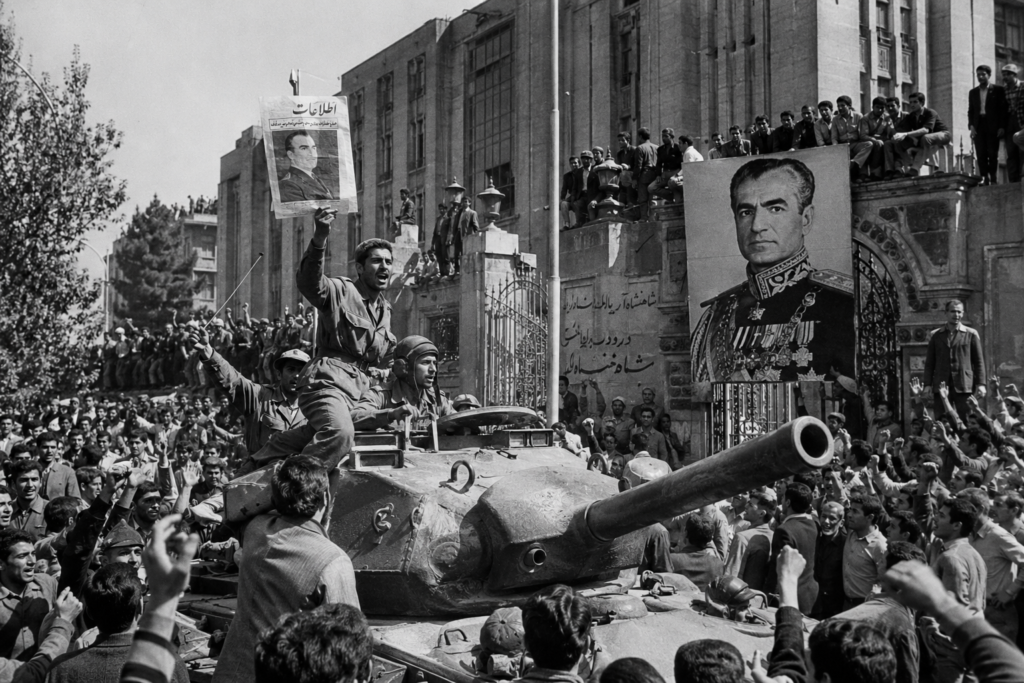
Image Credits: Today in History, August 19, 1953: The Coup That Overthrew Mohammad Mosaddegh and Changed Iran. AI-generated illustration created by Open Chronicle using ChatGPT (OpenAI). August 2026. This image is illustrative and does not depict a real-world scene.
By Open Chronicle History Desk
On August 19, 1953, the government of Iranian Prime Minister Mohammad Mosaddegh collapsed after a struggle that brought together domestic political opponents, supporters of Shah Mohammad Reza Pahlavi, and covert intervention by the United States and Britain.
The overthrow of Mosaddegh was the climax of a confrontation that had begun with one of the most important economic and political decisions in modern Iranian history: the nationalisation of the country’s oil industry.
For many Iranians, nationalisation represented sovereignty over a resource that had generated enormous profits for a British-controlled company while Iran received only part of the wealth produced beneath its own territory.
For Britain, the loss of Iranian oil threatened major economic and strategic interests.
For the United States, the crisis increasingly became entangled with Cold War fears about political instability and communist influence.
The covert operation that followed, commonly associated with the CIA codename TPAJAX, helped remove Mosaddegh and strengthen the authority of the Shah.
Its consequences extended far beyond August 1953.
The coup became one of the defining episodes in the modern history of Iran, a lasting symbol of foreign intervention and an important part of the historical background to the Iranian Revolution of 1979 and the subsequent breakdown of relations between Tehran and Washington.
Iran and the Politics of Oil
Oil transformed Iran’s relationship with the great powers during the twentieth century.
In 1901, Persian ruler Mozaffar ad Din Shah granted British businessman William Knox D’Arcy an extensive concession to search for petroleum across much of Persia.
Oil was discovered in 1908.
The enterprise eventually developed into the Anglo-Persian Oil Company, later renamed the Anglo-Iranian Oil Company.
Britain recognised the strategic importance of petroleum early.
The Royal Navy was shifting from coal to oil before the First World War, making reliable supplies increasingly important to British military power.
The British government acquired a controlling interest in the company in 1914.
Iran possessed the oil.
But a British-dominated company controlled its exploitation.
That arrangement became increasingly controversial.
Abadan and an Unequal Relationship
At the centre of Iran’s petroleum industry stood the enormous refinery at Abadan.
It became one of the world’s most important oil refining complexes and a symbol of the extraordinary strategic value of Iranian petroleum.
But the distribution of profits and the conditions surrounding the concession generated deep resentment.
Iranian nationalists argued that their country was receiving an unfair share of the revenue generated from its natural resources.
The issue was about more than money.
Oil became inseparable from national sovereignty.
To many Iranians, the Anglo-Iranian Oil Company represented the continuing ability of a foreign power to exercise enormous influence over the country’s economy.
By the middle of the twentieth century, opposition to that arrangement was becoming politically explosive.
Mohammad Mosaddegh
At the centre of the confrontation was Mohammad Mosaddegh.
Born in 1882 into a prominent Iranian family, Mosaddegh became a lawyer, administrator, parliamentarian and committed constitutionalist.
He supported Iran’s constitutional system and opposed excessive foreign influence.
Mosaddegh was also deeply suspicious of authoritarian power.
He believed that the elected parliament should play a central role in Iranian political life and that the country’s natural resources should serve Iranian interests.
By the late 1940s, he had become the leading figure of the National Front, a political coalition supporting constitutional government and control over Iran’s oil industry.
His campaign resonated strongly with a population increasingly frustrated by foreign interference.
The oil question propelled him to national leadership.
The Nationalisation of Iranian Oil
In March 1951, the Iranian parliament voted to nationalise the country’s oil industry.
The decision represented a direct challenge to the Anglo-Iranian Oil Company.
Shortly afterward, Mosaddegh became Prime Minister.
He was now responsible for implementing nationalisation.
For supporters, this was a historic assertion of Iranian independence.
Mosaddegh became enormously popular.
Crowds celebrated nationalisation as the recovery of a national resource from foreign control.
Britain saw the situation very differently.
The government in London refused to accept Iran’s unilateral seizure of the company’s assets.
A confrontation began that would rapidly become an international crisis.
Britain Responds
Britain applied intense economic and diplomatic pressure.
The Abadan refinery effectively ceased normal operations as British personnel departed.
British measures restricted Iran’s ability to sell its petroleum internationally.
The resulting blockade and boycott severely reduced Iranian oil revenues.
Britain also challenged nationalisation through international legal channels.
The dispute reached the International Court of Justice.
Mosaddegh personally travelled to The Hague to defend Iran’s position.
In 1952, the court concluded that it did not have jurisdiction over the dispute as Britain had presented it.
The ruling represented a political victory for Mosaddegh.
But Iran’s economic problems continued.
Without normal oil exports, government finances deteriorated.
The struggle over petroleum was becoming a struggle over the survival of Mosaddegh’s government.
The Shah and the Prime Minister
Iran was formally a constitutional monarchy.
The young monarch, Mohammad Reza Pahlavi, had become Shah in 1941 after his father, Reza Shah, abdicated during the Anglo Soviet occupation of Iran.
The relationship between Mosaddegh and the Shah became increasingly tense.
At stake was a fundamental question.
Who should control the Iranian state?
Mosaddegh sought to strengthen parliamentary government and reduce the political authority of the monarchy.
The Shah and his supporters feared that the Prime Minister was accumulating excessive power and undermining the institution of the monarchy.
Control over the armed forces became particularly important.
In 1952, Mosaddegh attempted to obtain greater authority over the military.
The confrontation became so serious that he briefly resigned.
Mass demonstrations followed.
Mosaddegh returned to office with increased political strength.
But Iran was becoming increasingly polarised.
Britain Looks for a Way to Remove Mosaddegh
British officials increasingly concluded that an agreement with Mosaddegh was unlikely.
Removing him became an objective.
Britain had substantial experience operating political and intelligence networks inside Iran.
But in October 1952, Mosaddegh broke diplomatic relations with Britain.
British personnel were forced to leave the country, making covert operations more difficult.
London therefore needed American assistance.
Initially, the administration of President Harry Truman had been reluctant to support a coup.
Washington attempted to mediate the oil dispute and worried about the consequences of destabilising Iran.
Then American leadership changed.
Dwight D. Eisenhower became president in January 1953.
The international environment was dominated by the Cold War.
That altered the calculations in Washington.
The Cold War Dimension
American officials increasingly viewed Iran not only through the oil dispute but through the global confrontation with the Soviet Union.
Iran shared a long border with the USSR.
The communist Tudeh Party had an organised political presence within the country.
As Mosaddegh’s coalition became more fragmented and Iran’s economy deteriorated, American and British officials worried that instability might create opportunities for communist influence.
Whether Iran was actually on the verge of a communist takeover remains a matter of historical debate.
But the fear was influential in Washington.
The Eisenhower administration became willing to cooperate with Britain in an operation designed to remove Mosaddegh.
The CIA and Britain’s intelligence service began working on a covert plan.
Operation Ajax
The CIA operation was known as TPAJAX, commonly referred to as Operation Ajax.
The British component was associated with the name Operation Boot.
One of the central CIA figures involved was Kermit Roosevelt Jr., grandson of former United States President Theodore Roosevelt.
The objective was to replace Mosaddegh with a government considered more favourable to Western interests.
General Fazlollah Zahedi, a former government minister and military officer, emerged as the preferred replacement.
But Iran’s constitutional structure created a problem.
The operation needed an appearance of legal legitimacy.
The Shah would therefore play an essential role.
He was encouraged to sign decrees dismissing Mosaddegh and appointing Zahedi as Prime Minister.
The Shah hesitated.
The plan was risky.
If it failed, his own position could collapse.
Eventually, he agreed.
Propaganda, Political Networks and Street Power
The operation was not simply a military conspiracy.
Covert political action played an important role.
Money was used to cultivate influence.
Newspapers and political figures were encouraged to attack Mosaddegh.
Networks of politicians, clerics, military officers and street organisers became part of the struggle.
Propaganda sought to portray the Prime Minister as a threat to stability, religion and the monarchy.
The goal was to create the impression that Mosaddegh was losing control of the country.
Iranian actors were not merely passive instruments of foreign intelligence agencies.
Mosaddegh had powerful domestic enemies with their own motivations.
Royalists feared for the monarchy.
Conservatives worried about political disorder.
Some religious figures had become alienated from the government.
Military officers opposed Mosaddegh.
The eventual coup emerged from the interaction between foreign intervention and genuine domestic political conflict.
The First Attempt Fails
The first attempt to remove Mosaddegh took place during the night of August 15 to 16.
Colonel Nematollah Nassiri delivered the Shah’s decree dismissing Mosaddegh.
But the government had apparently received warning of the plot.
Nassiri was arrested.
The attempted coup seemed to have failed.
The Shah fled Iran.
He first travelled to Iraq and then to Rome.
For Mosaddegh’s supporters, the danger appeared to have passed.
Demonstrators took to the streets.
Statues of the Shah were pulled down.
Some political activists demanded an end to the monarchy altogether.
The situation seemed disastrous for the coup organisers.
American officials considered abandoning the operation.
Kermit Roosevelt did not.
The struggle continued.
August 19, 1953
On August 19, Tehran’s streets became the centre of the battle for political power.
Crowds opposed to Mosaddegh appeared in different parts of the capital.
Royalist demonstrators were joined by elements of the security forces and military units.
The momentum shifted rapidly.
Police stations and government buildings were seized.
Radio Tehran became a crucial objective because control of broadcasting allowed the coup supporters to announce that the government had changed.
Military units supporting Zahedi moved against Mosaddegh.
Fighting erupted around the Prime Minister’s residence.
Tanks and armed troops participated in the assault.
After hours of violence, Mosaddegh’s position became untenable.
His residence was attacked and heavily damaged.
He escaped initially but surrendered the following day.
The government had fallen.
General Zahedi Takes Power
General Fazlollah Zahedi emerged as the new Prime Minister.
The Shah returned to Iran on August 22.
His position was dramatically strengthened.
Before 1953, Mohammad Reza Pahlavi had often been a cautious monarch operating within a political system containing competing centres of power.
After the coup, the monarchy gradually became far more dominant.
Mosaddegh was tried for treason.
He defended his actions and insisted that he had acted in defence of constitutional government and Iranian sovereignty.
He was sentenced to three years in prison.
After completing the sentence, he remained under house arrest at his estate in Ahmadabad until his death in 1967.
For many Iranians, he became a symbol of nationalism, constitutionalism and resistance to foreign domination.
What Happened to the Oil?
The overthrow of Mosaddegh did not simply restore the old Anglo Iranian Oil Company monopoly.
The political environment had changed too much for that.
A new international consortium was created in 1954.
British Petroleum, the successor to the Anglo Iranian Oil Company, retained a major share, while American and other Western petroleum companies also participated.
Iran formally retained ownership of its oil resources, but foreign companies again played a central role in production and international marketing.
The immediate confrontation over nationalisation had therefore ended.
But the political memory of the struggle did not.
The Shah’s Growing Power
During the following decades, the Shah became one of the United States’ most important allies in the Middle East.
Iran received substantial military support.
Oil revenues increased dramatically, particularly after the energy shocks of the 1970s.
The Shah launched ambitious programmes of economic and social modernisation.
The White Revolution, introduced during the 1960s, included land reform, education programmes, women’s suffrage and other measures intended to transform Iranian society.
Iran industrialised rapidly.
Its military became one of the most powerful in the region.
But political repression also intensified.
The Shah’s security and intelligence organisation, SAVAK, became notorious among opponents of the regime.
Political parties were restricted.
Dissidents faced surveillance, imprisonment and torture.
The monarchy appeared powerful.
Underneath that power, opposition was growing.
The Memory of 1953
For critics of the Shah, the events of 1953 undermined the legitimacy of his rule.
The monarchy could be portrayed as having been restored through foreign intervention against a nationalist Prime Minister.
This memory became increasingly important as opposition movements expanded during the 1960s and 1970s.
Islamists, nationalists, liberals and left wing groups disagreed profoundly about Iran’s future.
But many shared hostility toward the Shah and resentment of Western influence.
The coup became part of a broader narrative.
In that narrative, foreign powers had intervened whenever Iranian control over strategic resources threatened their interests.
That interpretation would have enormous consequences in 1979.
From Mosaddegh to the Iranian Revolution
By the late 1970s, opposition to the Shah had become a mass movement.
Ayatollah Ruhollah Khomeini emerged as its most influential leader.
Demonstrations expanded.
Strikes paralysed parts of the economy.
The Shah left Iran in January 1979.
In February, the monarchy collapsed.
The Iranian Revolution transformed the country into an Islamic Republic.
Later that year, another crisis dramatically reshaped relations with the United States.
On November 4, Iranian students seized the American embassy in Tehran and took dozens of Americans hostage.
The memory of 1953 was part of the political context surrounding the embassy seizure.
Many revolutionaries feared that the United States might again attempt to restore the Shah or reverse Iran’s political transformation.
The hostage crisis lasted 444 days.
Diplomatic relations between Iran and the United States collapsed.
They have never been fully restored.
Washington Acknowledges the Past
For decades, the American role in the coup was widely discussed but often obscured by secrecy surrounding intelligence operations.
Declassified documents eventually provided extensive evidence about CIA involvement.
In 2000, United States Secretary of State Madeleine Albright publicly acknowledged the American role in the overthrow, describing it as a setback for Iran’s political development.
President Barack Obama referred to the episode in his 2009 Cairo speech, acknowledging that the United States had played a role in overthrowing a democratically elected Iranian government.
Further CIA documents concerning the operation were subsequently declassified.
The historical record leaves little doubt that American and British intelligence participated in efforts to remove Mosaddegh.
The more complicated question concerns how much responsibility should be assigned to foreign intervention compared with Iran’s own internal political divisions.
Historians continue to debate that balance.
A Coup with Iranian Actors
Reducing the events of August 1953 entirely to a CIA operation can obscure the complexity of Iranian politics.
Mosaddegh faced real domestic opposition.
His coalition had fractured.
Relations with sections of the clergy deteriorated.
The Tudeh Party created fears among conservatives and Western governments.
Royalist military officers actively wanted the Shah restored.
Street politics in Tehran involved groups with competing motivations.
The coup succeeded because foreign intelligence operations intersected with those internal divisions.
Without American and British involvement, events might have unfolded differently.
Without Iranian political actors willing to oppose Mosaddegh, however, foreign intervention alone would have faced enormous obstacles.
Understanding 1953 therefore requires recognising both dimensions.
It was an externally supported coup and an Iranian political struggle.
The Global Context of 1953
The overthrow also belongs to the broader history of the Cold War.
The early 1950s were characterised by intense fears about communist expansion.
The Chinese Communist Revolution had succeeded in 1949.
The Korean War began in 1950.
The Soviet Union had developed atomic weapons.
Western policymakers frequently interpreted nationalist and political crises through the framework of competition with Moscow.
Iran demonstrated how that logic could intersect with older imperial interests.
Britain’s concerns had begun primarily with oil and the loss of economic influence.
American concerns increasingly centred on Cold War strategy.
Together, those interests produced one of the most consequential covert interventions of the era.
Similar operations and interventions would later become associated with Cold War politics in Guatemala, Congo, Cuba, Chile and elsewhere.
Why August 19 Matters
The events of August 19, 1953, lasted only a matter of hours.
Their consequences lasted generations.
Mohammad Mosaddegh was removed.
The Shah returned.
Western access to Iranian oil was reorganised.
The Iranian monarchy became increasingly powerful and increasingly closely associated with the United States.
Twenty six years later, that monarchy collapsed in a revolution defined partly by opposition to foreign influence.
The memory of Mosaddegh survived.
For many Iranians, he became the symbol of a political possibility that had been interrupted, a constitutional nationalist government seeking control over the country’s resources and greater independence from foreign powers.
For historians, the coup remains a case study in the interaction between imperial interests, nationalism, intelligence operations, Cold War strategy and domestic political conflict.
It also demonstrates how covert intervention can produce consequences far beyond the objectives of those who originally planned it.
In August 1953, American and British policymakers sought to resolve an immediate strategic crisis.
They succeeded in removing Mohammad Mosaddegh.
But they also helped create a historical grievance that would become deeply embedded in Iranian political memory.
Decades later, as revolutionaries confronted the Shah and relations between Iran and the United States collapsed, the events of August 19 had not been forgotten.
They still have not been forgotten today.