
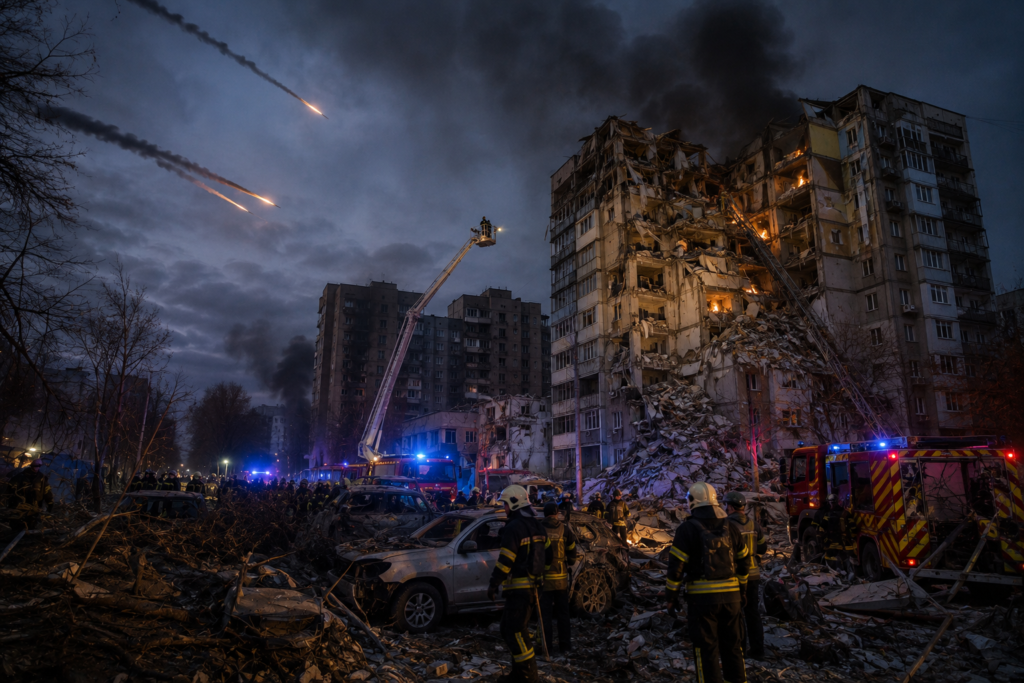
Image Credits: Russian Strikes Kill 16 in Ukraine as Zelensky Warns Patriot Missile Shortage Is Costing Lives. AI-generated illustration created by Open Chronicle using ChatGPT (OpenAI). August 2026. This image is illustrative and does not depict a real-world scene.
By Open Chronicle with agencies
A massive Russian missile and drone attack on Ukraine killed at least 16 people and injured more than 40 on Thursday, August 20, as President Volodymyr Zelensky renewed his appeal for additional Patriot air defence interceptors, warning that shortages are leaving Ukrainian cities increasingly vulnerable to ballistic missile attacks.
Russia launched a large overnight assault involving cruise, ballistic and hypersonic missiles alongside 168 drones, according to the Ukrainian Air Force. Kyiv and the surrounding region suffered some of the heaviest damage, while strikes also targeted the strategically important Black Sea region of Odesa.
Ukrainian authorities said the country’s air defences destroyed nearly 90 percent of the incoming drones and most of the cruise missiles. However, the Air Force did not disclose how many ballistic missiles were launched or how many were successfully intercepted.
The attack has renewed attention on one of Ukraine’s most pressing military problems: maintaining enough advanced interceptors to protect its cities as Russia increases its use of difficult to stop ballistic weapons.
Fifteen killed in Kyiv
Kyiv suffered the majority of the casualties.
The upper floors of a nine-storey apartment building in the capital’s Solomianskyi district were destroyed during the attack. Kyiv Mayor Vitali Klitschko said most of the 15 people killed in the capital died there.
Another person was killed in the surrounding Kyiv region, bringing the reported death toll to 16.
Klitschko declared Friday a day of mourning in Kyiv.
Two other districts of the capital were also damaged. Authorities reported damage to a school, a children’s hospital, warehouses and other non-residential buildings.
Emergency services worked through the destruction, searching for survivors and recovering victims.
The scale of the casualties demonstrated that even when Ukrainian air defences intercept the overwhelming majority of incoming drones, a relatively small number of weapons penetrating the defensive network can still produce devastating consequences.
Russia launched 168 drones
The overnight operation was a complex attack involving several different types of weapons.
Ukraine’s Air Force reported 168 drones alongside dozens of cruise missiles and an unspecified number of ballistic and hypersonic weapons.
Such combined attacks are designed to complicate air defence.
Different weapons fly at different speeds and altitudes and follow different trajectories toward their targets.
Drones can approach slowly from several directions.
Cruise missiles can fly at relatively low altitude and manoeuvre along complex routes.
Ballistic missiles descend toward their targets at extremely high speeds, giving defenders significantly less time to detect and intercept them.
Combining these systems can force Ukraine to divide its limited air defence resources between numerous simultaneous threats.
Zelensky: Patriot interceptors are needed every day
Following the attack, Zelensky directly linked civilian casualties to Ukraine’s shortage of Patriot missiles.
“The interceptors for Patriot systems have not yet been replaced, and they are needed every day,” Zelensky said.
“Each additional missile saves the lives of our people.”
The statement reflects Kyiv’s growing concern about the availability of sophisticated interceptors rather than simply the number of Patriot launchers deployed in Ukraine.
A Patriot battery without sufficient interceptor missiles cannot provide sustained protection during repeated Russian attacks.
And Russia can launch large numbers of relatively inexpensive drones alongside more sophisticated missiles, forcing Ukrainian commanders to carefully manage which weapons they use against each incoming threat.
Why Patriot is so important
The Patriot system occupies a particularly important position within Ukraine’s layered air defence network because it provides Kyiv with a capability against ballistic missiles.
Ukraine operates several Western and Soviet designed air defence systems, each optimised for different threats and engagement ranges.
But Patriot has become particularly valuable for protecting major cities and strategic targets from ballistic missile attacks.
The system has demonstrated the ability to intercept some of Russia’s most sophisticated weapons.
That capability is increasingly important as Moscow expands its use of ballistic missiles, which are considerably more difficult to intercept than conventional drones.
Ukraine’s problem is therefore partly mathematical.
Every successful defensive engagement consumes ammunition.
Russia can continue launching missiles.
Ukraine must continuously obtain replacement interceptors from its allies.
If that supply chain fails to keep pace, the effectiveness of the defensive network gradually declines.
Europe says anti-ballistic defence is an urgent priority
European Commission President Ursula von der Leyen responded to Zelensky’s appeal by saying she was working with European Union member states and international partners to provide additional anti-ballistic capabilities.
She described the issue as among the “most urgent of priorities”.
The challenge extends beyond Ukraine.
Patriot interceptors are expensive, technologically sophisticated weapons produced in limited quantities.
European countries are simultaneously trying to strengthen their own air and missile defence networks following Russia’s invasion of Ukraine.
NATO governments therefore face competing requirements.
They need to maintain national defensive inventories while providing Ukraine with enough missiles to sustain an active air defence campaign against continuous Russian attacks.
Russia says military and industrial targets were attacked
Russia’s Defence Ministry confirmed that its forces had attacked Kyiv and the surrounding region with missiles and drones.
Moscow said the targets included facilities manufacturing drone components, a military depot and a logistics hub.
Ukraine reported extensive damage extending beyond explicitly military facilities.
Prime Minister Sergii Koretskyi said food warehouses and Red Cross facilities around Kyiv were among the sites damaged during the approximately nine hour attack.
The damage to logistics infrastructure has increasingly affected everyday life in the capital.
According to the report, fresh fruit and vegetables have occasionally disappeared from some Kyiv supermarket shelves in recent weeks following attacks against food distribution facilities.
Odesa comes under further pressure
Russian attacks also targeted the Odesa region on the Black Sea.
The region has experienced repeated strikes against port infrastructure and vessels.
Ukraine’s Black Sea ports are economically vital because they provide one of the country’s principal routes for agricultural exports.
Recent attacks have severely disrupted that trade, adding pressure to global food markets.
The military and economic dimensions are closely connected.
Damaging ports can constrain Ukraine’s export revenues while simultaneously disrupting logistics infrastructure that may have military significance.
For Kyiv, protecting Odesa is therefore both an economic and national security priority.
Ukraine is also striking deep inside Russia
The air campaign is not moving in only one direction.
Ukraine has substantially expanded its own long-range drone operations against Russian oil facilities, industrial sites and military logistics infrastructure.
Kyiv’s strategy is intended to weaken Moscow’s ability to finance and sustain the war while forcing Russia to distribute air defence systems across a vast territory.
During the same period as Thursday’s Russian assault, authorities in Russia’s Tatarstan region reported disruption at an industrial complex in Nizhnekamsk following a Ukrainian drone attack.
Ukraine’s General Staff said its forces struck the Taneco oil refinery as well as an oil terminal in Russia’s Krasnodar region.
The increasingly intense exchange of long-range attacks demonstrates how the geographical boundaries of the conflict continue to expand far beyond the frontline.
Russian attack spills into neighbouring countries
Thursday’s Russian attack also produced incidents beyond Ukrainian territory.
Romania’s Defence Ministry reported that a drone crashed inside Romania, a member of both NATO and the European Union.
Another drone came down in Moldova, according to President Maia Sandu.
Such incidents are particularly sensitive when they involve NATO territory.
Russian attacks against western and southern Ukraine frequently occur relatively close to the borders of Romania and other Alliance members.
Even when drones enter NATO airspace accidentally or as the result of navigation failures, the incidents require military responses and create potential escalation risks.
Civilian casualties continue to rise
The attack comes amid evidence that civilian casualties are again increasing.
According to the United Nations, the previous month recorded the highest civilian casualty total since the opening months of the war, with most casualties occurring on Ukrainian territory.
That trend reflects the continued intensity of Russian missile and drone attacks as well as ongoing fighting along the frontline.
Ukraine’s increasingly sophisticated air defence network has prevented many attacks from reaching their targets, but no system can provide complete protection.
The challenge becomes particularly severe when hundreds of aerial threats are launched during the same attack.
Air defence has become a war of resources
The battle over Ukraine’s skies increasingly resembles a contest between two industrial systems.
Russia needs to manufacture enough drones and missiles to sustain repeated attacks.
Ukraine and its partners need to produce enough interceptors to stop them.
This creates an uncomfortable economic imbalance.
Some attack drones can cost far less than the sophisticated missiles used to destroy them.
Ukraine consequently relies on a layered defensive network.
Electronic warfare can disrupt some drones.
Mobile gun teams can engage others.
Short range air defence protects particular locations.
More sophisticated missiles are reserved whenever possible for the most dangerous targets.
Patriot sits near the top of this defensive architecture because of its ability to confront high-end threats, particularly ballistic missiles.
Zelensky links air defence to peace negotiations
Zelensky also argued that Ukraine’s vulnerability affects the diplomatic balance surrounding attempts to end the war.
He said Moscow would have little incentive to negotiate seriously while Ukrainian cities remained inadequately protected from missile attacks.
“Unfortunately, the world’s response to such attacks is not always adequate,” Zelensky said.
US-mediated attempts to negotiate an end to the four-year conflict have stalled during 2026.
Ukraine has resisted Russian demands involving additional territorial concessions, while fundamental disagreements remain over occupied territory, security guarantees and the future military relationship between Ukraine and the West.
Kyiv has recently submitted peace proposals to American negotiators Steve Witkoff and Jared Kushner.
Russia has said it has not received specific proposals for another meeting with the American negotiating team, although Moscow indicated it could arrange talks at short notice.
The battle for Ukraine’s skies remains critical
The August 20 attack demonstrates why air defence has become one of the defining strategic requirements of the war.
Ukraine successfully destroyed most of the drones and many of the cruise missiles launched against it.
Yet 16 people were still killed.
For Kyiv, that is precisely the argument behind its continuing requests for Patriot interceptors and additional Western air defence systems.
Interception rates alone cannot measure success when the weapons that penetrate the network can destroy apartment buildings and kill civilians.
Russia appears determined to maintain pressure through increasingly complex combinations of drones, cruise missiles and ballistic weapons.
Ukraine’s ability to withstand that campaign will depend not only on the air defence systems already deployed, but on whether its allies can maintain the flow of missiles required to keep them firing.
As Zelensky put it, every additional interceptor potentially represents something more consequential than another piece of military equipment.
It represents another chance to stop a missile before it reaches a Ukrainian city.