
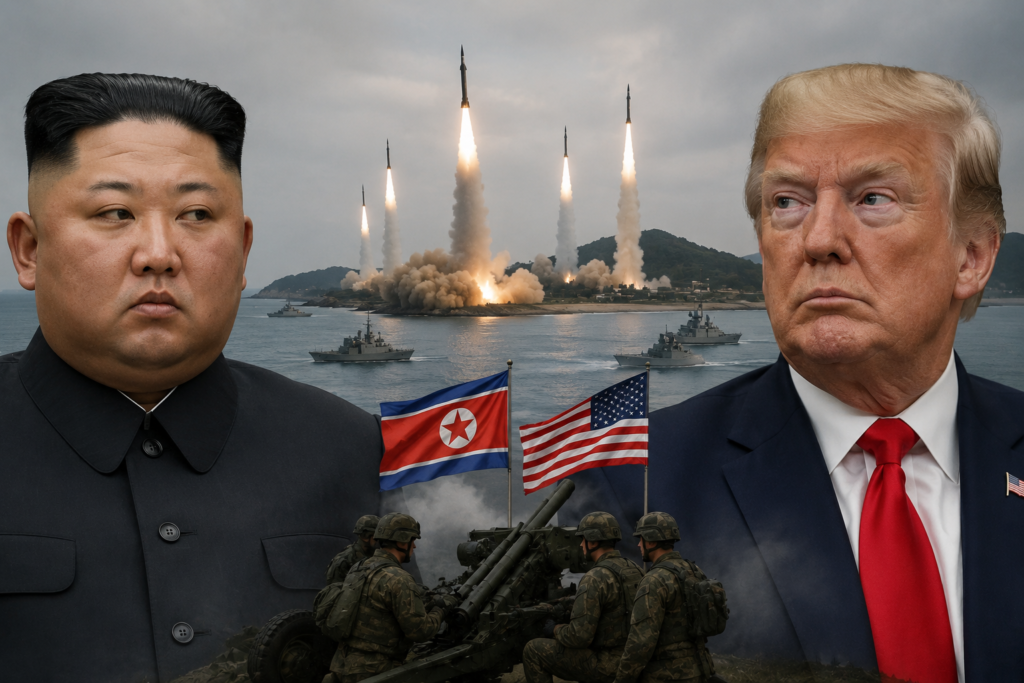
Image Credits: North Korea Fires Around 10 Ballistic Missiles After US Scales Back Drills With South Korea. AI-generated illustration created by Open Chronicle using ChatGPT (OpenAI). August 2026. This image is illustrative and does not depict a real-world scene.
By Open Chronicle with agencies
North Korea fired around 10 short-range ballistic missiles toward its eastern waters on Thursday, August 20, a day after dismissing Washington’s decision to substantially reduce joint military exercises with South Korea.
The launches underline the difficulty facing renewed diplomatic efforts by US President Donald Trump, who has signalled an interest in reopening dialogue with North Korean leader Kim Jong Un while simultaneously maintaining the military alliance between Washington and Seoul.
According to South Korea’s military, the missiles were launched from the region around Pyongyang at approximately 5 p.m. local time and travelled about 300 kilometres before falling into the sea.
South Korean forces strengthened surveillance following the launches and shared information with the United States and Japan. Seoul’s presidential National Security Council also called on Pyongyang to halt ballistic missile launches.
The timing was particularly significant. Washington and Seoul had just reduced one of their most important annual military exercises, apparently hoping the decision could help create space for diplomacy.
Pyongyang’s answer suggests considerably more will be required.
Around 10 missiles launched from Pyongyang region
South Korea detected approximately 10 short-range ballistic missiles launched from the North Korean capital region.
Each travelled roughly 300 kilometres toward waters east of the Korean Peninsula.
Japan also detected what appeared to be a North Korean missile launch, while South Korea said it was coordinating closely with both Tokyo and Washington.
The salvo represents another demonstration of North Korea’s growing missile arsenal and its ability to conduct multiple launches in a relatively short period.
Short-range ballistic missiles are particularly important to the military balance on the Korean Peninsula because they could potentially target South Korean military bases, command centres, airfields and other strategic facilities.
They could also threaten American forces stationed in the region.
Trump ordered military exercises reduced
The launches followed an unusual American decision concerning Ulchi Freedom Shield, one of the principal annual exercises conducted by the United States and South Korea.
Shortly before the exercise began on Monday, Trump ordered the Pentagon to “substantially reduce” its scale.
On Wednesday, the American and South Korean militaries confirmed that the 11-day exercise had been cut approximately in half, with some field training cancelled.
Trump linked his decision partly to what he described as his good relationship with Kim Jong Un.
The reduction therefore appeared to represent a potential diplomatic signal toward Pyongyang.
It also generated concerns about whether repeated reductions to exercises could eventually affect the readiness of American and South Korean forces.
Pyongyang rejects Washington’s gesture
North Korea quickly dismissed the significance of the decision.
Kim Yo Jong, the influential sister of Kim Jong Un and one of the regime’s most prominent political voices, argued that reducing the duration and scale of the exercise did not change its fundamental character.
“The provocative, aggressive nature of the drills won’t change even though their duration and size were reduced,” she said.
Kim Yo Jong also warned Washington against presenting the decision as an act of goodwill.
“If the US calculates that it can propagate its recent measure as the one of so-called good faith, they will not get the desired answer,” she said.
The message suggested that Pyongyang expects substantially larger concessions before reconsidering its refusal to return to negotiations.
But Kim Yo Jong leaves diplomatic door slightly open
Despite rejecting the American gesture, Kim Yo Jong’s language contained an important qualification.
She said the personal relationship between Trump and her brother remained “still excellent”.
That is notable because North Korean statements concerning the United States frequently employ much more confrontational rhetoric.
Maintaining a distinction between opposition to American policy and Kim Jong Un’s personal relationship with Trump could provide Pyongyang with political space to reopen negotiations later.
Kim Yo Jong nevertheless disputed Trump’s suggestion that her brother had already responded to an American request for talks.
Trump had previously indicated that communication had taken place.
The conflicting accounts leave considerable uncertainty surrounding any private contacts between Washington and Pyongyang.
Trump says he expects to meet Kim
Asked on Wednesday whether he expected to meet Kim Jong Un during 2026, Trump replied: “Yeah, I will be.”
He did not directly answer whether the two leaders were exchanging letters but again emphasised his personal relationship with Kim.
A new meeting would revive one of the most unusual diplomatic relationships of Trump’s presidency.
During his first administration, Trump met Kim three times as Washington attempted to negotiate limits on North Korea’s nuclear programme.
The diplomacy produced unprecedented direct contact between the leaders but ultimately failed to achieve a lasting nuclear agreement.
Ulchi Freedom Shield remains central to allied readiness
The dispute once again places Ulchi Freedom Shield at the centre of tensions on the Korean Peninsula.
The annual exercise is intended to prepare American and South Korean forces to operate together during a major military crisis.
Washington and Seoul describe the exercises as defensive and necessary to maintain readiness against a potential North Korean attack.
Pyongyang sees them very differently.
North Korea has long characterised major US and South Korean military exercises as preparations for invasion and frequently responds with missile launches, artillery exercises or other military demonstrations.
Before this year’s exercises began, North Korea warned that it would respond with a “new level of a deterrent”.
Days before the drills started, Pyongyang launched two ballistic missiles into the sea, its first such launches since late June.
A recurring strategic dilemma for Washington
The latest episode illustrates a persistent problem in American policy toward North Korea.
Large military exercises strengthen deterrence and improve coordination between American and South Korean forces.
But Pyongyang uses those exercises to justify weapons development and military demonstrations.
Reducing exercises can create diplomatic opportunities, but doing so without reciprocal North Korean concessions risks weakening allied readiness while providing little in return.
Trump appears willing to test whether modifying the exercises can encourage Kim to reconsider diplomacy.
Thursday’s missile salvo suggests the initial response has been negative.
North Korea has far greater leverage than in 2018
Any renewed negotiations would also take place under very different circumstances from Trump’s first meetings with Kim.
North Korea’s weapons programmes have continued advancing.
Pyongyang possesses a larger and increasingly diverse missile arsenal, including systems intended to threaten South Korea, Japan, US bases across the Pacific and potentially the continental United States.
Kim has also strengthened his relationship with Russia.
Growing cooperation between Moscow and Pyongyang has reduced some of the isolation that previously increased North Korea’s incentive to negotiate with Washington.
As a result, Kim may believe he now has considerably more bargaining power than during the diplomatic opening of 2018 and 2019.
The failure of the Hanoi summit still matters
Trump’s earlier diplomatic initiative effectively collapsed following the February 2019 summit in Hanoi.
The two governments could not agree on the relationship between sanctions relief and North Korean denuclearisation.
Pyongyang sought substantial economic concessions, while Washington wanted more extensive steps to dismantle North Korea’s nuclear infrastructure.
No comprehensive agreement emerged.
Since then, Kim has repeatedly signalled that North Korea will not simply surrender its nuclear arsenal.
Instead, Pyongyang has increasingly presented nuclear weapons as a permanent component of national defence.
That significantly complicates any new negotiations.
What would North Korea want?
One of the most important questions surrounding potential talks is whether North Korea would still negotiate over denuclearisation at all.
Pyongyang may instead seek international acceptance of its status as a nuclear-armed state.
Under such a scenario, North Korea could potentially offer restrictions on missile testing, nuclear production or particular facilities in exchange for sanctions relief and other concessions.
Washington would then face a difficult choice.
Rejecting such an arrangement could leave North Korea’s arsenal growing without restrictions.
Accepting it could be interpreted as recognising that decades of efforts to achieve complete denuclearisation had failed.
That dilemma would make a second Trump-Kim diplomatic process fundamentally different from the first.
South Korea faces its own difficult balance
Seoul also has significant interests at stake.
South Korea benefits from any reduction in military tensions that lowers the risk of conflict on the peninsula.
At the same time, its security depends heavily on the credibility of the alliance with the United States.
Reducing joint exercises without corresponding restraint by the North Korean military could therefore raise concerns in South Korea about deterrence.
The latest missile launches reinforce those concerns.
Even after Washington reduced the exercises, Pyongyang proceeded with another weapons demonstration.
For South Korean defence planners, that provides another argument for maintaining strong surveillance, missile defence and conventional military readiness.
Japan watches closely
Japan’s involvement in monitoring the launches demonstrates how North Korea’s missile programme affects the wider region.
Tokyo has repeatedly issued alerts following North Korean missile launches, some of which have travelled over or near Japanese territory.
Japan also hosts major American military bases that would be strategically important during any conflict on the Korean Peninsula.
This makes trilateral cooperation between Washington, Seoul and Tokyo increasingly important.
Sharing missile warning data can allow the three countries to build a more accurate picture of North Korean launches and improve their ability to respond.
Missile diplomacy returns to the Korean Peninsula
North Korea has frequently combined military pressure with diplomacy.
Weapons tests demonstrate capability and create urgency.
Diplomatic signals preserve the possibility of negotiation.
Thursday’s events fit that familiar pattern.
Kim Yo Jong rejected the reduction in US South Korean military exercises.
North Korea then launched approximately 10 ballistic missiles.
Yet she simultaneously described relations between Kim Jong Un and Trump as excellent.
The combination appears designed to send Washington a carefully calibrated message.
Pyongyang is not accepting the current American offer, but it is not necessarily closing the door on negotiations.
A higher price for renewed diplomacy
The central question is therefore not simply whether Trump and Kim will meet again.
It is what each side would expect from such a meeting.
Washington would want meaningful restrictions on North Korea’s nuclear and missile programmes.
Pyongyang would probably demand substantial sanctions relief, security concessions and potentially further reductions in American military activity around the peninsula.
The gap between those positions remains enormous.
North Korea’s latest missile launches suggest that reducing Ulchi Freedom Shield alone will not bridge it.
Trump’s decision may have been intended as a first confidence-building measure.
Pyongyang’s response indicates that Kim expects much more.
That leaves the Korean Peninsula in a familiar but increasingly dangerous position: diplomacy remains possible, military deterrence remains essential, and North Korea’s arsenal continues to grow while Washington searches for a way to bring Kim Jong Un back to the negotiating table.