
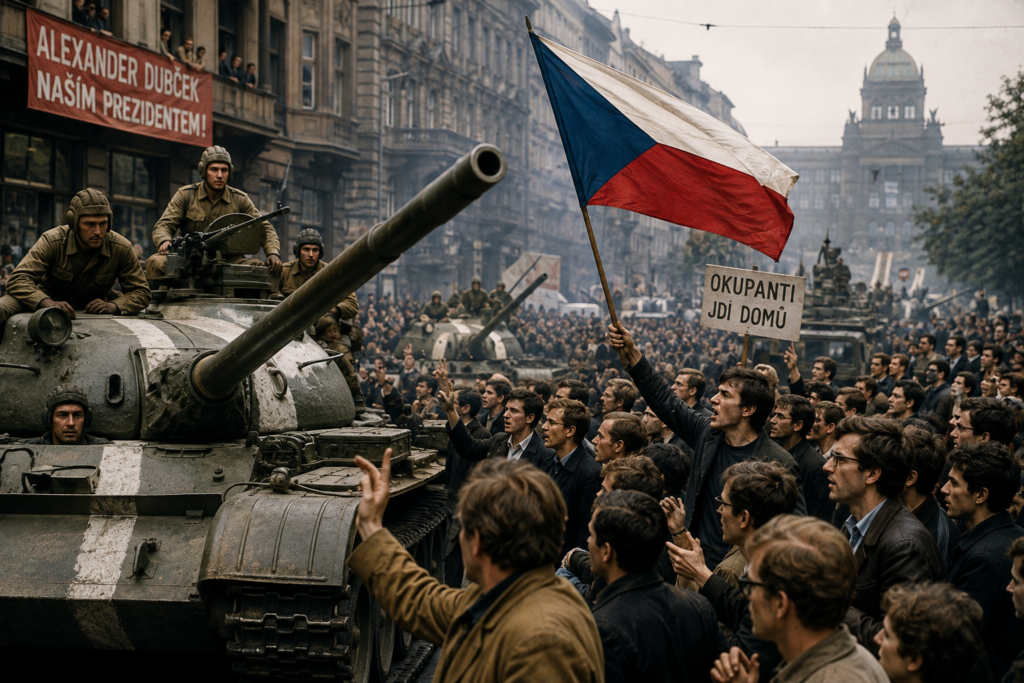
Image Credits: Today in History, August 20, 1968: The Warsaw Pact Invasion That Crushed the Prague Spring. AI-generated illustration created by Open Chronicle using ChatGPT (OpenAI). August 2026. This image is illustrative and does not depict a real-world scene.
By Open Chronicle History Desk
On the night of August 20 to 21, 1968, tanks and troops from Warsaw Pact countries crossed into Czechoslovakia.
Their objective was not to defeat a Western army or repel a foreign invasion. They had been sent to stop political reforms taking place inside another socialist state.
Only months earlier, Alexander Dubček had risen to leadership of the Communist Party of Czechoslovakia and launched an ambitious reform programme that promised greater freedom of expression, reduced censorship, economic reform and a political system described as “socialism with a human face.”
The experiment became known as the Prague Spring.
For many Czechoslovaks, it represented the possibility that socialism could coexist with greater political and personal freedom.
For the Soviet leadership under Leonid Brezhnev, however, the reforms raised a dangerous question. If one country inside the Soviet bloc could loosen Communist Party control, what might happen in Poland, Hungary, East Germany or even the Soviet Union itself?
Moscow decided that the experiment could not continue.
During the night of August 20, one of the largest military operations in postwar European history began.
By the following morning, Soviet tanks were in Prague.
The Prague Spring was being crushed.
Czechoslovakia Behind the Iron Curtain
Czechoslovakia emerged from the Second World War profoundly changed.
Before the conflict, it had been one of Central Europe’s most developed democracies and industrial economies. Nazi Germany dismantled the country in 1938 and 1939, occupying the Czech lands while Slovakia became a German-aligned state.
Liberation in 1945 restored Czechoslovakia, but the political balance of Europe had shifted.
The Soviet Red Army had liberated much of the country, and the Communist Party emerged from the war with considerable influence.
In February 1948, the Communists consolidated control of the government.
Czechoslovakia became part of the Soviet dominated political system developing across Eastern Europe.
Political opposition was suppressed.
Industry was nationalised.
Agriculture was collectivised.
Censorship restricted the press and cultural life.
Political trials targeted real and imagined opponents.
The country became firmly integrated into the Soviet bloc and joined the Warsaw Pact after its creation in 1955.
Yet beneath the apparent political stability, dissatisfaction was growing.
The Stalinist Legacy
Czechoslovakia experienced some of the harshest political repression in postwar Eastern Europe.
During the early 1950s, Stalinist purges reached deep into the Communist Party itself.
The most notorious example was the 1952 Slánský trial.
Rudolf Slánský, formerly General Secretary of the Communist Party, and other senior officials were accused of conspiracy and treason.
Eleven defendants were executed.
Such trials demonstrated that even loyal Communists could become victims of the political system.
After Joseph Stalin died in 1953, the Soviet Union gradually moved away from some of the most extreme aspects of Stalinism.
Nikita Khrushchev denounced Stalin’s cult of personality in 1956.
Reform followed unevenly across Eastern Europe.
Czechoslovakia changed more slowly.
By the 1960s, however, economic difficulties and intellectual dissatisfaction were making reform increasingly difficult to avoid.
A System Under Pressure
The Czechoslovak economy had once been among Europe’s strongest.
Central planning initially produced rapid industrial development, but by the 1960s economic growth was slowing.
The system struggled to encourage innovation and respond efficiently to consumer demand.
Economists began arguing for greater decentralisation and limited market mechanisms.
Writers and intellectuals simultaneously demanded greater cultural freedom.
The Writers’ Union became an important centre of criticism.
At its congress in 1967, writers openly challenged censorship and political restrictions.
Students also demonstrated.
The authority of Communist Party leader and President Antonín Novotný was weakening.
Within the party itself, reformers increasingly believed substantial change was necessary.
One of them was Alexander Dubček.
Alexander Dubček
Dubček was born in 1921 and spent part of his childhood in the Soviet Union.
He joined the Communist resistance during the Second World War and rose steadily through the Czechoslovak Communist Party after the war.
By the 1960s, he had become a prominent Slovak political leader.
He was not an anti communist revolutionary.
This distinction is essential to understanding the Prague Spring.
Dubček did not initially seek to abolish socialism, leave the Warsaw Pact, or transform Czechoslovakia into a Western capitalist democracy.
He wanted to reform the socialist system.
In January 1968, Novotný was removed as First Secretary of the Communist Party.
Dubček replaced him.
The political atmosphere changed remarkably quickly.
The Prague Spring Begins
The months that followed produced an extraordinary flowering of political discussion.
Censorship weakened.
Newspapers began publishing material that previously would have been impossible.
Writers debated the country’s history.
Citizens discussed Stalinist repression.
Political and economic reforms were openly considered.
Radio and television became more independent.
Previously suppressed information entered public debate.
For people accustomed to years of tightly controlled public life, the transformation was dramatic.
The reform movement soon became known internationally as the Prague Spring.
Its most important political document appeared in April.
The Action Programme
On April 5, 1968, the Communist Party adopted its Action Programme.
It proposed significant reforms.
The programme envisioned greater freedom of speech and information, economic decentralisation, rehabilitation of victims of political persecution and changes in relations between the Czech and Slovak parts of the country.
It also accepted a greater degree of political pluralism within the socialist framework.
Dubček summarised the philosophy of reform through the phrase “socialism with a human face.”
The idea was revolutionary precisely because it claimed socialism did not require permanent political repression.
Communist government, the reformers argued, could survive while allowing citizens substantially greater freedom.
That proposition attracted attention far beyond Czechoslovakia.
It also alarmed Moscow.
Moscow Becomes Worried
The Soviet leadership initially attempted to influence Dubček through political pressure.
Leonid Brezhnev and other Soviet officials feared the reforms were moving beyond the Communist Party’s control.
Their concerns extended far beyond Czechoslovakia.
Eastern Europe formed a strategic security zone separating the Soviet Union from NATO countries.
Czechoslovakia occupied an especially important geographic position in Central Europe.
But military geography was only part of the problem.
The Prague Spring presented an ideological challenge.
If Czechoslovakia demonstrated that a Communist society could tolerate a free press, open political debate and reduced party control, citizens elsewhere in Eastern Europe might demand the same freedoms.
The Soviet bloc could begin to unravel from within.
Memories of Hungary
Soviet leaders had confronted a similar challenge twelve years earlier.
In 1956, political unrest in Hungary developed into a national uprising.
Hungarian Prime Minister Imre Nagy announced plans that included withdrawal from the Warsaw Pact.
Soviet forces invaded.
Thousands of Hungarians were killed; Nagy was eventually executed, and Communist control was restored.
Czechoslovakia in 1968 was different.
Dubček repeatedly reassured Moscow that the country would remain socialist and continue its membership of the Warsaw Pact.
But Soviet leaders feared that political liberalisation had its own momentum.
Once censorship disappeared and independent organisations emerged, they worried that the Communist Party might eventually lose control regardless of Dubček’s intentions.
The Two Thousand Words
Those fears intensified during the summer.
In June, writer Ludvík Vaculík published a manifesto known as The Two Thousand Words.
The document encouraged citizens to take a more active role in the reform process and criticised conservative forces resisting change.
Dubček and other reform leaders distanced themselves from some of its implications.
Moscow nevertheless interpreted it as evidence that political developments were escaping party control.
Pressure increased.
Soviet and Czechoslovak leaders held repeated meetings.
Warsaw Pact governments also became involved.
Not every Communist state viewed the situation identically, but leaders in East Germany and Poland were particularly concerned about the possibility that reformist ideas might spread across their borders.
The possibility of military intervention became increasingly real.
Negotiations at Čierna nad Tisou
At the end of July, Soviet and Czechoslovak leaders met at Čierna nad Tisou near the Soviet border.
It was an extraordinary encounter between the leaderships of two supposedly allied socialist countries.
Dubček attempted to reassure Brezhnev.
Czechoslovakia would remain in the Warsaw Pact.
It would remain socialist.
The reforms were not intended to threaten Soviet security.
A further meeting in Bratislava appeared to produce a compromise.
For a brief period, it seemed possible that intervention might be avoided.
Behind the scenes, however, Soviet leaders remained unconvinced.
Plans for military action continued.
The Decision to Invade
The Soviet leadership ultimately concluded that the political risks of allowing the Prague Spring to continue were greater than the risks of intervention.
The invasion was organised through the Warsaw Pact.
The Soviet Union supplied the overwhelming majority of the military power.
Polish, Hungarian and Bulgarian troops also participated. East German forces were prepared for the operation, although their direct role inside Czechoslovakia was limited.
Romania refused to participate.
Its Communist leader, Nicolae Ceaușescu, publicly condemned the invasion.
Albania, already increasingly estranged from Moscow, subsequently withdrew formally from the Warsaw Pact.
For Moscow, however, the central objective remained unchanged.
The reform movement had to be brought under control.
The Night of August 20
Late on August 20, Warsaw Pact forces began crossing Czechoslovakia’s borders.
The operation achieved tactical surprise.
Aircraft carrying Soviet troops landed at Prague’s Ruzyně Airport.
Armoured columns advanced from several directions.
Within hours, enormous military forces were moving through the country.
Hundreds of thousands of troops eventually participated in the occupation.
The Czechoslovak leadership had not ordered the armed forces to resist.
A military confrontation with the Soviet Union would have been catastrophic.
Instead, the population responded largely through spontaneous civilian resistance.
The images that followed became some of the defining photographs of the Cold War.
Tanks moved through Prague.
Citizens surrounded armoured vehicles.
Young people argued with Soviet soldiers.
Czechoslovak flags appeared in the streets.
Road signs were removed or altered to confuse invading forces.
Walls filled with political slogans.
The country was occupied, but it was not politically silent.
The Battle for Czechoslovak Radio
One of the most dramatic confrontations occurred around the headquarters of Czechoslovak Radio in Prague.
Broadcasting had played an important role in the reform movement.
As Soviet troops attempted to control communications, citizens gathered to defend the radio building.
Barricades appeared.
Violence followed.
People were killed and wounded.
Despite attempts to silence broadcasting, journalists continued transmitting from alternative locations.
Radio stations called for calm while providing information about the occupation.
The struggle demonstrated how much the Prague Spring had transformed public life.
Information itself had become something citizens were prepared to defend.
“Why Are You Here?”
Many Soviet soldiers had been told they were entering Czechoslovakia to prevent a counterrevolution or foreign-backed takeover.
Instead, they encountered civilians asking why supposedly allied armies had invaded them.
Photographs show crowds confronting tank crews and attempting to explain that there was no counterrevolution.
Some soldiers appeared confused.
Others remained disciplined.
There was no organised nationwide armed resistance.
But civilian opposition was widespread.
Demonstrators used argument, humour, graffiti, flags and non-cooperation.
One slogan captured the contradiction of the invasion:
“Ivan, go home.”
The Soviet Union claimed to be protecting socialism.
Many Czechoslovaks saw Soviet tanks destroying the possibility of reforming it.
Dubček Is Arrested
Soviet forces detained Dubček and other senior reform leaders.
They were transported to Moscow.
The occupation authorities initially hoped to establish a replacement government quickly.
That proved difficult.
Popular support for Dubček remained strong, and many Czechoslovak officials refused to legitimise the intervention.
The arrested leaders therefore became necessary participants in negotiations.
Under enormous pressure, they signed the Moscow Protocol.
Most of the reform leadership accepted the agreement, although František Kriegel famously refused to sign.
The protocol effectively required Czechoslovakia to accept the military presence and begin reversing the reform process.
Dubček returned to Prague.
But the Prague Spring was effectively over.
The Brezhnev Doctrine
The invasion soon became associated with a broader Soviet principle known as the Brezhnev Doctrine.
Its basic implication was that the sovereignty of socialist countries was limited when developments within one state threatened what Moscow regarded as the interests of socialism as a whole.
In practice, this meant that the Soviet Union claimed the right to intervene within its sphere of influence.
The doctrine formalised one of the central realities of Cold War Eastern Europe.
Warsaw Pact governments possessed sovereignty, but only within limits acceptable to Moscow.
Czechoslovakia had discovered where those limits stood.
The Human Cost
The invasion was far less bloody than the Soviet suppression of the Hungarian uprising in 1956, but it was not bloodless.
More than 100 Czechoslovaks were killed during the initial invasion and occupation period, while hundreds were seriously injured.
Further deaths occurred during subsequent confrontations.
There were also enormous political and psychological consequences.
Thousands of people left the country.
Many intellectuals, professionals and political activists emigrated.
Those who remained faced a gradual restoration of censorship and political control.
The atmosphere of possibility that had defined the first months of 1968 disappeared.
Jan Palach
One of the most powerful symbols of resistance emerged several months later.
On January 16, 1969, university student Jan Palach set himself on fire in Prague’s Wenceslas Square.
He was protesting against the growing resignation of society and the suppression of the freedoms associated with the Prague Spring.
Palach died three days later.
His funeral became a major public demonstration.
Other self immolations followed.
Palach’s death became a lasting symbol of moral resistance to occupation.
Two decades later, commemorations of his sacrifice would again become politically important as Communist rule approached its end.
Dubček Is Removed
The dismantling of the Prague Spring occurred gradually.
In April 1969, Dubček was removed as First Secretary of the Communist Party.
He was replaced by Gustáv Husák.
The new leadership began a process known as normalisation.
The term sounded administrative.
Its consequences were profoundly political.
Reformers were removed from government positions.
Party members were purged.
Censorship returned.
Independent organisations disappeared.
Academics, journalists and professionals who had supported reform could lose their careers.
Dubček himself was eventually expelled from the Communist Party.
For approximately two decades, Czechoslovakia returned to political conformity.
Resistance Moves Underground
Political opposition did not disappear.
It changed form.
Dissidents developed networks outside official institutions.
Writers, intellectuals, religious activists and former reform Communists continued challenging the government’s restrictions.
In 1977, a group of dissidents issued Charter 77, criticising the government for failing to respect human rights commitments.
Among its most prominent figures was playwright Václav Havel.
The authorities harassed and imprisoned Charter 77 activists.
But the movement preserved an alternative political culture.
The ideals suppressed in 1968 had not vanished.
They were waiting for another historical opportunity.
International Reaction
The invasion produced condemnation across much of the world.
Western governments protested but did not intervene militarily.
Czechoslovakia lay firmly inside the Soviet sphere, and direct confrontation could have escalated into a conflict between nuclear armed alliances.
More damaging for Moscow was the reaction within the international communist movement.
Communist parties in Western Europe increasingly distanced themselves from Soviet control.
The invasion contributed to the development of Eurocommunism, which emphasised democratic political methods and greater independence from Moscow.
Even within the Soviet Union, a small number of dissidents protested.
On August 25, 1968, demonstrators gathered in Moscow’s Red Square carrying banners opposing the invasion.
They were quickly arrested.
Their protest was tiny.
Its moral significance was much larger.
Romania Says No
One of the most striking reactions came from another Communist state.
On August 21, Romanian leader Nicolae Ceaușescu addressed a huge crowd in Bucharest and condemned the invasion.
He described it as a serious mistake and a threat to national sovereignty.
At the time, the speech dramatically increased Ceaușescu’s popularity both inside Romania and in parts of the West.
His later dictatorship would become one of the most repressive in Eastern Europe.
But in August 1968, Romania’s refusal to participate demonstrated that even within the Warsaw Pact, Moscow could not command complete political uniformity.
The Long Winter After Prague
For the next two decades, the political system appeared stable.
Soviet troops remained stationed in Czechoslovakia.
Public political life was tightly controlled.
Many citizens retreated into private life.
But the memory of 1968 remained powerful.
Parents told their children about the tanks.
Photographs circulated.
Former reformers remembered the months when censorship had disappeared.
Dissidents preserved the idea that another political system was possible.
Then, during the 1980s, the Soviet Union itself began changing.
Mikhail Gorbachev introduced glasnost and perestroika.
The irony was impossible to miss.
Moscow was now promoting reforms that resembled some of the ideas Soviet tanks had suppressed in Czechoslovakia two decades earlier.
The Velvet Revolution
In 1989, Communist regimes began collapsing across Eastern Europe.
Poland moved toward democratic government.
Hungary opened its borders.
The Berlin Wall fell on November 9.
In Czechoslovakia, mass demonstrations erupted after police violently dispersed a student protest in Prague on November 17.
Within weeks, Communist rule collapsed through an overwhelmingly peaceful political movement known as the Velvet Revolution.
Václav Havel became President.
And Alexander Dubček returned to public life.
The man whose reform experiment had been crushed by Soviet tanks in 1968 appeared before enormous crowds.
He was elected chairman of the Federal Assembly.
History had brought him back.
Soviet Troops Finally Leave
The occupation that began in August 1968 lasted more than twenty years.
After the Velvet Revolution, negotiations began over the withdrawal of Soviet forces.
The last Soviet troops left Czechoslovakia in 1991.
The military intervention intended to preserve the Soviet political order had ultimately failed.
It delayed political change.
It could not prevent it permanently.
Two years later, Czechoslovakia itself peacefully divided into the Czech Republic and Slovakia.
Both eventually joined NATO and the European Union.
The strategic landscape Moscow had attempted to preserve through force in 1968 had completely disappeared.
Why August 20 Matters
The invasion of Czechoslovakia was one of the defining moments of the Cold War.
It revealed the limits of political independence inside the Soviet bloc.
It demonstrated that Moscow was prepared to use overwhelming military force against an allied government when Communist Party control appeared threatened.
But the deeper historical significance of the Prague Spring lies in the idea that Soviet intervention failed to destroy.
Dubček and his supporters had asked whether socialism could be reformed to allow political freedom, open debate and a more humane society.
Soviet tanks answered that question with force.
For a generation, the answer appeared definitive.
Yet the invasion also exposed the weakness beneath the apparent strength of the Soviet system.
A political order requiring tanks to prevent newspapers from speaking freely and citizens from debating their country’s future could suppress dissent, but it struggled to command genuine legitimacy.
On the night of August 20, 1968, Warsaw Pact armies entered Czechoslovakia expecting to restore political control.
They succeeded.
For twenty-one years.
Then the people returned to the streets of Prague.
This time, the tanks did not come.