
By Open Chronicle with agencies
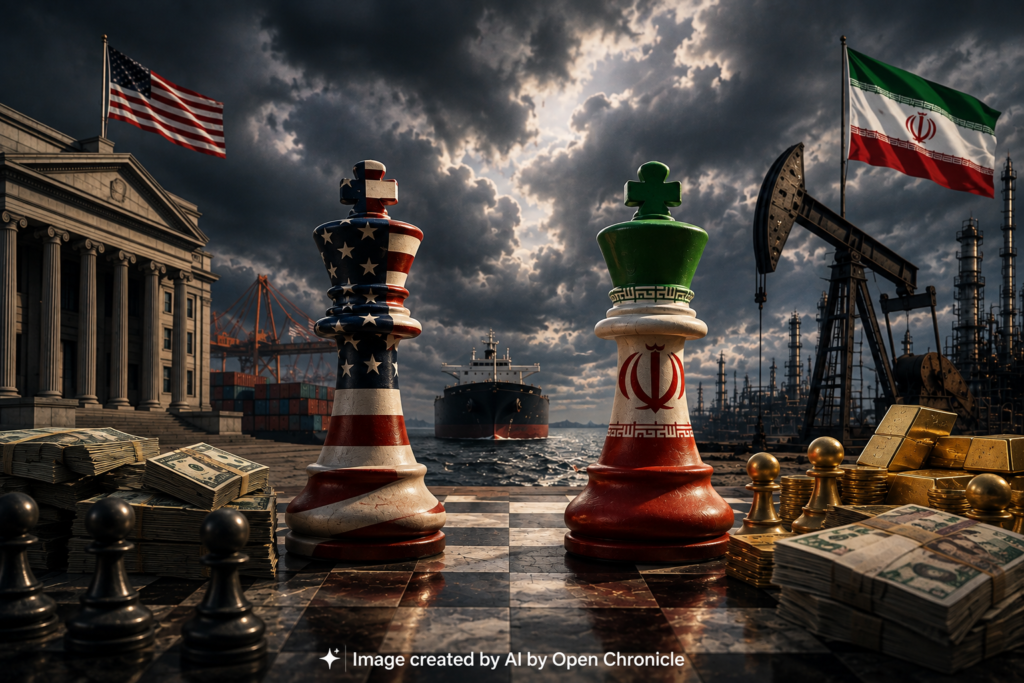
The United States has dramatically intensified its economic campaign against Iran, warning governments and businesses around the world that continued commercial ties with Tehran could expose them to American secondary sanctions and exclusion from the dollar based financial system.
US Treasury Secretary Scott Bessent announced the new strategy on Monday, describing it as an “economic D Day” designed to dismantle the international financial networks that continue to provide revenue to the Iranian government.
The measures expand Washington’s pressure beyond traditional oil sanctions, targeting sectors including digital assets, technology, gold, aviation and shipping as the Trump administration seeks to isolate Tehran economically nearly six months into the war with Iran.
“We are launching an economic onslaught against Iran’s financial connections around the globe,” Bessent said. “Our objective is to sever every economic lifeline that sustains this tyrannical regime until Tehran stands alone.”
Washington warns there can be no economic middle ground
At the centre of the new strategy is a warning to governments, financial institutions and companies continuing to conduct business with Iran.
Bessent said Washington would no longer accept companies attempting to operate within what he characterised as economic grey areas surrounding the conflict.
“Let there be no ambiguity as to the position of the United States,” he said. “An economic engagement of any kind with this murderous regime will expose those responsible to the full reach of American power.”
The Treasury secretary did not identify individual countries that could become targets of secondary sanctions.
That omission is significant.
Rather than initially directing the warning toward a limited group of governments, Washington appears to be establishing a broader principle: companies and entities maintaining economic connections with Iran could potentially be forced to choose between access to the Iranian economy and access to the American financial system.
For many international businesses, that would not be an equal choice.
The dollar remains Washington’s most powerful economic weapon
The effectiveness of secondary sanctions depends heavily on the central position of the United States in global finance.
The dollar remains fundamental to international trade, banking and commodity markets.
Companies do not necessarily need to operate directly inside the United States to depend upon dollar transactions, American financial institutions or access to markets influenced by US regulations.
Washington can therefore exert pressure well beyond its own borders.
A foreign company doing business with Iran might theoretically comply with the laws of its own country while still facing consequences from the United States.
That extraterritorial dimension has long made American sanctions particularly powerful and controversial.
The new campaign appears designed to exploit that leverage on a much larger scale.
Treasury maps Iran’s international networks
The US Treasury Department says it has mapped networks, facilitators and financial channels used by Iran to move oil, generate revenue and circumvent existing restrictions.
Washington now intends to work with partners to target sources of what it describes as Iran’s illicit revenue.
The approach reflects a persistent challenge associated with sanctions enforcement.
Designating a company or vessel does not necessarily stop the underlying commercial activity.
Networks can reorganise.
Ships can change names or ownership structures.
Companies can operate through intermediaries.
Payments can move through alternative financial channels.
Cargo can be transferred between vessels.
Digital assets can provide additional mechanisms for moving value.
Consequently, sanctions enforcement increasingly resembles a continuous intelligence operation rather than a single regulatory action.
Five sectors come under particular scrutiny
Treasury has issued determinations covering five sectors that Washington believes are helping sustain Iran’s economy: digital assets, technology, gold, aviation and shipping.
Each plays a different role.
Shipping remains critical because Iran needs vessels and maritime networks to move commodities and maintain international trade.
Aviation provides another connection to global transportation and logistics.
Gold can function as an alternative store of value and settlement mechanism when conventional banking channels become difficult to access.
Digital assets potentially offer additional routes for transferring funds outside traditional financial institutions.
Technology is particularly important because modern industrial, military and energy systems depend heavily on specialised components and expertise.
By targeting several sectors simultaneously, Washington is attempting to close multiple pathways rather than concentrating exclusively on Iran’s petroleum exports.
Nearly 60 targets sanctioned
The Treasury has also imposed sanctions on nearly 60 entities, individuals and vessels as part of the expanded campaign.
The designations represent the enforcement component of Bessent’s wider warning.
The objective is not merely to punish already identified Iranian networks.
Washington wants companies elsewhere to reconsider their own exposure before they become targets.
This deterrent effect is central to secondary sanctions.
If international banks conclude that processing Iranian related transactions creates unacceptable risk, they may withdraw even when a specific transaction has not explicitly been prohibited.
Shipping companies can make similar calculations.
So can insurers, technology suppliers, commodity traders and investors.
The economic effect can therefore extend considerably beyond the organisations formally appearing on sanctions lists.
Iran’s oil trade remains crucial
Energy revenue remains one of Tehran’s most important economic lifelines.
Iran possesses some of the world’s largest hydrocarbon reserves, making its ability to sell oil and related products internationally central to government finances.
Sanctions have repeatedly attempted to restrict that revenue.
Iran, however, has accumulated considerable experience operating under international restrictions.
Complex trading networks, intermediaries and maritime practices have allowed Iranian commodities to continue reaching foreign markets despite previous rounds of sanctions.
The latest American strategy appears intended to attack not simply the exports themselves but the wider ecosystem that makes those transactions possible.
That includes financing, transportation, technology and intermediary companies.
The difficult question: what will major trading partners do?
The effectiveness of the campaign will ultimately depend heavily on how other countries respond.
Washington can impose significant costs through its control over access to American financial infrastructure.
But the international economy is not completely dependent on the United States.
Governments maintaining important relationships with Tehran may attempt to develop alternative payment mechanisms, increase transactions outside the dollar or provide companies with political protection.
The larger the economy involved, the more complicated enforcement becomes.
If major powers resist American pressure, Washington may eventually face a difficult decision: whether to impose substantial penalties on companies from economically important countries and risk creating wider diplomatic or trade confrontations.
That makes secondary sanctions both powerful and potentially destabilising.
Economic warfare could accelerate financial fragmentation
There is also a longer term strategic risk for Washington.
The extraordinary power of American sanctions derives partly from global dependence on the dollar based financial system.
Using that system aggressively gives targeted countries an incentive to develop alternatives.
Those alternatives remain limited compared with the scale and liquidity of dollar markets.
Nevertheless, repeated sanctions campaigns have encouraged governments to explore bilateral currency arrangements, alternative payment systems and other mechanisms intended to reduce exposure to American financial pressure.
The immediate advantage therefore comes with a strategic calculation.
Washington wants to maximise the coercive power of the dollar without encouraging a sufficiently large group of countries to accelerate efforts to bypass it.
Nearly six months of war
The escalation in economic pressure comes as President Donald Trump’s war with Iran approaches the six month mark.
Heavy fighting has subsided from earlier stages of the conflict, but efforts to secure a diplomatic settlement have stalled.
That has left economic warfare occupying an increasingly important role.
Washington appears to be attempting to achieve through financial isolation some of the strategic objectives that military pressure alone has not produced.
The strategy seeks to make continuation of the conflict progressively more expensive for Tehran.
Iran must finance government operations, maintain military capabilities, support domestic economic activity and preserve international commercial relationships while confronting expanding restrictions.
The United States is attempting to narrow those options.
The Strait of Hormuz keeps the global economy involved
The conflict’s consequences extend far beyond Iran and the United States.
Shipping through the Strait of Hormuz remains blocked, keeping energy prices elevated and disrupting one of the world’s most strategically important maritime corridors.
The waterway connects the Persian Gulf with the Gulf of Oman and the wider Indian Ocean.
A significant share of global petroleum and liquefied natural gas exports normally moves through or near the strait.
Disruption therefore creates consequences thousands of kilometres from the battlefield.
Consumers pay higher energy prices.
Airlines face increased fuel costs.
Manufacturers experience higher transportation and raw material expenses.
Governments importing large quantities of energy face additional economic pressure.
The longer disruption continues, the more the Iran conflict becomes a global economic event rather than solely a regional war.
Sanctions and military pressure increasingly converge
The new measures demonstrate how modern economic warfare increasingly operates alongside conventional military power.
Ships, aircraft and missiles represent one form of pressure.
Financial regulations represent another.
Intelligence agencies identify networks.
Treasury officials designate companies.
Banks block transactions.
Insurers withdraw coverage.
Shipping companies reconsider routes.
Technology suppliers terminate relationships.
The cumulative objective is to reduce an adversary’s ability to convert economic activity into military and political power.
For Iran, this means the battlefield increasingly extends into banks, ports, cryptocurrency networks, commodity markets and corporate boardrooms around the world.
Tehran is unlikely to remain passive
Iran has extensive experience surviving sanctions and is likely to seek ways around the latest restrictions.
Alternative financial channels will become more important.
Trading relationships with governments willing to resist American pressure could deepen.
Cryptocurrency and other nontraditional payment mechanisms may receive additional attention.
Maritime networks could become more opaque.
Iran may also respond politically or economically against countries participating in the American campaign.
The result will probably be an extended contest between American enforcement and Iranian adaptation.
Every network Washington identifies creates an incentive for Tehran to construct another.
The risk of a wider economic confrontation
Bessent’s warning potentially creates consequences well beyond Iran.
If Washington aggressively sanctions foreign companies doing business with Tehran, disputes could emerge with governments whose companies become targets.
That is especially true if those governments reject the legitimacy of American secondary sanctions.
The campaign could therefore evolve into a test of American financial influence.
Countries will have to calculate how valuable their economic relationship with Iran is compared with their exposure to the United States.
For most companies deeply integrated into global finance, losing access to dollar transactions would be extraordinarily costly.
That asymmetry is precisely what Washington intends to exploit.
A campaign to isolate Tehran
The Trump administration is making the objective increasingly explicit.
It does not simply want to reduce Iranian revenues.
It wants to isolate the country from the international economic networks that allow those revenues to be generated and moved.
That is a far more ambitious undertaking.
Iran has a large population, substantial natural resources and longstanding commercial relationships extending across Asia, the Middle East and beyond.
Completely severing those connections would require extraordinary international compliance.
Whether Washington can achieve that remains uncertain.
But Bessent’s announcement indicates that the United States intends to try.
Nearly six months after the conflict began, the confrontation is consequently entering another phase.
The battlefield remains important.
So does the Strait of Hormuz.
But increasingly, the decisive pressure may be applied far away from either.
It may emerge in a bank deciding whether to process a transaction, a shipping company considering whether to carry Iranian cargo, or an international corporation choosing which market it can afford to lose.
Washington’s message is deliberately stark.
In the escalating economic confrontation with Iran, the United States wants the rest of the world to decide which financial system it values more.