
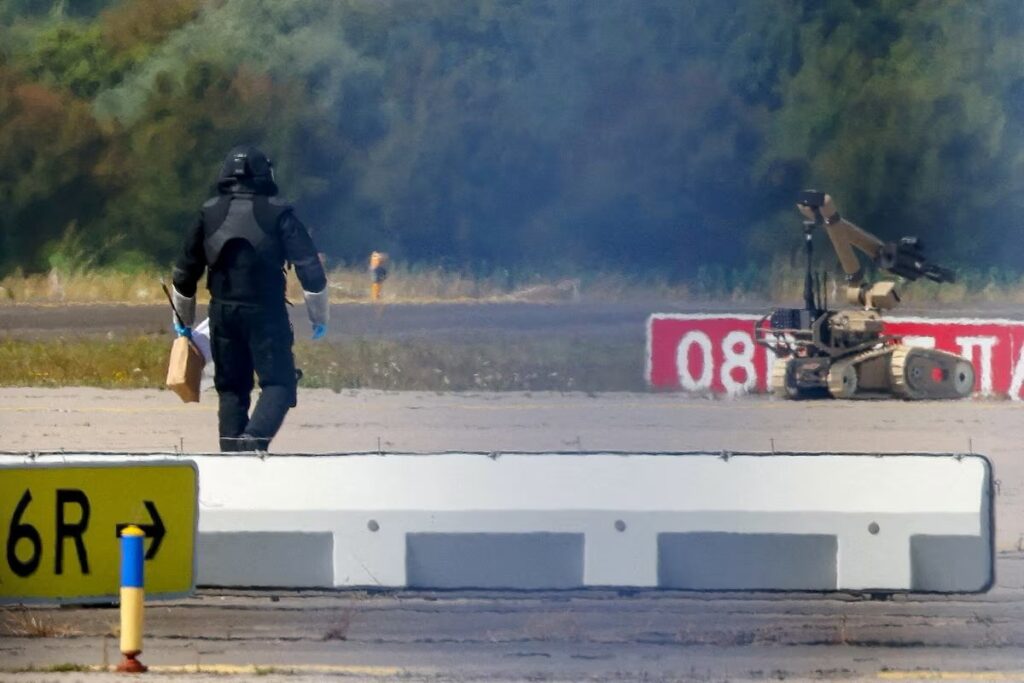
Image: from OSINTdefender X @sentdefender
Defence & Security
By Open Chronicle with agencies
German investigators have reportedly discovered a third drone and a quantity of suspected military grade explosive near Leipzig/Halle Airport, adding a new dimension to an investigation into what authorities suspect may have been an attempted attack on one of Germany’s most strategically important logistics hubs.
According to reports by German public broadcasters WDR and NDR and the Süddeutsche Zeitung, cited by Reuters, the latest drone was discovered on August 14, ten days after an earlier security incident at the airport.
Investigators also reportedly recovered around 50 grams of a substance believed to be hexogen, a powerful explosive widely known as RDX.
German prosecutors had not immediately provided public details about the latest discovery.
Third drone deepens investigation
The discovery follows an incident on August 4, when investigators found a drone carrying explosives close to a Ukrainian Antonov transport aircraft.
The aircraft was reportedly being used for military supply operations, making the circumstances surrounding the drone particularly sensitive.
Authorities are also investigating whether another drone may have struck or crashed into a DHL cargo aircraft shortly after Leipzig/Halle Airport was temporarily closed following the initial discovery.
If confirmed, the presence of three drones associated with the same area would significantly broaden the investigation beyond what might otherwise have been considered an isolated security incident.
Investigators will now seek to establish whether the aircraft were operated as part of a coordinated operation, where they originated and whether the explosive material recovered from the area can be linked to the drones.
Suspected hexogen discovered
The reported discovery of approximately 50 grams of suspected hexogen is another important element of the investigation.
Hexogen, commonly known as RDX, is a powerful high explosive used in military applications. It has a high detonation velocity and can be incorporated into several types of explosive compounds.
Its possible presence near an airport involved in strategic logistics operations is therefore likely to receive particular scrutiny from German security authorities.
Laboratory analysis would be required to establish conclusively whether the recovered substance is RDX and determine its composition and potential origin.
Leipzig/Halle is a strategic logistics hub
Leipzig/Halle Airport occupies an unusually important position within Germany’s transport infrastructure.
In addition to civilian aviation, the airport is a major European cargo hub and supports international logistics operations. It has also been used in connection with NATO activities and Ukrainian transport operations.
Ukraine’s Antonov Airlines operates large transport aircraft capable of carrying heavy and oversized cargo, making such aircraft valuable for international logistics and military support missions.
The reported proximity of an explosive carrying drone to a Ukrainian Antonov aircraft therefore raises questions about whether a specific aircraft, cargo operation or broader logistics network may have been targeted.
Reports point to possible Russian involvement
German media reports cited sources who suspect that Russian military intelligence could have been connected to the alleged operation.
Russia has denied the accusation.
At this stage, publicly available information does not establish responsibility for the incidents, and any attribution would require evidence linking the drones, explosive material, operators and potential organizers.
The distinction is particularly important because an attack linked to a foreign intelligence service would transform the case from an aviation security investigation into a potentially serious act of sabotage or hybrid warfare.
Europe increasingly concerned about sabotage
The Leipzig investigation comes against a broader backdrop of heightened European concern over sabotage, espionage and attacks against critical infrastructure.
Since Russia’s full scale invasion of Ukraine in 2022, European governments have increased protection around military installations, transport networks, energy infrastructure and facilities involved in supplying Ukraine.
Drones have become an especially difficult security challenge.
Small unmanned aircraft are relatively inexpensive, can operate at low altitude and can potentially be modified to carry cameras, electronic equipment or explosives. Their accessibility makes them useful not only for conventional military operations but also for espionage, disruption and sabotage.
Airports present an additional vulnerability because even an unarmed drone can force temporary closures and disrupt aviation.
Investigators face key questions
Several important questions remain unanswered.
Authorities will need to determine whether the three reported drones were connected, whether the suspected explosive material was intended for use in an attack and whether the Antonov aircraft was deliberately selected as a target.
Investigators will also examine how the drones reached the airport area, whether they were remotely controlled or programmed to operate autonomously, and whether additional devices remain undiscovered.
The question of attribution will be the most politically sensitive.
If investigators eventually establish that a foreign intelligence service directed the operation, the Leipzig/Halle incidents could become one of the more serious suspected acts of sabotage against European logistics infrastructure supporting Ukraine.
For now, however, the investigation remains open, and allegations of Russian involvement have not been publicly proven.
What is already clear is that the discovery of another drone and suspected military explosive has raised the stakes surrounding an airport that plays an important role in both European commercial transport and strategic logistics.