
Department: World | Europe | War Crimes & Justice
By Open Chronicle with agencies
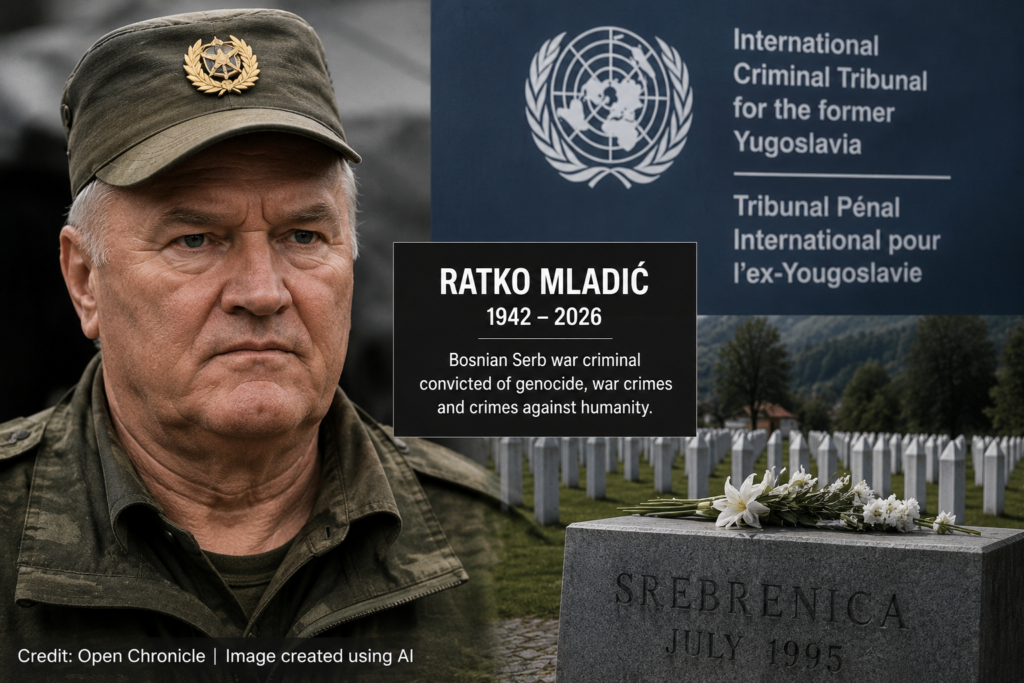
Ratko Mladic, the former Bosnian Serb military commander convicted of genocide, war crimes and crimes against humanity for atrocities committed during the Bosnian War, has died at the age of 84 in The Hague.
The United Nations confirmed his death on Thursday. Mladic had been serving a life sentence following his conviction over some of the worst atrocities committed in Europe since the Second World War.
Dutch authorities are investigating the circumstances of his death, according to the U.N. court, whose judge has ordered an inquiry.
Commander During the Bosnian War
Mladic commanded the Bosnian Serb Army during the 1992 to 1995 conflict that followed the collapse of Yugoslavia.
Under his command, Bosnian Serb forces conducted campaigns aimed at forcibly removing Bosniak Muslims and other non Serb communities from areas claimed by Bosnian Serb authorities.
His forces were responsible for the prolonged siege of Sarajevo, during which more than 10,000 people were killed as the Bosnian capital endured years of shelling and sniper attacks.
Mladic became particularly notorious for his role in the July 1995 Srebrenica massacre.
Bosnian Serb forces overran the United Nations designated safe area and subsequently killed more than 8,000 Bosniak Muslim men and boys. International courts later determined that the massacre constituted genocide.
The scale and systematic nature of the killings made Srebrenica one of the defining atrocities of the wars that accompanied Yugoslavia’s disintegration.
Sixteen Years in Hiding
Following the end of the Bosnian War, Mladic evaded international justice for approximately 16 years.
He was eventually arrested in rural Serbia in May 2011 after years of international pressure on Belgrade to locate and surrender him. He was transferred to The Hague, where he faced trial before the International Criminal Tribunal for the former Yugoslavia.
In November 2017, judges found Mladic guilty of genocide, crimes against humanity and war crimes and sentenced him to life imprisonment.
His conviction and sentence were upheld on appeal in 2021.
The verdict represented the culmination of decades of international efforts to prosecute senior political and military leaders responsible for atrocities during the Balkan wars.
Health Deteriorated in Recent Months
Mladic’s health had deteriorated significantly before his death.
His lawyers sought his early release on humanitarian grounds, arguing that his medical condition had become extremely serious. The request was rejected in May.
The court acknowledged that his condition was dire but concluded that he continued to receive comprehensive medical treatment while in detention.
His attorneys subsequently said that Mladic had become bedridden or dependent on a wheelchair. The court later indicated that he had lost the ability to speak following a suspected stroke.
Despite his declining health, judges did not consider his condition sufficient to justify releasing him before the completion of his life sentence.
Survivors Say His Death Does Not Bring Closure
For survivors and relatives of those killed during the Bosnian War, Mladic’s death carries complicated significance.
Hasan Hasanovic, a survivor of the Srebrenica massacre who lost his father and twin brother, said Mladic’s death could not provide genuine closure because those murdered could never be brought back.
He also warned that the consequences of the ideology and political project behind the atrocities continue to affect Bosnia and Herzegovina decades after the war.
The country remains deeply divided along political and ethnic lines, while disputes over the interpretation of the war and denial of the Srebrenica genocide continue to generate tension.
A Legacy Defined by Srebrenica
Mladic’s death closes the life of one of the most notorious military commanders of the Yugoslav wars, but it does not close the historical and political questions surrounding the conflict.
The Srebrenica massacre remains central to international understanding of the Bosnian War and became a landmark case in the development of modern international criminal justice.
Mladic’s prosecution, together with cases involving other senior figures from the former Yugoslavia, demonstrated that military and political leaders could be held individually responsible for genocide, crimes against humanity and violations of the laws of war.
For Bosnia and Herzegovina, however, the human consequences remain present more than three decades after the conflict ended.
Thousands of families continue to live with the losses inflicted during the war, while Srebrenica stands as both a memorial to its victims and a warning about the consequences of ethnic hatred, organised violence and the failure to protect civilians.
Ratko Mladic dies in custody as a convicted war criminal, leaving behind a legacy inseparable from the siege of Sarajevo, the genocide at Srebrenica and one of the darkest chapters in modern European history.