
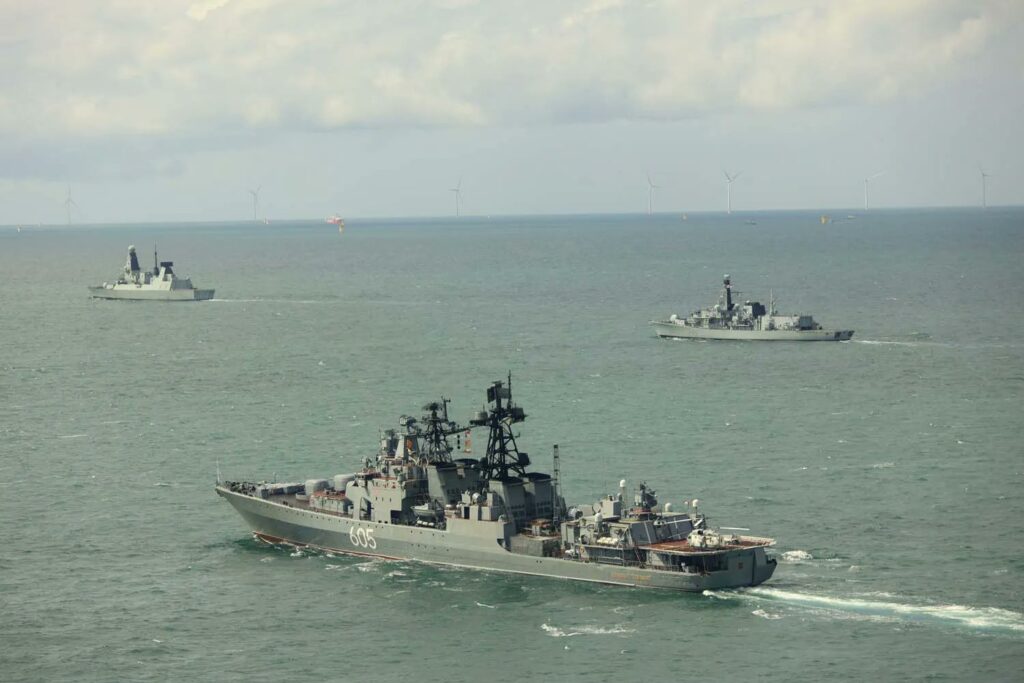
Image: from DefPost X @defpostmedia
Department: Defence & Security
By Open Chronicle with agencies
The Royal Navy deployed several warships to monitor a Russian naval group and sanctioned cargo vessels as they passed through waters near Britain, conducting what officials described as an intensive 72-hour surveillance operation through the North Sea and English Channel.
The British deployment included the Type 45 destroyer HMS Duncan, the Type 23 frigate HMS St Albans and the patrol vessel HMS Severn. Together, they monitored a Russian group centred on the destroyer Admiral Levchenko and accompanied by the sanctioned cargo vessels General Skobelev and Sparta.
The operation formed part of Britain’s increasingly active effort to monitor Russian naval movements and vessels associated with Moscow’s so-called shadow fleet, which Western governments accuse Russia of using to circumvent sanctions imposed following its invasion of Ukraine.
Russian Group Monitored Through the English Channel
Royal Navy surveillance intensified as the Russian vessels approached the Strait of Dover, one of the world’s busiest and strategically most important maritime passages.
According to the information released about the operation, Russia subsequently deployed the frigate Neustrashimy to accompany the group.
British ships continued tracking the vessels for approximately 72 hours as they moved southwest through the English Channel. Surveillance responsibility was eventually transferred to a NATO ally near Ushant, off the western coast of France.
Such handovers are a routine element of NATO maritime monitoring, allowing allied navies to maintain surveillance as Russian vessels move through different areas of responsibility.
Britain’s Concern Over Russia’s Shadow Fleet
The operation also highlights growing Western concern surrounding Russia’s shadow fleet.
The term generally refers to vessels used to transport Russian commodities, particularly oil, through networks intended to reduce exposure to Western sanctions and restrictions.
Many of these ships are older vessels operating through complex ownership, registration and insurance arrangements. European governments have increasingly argued that the fleet represents not only a sanctions enforcement challenge but also a potential environmental and maritime security risk.
First Sea Lord General Sir Gwyn Jenkins warned that there was “no room for complacency” when dealing with such vessels.
He argued that sustained monitoring by Britain and its allies was forcing Moscow to divert military assets to protect shipping connected to its sanctions circumvention network.
The deployment of the Neustrashimy alongside the group appears to reinforce British assessments that Russia is prepared to dedicate naval resources to protecting strategically important maritime movements.
Russian Naval Activity Around Britain Increasing
The latest operation comes amid a broader increase in Russian naval activity around British waters.
According to Royal Navy figures cited in reports, monitoring operations involving Russian vessels increased by approximately 25 percent in July compared with the same period a year earlier.
British forces spent 21 days monitoring Russian maritime activity during July alone, with Russian military and associated vessels making repeated passages through the North Sea and Dover Strait.
The trend has placed additional emphasis on maritime surveillance as NATO governments monitor Russian military movements across Europe’s northern and Atlantic approaches.
Britain’s geographic position makes the English Channel particularly important. Russian vessels travelling between northern Russian ports and the Atlantic frequently pass through waters close to the UK, France and other NATO members.
Pressure on Moscow’s Maritime Networks
Britain has also demonstrated a willingness to move beyond surveillance when authorities believe sanctions enforcement or maritime law provides grounds for intervention.
The latest monitoring mission follows the reported seizure of the tanker Smyrtos by Royal Marines in June, an operation described as the first direct British military boarding of a vessel associated with Russia’s shadow fleet.
Western governments have increasingly focused on disrupting maritime networks that they believe generate revenue supporting Russia’s war effort in Ukraine.
The strategy creates an additional challenge for Moscow. If Russian authorities decide that commercial or sanctioned vessels require military escorts, warships that might otherwise perform combat, patrol or training missions must instead be assigned to escort duties.
Operation Comes Amid Heightened UK-Russia Tensions
The naval encounter also occurred during a period of increasingly hostile rhetoric between Moscow and London.
Tensions intensified following British Prime Minister Andy Burnham’s visit to Kyiv and Britain’s announcement that it would provide Ukraine with technical support related to long range Scalp missile capabilities.
Russian officials and commentators have repeatedly warned Western governments against expanding their military assistance to Ukraine.
Former Russian foreign minister Andrei Fedorov also raised the possibility of what he described as “semi military” action against Britain, including potential attacks from unidentified actors against facilities involved in drone production.
Western officials have urged caution when interpreting such statements.
They argue that threatening rhetoric has long been part of Russian military and political strategy and may be intended to influence Western public opinion and discourage governments from providing additional assistance to Ukraine.
Despite the increasingly confrontational language, Western assessments continue to indicate that Moscow is not actively seeking a direct military confrontation with NATO.
Maritime Surveillance Becoming a Larger NATO Mission
The 72 hour operation illustrates how the maritime dimension of tensions between Russia and NATO has expanded beyond conventional warships.
Russian naval movements, sanctioned cargo vessels, energy exports, subsea infrastructure and increasingly complex shipping networks have all become part of the wider security environment surrounding European waters.
For Britain, monitoring Russian movements through the North Sea and English Channel is therefore becoming an increasingly frequent mission.
The presence of HMS Duncan, HMS St Albans and HMS Severn demonstrated the scale of resources London was prepared to deploy for a single Russian transit.
It also reflected the wider NATO approach of maintaining continuous surveillance as Russian vessels move through allied maritime areas.
For the Royal Navy, such operations are increasingly becoming part of the everyday strategic competition surrounding Europe, a contest taking place below the threshold of direct conflict but requiring persistent military presence, intelligence gathering and coordination between NATO members.