
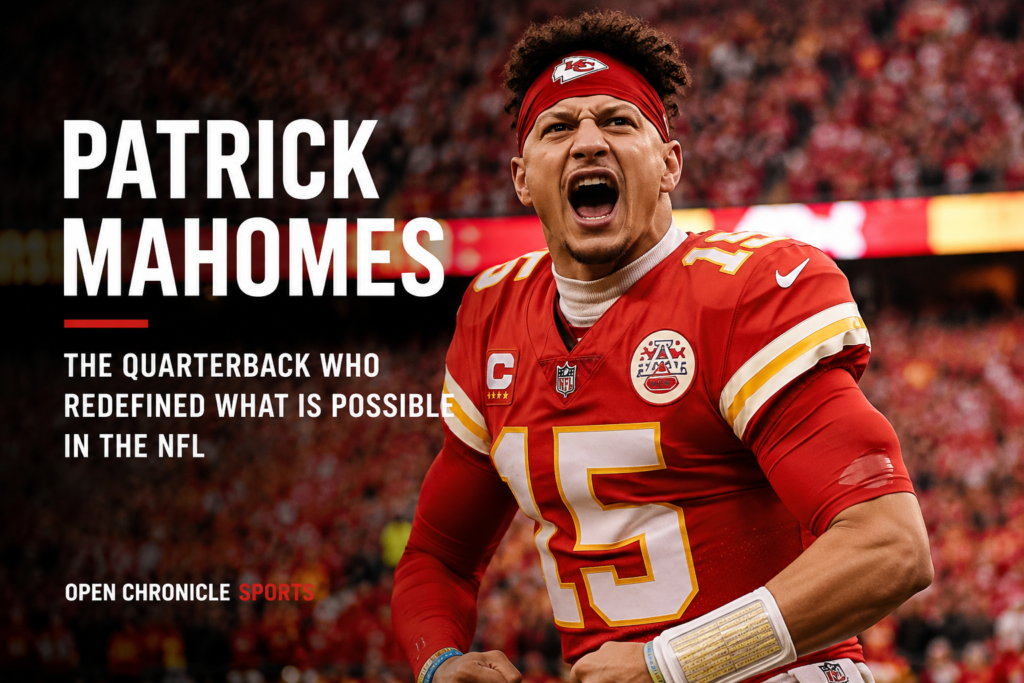
By Open Chronicle Sports
Players to Watch | Kansas City Chiefs | Quarterback
There are quarterbacks who execute an offense, quarterbacks who control games and quarterbacks who define an era.
Patrick Mahomes belongs to the last category.
For much of his career with the Kansas City Chiefs, Mahomes has represented one of the clearest expressions of what makes the National Football League compelling. He combines structure with improvisation, preparation with instinct, extraordinary physical ability with the responsibility that comes with playing the most influential position in American football.
The result has been a quarterback capable not merely of winning games, but of changing expectations about what a quarterback can attempt.
A collapsing pocket does not necessarily mean the end of a play when Mahomes has the football. A defender forcing him away from his preferred throwing position does not necessarily remove the possibility of a completion. A difficult angle can become an opportunity.
That uncertainty is central to the Mahomes experience.
The Quarterback at the Centre of Everything
No position influences an NFL game quite like quarterback.
Before the snap, the quarterback must understand the defensive alignment, identify pressure, communicate protections and recognise where the most favourable matchup may exist.
After the snap, all of that information begins changing.
Defenders disguise coverages. Pass rushers attack protection schemes. Receivers adjust routes. The pocket contracts. Decisions that looked obvious a second earlier suddenly disappear.
Mahomes has become exceptional at operating within that chaos.
His arm strength attracts attention, but his ability to process what is happening around him is equally important. The spectacular throws are often the conclusion of something more sophisticated: recognition, movement, patience and an understanding of how defenders will react.
This is why watching Mahomes provides such a useful introduction to quarterback play.
The position is not simply about throwing the football.
It is about controlling possibilities.
Creativity Without Abandoning Structure
Mahomes entered the NFL with physical abilities that immediately separated him from conventional quarterback archetypes.
He could throw from unusual arm angles. He could release the football while moving in either direction. He possessed enough arm strength to attack almost every area of the field.
Then came the improvisation.
Sidearm passes, off-platform throws, sudden changes of direction and seemingly impossible completions became familiar parts of Kansas City’s offense.
But describing Mahomes merely as an improviser misses an important part of his development.
The greatest transformation in his career has been learning when not to improvise.
NFL defenses adapted. Opponents increasingly attempted to remove explosive plays, force Kansas City to construct longer drives and make Mahomes repeatedly accept shorter completions.
Mahomes adapted in return.
The spectacular remained available, but patience became another weapon.
That evolution helped turn extraordinary talent into sustained elite quarterback play.
The Andy Reid Partnership
Mahomes’ career cannot be separated from Andy Reid.
The Kansas City head coach has spent decades developing offensive concepts, and Mahomes provided him with a quarterback capable of expanding the boundaries of those ideas.
Their partnership became one of the defining coach-quarterback combinations of the modern NFL.
Motion, formations, misdirection and creative route combinations can create advantages before the football is snapped. Mahomes then has the freedom and ability to exploit what develops afterwards.
At its best, the Kansas City offense has therefore operated on two levels.
Reid creates the puzzle.
Mahomes solves it.
And when the original solution disappears, Mahomes frequently invents another one.
When the Play Breaks Down
Some quarterbacks are most comfortable when everything happens exactly as designed.
Mahomes can be most dangerous when it does not.
A broken pocket can force defenders to abandon their assignments. A scramble can extend a play long enough for a receiver to uncover. A defender moving toward Mahomes can create space somewhere else.
Few quarterbacks have been better at exploiting those moments.
Mahomes possesses an unusual ability to keep his eyes downfield while escaping pressure. Instead of immediately becoming a runner, he continues searching for a passing opportunity.
That creates one of the most difficult situations for a defense.
Should a defender continue covering the receiver, or attack the quarterback?
Mahomes often needs only a fraction of a second of hesitation.
That is enough.
The Championship Standard
Creativity made Mahomes famous.
Winning transformed him into a defining figure of his generation.
He has already won three Super Bowls with Kansas City and was named Super Bowl MVP in each of those victories. He has also twice been named the NFL’s Most Valuable Player.
The numbers demonstrate the scale of his career.
Through the end of the 2025 regular season, Mahomes had accumulated 35,939 passing yards and 267 passing touchdowns across 126 regular-season games.
Yet statistics alone do not fully explain his importance.
Championship football creates a different form of pressure.
Possessions become more valuable. Defenses become more sophisticated. Mistakes become harder to recover from.
Mahomes has repeatedly demonstrated the ability to remain aggressive without allowing pressure to dictate his decisions.
Super Bowl LVIII provided one of the clearest examples. Against San Francisco, Mahomes finished with 333 passing yards and also led Kansas City with 66 rushing yards. The final possession ended with his touchdown pass to Mecole Hardman in overtime, securing another championship.
Those are the moments that have shaped his reputation.
When the game becomes smaller, the pressure becomes greater and the number of available opportunities decreases, Mahomes continues to believe another play exists.
Leadership Beyond the Highlights
The quarterback occupies a unique position inside an NFL organisation.
He must communicate with coaches, offensive linemen, running backs, receivers and tight ends. He must understand the offensive system while also recognising how opponents intend to attack it.
And because the quarterback touches the football on virtually every offensive play, his behaviour inevitably influences the team.
Mahomes’ leadership has increasingly become part of his identity.
The spectacular throws may dominate highlight packages, but championship teams also require resilience.
Drives fail.
Interceptions happen.
Protection breaks down.
Games move against you.
Elite quarterbacks cannot allow the previous possession to control the next one.
Mahomes’ career has repeatedly demonstrated that capacity to reset.
It is one of the less visible qualities that separates great quarterbacking from great throwing.
The 2026 Question
That resilience gives the 2026 season a particularly significant dimension.
Mahomes’ 2025 campaign ended after 14 games following a serious left knee injury. Before the injury, he had thrown for 3,587 yards and 22 touchdowns while adding 422 rushing yards and five rushing touchdowns.
Kansas City also missed the postseason, ending an extraordinary sequence of playoff appearances during the Mahomes era.
The new season therefore presents something different.
It is a comeback.
Mahomes has spent the offseason recovering from ACL and LCL injuries, and the progress during training camp has been encouraging. Kansas City reported that he returned to 11-on-11 work in late July, while subsequent practices showed him moving, changing direction and producing the improvised throws that have characterised his career.
Earlier in August, Mahomes said his knee felt strong enough that there were moments when he effectively stopped thinking about it while playing. The objective remains returning for the beginning of the regular season.
That makes Mahomes one of the most compelling players to watch in the entire 2026 NFL season.
The question is no longer simply whether he can produce another spectacular year.
It is whether one of the defining quarterbacks of his generation can return from significant injury and begin another chapter of the Kansas City era.
What to Watch
When watching Patrick Mahomes in 2026, do not focus only on touchdown passes.
Watch his feet when pressure arrives.
Watch where his eyes move before the snap.
Watch how he manipulates defenders by looking in one direction before throwing somewhere else.
Watch how long he keeps a passing play alive before deciding to run.
Watch the difference between the plays where he accepts the simple completion and those rare moments when he decides that the impossible throw is actually possible.
And, particularly early in the season, watch his movement.
The ability to plant, accelerate, escape pressure and throw while moving will provide some of the clearest indications of how completely Mahomes has recovered.
Why Mahomes Represents the NFL
Patrick Mahomes is an appropriate starting point for Open Chronicle’s Players to Watch because his game contains so many of the elements that make the NFL distinctive.
Strategy and improvisation.
Physical talent and intellectual preparation.
Individual brilliance operating inside an extraordinarily complex team structure.
Risk and discipline.
Pressure and resilience.
And above everything else, competition.
Mahomes has already accumulated the championships, individual awards and signature moments required to define an exceptional career.
But that is precisely what makes 2026 interesting.
His story is no longer about proving that he can become great.
That question has been answered.
The next question is what greatness looks like when a quarterback who has spent years setting the standard is forced to rebuild, adapt and pursue the summit again.
For Patrick Mahomes, the next play has always seemed possible.
The 2026 season will test that belief once more.