
By Open Chronicle History Desk
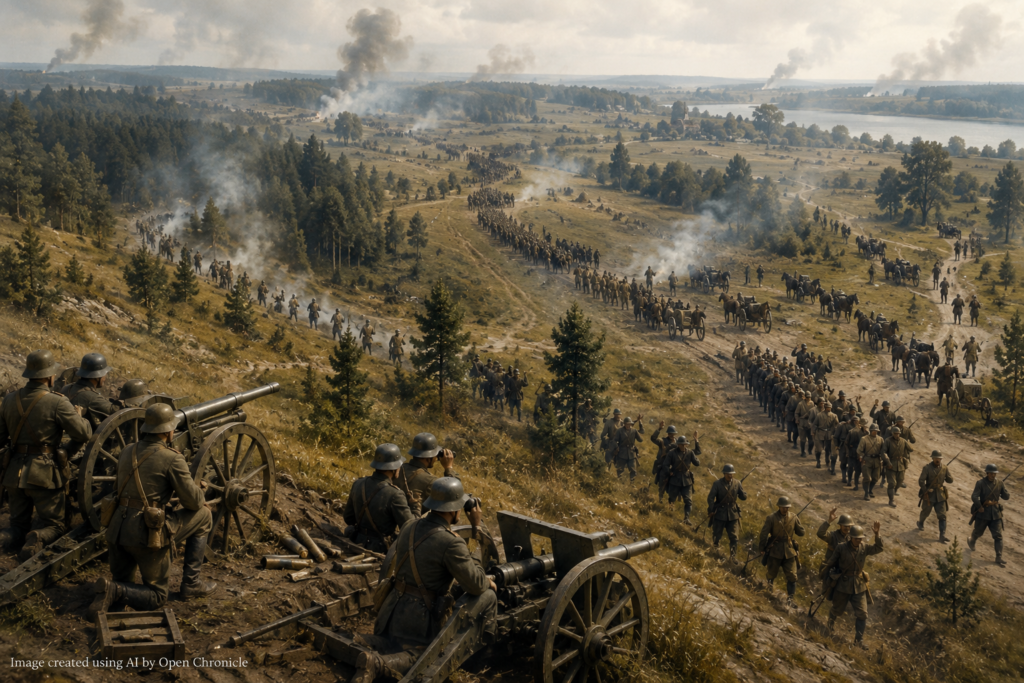
On August 30, 1914, one of the most dramatic battles of the opening weeks of the First World War reached its devastating conclusion in East Prussia.
The Russian Second Army, commanded by General Alexander Samsonov, had invaded German territory as part of a massive offensive intended to relieve pressure on France in the west.
Instead, it walked into catastrophe.
German forces surrounded large portions of Samsonov’s army near Tannenberg. Russian formations became separated from one another, communications broke down and retreat routes disappeared.
Thousands were killed or wounded.
Tens of thousands surrendered.
The Second Army effectively ceased to exist as an organised fighting force.
Samsonov, unable to face the scale of the disaster, disappeared into the darkness during the retreat and took his own life.
For Germany, the victory became legendary.
Generals Paul von Hindenburg and Erich Ludendorff emerged as national heroes. The battle appeared to demonstrate the superiority of German command, mobility and operational planning.
Yet the reality was more complicated.
Tannenberg was not simply the story of German brilliance defeating overwhelming Russian numbers.
It was also a story of intercepted radio messages, railway networks, exhausted soldiers, command rivalries, logistical failure and extraordinary risk.
And behind the triumph lay a strategic paradox.
Germany destroyed a Russian army in the east.
But Russia’s invasion had already helped force Germany to divert attention and troops from the campaign against France.
The Battle of Tannenberg was therefore both a spectacular German victory and part of the larger strategic struggle that prevented the First World War from unfolding according to Germany’s original expectations.
Europe Goes to War
The crisis began far from East Prussia.
On June 28, 1914, Archduke Franz Ferdinand, heir to the Austro Hungarian throne, was assassinated in Sarajevo by Bosnian Serb nationalist Gavrilo Princip.
The assassination triggered the July Crisis.
Austria Hungary blamed Serbia.
Germany supported Austria Hungary.
Russia backed Serbia.
France was allied with Russia.
Germany feared encirclement by France and Russia.
Diplomatic manoeuvring rapidly became military mobilisation.
Austria Hungary declared war on Serbia on July 28.
Russia mobilised.
Germany declared war on Russia on August 1 and France on August 3.
German forces invaded Belgium.
Britain entered the war on August 4.
Within days, a Balkan crisis had become a European war.
Germany’s Strategic Problem
German military planners had long feared fighting France and Russia simultaneously.
Geography created the fundamental problem.
France stood to the west.
The enormous Russian Empire stood to the east.
Germany lay between them.
A prolonged two front war threatened to stretch German military resources beyond their limits.
German planners therefore sought a way to defeat one enemy before concentrating against the other.
The solution became associated with Alfred von Schlieffen, former Chief of the German General Staff.
Germany would concentrate the majority of its forces in the west.
France would be defeated rapidly.
Then German armies could move east against Russia.
The plan depended upon time.
The Assumption About Russia
German planning rested partly upon the belief that Russia would mobilise relatively slowly.
The Russian Empire possessed enormous manpower.
But its vast geography and less developed transportation infrastructure complicated mobilisation.
German planners expected several weeks before Russia could launch a major offensive.
That interval was supposed to allow Germany to defeat France.
The Russians moved faster than expected.
Even before mobilisation was fully complete, Russian armies advanced into East Prussia.
The German timetable was suddenly under pressure.
East Prussia
East Prussia occupied a vulnerable position.
The province projected eastward from the main body of Germany.
To its south and east lay territories of the Russian Empire.
The region contained forests, lakes and difficult terrain.
The Masurian Lakes created natural barriers that divided possible routes of advance.
Germany could not defend every frontier equally.
Most German forces were committed to the western campaign.
Only the Eighth Army defended East Prussia.
Its task was difficult.
It faced potentially much larger Russian forces.
But geography offered opportunities.
If the Russians advanced in separate groups around the Masurian Lakes, Germany might be able to concentrate against one army before the other could intervene.
That possibility would become the key to Tannenberg.
The Russian Plan
Russia planned to invade East Prussia with two armies.
The First Army, commanded by General Paul von Rennenkampf, would advance from the east.
The Second Army, under General Alexander Samsonov, would advance from the south.
Together they were intended to trap the German Eighth Army.
On paper, the concept was dangerous for Germany.
If both Russian armies coordinated effectively, German forces could find themselves caught between them.
But coordination would prove extraordinarily difficult.
The Russian armies were separated geographically.
Communications were poor.
Command relationships were strained.
And their commanders had a troubled history.
Rennenkampf and Samsonov
Paul von Rennenkampf and Alexander Samsonov were experienced officers.
Both had served during the Russo Japanese War.
Later accounts frequently emphasised a personal hostility between them supposedly dating from that conflict.
Some popular versions describe an actual physical confrontation between the two officers.
The evidence for the most dramatic versions is uncertain.
What matters operationally is clearer.
The two Russian armies did not cooperate effectively during the East Prussian campaign.
Their movements became increasingly separated.
That gap gave the Germans an opportunity.
The First Russian Blow
The campaign initially went badly for Germany.
On August 20, Russian and German forces fought at Gumbinnen.
The German Eighth Army attacked Rennenkampf’s First Army.
The result was a German setback.
Russian forces resisted effectively, and German formations suffered significant casualties.
The commander of the Eighth Army, General Maximilian von Prittwitz, became deeply concerned.
With Samsonov advancing from the south and Rennenkampf remaining to the east, he feared encirclement.
Prittwitz considered retreating behind the Vistula.
For the German High Command, abandoning much of East Prussia was politically and strategically unacceptable.
A change of leadership followed.
Hindenburg Returns
Germany turned to a retired general.
Paul von Hindenburg was 66 years old.
He had retired from active service in 1911.
Now he was recalled.
Hindenburg was appointed commander of the Eighth Army.
He would soon become one of the most famous Germans of the twentieth century.
But he did not arrive alone.
His new chief of staff would play an equally important operational role.
Erich Ludendorff
Erich Ludendorff had already distinguished himself during the opening days of the war.
During the German assault on Liège in Belgium, Ludendorff had demonstrated exceptional energy and personal courage.
He was sent east to serve as Hindenburg’s chief of staff.
The partnership became one of the most important military relationships of the First World War.
Hindenburg projected calm authority.
Ludendorff brought enormous energy, ambition and operational intensity.
Together they would eventually rise far beyond command of the Eighth Army.
But another officer had already helped shape the plan that awaited them.
Max Hoffmann
Lieutenant Colonel Max Hoffmann, an operations officer on the Eighth Army staff, possessed detailed knowledge of the Russian army.
Hoffmann understood the geography of East Prussia and recognised the weakness created by the separation between Rennenkampf and Samsonov.
The basic German response was already developing before Hindenburg and Ludendorff arrived.
German forces would disengage from the First Army and concentrate against Samsonov.
It was an audacious decision.
If Rennenkampf advanced rapidly, the Germans could themselves be trapped.
Success depended on understanding what the Russians were doing.
German intelligence was about to receive extraordinary assistance.
The Russians Transmit in the Clear
Russian communications became one of the most famous elements of the campaign.
Radio technology was still relatively new.
Russian units did not always possess sufficient cryptographic capability or properly distributed codes.
As a result, some important operational messages were transmitted without effective encryption.
German wireless stations intercepted them.
The Germans gained valuable information about Russian movements, intentions and dispositions.
This did not mean they possessed perfect knowledge.
War remained confused.
Reports could be inaccurate.
Movements changed.
But the intercepted messages substantially reduced uncertainty.
The Germans could take risks that might otherwise have seemed reckless.
Samsonov Advances
Samsonov’s Second Army marched northward into East Prussia.
The advance was exhausting.
Russian supply arrangements struggled to keep pace.
The railway system created additional problems.
Russian railways used a different gauge from German lines, making it difficult to exploit captured railway infrastructure directly.
Soldiers marched long distances.
Food supplies became irregular.
Communication between headquarters and units was difficult.
The army continued advancing, but its formations became increasingly dispersed.
Samsonov believed the Germans were withdrawing.
In reality, they were concentrating against him.
Railways as Weapons
Germany possessed one enormous advantage.
Railways.
The dense East Prussian railway network allowed German forces to move rapidly from one part of the battlefield to another.
Units facing Rennenkampf could be transferred south against Samsonov.
Trains became instruments of operational manoeuvre.
This was one of the defining characteristics of industrial warfare.
Armies still marched on foot.
But railways determined how quickly large formations could be repositioned across strategic distances.
At Tannenberg, Germany used its internal transportation network with devastating effectiveness.
François and the German Right
General Hermann von François, commander of the German I Corps, played a crucial role.
François was aggressive and independent.
At several moments he resisted orders he believed premature.
His corps was positioned to strike the Russian left flank.
Ludendorff wanted rapid action.
François insisted that his artillery and ammunition needed to arrive before launching the attack.
His refusal created tension.
Yet when I Corps finally attacked, its artillery preparation and concentrated strength contributed significantly to the German success.
Tannenberg was not a perfectly coordinated operation.
German commanders argued.
Orders were questioned.
Timing remained uncertain.
Victory emerged from a battle that could easily have developed differently.
August 26
Major fighting began on August 26.
Russian forces encountered increasingly strong German resistance.
Near Seeburg, Bischofstein, Orlau and Frankenau, engagements developed across a wide battlefield.
The German plan was gradually becoming visible.
Pressure would hold the Russian centre.
German forces on the flanks would move inward.
If successful, Samsonov’s army would be enveloped.
But the danger remained considerable.
Rennenkampf’s First Army still existed to the northeast.
If it moved quickly toward the battle, German forces concentrating against Samsonov could face disaster.
Where Was Rennenkampf?
This question haunted German headquarters.
How quickly could the Russian First Army intervene?
Intercepted communications suggested Rennenkampf was not immediately moving to Samsonov’s assistance.
German commanders increasingly trusted that information.
The First Army had suffered losses at Gumbinnen and required reorganisation.
Rennenkampf also believed German forces were retreating westward.
His advance was cautious.
The distance between the two Russian armies widened.
Every hour mattered.
Germany used those hours to tighten the trap around Samsonov.
August 27
On August 27, the battle intensified.
François’s I Corps attacked the Russian left around Usdau.
German artillery inflicted severe damage.
Russian formations began falling back.
Meanwhile, German XVII Corps and I Reserve Corps pressured the Russian right.
The Russian Second Army was being compressed.
Samsonov did not initially understand the full danger.
Reports were delayed.
Communications were unreliable.
Headquarters struggled to maintain an accurate picture of the battlefield.
Some Russian formations continued advancing even as others retreated.
The army was losing coherence.
The Russian Centre Pushes Forward
The tragedy of Samsonov’s position was that parts of his centre continued pushing toward what they believed was a retreating enemy.
Russian XV Corps and XIII Corps advanced deeper into the German operational pocket.
Their local successes only increased their danger.
They were moving farther from supply lines and farther from supporting formations.
German forces were closing behind them.
What appeared tactically like continued pressure against the enemy was becoming strategic encirclement.
The battlefield had become a trap.
August 28
By August 28, Samsonov increasingly recognised the seriousness of the situation.
His flanks were collapsing.
Communications with neighbouring armies remained inadequate.
German forces were threatening routes to the south.
Samsonov attempted to regain control personally.
He left his headquarters and moved closer to the fighting.
That decision would further complicate communications.
A commander of a vast field army needed information.
Instead, Samsonov entered the confusion of retreating formations and broken communication lines.
His army was beginning to disintegrate around him.
The Encirclement
German forces continued advancing around the Russian Second Army.
François moved eastward across the Russian rear.
Other German formations pressed from the north and northeast.
The routes of retreat narrowed.
Russian units attempted to escape through forests and difficult terrain.
Some formations fought desperately.
Others became separated.
Ammunition ran low.
Food was scarce.
Exhausted soldiers wandered through unfamiliar countryside.
The Russian command system could no longer coordinate an organised withdrawal.
Tens of thousands of men were being enclosed.
August 29
The encirclement became increasingly complete on August 29.
Large elements of the Russian XIII and XV Corps were trapped.
German artillery controlled key routes.
Russian units attempting to break out encountered organised German positions.
Some groups escaped.
Many could not.
The scale of the catastrophe became clear.
Samsonov moved through the forest with members of his staff.
He understood that his army had been destroyed.
According to accounts from those around him, he was overwhelmed by the consequences.
He reportedly expressed anguish over facing Tsar Nicholas II after such a defeat.
During the night, he separated from the group.
A gunshot was heard.
Samsonov’s Death
Alexander Samsonov had taken his own life.
His body was later found by German forces.
The death became one of the most dramatic symbols of the battle.
Samsonov had entered East Prussia commanding an army expected to help crush the German defenders.
Days later, much of that army had disappeared and its commander was dead.
Yet placing all responsibility upon Samsonov would be misleading.
The disaster resulted from systemic failures.
Poor coordination between armies.
Inadequate communications.
Logistical problems.
Operational overextension.
Faulty assumptions.
Weak intelligence security.
Command confusion.
Samsonov became the human face of a much larger institutional catastrophe.
August 30
By August 30, organised resistance inside the encirclement was collapsing.
Large groups of Russian soldiers surrendered.
German forces collected enormous numbers of prisoners.
Weapons, artillery and equipment were abandoned or captured.
The Russian Second Army had effectively been destroyed as an operational force.
German estimates and later historical accounts vary regarding exact casualties.
Broadly, the Russians suffered tens of thousands killed and wounded, while approximately 90,000 soldiers were taken prisoner.
Only a fraction of the army escaped the encirclement in organised formations.
German losses were far smaller, though still significant.
The disparity turned Tannenberg into one of the most spectacular victories of the war.
Why Call It Tannenberg?
The principal fighting did not occur directly at the medieval village of Tannenberg.
The name was chosen deliberately.
In 1410, the Teutonic Order had suffered a catastrophic defeat against Polish and Lithuanian forces at the Battle of Grunwald, known in German tradition as the Battle of Tannenberg.
More than five centuries later, German leaders presented the 1914 victory as symbolic revenge.
The historical connection was artificial.
The Russian Empire of 1914 was not the Polish Lithuanian army of 1410.
But national mythology rarely requires precise continuity.
The name gave the victory deeper emotional resonance.
Germany had supposedly avenged a medieval defeat.
Hindenburg Becomes a Hero
The German public needed heroes.
Hindenburg became one almost immediately.
His age, appearance and calm demeanour helped create an image of paternal military authority.
Propaganda transformed him into the embodiment of German strength.
Tannenberg became inseparable from his name.
Monuments, postcards and newspapers celebrated the victory.
Hindenburg’s reputation would continue growing.
By 1916, he would become Chief of the German General Staff.
After the war, he entered politics.
In 1925, he became President of Germany.
His historical path would eventually intersect catastrophically with the rise of Adolf Hitler.
The road from Tannenberg extended far beyond the battlefield.
Ludendorff Rises With Him
Ludendorff also emerged from the battle with enormous prestige.
His operational reputation soared.
He and Hindenburg continued working together on the Eastern Front.
By 1916, they effectively dominated Germany’s military leadership.
Their influence extended increasingly into politics and economic mobilisation.
Germany moved toward what some historians have described as a form of military dictatorship during the final years of the war.
Ludendorff would later play a controversial role in postwar German politics and promote myths that helped undermine the Weimar Republic.
The victory of 1914 elevated men whose influence would shape German history for decades.
Hoffmann and the Myth of Command
Max Hoffmann later resented the enormous credit given to Hindenburg and Ludendorff.
He believed his own operational contribution had been underappreciated.
The dispute illustrates a broader problem in military history.
Victories are often attributed to famous commanders.
Real battles are created by staffs, intelligence officers, railway planners, artillery commanders, junior officers and ordinary soldiers.
Tannenberg became the triumph of Hindenburg.
The reality involved many people.
Even German success depended partly upon Russian decisions that German commanders could not control.
Was Tannenberg a Masterpiece?
The battle is frequently described as a masterpiece of encirclement.
There is good reason.
Germany concentrated inferior overall forces against one portion of a larger enemy.
Railways enabled rapid movement.
Intelligence provided critical information.
German corps struck Samsonov’s flanks.
The Russian centre was allowed to advance into an increasingly dangerous position.
The final encirclement destroyed much of an army.
But hindsight can make the operation appear more controlled than it was.
German commanders experienced moments of uncertainty.
Orders were disputed.
The possibility of Rennenkampf intervening remained frightening.
Had Russian coordination been better, the German concentration might have become dangerous.
Tannenberg combined skill with risk.
Russian Communications
The use of uncoded radio transmissions became one of the classic lessons of Tannenberg.
The Germans repeatedly intercepted Russian messages.
This intelligence helped reveal marching directions and operational intentions.
The episode became an early demonstration of the importance of signals intelligence in modern warfare.
Future conflicts would make interception, cryptography and electronic intelligence central components of military operations.
Tannenberg occurred at the beginning of that transformation.
The battlefield was no longer defined only by what soldiers could see.
Invisible information travelling through the electromagnetic spectrum could decide campaigns.
Logistics Defeats Numbers
Russia possessed greater manpower.
But manpower alone did not determine battlefield power.
An army needed food.
Ammunition.
Artillery shells.
Horses.
Medical support.
Reliable communications.
Railways.
Staff organisation.
The Second Army’s rapid advance placed severe strain on its logistics.
Soldiers became exhausted.
Supply columns struggled.
Captured German railway lines could not immediately solve the problem because of different rail gauges.
German forces operated closer to established supply infrastructure.
Tannenberg demonstrated one of the central truths of industrial warfare.
An army’s strength was not simply the number of soldiers it possessed.
It was the number it could move, feed, supply and command effectively.
The Battle Was Not the End
The destruction of the Second Army did not eliminate the Russian threat to East Prussia.
Rennenkampf’s First Army remained in the field.
The Germans turned against it.
In September, the First Battle of the Masurian Lakes forced Russian forces back toward the frontier.
East Prussia was largely cleared of the immediate invasion.
Germany had survived the first great Russian offensive.
The victories created an impression of German dominance in the east.
But Russia was far from defeated.
Its enormous reserves allowed it to replace losses that would have destroyed a smaller power.
The Eastern Front continued.
The Russian Steamroller
Before the war, Europeans frequently spoke of the Russian steamroller.
Russia’s population appeared to provide almost limitless manpower.
German strategists feared that once fully mobilised, Russian armies could overwhelm Central Europe.
Tannenberg temporarily shattered that image.
The Russian army appeared clumsy, badly led and technologically inferior.
But this perception was also misleading.
Russian forces achieved major successes against Austria Hungary during the same period.
The Russian military contained serious weaknesses, but it remained capable of inflicting enormous damage.
The Eastern Front would become a vast war of movement, retreat, offensive and counteroffensive.
Austria Hungary’s Crisis
While Germany celebrated Tannenberg, its principal ally was experiencing severe difficulties.
Austria Hungary launched offensives against both Serbia and Russia.
Its armies suffered major defeats.
In Galicia, Russian forces achieved significant victories and captured large territories.
The Austro Hungarian military required increasing German support.
This created another strategic burden for Berlin.
Germany could defeat Russian armies tactically.
But it could not ignore the weakness of its ally.
The Eastern Front increasingly demanded resources Germany had hoped to concentrate elsewhere.
The Western Front
This brings us to the great paradox of Tannenberg.
Germany won spectacularly in East Prussia.
But Russia’s decision to invade early had already influenced the wider war.
German commanders were deeply concerned about the eastern threat.
Units were transferred from the Western Front toward the east during the critical opening campaign.
The exact significance of those transfers in determining the outcome in France remains debated.
They were only one element among many.
But Germany’s strategic problem was clear.
The war could not be separated into perfectly isolated stages.
Russia was fighting before France had been defeated.
The two front war Germany feared had already arrived.
The Marne
Only days after Tannenberg, German and Allied armies fought the First Battle of the Marne in France.
The German advance toward Paris was halted.
The French and British counterattack forced German forces to retreat.
The Schlieffen based strategy of rapidly defeating France had failed.
Soon, trench systems stretched across the Western Front.
Germany now faced precisely the situation its prewar planning had sought to avoid.
A prolonged war against major enemies in both east and west.
Tannenberg was therefore an operational triumph inside a deteriorating strategic situation.
France and Russia
The Russian offensive also demonstrated the importance of alliance warfare.
France had long feared facing Germany alone.
The Franco Russian alliance was designed partly to force Germany to divide its forces.
In August 1914, Russia attacked before its mobilisation and logistical preparations were complete.
That decision contributed to disaster at Tannenberg.
But it also placed pressure on Germany at a moment when France desperately needed relief.
The Russians paid an enormous price.
Their sacrifice formed part of the interconnected nature of coalition warfare.
One front could influence another thousands of kilometres away.
The Human Cost
Strategic maps can make Tannenberg appear elegant.
Arrows move around enemy flanks.
Railways shift corps.
A pocket closes.
An army disappears.
For the soldiers inside that pocket, there was nothing elegant about it.
Men marched for days with insufficient food.
Artillery shells exploded among columns.
Units became separated.
Officers lost contact with headquarters.
Wounded soldiers were abandoned during retreats.
Thousands wandered through forests attempting to escape.
Many surrendered from exhaustion.
Others died without their families ever knowing precisely where.
The destruction of an army meant the destruction of tens of thousands of individual lives and futures.
Russian Prisoners
Approximately 90,000 Russian soldiers were captured.
The logistical challenge of handling such numbers was enormous.
Columns of prisoners moved away from the battlefield.
For Germany, the images provided extraordinary propaganda.
They appeared to confirm the scale of victory.
For the prisoners, captivity could last years.
The First World War produced millions of prisoners across its many fronts.
Their experiences varied enormously.
Disease, hunger, forced labour and isolation became part of the wartime experience.
Tannenberg added an immense population to that hidden history of captivity.
Memory in Germany
The battle became a foundational wartime myth.
Hindenburg was celebrated as the saviour of East Prussia.
Tannenberg symbolised national unity and military competence.
After the war, when Germany struggled to understand defeat, the memory became even more politically useful.
The German army had won spectacular victories.
How, then, had Germany lost the war?
Nationalists increasingly blamed civilians, socialists, revolutionaries and Jews through the false stab in the back myth.
Hindenburg himself helped legitimise aspects of this narrative.
The hero of Tannenberg became part of the political mythology that weakened Germany’s first democracy.
The Tannenberg Memorial
In the 1920s, Germany constructed a massive memorial near the battlefield.
The Tannenberg Memorial became a monumental expression of nationalist memory.
After Hindenburg died in 1934, Adolf Hitler’s regime transformed the site further and arranged for Hindenburg to be buried there.
The Nazis appropriated the symbolism of Tannenberg for their own political mythology.
As the Red Army approached East Prussia in 1945, German forces destroyed parts of the memorial to prevent its capture.
The ruins were later dismantled.
A battlefield victory had become architecture, propaganda and eventually rubble.
East Prussia Disappears
The geography that produced Tannenberg would itself be transformed by the next world war.
After Germany’s defeat in 1945, East Prussia ceased to exist as a German province.
Its northern territory became part of the Soviet Union and is today Russia’s Kaliningrad region.
Southern areas became part of Poland.
The German population largely fled or was expelled.
Cities and villages received new names.
Borders moved.
The landscape where Hindenburg became a national hero no longer belonged to Germany.
Few historical examples demonstrate more clearly how temporary apparently permanent geography can be.
Tannenberg and Military Education
The battle remains widely studied in military history.
It offers lessons in operational concentration.
Interior lines.
Intelligence.
Communications.
Logistics.
Command relationships.
Railway mobilisation.
Encirclement.
Risk.
It also warns against simplistic conclusions.
German success was not produced by one brilliant decision.
Russian failure was not produced by one incompetent commander.
Campaigns emerge from interacting systems.
Information.
Terrain.
Technology.
Organisation.
Human judgement.
Chance.
Tannenberg remains valuable precisely because all of these factors were present.
The Myth of Perfect German Efficiency
Later accounts sometimes presented Tannenberg as evidence of flawless German military efficiency.
The actual campaign was much messier.
Prittwitz had contemplated retreat.
François resisted orders.
German commanders worried repeatedly about Rennenkampf.
Information remained incomplete.
The operation evolved rapidly.
What distinguished the German response was not perfection.
It was the ability to exploit opportunities despite uncertainty.
That distinction matters.
Military organisations do not need perfect information.
They need the ability to act effectively with imperfect information.
At Tannenberg, Germany did this better than Russia.
Samsonov Reconsidered
Samsonov has often been remembered primarily as the defeated commander who killed himself.
His story deserves greater nuance.
He faced an extraordinarily difficult assignment.
His army advanced through challenging terrain with inadequate logistical support.
Coordination with Rennenkampf was poor.
Communications failed.
Russian higher command pushed forces forward before mobilisation and supply systems were fully prepared.
Samsonov made serious operational mistakes.
But he inherited structural weaknesses he could not easily solve.
His suicide transformed military defeat into personal tragedy.
The destruction of the Second Army destroyed its commander as well.
Hindenburg’s Long Shadow
Few victories have transformed a commander’s political destiny as dramatically as Tannenberg transformed Hindenburg’s.
Before the battle, he was a retired general recalled during an emergency.
After it, he was a national icon.
During the war, his authority grew.
After the war, his reputation helped carry him to the presidency.
In January 1933, President Hindenburg appointed Adolf Hitler as Chancellor of Germany.
The old field marshal did not create Nazism.
But his decisions during the final years of the Weimar Republic helped open the path to Hitler’s dictatorship.
Thus the political afterlife of Tannenberg reaches unexpectedly into the darkest chapters of twentieth century Europe.
Ludendorff’s Radicalisation
Ludendorff’s postwar trajectory was even more direct.
Unable to accept Germany’s defeat as primarily military and strategic, he became associated with nationalist conspiracy theories.
He participated with Hitler in the failed Beer Hall Putsch of 1923.
Although he later broke politically with Hitler, Ludendorff remained associated with radical nationalist politics.
The brilliant staff officer of Tannenberg became an example of how military prestige could migrate into destructive political mythology.
Victory can create authority far beyond the battlefield.
Why August 30 Matters
On August 30, 1914, the Russian Second Army ceased to exist as an effective fighting formation.
For Germany, the victory seemed almost miraculous.
East Prussia had appeared threatened.
Russian armies had invaded from two directions.
German forces were numerically constrained because the country’s main military effort was taking place in France.
Yet within days the situation had been reversed.
Railways concentrated German corps.
Intercepted radio messages revealed Russian intentions.
Rennenkampf and Samsonov failed to coordinate.
Russian logistics deteriorated.
German attacks struck the Second Army’s exposed flanks.
The trap closed.
Approximately 90,000 Russian soldiers entered captivity.
Samsonov took his own life.
Hindenburg and Ludendorff entered legend.
But Tannenberg should not be remembered only as a perfect encirclement drawn on a military map.
It revealed the nature of the war that Europe had just begun.
Industrial infrastructure mattered as much as courage.
Railways could decide campaigns.
Radio communications could betray armies.
Intelligence could compensate for numerical inferiority.
Logistics could destroy offensives before enemy fire finished the job.
Coalition strategy linked battlefields separated by entire countries.
And operational victory did not necessarily produce strategic success.
Germany destroyed a Russian army.
It did not destroy Russia.
It saved East Prussia.
It did not solve the two front war.
It created national heroes.
Those heroes would later exercise political influence with consequences extending far beyond 1914.
Above all, Tannenberg demonstrated how quickly the optimistic assumptions with which Europe entered the First World War were collapsing.
The Russians believed numerical pressure could overwhelm East Prussia.
The Germans believed France could be defeated before Russia became fully dangerous.
Both assumptions proved wrong.
The war would not be short.
It would not remain controlled.
And the armies destroyed in its opening weeks were only the beginning.