
By Open Chronicle News Desk
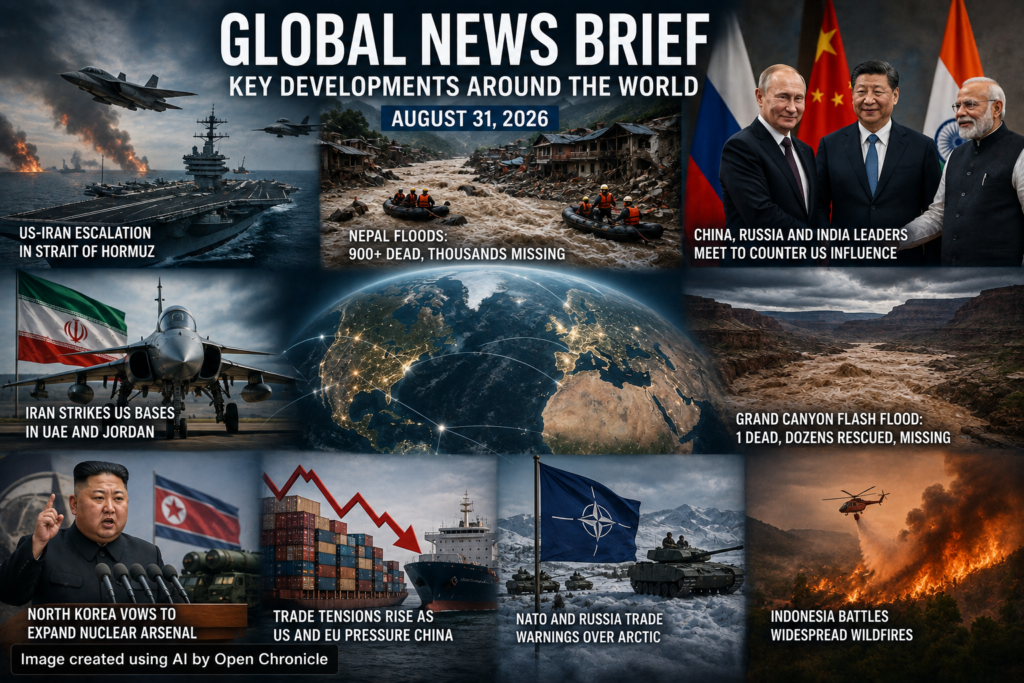
The international agenda on August 31 is dominated by a renewed escalation between the United States and Iran around the Strait of Hormuz, the catastrophic Himalayan floods affecting Nepal and China, and an increasingly complex geopolitical contest involving Washington, Beijing, Moscow and New Delhi.
Elsewhere, a deadly flash flood has triggered a major rescue operation in the Grand Canyon, North Korea has renewed its commitment to expanding its nuclear arsenal, European governments are confronting new security and trade pressures, and developments across the Middle East underline the continuing volatility of the region.
Middle East
US and Iran exchange strikes as tensions return to the Strait of Hormuz
The most consequential international development is the renewed military confrontation between the United States and Iran.
US forces carried out strikes against Iranian military targets around the Strait of Hormuz, including rocket launchers and targets on Larak Island. The attacks marked the first significant direct US military action against Iran in several weeks and immediately prompted retaliation from Tehran.
Iranian forces said they subsequently attacked American positions in the United Arab Emirates and Jordan. Iran’s military also said it targeted a UAE air base used by US forces with explosive drones.
The UAE reported intercepting or neutralising a drone approaching from Iran over its territorial waters. At the same time, the UAE Defense Ministry denied reports that Al Minhad Air Base had been successfully struck.
Jordan reported another dimension of the confrontation, saying its forces had intercepted eight missiles that entered the kingdom’s airspace.
The escalation comes amid continuing uncertainty over navigation through the Strait of Hormuz, one of the world’s most strategically important energy corridors.
Reports indicated that an oil tanker caught fire after striking two sea mines in the strait. Iran’s Islamic Revolutionary Guard Corps said the vessel had hit two mines, while maritime traffic through the waterway has reportedly fallen sharply.
The competing military claims remain difficult to independently verify, but the latest exchange demonstrates how rapidly incidents around Hormuz can broaden into a regional confrontation involving American forces and neighbouring states.
President Donald Trump, meanwhile, reiterated that Iran would not be permitted to acquire nuclear weapons.
Security concerns intensify across Israel and the Palestinian territories
Israeli authorities reportedly ordered the seizure of Palestinian land to expand a military site in the occupied West Bank, adding another source of tension in the territory.
Separately, reports indicated that the eldest son of Israeli Prime Minister Benjamin Netanyahu was urgently evacuated because of a security threat.
Former Israeli prime minister Ehud Olmert also weighed into the increasingly contentious international debate surrounding Israel, arguing that perceptions of the country among American university students have deteriorated sharply.
South Asia and the Himalayas
Nepal flood disaster deepens as death toll passes 900
The Himalayan flood catastrophe remains one of the world’s largest ongoing humanitarian emergencies.
Multiple reports put the death toll in Nepal at more than 900, while thousands of people remain unaccounted for across areas of Nepal and neighbouring China following the devastating floods triggered by a massive glacial collapse.
Rescue operations have entered a particularly difficult phase as teams attempt to reach isolated communities and hundreds of workers trapped around hydropower installations.
Reports indicate that more than 900 workers have been trapped at hydropower projects, with rescue teams attempting to reach people inside tunnels and other damaged infrastructure.
The international dimension of the disaster is also becoming clearer. Around 85 Americans remain unaccounted for, according to the US State Department, while reports say 15 British citizens are among hundreds of foreign nationals missing in China.
Another emerging issue concerns disaster preparedness. Reports indicate that Nepal requested early warning information from China before the floods struck, raising questions about cross-border monitoring and the exchange of hydrological and glacial data.
Rescue operations are being further complicated by misinformation. AI-generated images and false reports circulating online are reportedly making it harder for authorities and families to distinguish verified information from fabricated material.
India, China and Russia converge on Kyrgyzstan
Indian Prime Minister Narendra Modi has arrived in Kyrgyzstan for a major regional summit, where meetings involving Chinese President Xi Jinping and Russian President Vladimir Putin are drawing considerable attention.
The gathering comes at a moment when China, Russia and India are seeking greater influence over the evolving international order.
Although the three powers have substantial differences of their own, their presence at the summit illustrates the growing importance of institutions outside the traditional Western-led diplomatic architecture.
A Modi-Putin meeting is expected to attract particular attention, while Beijing is promoting closer cooperation between China and neighbouring states.
East Asia
North Korea vows to continue expanding nuclear arsenal
North Korea has again declared that its nuclear weapons programme will continue to grow, arguing that US policy toward Pyongyang remains fundamentally hostile.
The statement followed renewed criticism of military cooperation between the United States, South Korea and Japan. Pyongyang described trilateral naval exercises involving the three countries as a threat to its security.
The declarations suggest little prospect of an immediate return to nuclear negotiations and reinforce concerns about the continuing expansion of North Korea’s strategic capabilities.
China faces renewed Western pressure over trade
Trade tensions between China and Western economies are also rising.
European Commissioner Wopke Hoekstra accused China of failing to play by established international trade rules, while US Treasury Secretary Scott Bessent reportedly argued that G20 economies should consider additional trade barriers against Beijing.
Bessent pointed to China’s enormous trade surplus as evidence of structural imbalances requiring an international response.
At the same time, China’s technology sector continues to attract investors, with artificial intelligence and robotics companies contributing to a new wave of public listings.
Europe
Russia and NATO trade warnings over the Arctic
Russia has accused NATO of creating a direct security threat through increased military activity in the Arctic.
Foreign Minister Sergei Lavrov’s comments come as Arctic security becomes increasingly important because of new shipping routes, natural resources and growing military activity.
Russia simultaneously announced what it described as a new phase in the development of its Arctic infrastructure following the arrival of a Chinese vessel at Murmansk.
Closer Sino-Russian cooperation in the region is likely to receive increasing attention from NATO governments.
Western officials assess potential Russian escalation beyond Ukraine
Reports citing Western assessments have raised renewed concerns about possible Russian actions against NATO countries, particularly through hybrid operations rather than conventional invasion.
Analysts nevertheless say there are currently no clear indications that Russia is preparing an imminent military invasion of the Baltic states.
Western officials have repeatedly warned that cyberattacks, sabotage, disinformation and other forms of pressure could remain important elements of Russian strategy.
France and Sweden strengthen defence relationship
French President Emmanuel Macron is visiting Sweden as the two countries move toward a frigate agreement and a broader strengthening of their strategic partnership.
The discussions reflect the acceleration of European defence cooperation as governments reassess their military capabilities and maritime security requirements.
German regional election could produce historic result
Germany is also watching an upcoming regional election that could potentially result in the country’s first modern far-right state governor.
Such an outcome would represent another significant milestone in the changing political landscape of Europe’s largest economy.
North America
Grand Canyon flash flood triggers major rescue operation
A deadly flash flood in the Grand Canyon has left at least one person dead and several others missing.
Initial reports indicated that around 15 to 20 people could be unaccounted for, while more than 60 people were reportedly evacuated by air as torrents swept debris through affected areas.
Emergency teams are conducting searches across difficult terrain as authorities attempt to establish the full number of missing people.
The rapidly changing casualty figures underline the continuing nature of the operation.
Trump says companies are returning from Canada because of tariffs
President Donald Trump said companies are relocating operations from Canada to the United States to avoid tariffs imposed under his trade policies.
The claim comes as Washington continues using tariffs as a central instrument of its economic strategy.
Trump is also attracting renewed political attention over comments concerning the period beyond the end of his current presidency in 2029.
US trains Polish forces for drone-heavy battlefield
American forces are reportedly training Polish special operations personnel to operate in environments saturated with drones.
Lessons from the war in Ukraine are increasingly influencing NATO training, particularly regarding electronic warfare, reconnaissance drones and the vulnerability of troops and vehicles to inexpensive unmanned systems.
Latin America
Car bomb wounds six outside Mexican police station
Six people were wounded when a car bomb exploded outside a police station in Mexico.
Authorities are investigating the attack, which adds to concerns over the growing tactical sophistication of organised criminal groups operating in parts of the country.
Africa
Egypt rejects using Suez Canal to settle government debt
Egypt has ruled out using the Suez Canal as part of arrangements to settle government debt.
The canal remains one of Egypt’s most strategically important national assets and a major source of foreign currency.
The issue has gained additional significance because instability around the Red Sea and the wider Middle East has disrupted international shipping patterns.
Southeast Asia
Indonesia battles major wildfires
Indonesia is confronting another period of significant wildfire activity, renewing concerns about air pollution, environmental destruction and regional haze.
Authorities continue monitoring affected regions as dry conditions increase the danger of fires spreading across forest and peatland areas.
Central Asia
Erdoğan travels to Kyrgyzstan as regional diplomacy intensifies
Turkish President Recep Tayyip Erdoğan has departed for Kyrgyzstan as the country hosts an important round of international diplomacy.
His visit coincides with the presence of several major Eurasian leaders and highlights Türkiye’s efforts to expand its political and economic influence across Central Asia.
Global Economy and Trade
Trade tensions are increasingly becoming intertwined with geopolitical competition.
Washington is pushing for stronger international action over China’s trade surplus, while European officials are voicing their own concerns about Chinese economic practices.
At the same time, the US administration continues to defend tariffs as a tool for encouraging companies to move production into the United States.
Climate policy is becoming another element of the economic debate. European officials have increasingly argued that climate resilience and national security can no longer be treated as separate issues.
Global Outlook
August 31 opens with three developments dominating the international picture.
The first is the renewed confrontation between the United States and Iran. Military exchanges around the Strait of Hormuz carry consequences extending far beyond the two countries because disruption to shipping could rapidly affect global energy markets.
The second is the Himalayan disaster. With more than 900 deaths reported and thousands still missing, the Nepal-China floods are developing into one of the year’s most serious natural disasters.
The third is the accelerating geopolitical realignment across Eurasia. Meetings involving China, Russia and India, combined with growing Western economic pressure on Beijing and continuing tensions between Russia and NATO, illustrate an increasingly fragmented international system.
Together, these crises reveal an international environment shaped simultaneously by military confrontation, climate-related disasters, economic rivalry and competition between major powers.