
By Open Chronicle History Desk
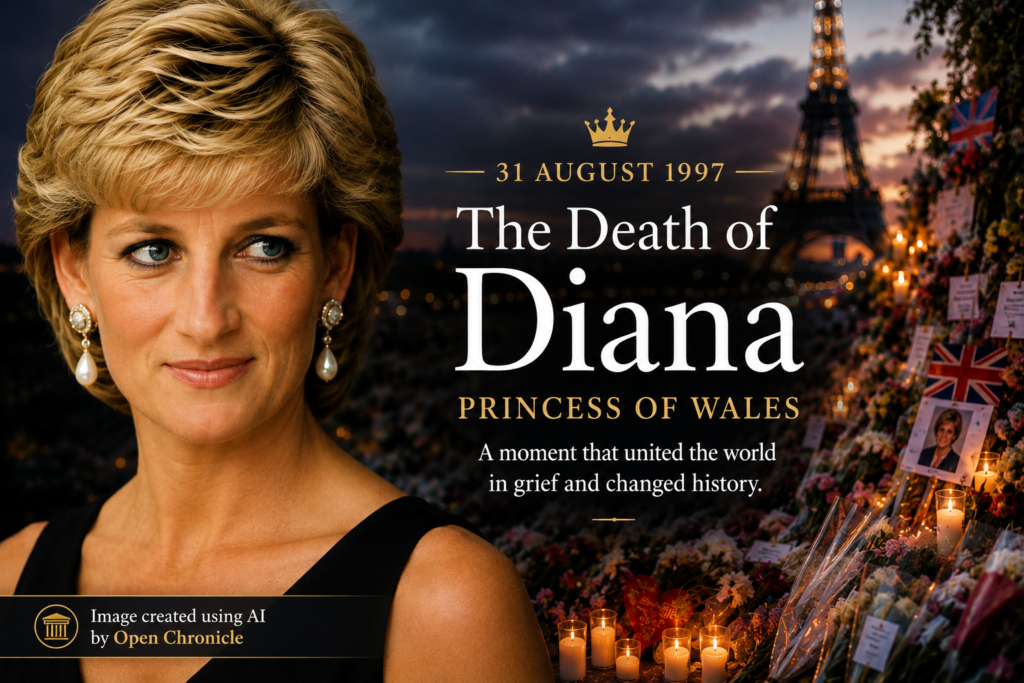
On 31 August 1997, Diana, Princess of Wales, died following a car crash in Paris, an event that produced an extraordinary worldwide reaction and became one of the defining public moments of the late twentieth century.
Diana was 36 years old. Her death triggered an outpouring of grief in Britain and far beyond it, while the circumstances surrounding the crash intensified an already fierce debate about celebrity culture, press intrusion and the relationship between the British monarchy and the public.
The Night in Paris
During the final hours of 30 August 1997, Diana was in Paris with Dodi Fayed. They left the Hôtel Ritz shortly after midnight and travelled in a Mercedes towards an apartment belonging to Fayed’s family.
Photographers were following the couple.
Shortly after entering the Pont de l’Alma road tunnel, the Mercedes crashed at high speed. Dodi Fayed and driver Henri Paul died at the scene. Bodyguard Trevor Rees Jones survived with serious injuries.
Diana was still alive when emergency services reached the wreckage. She was taken to the Pitié Salpêtrière Hospital, where doctors attempted to save her.
She was pronounced dead in the early hours of 31 August.
The announcement rapidly spread around the world.
A Princess Unlike Any Other
Diana Frances Spencer had married Charles, Prince of Wales, in 1981. Their wedding at St Paul’s Cathedral became a global television event watched by hundreds of millions of people.
The couple had two sons, Prince William, born in 1982, and Prince Harry, born in 1984.
Yet Diana’s importance eventually extended far beyond her position within the Royal Family.
She developed an unusually direct relationship with the public and became associated with humanitarian causes that were sometimes considered difficult or controversial.
One of the most influential examples came during the AIDS crisis.
In 1987, Diana was photographed shaking hands with an HIV positive patient without wearing gloves. At a time when misinformation and fear surrounding HIV and AIDS remained widespread, the gesture carried considerable symbolic importance.
She also became an internationally recognised campaigner against landmines.
In January 1997, photographs of Diana walking through a cleared minefield in Angola wearing protective equipment became some of the most memorable images of her humanitarian work.
Diana and the Monarchy
Behind the public image, Diana’s relationship with the Royal Family had become increasingly difficult.
Her marriage to Charles deteriorated publicly during the 1990s. The couple separated in 1992 and divorced in 1996.
Diana nevertheless remained one of the most recognisable people in the world.
Her ability to communicate emotion openly contrasted with the more restrained traditions historically associated with the British monarchy. That difference became particularly significant after her death.
As news of the Paris crash spread, thousands of people began gathering outside royal residences.
Flowers accumulated outside Kensington Palace. Messages, photographs and personal tributes transformed the area into an enormous spontaneous memorial.
The scale of the reaction was unprecedented.