
By Open Chronicle News Desk
The conflict between the United States and Iran has entered another dangerous phase around the Strait of Hormuz, with American strikes on Iranian positions followed by retaliatory attacks against US military facilities elsewhere in the Middle East.
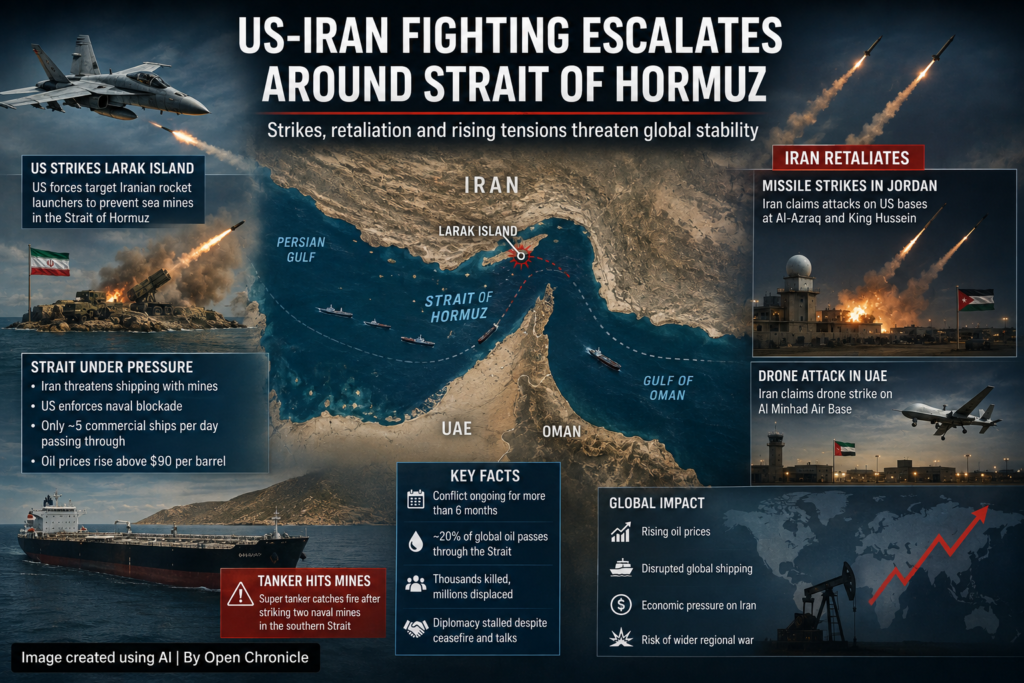
US forces struck two Iranian rocket launchers on Larak Island on Sunday, saying Islamic Revolutionary Guard Corps units were preparing to deploy additional sea mines into one of the world’s most strategically important waterways.
Iran subsequently announced retaliatory missile and drone operations against American military positions in Jordan and the United Arab Emirates, raising fears that a period of relative military restraint could give way to another broader cycle of escalation.
US strikes Larak Island
US Central Command said its forces conducted what it described as a limited and precise operation against IRGC units on Larak Island.
According to the American military, Iranian forces had been observed preparing rockets associated with the deployment of sea mines into the Strait of Hormuz. Washington argued that the activity represented an imminent threat to civilian vessels and international commerce.
A US official said two launchers were targeted. Iranian media reported that an American drone carried out the attack.
Tehran said the operation caused casualties among Iranian military personnel and civilians. The Revolutionary Guard promised retaliation and also claimed to have shot down an American MQ 9 drone over the Strait of Hormuz, saying the aircraft fell into Gulf waters.
The competing claims could not immediately be independently verified.
Iran retaliates against bases in Jordan
Iran later announced ballistic missile attacks against two bases used by US forces in Jordan.
The IRGC said technical infrastructure, maintenance facilities and areas associated with combat aircraft at King Hussein and Al Azraq air bases had been targeted.
Tehran claimed that the attacks caused substantial damage. Jordanian authorities presented a different account, saying national air defences intercepted eight missiles that entered Jordanian airspace.
US sources similarly indicated that almost all incoming missiles had been intercepted and that there had been no significant impact.
Iran’s Foreign Ministry characterised the attacks as legitimate self defence, arguing that facilities in Jordan had supported the American operation against Larak Island.
UAE drawn into renewed confrontation
Iranian forces also claimed to have attacked the American military presence at Al Minhad Air Base in the United Arab Emirates with drones early Monday.
Iranian state television, citing the country’s military, said US personnel, aircraft and helicopters at the installation had been targeted in retaliation for the Larak operation.
The claims initially lacked independent confirmation, leaving uncertainty over the scale and effectiveness of the reported attack.
The expansion of Iranian retaliation beyond the immediate Strait of Hormuz theatre illustrates one of the central dangers facing Washington and Tehran. American forces are distributed across numerous bases in the Middle East, giving Iran multiple potential targets if the confrontation widens.
Military communications become increasingly important
Behind the missile, drone and naval operations lies another increasingly important dimension of the confrontation, military communications.
US Central Command must maintain secure communications between naval forces in and around the Strait of Hormuz, surveillance aircraft, drones, regional air bases and command centres overseeing the wider operation.
These networks allow commanders to distribute intelligence, track Iranian movements, coordinate air and missile defence and provide warnings to commercial vessels operating near the conflict zone.
Iran faces similar requirements. The IRGC and conventional Iranian military must coordinate coastal missile batteries, naval units, drones, air defence systems and forces positioned around strategically important islands.
Satellite communications, encrypted tactical radio networks, airborne communications relays and secure data links therefore form an essential but less visible part of the confrontation.
Electronic warfare could become particularly important if either side attempts to disrupt navigation, communications or targeting systems. GPS interference, communications jamming and attacks against command networks could complicate operations without immediately crossing the threshold into large scale conventional strikes.
Maintaining reliable communications is also essential for preventing accidental escalation. With American, Iranian and regional forces operating in relatively confined areas, misidentification or delayed communication could turn a limited engagement into a much larger confrontation.
Strait of Hormuz under increasing pressure
The Strait of Hormuz remains at the centre of the conflict.
Before the war, roughly one fifth of global oil consumption passed through the narrow waterway connecting the Persian Gulf with the Arabian Sea.
The conflict has dramatically disrupted that traffic.
US Central Command said its forces redirected 83 commercial vessels, disabled three and boarded another two as part of operations connected to Washington’s blockade.
Shipping data cited in the supplied reports indicated that only around five visible commodity vessels per day crossed the strait during the weekend. The true figure may have been higher because some ships reportedly switched off their automatic identification systems.
Doing so makes commercial vessels considerably more difficult to track, but also creates additional navigational and security risks in an already heavily militarised environment.
Tanker reportedly strikes mines
The confrontation intensified further after Iranian state television reported that a supertanker caught fire after striking two naval mines while attempting to navigate the southern part of the strait.
The ship reportedly came to a complete stop.
Iranian authorities did not initially identify the tanker or provide details about its crew.
The Revolutionary Guard said the vessel had attempted to cross the waterway illegally and warned that other ships could face similar consequences if they failed to follow Iranian requirements.
Washington says preventing precisely this type of incident was the purpose of its operation against Larak Island.
The United States previously announced that its forces had removed or destroyed mines threatening international shipping routes and warned that Iranian vessels attempting to deploy additional mines could be attacked.
Oil returns above $90
The military escalation quickly affected international energy markets.
Brent crude climbed above $90 per barrel on Monday, returning to that level for the first time in approximately a month.
During the most intense stage of the conflict, prices had climbed beyond $120 per barrel.
Any prolonged disruption of the Strait of Hormuz could again produce substantial consequences for energy importing economies, shipping companies and global supply chains.
The threat extends beyond crude oil. Liquefied natural gas, refined petroleum products, petrochemicals and other commodities depend heavily on Gulf shipping routes.
Kharg Island enters the confrontation
President Donald Trump added another element of uncertainty by claiming that Iran’s strategically important Kharg Island was being heavily attacked.
No immediate details were provided about the alleged operation, and neither the White House nor the US Defense Department initially clarified the statement.
Kharg Island has historically served as the principal hub for Iranian crude exports. Before the conflict, it reportedly handled approximately 90 percent of Iran’s oil exports.
Serious damage to the island’s infrastructure could therefore have consequences far beyond the battlefield.
An attack capable of substantially reducing Kharg’s export capacity would increase economic pressure on Tehran while potentially placing additional upward pressure on global energy prices.
Six months of conflict
The latest confrontation comes more than six months after the conflict began on February 28 with American and Israeli attacks against Iran.
Iran subsequently retaliated against Israel and facilities associated with the United States and its regional partners.
According to the supplied information, Iranian operations have affected or targeted facilities in Qatar, the UAE, Saudi Arabia, Bahrain, Kuwait and Oman.
American forces conducted repeated operations against Iran during the first months of the conflict, including 13 consecutive nights of strikes earlier in July.
The previous reported US strike before the latest Larak Island operation occurred on July 29.
The relative reduction in direct attacks since then had raised hopes that diplomacy could gradually contain the conflict. Sunday’s exchange demonstrates how quickly that restraint can unravel.
Diplomacy has failed to produce a lasting settlement
Pakistan and Qatar have been among the countries attempting to mediate between Washington and Tehran.
A ceasefire reached in April ended the most intensive stage of the fighting, while a memorandum of understanding signed in June was intended to provide a pathway toward a broader settlement.
A comprehensive peace agreement has nevertheless remained elusive.
Instead, military confrontations around Hormuz have continued alongside increasingly aggressive economic pressure.
Washington has placed greater emphasis on what the Trump administration describes as economic warfare against Tehran, including sanctions, restrictions on financial transactions and pressure on countries doing business with Iran.
Treasury Secretary Scott Bessent said another bank would face sanctions as Washington sought to further restrict Iran’s access to international finance.
Risk of wider regional escalation
The central question is now whether the latest attacks remain contained.
Washington describes its Larak operation as a defensive response to an imminent threat against shipping. Tehran considers the strike an act of aggression and argues that its subsequent attacks constitute legitimate retaliation.
Those fundamentally incompatible interpretations create conditions for another escalation cycle.
The geographical environment makes the situation particularly dangerous. US bases, Iranian missile systems, commercial shipping, regional military forces and critical energy infrastructure are concentrated across a relatively small area.
Missile defence systems and secure military communications can reduce some risks, but they cannot eliminate the possibility of miscalculation.
Iran’s Supreme Leader has meanwhile called on Muslim countries to unite against the United States and Israel, adding another political dimension to the confrontation.
The immediate dispute may concern mines, rocket launchers and freedom of navigation, but the strategic stakes are considerably larger.
For Washington, keeping the Strait of Hormuz open is critical to international commerce and the credibility of the American security presence in the Gulf. For Tehran, the waterway represents one of its most powerful instruments of military and economic leverage.
As both sides demonstrate their willingness to use force, the Strait of Hormuz has once again become the most dangerous flashpoint in a conflict whose consequences now extend far beyond the Middle East.