By Open Chronicle
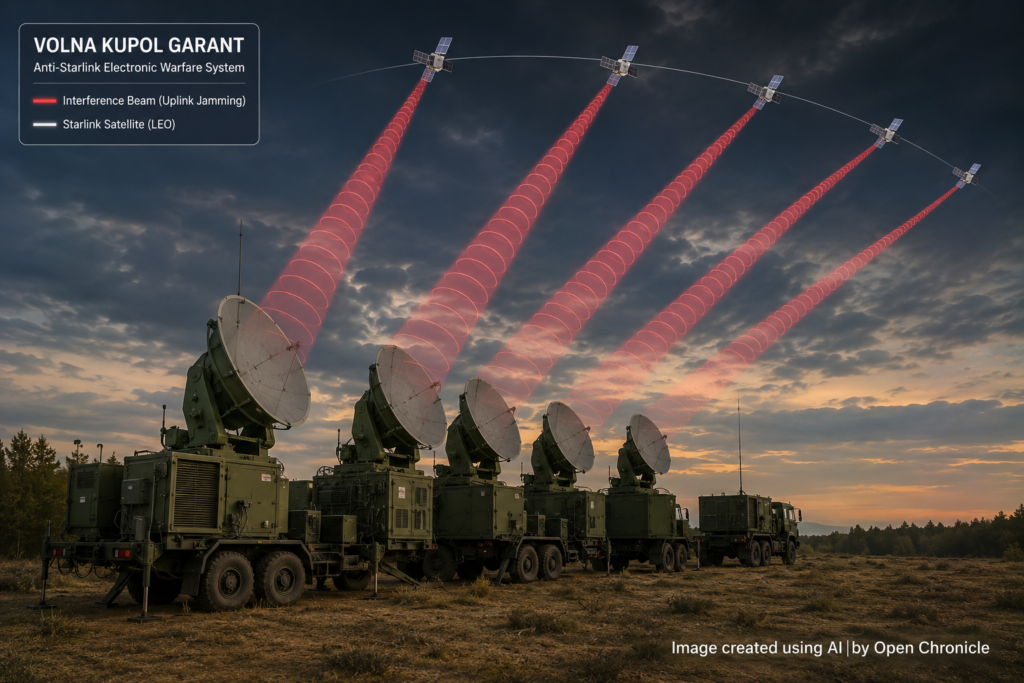
The Volna Kupol Garant is a Russian electronic warfare system reported to have been developed specifically to interfere with communications between Starlink user terminals and satellites in low Earth orbit.
The system became publicly documented during 2026 as Russia sought methods to disrupt Ukrainian drones and other battlefield systems relying on Starlink for long range command, control and communications.
Unlike many conventional electronic warfare systems that attempt to jam a receiver located on the ground, the Volna Kupol Garant is reported to direct powerful radio frequency interference towards Starlink satellites passing overhead.
The intended effect is to interfere with the satellite’s ability to receive uplink transmissions originating from terminals located within a defined area on the ground.
This approach places the system at the intersection of electronic warfare, satellite communications warfare and emerging counterspace operations.
Ukrainian officials and military personnel have reported operational encounters with the system, while Russian sources have claimed successful deployment and, in August 2026, the beginning of serial production.
However, significant uncertainty remains concerning its actual effectiveness, coverage, power output and ability to sustain interference against the highly distributed Starlink constellation.
For this reason, the Volna Kupol Garant should be understood as an operationally relevant but incompletely documented electronic warfare system whose capabilities remain partly based on battlefield reporting and competing wartime claims.
Quick Facts
Name: Volna Kupol Garant
Russian name: Волна Купол Гарант
Type: Electronic warfare system
Primary reported role: Disruption of Starlink satellite communications
Country of origin: Russia
Reported manufacturer: Rossiysky Kupol LLC
Reported manufacturer location: Simferopol, Crimea
Primary target: Starlink communications uplink
Reported operating band: Ku band
Frequently reported frequency range: Approximately 14 to 14.5 GHz
Reported channel structure: Eight channels
Reported bandwidth per channel: Approximately 62.5 MHz
Reported system configuration: Multiple steerable satellite antennas mounted across six trailer based modules
Reported effective area: Up to approximately 20 square kilometres
Power supply: Reportedly onboard generators or external electrical supply
Operational use: Reported during the Russia-Ukraine War
Serial production: Claimed by Russian defence industry sources in August 2026
Independent verification: Partial
Background
Satellite communications have become increasingly important in modern warfare.
Traditional military satellite systems are expensive, limited in number and controlled primarily by governments.
Commercial satellite constellations have changed this environment.
Starlink, developed and operated by SpaceX, consists of thousands of satellites in low Earth orbit providing broadband communication to relatively compact ground terminals.
Following Russia’s full scale invasion of Ukraine in February 2022, Starlink became an important component of Ukrainian communications infrastructure.
Its uses expanded beyond conventional internet access.
Ukrainian military units employed Starlink terminals for command and control, situational awareness, reconnaissance coordination and communication between dispersed forces.
Over time, satellite connectivity also became increasingly associated with Ukrainian unmanned systems.
By 2026, some Ukrainian medium range strike drones were using Starlink connections to support command and control during operations against targets located well behind Russian lines.
Reuters reported in July 2026 that Russia was increasingly attempting to disrupt these connections as Ukrainian Starlink controlled drones attacked logistics, fuel installations, air defence systems and command infrastructure.
Why Starlink Is Difficult to Jam
Traditional satellite communications often rely upon a limited number of large satellites.
Starlink operates differently.
Its constellation consists of thousands of satellites moving rapidly across the sky in low Earth orbit.
A user terminal communicates with one satellite and then transitions to another as satellites move through its field of view.
This creates substantial resilience.
Disrupting a single satellite does not automatically disable the network.
Another spacecraft may soon become available.
Starlink also employs directional antennas, dynamic network management and software controlled communications.
These characteristics complicate conventional electronic warfare.
Nevertheless, no radio communication system is immune to interference.
If enough unwanted energy reaches a receiver in the relevant frequency band, communications can be degraded or temporarily disrupted.
The challenge is generating sufficient interference at the correct location, frequency and time.
Development
Russia reportedly began experimenting with methods for suppressing Starlink relatively early in the full scale war.
Ukrainian radio technology specialist Serhii Beskrestnov stated in June 2026 that an earlier system had been detected on the Kharkiv axis before being located and destroyed by Ukrainian forces.
According to his account, widespread repeated use was not observed immediately afterwards.
The situation changed as Ukraine expanded the use of medium range strike drones connected through satellite communications.
Russian forces then began deploying more specialised systems intended specifically to interfere with Starlink.
Beskrestnov identified one of these systems as Volna Kupol Garant and attributed its manufacture to Rossiysky Kupol LLC in Simferopol.
Name
The Russian designation is commonly transliterated as Volna Kupol Garant.
Individual translations into English vary.
The component words can approximately convey concepts such as wave, dome and guarantor or guarantee.
Open source reporting generally retains the Russian transliteration rather than attempting to create a formal English designation.
No confirmed official NATO reporting name has been publicly established.
Manufacturer
Ukrainian reporting attributes the system to Rossiysky Kupol LLC, described as operating from Simferopol in Crimea.
Information about the organisation remains limited compared with major Russian defence corporations.
Its reported location is significant because Crimea has become an important centre for Russian military logistics, electronic warfare and defence related activity since the peninsula was annexed by Russia in 2014.
The precise industrial supply chain supporting Volna Kupol Garant has not been independently documented in detail.
System Architecture
Available descriptions suggest that Volna Kupol Garant is not a single compact vehicle.
Instead, it appears to consist of several distributed antenna modules.
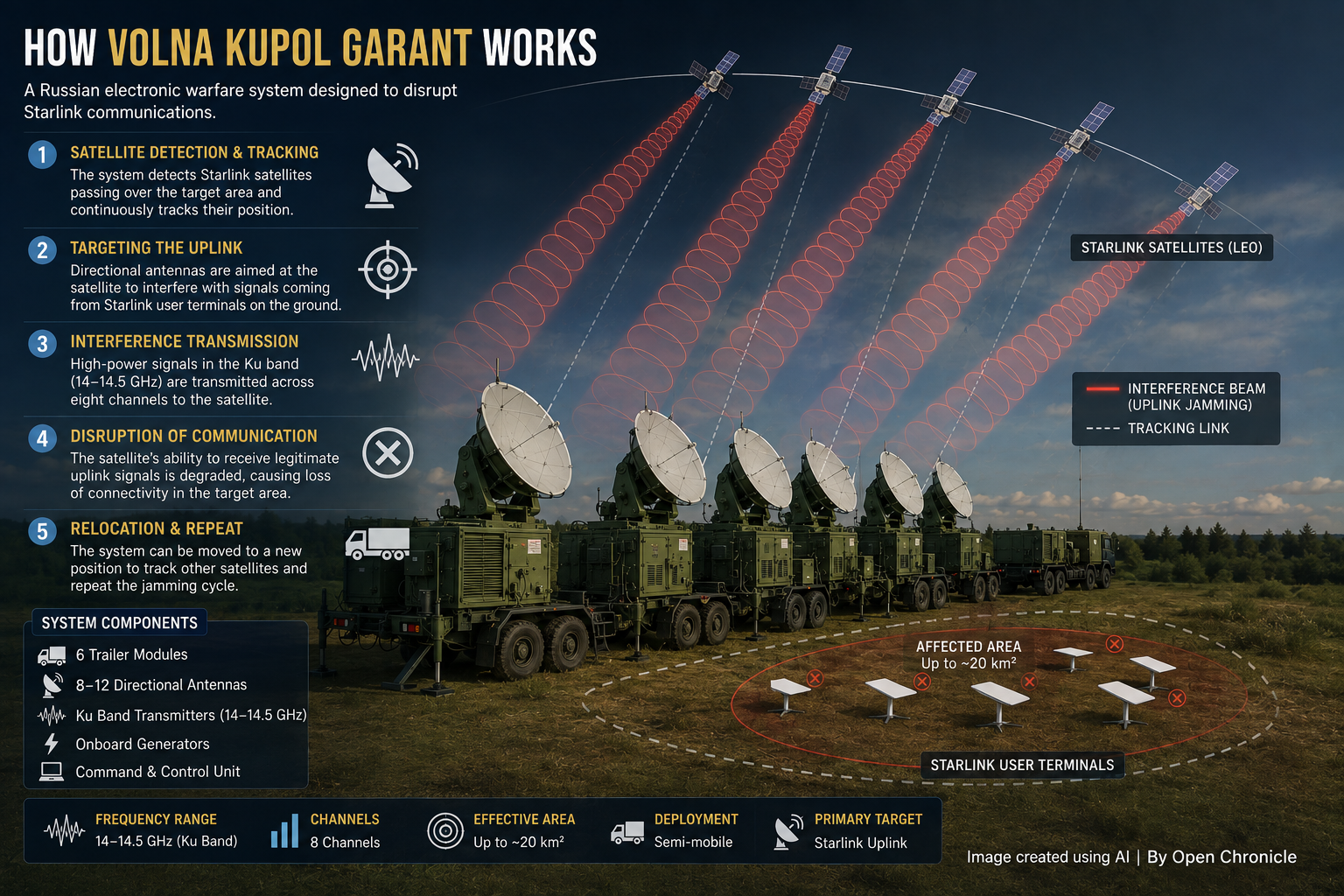
The most commonly cited configuration uses six trailer based units.
Reports describe steerable satellite dish antennas mounted beneath protective radio transparent enclosures.
Some descriptions indicate eight active antennas.
Others describe twelve physical dishes distributed between the six trailers, potentially providing redundancy or additional operating flexibility.
This discrepancy illustrates an important limitation in the available evidence.
Different photographed or deployed configurations may exist, or open source descriptions may simply be incomplete.
Interfax Ukraine, citing Beskrestnov, described the system as using multiple antennas and six trailers. Ukrainska Pravda later reported six trailers equipped with two antennas each.
Antenna Modules
The antennas are reported to be directional rather than omnidirectional.
This is essential to the concept.
Attempting to radiate interference uniformly towards the sky would waste enormous amounts of power.
A directional antenna concentrates radio frequency energy into a relatively narrow beam.
If the beam can be accurately directed towards a Starlink satellite, the jammer can place significantly more interference energy at the satellite receiver than would be possible using an omnidirectional transmitter.
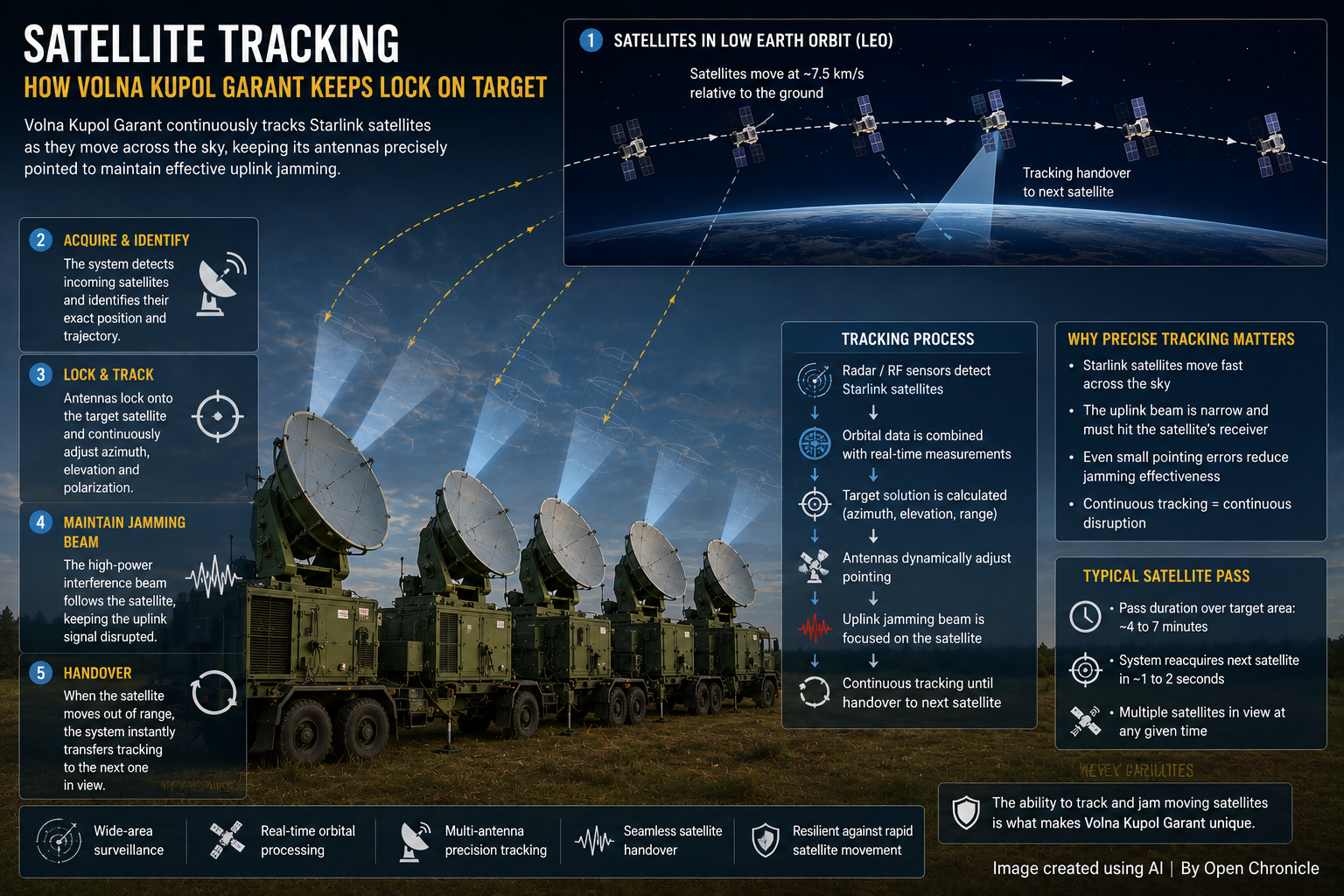
The antenna therefore needs to track satellites as they move across the sky.
Because Starlink satellites travel rapidly relative to a fixed ground position, this requires continuous pointing adjustments.
Ku Band Operation
Most detailed reporting places the system’s operating frequency in the 14 to 14.5 GHz region of the Ku band.
This frequency range corresponds to uplink communications from Starlink user terminals towards satellites.
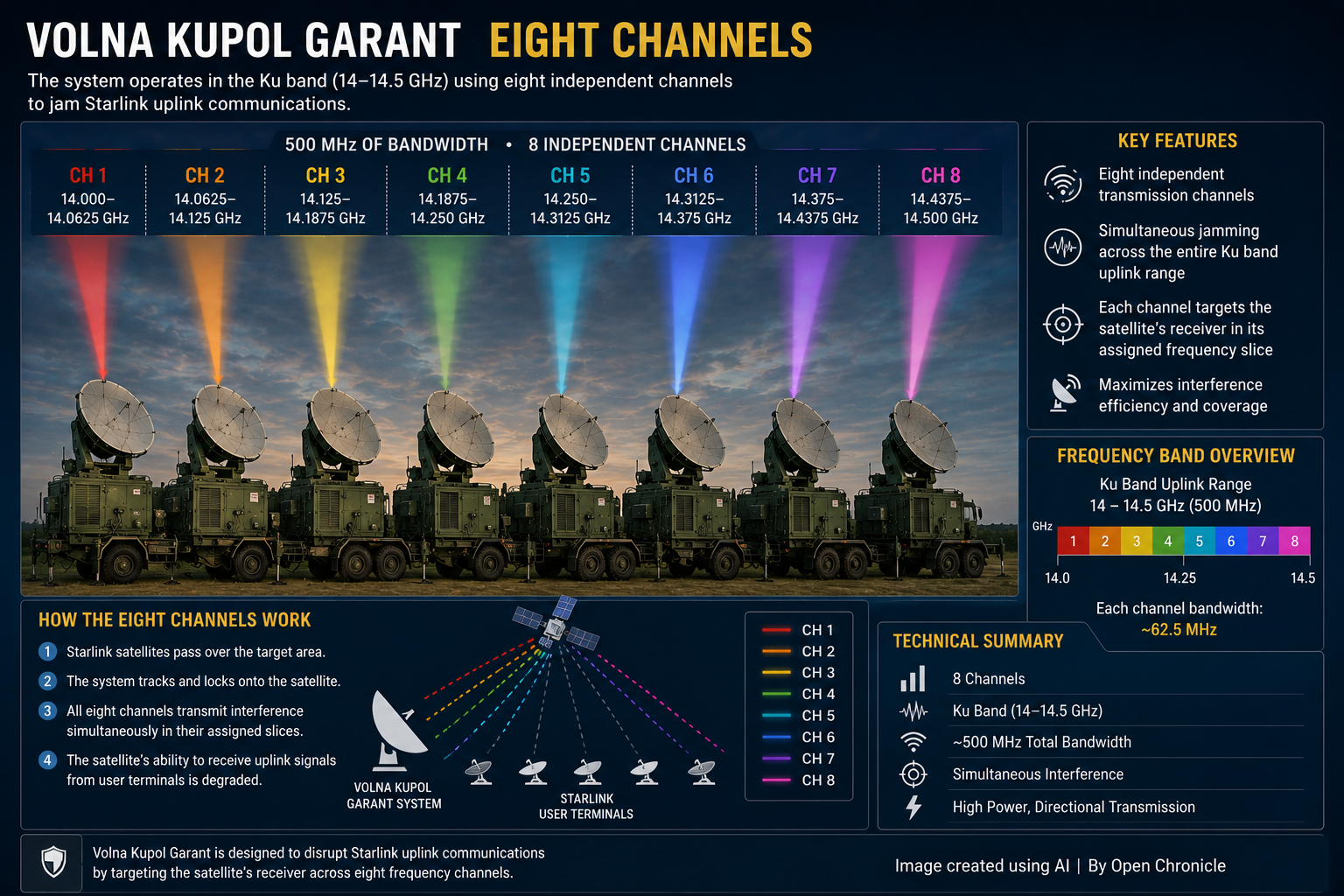
Reports frequently describe the approximately 500 MHz range as being divided into eight channels of approximately 62.5 MHz each.
The jammer would therefore attempt to interfere with all relevant channels rather than concentrating on a single narrow frequency.
This architecture has been described by Ukrainian specialists and subsequently repeated by multiple specialist publications.
Some alternative sources have published different frequency figures.
Those discrepancies should be treated cautiously.
The 14 to 14.5 GHz uplink description is presently the most consistently reported configuration in higher quality open source reporting.
Operating Principle
The most important reported characteristic of Volna Kupol Garant is its attack direction.
Many communications jammers target the receiver used by the person or platform attempting to communicate.
For example, a jammer attempting to disrupt a radio used by a drone can transmit interference near the drone or near its operator.
Volna Kupol Garant is reported to approach the problem differently.
It directs interference upwards.
The objective is to place powerful unwanted radio frequency energy into the receiving system of a Starlink satellite.
If the interference becomes sufficiently strong relative to legitimate user terminal transmissions, the satellite may become temporarily unable to distinguish those signals.
The communication link can then become unstable or unavailable.
This technique is known as uplink jamming.
Uplink Jamming
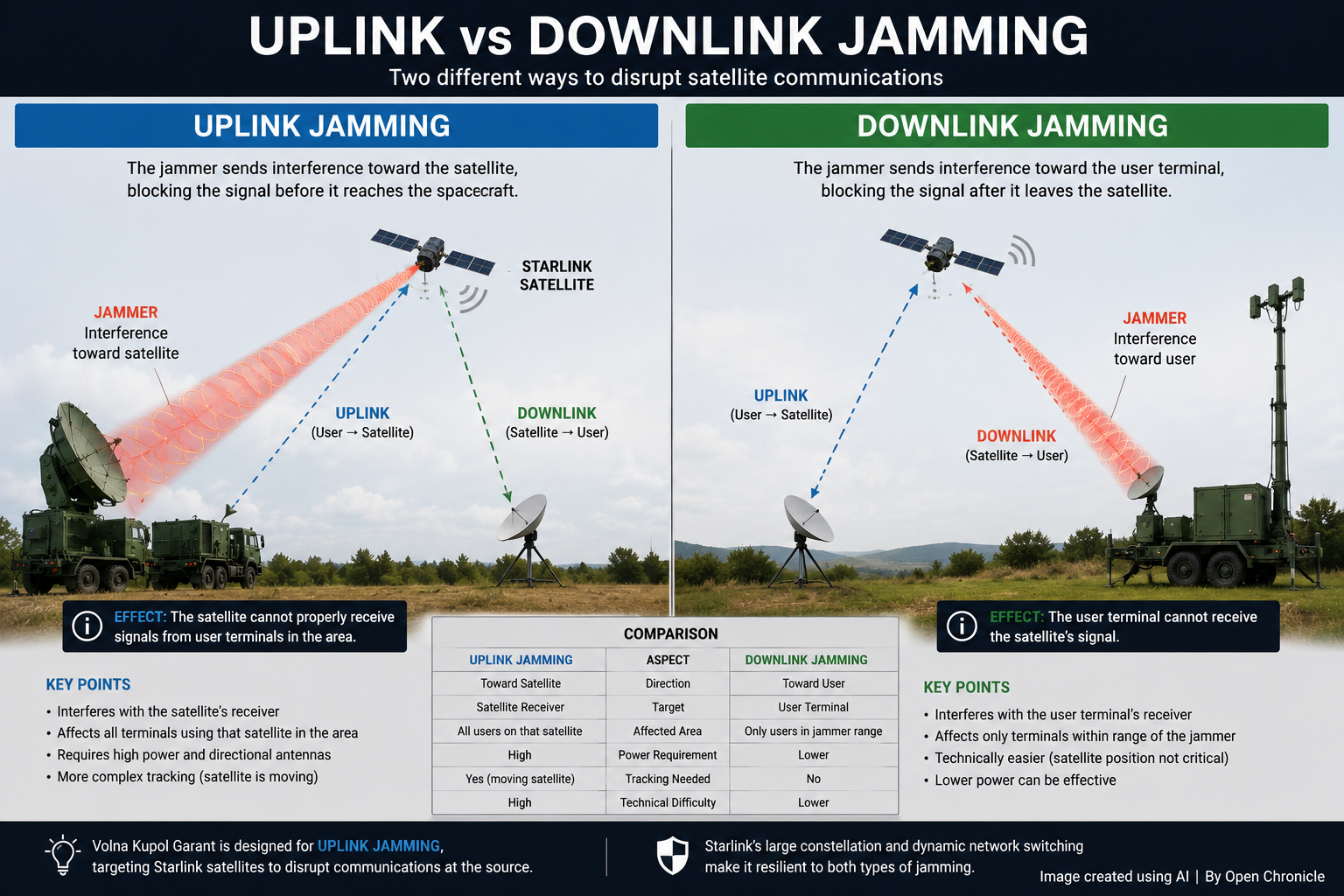
Satellite communications involve at least two fundamental directions.
The uplink carries information from the ground towards the satellite.
The downlink carries information from the satellite towards the ground.
A jammer attacking a ground terminal typically targets the downlink reception environment.
Volna Kupol Garant is reported to attack the uplink.
This approach is technically demanding.
A Starlink satellite may orbit approximately several hundred kilometres above Earth.
The interference therefore has to travel from the ground to the spacecraft with enough effective power to compete with legitimate terminal transmissions.
Directional antennas and substantial transmitter power are required.
The potential advantage is that a jammer may interfere with multiple terminals communicating through the same satellite while that satellite is visible over the affected location.
Eight Channel Interference
Descriptions of the system repeatedly refer to eight communications channels.
Each channel is reported to occupy approximately 62.5 MHz.
Dedicated antennas or transmitter chains can therefore cover the entire relevant frequency range.
Conceptually, one antenna or transmitter path can concentrate interference within each channel.
All channels can then be attacked simultaneously.
This differs from attempting to generate broad spectrum noise across an extremely wide frequency range.
The multi channel approach can concentrate available transmitter energy more efficiently.
Satellite Tracking
Successful uplink jamming requires accurate tracking.
A Starlink satellite does not remain stationary above the jammer.
It moves rapidly across the sky.
The antenna therefore needs to calculate or receive the satellite’s orbital position and continuously adjust its pointing angle.
Once the satellite passes beyond usable geometry, another satellite must be acquired.
This presents a significant technical challenge.
Starlink’s large constellation means many satellites can potentially serve a particular location.
A jammer that affects one spacecraft does not necessarily affect all alternative connections available to terminals in the same region.
This is one reason why claims that a small number of Volna Kupol Garant systems could disable Starlink across enormous geographical areas should be treated with considerable caution.
Reported Coverage
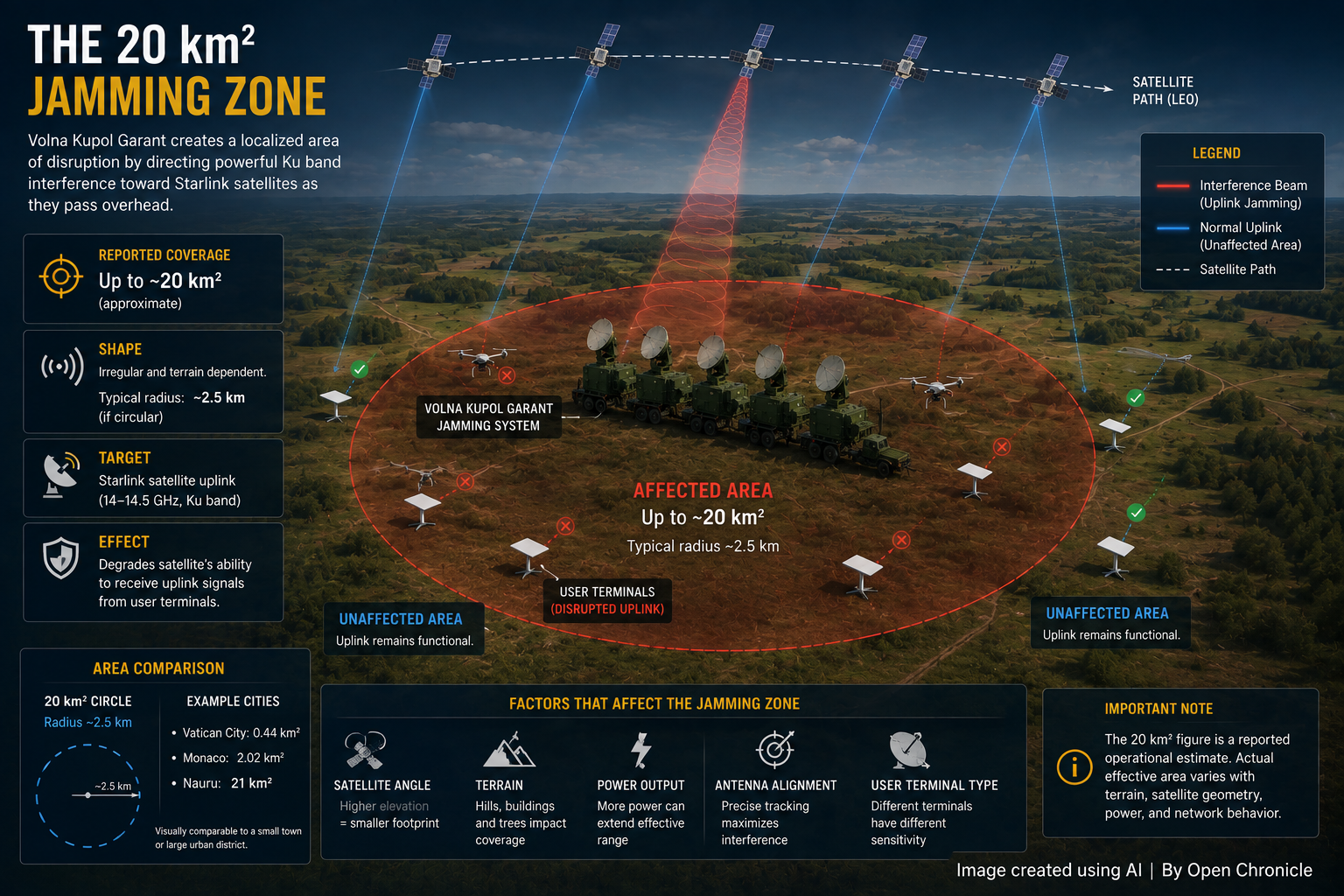
The most frequently reported effective area is approximately 20 square kilometres.
Beskrestnov cited this figure, and Reuters repeated it when reporting Russian use of the system in July 2026.
An area of 20 square kilometres would correspond approximately to a circular region with a radius of around 2.5 kilometres.
The real geometry would almost certainly be more complicated.
Satellite position, terrain, antenna pointing, transmitter power, user terminal location and network behaviour could all affect the size and shape of the disruption area.
The 20 square kilometre value should therefore be understood as a reported operational estimate rather than a precisely verified technical specification.
Power Requirements
Uplink jamming is power intensive.
The satellite is hundreds of kilometres away.
Radio frequency energy decreases dramatically with distance.
The system therefore requires substantial electrical power to generate effective interference.
Reported configurations use generators associated with the trailer modules.
External electrical power can reportedly also be used.
This requirement has operational consequences.
Generators produce heat, noise and electromagnetic signatures.
They require fuel.
Large power systems reduce mobility.
All of these factors can make the jammer easier to locate.
Mobility
The trailer based architecture appears designed to provide some mobility.
Individual modules can reportedly be relocated.
Antennas may also be removed from trailers and positioned separately.
This allows operators to disperse the system or adapt it to prepared positions.
However, Volna Kupol Garant should not necessarily be understood as a highly mobile electronic warfare vehicle capable of immediately transmitting while moving.
Its reliance on multiple antennas, generators and accurate satellite tracking suggests that deployment and alignment are important operational considerations.
Fixed and Semi Mobile Deployment
Available imagery and reporting suggest that the system can function in both fixed and semi mobile configurations.
Prepared sites may provide external electrical power and better antenna positioning.
Trailer operation provides greater flexibility.
This trade off is common in electronic warfare.
A fixed position can support greater power and stability.
A mobile configuration improves survivability.
Volna Kupol Garant appears to attempt to combine elements of both approaches.
Operational Use
By mid 2026 the system had moved beyond theoretical discussion.
Ukrainian forces reported detecting multiple Volna Kupol Garant installations.
Reuters reported that approximately ten had been detected according to Ukrainian officials.
Ukrainian drone units described operations aimed specifically at destroying them.
One Ukrainian crew commander told Reuters that after a detected installation was struck, Starlink equipped drones operating through that area were again able to fly without the previous communication problems.
This constitutes some of the strongest public evidence that the system can produce at least local operational effects.
It does not independently verify all Russian claims about its maximum performance.
Protection of Logistics
One important reported mission is the defence of Russian logistics.
Ukraine increasingly used remotely controlled drones to attack supply movements behind Russian lines.
Fuel vehicles, ammunition transport, air defence assets and command sites became targets.
Starlink connectivity allowed some drones to maintain communications over distances that would otherwise be difficult using conventional radio links.
Volna Kupol Garant could therefore create temporary zones where those connections become unreliable.
For logistics forces, even limited local disruption can be valuable.
A protected corridor does not need to suppress Starlink across an entire front.
It only needs to interfere with drone communications near a critical convoy route, depot or command location.
Crimea and Southern Ukraine
Crimea and Russian controlled southern Ukraine became particularly important environments for this type of warfare.
The peninsula contains airfields, naval infrastructure, logistics hubs and command facilities.
It also serves as an important node connecting Russian forces operating in southern Ukraine.
Ukraine has repeatedly used long range missiles, unmanned aircraft and maritime drones against infrastructure in and around Crimea.
Electronic warfare therefore became one layer of a broader defensive network that also includes conventional air defence, camouflage, deception and physical protection.
Countering Starlink Controlled Drones
The most strategically interesting reported mission involves drones maintaining control links through Starlink.
Conventional drone jamming generally attempts to interfere with command frequencies, navigation signals or video transmissions.
A Starlink equipped platform can bypass some of these vulnerabilities.
Instead of communicating directly with an operator over a terrestrial radio link, the drone communicates through a satellite network.
The operator can therefore potentially control the aircraft far beyond conventional radio horizon.
Volna Kupol Garant represents an attempt to move electronic warfare upwards into that communications architecture.
Rather than attacking the drone directly, it attacks the infrastructure connecting the drone with its operator.
Ukrainian Countermeasures
The system’s own electromagnetic emissions create vulnerabilities.
Electronic warfare systems reveal information whenever they transmit.
Directional antennas reduce unnecessary radiation, but powerful signals can still potentially be detected by electronic intelligence systems.
Once located, a Volna Kupol Garant installation becomes a physical target.
Ukrainian units have consequently treated the jammers as priority objectives.
Videos and satellite imagery have been reported showing attacks against installations believed to belong to the system.
Ukrainian reporting also described destruction of systems at locations including Gelendzhik.
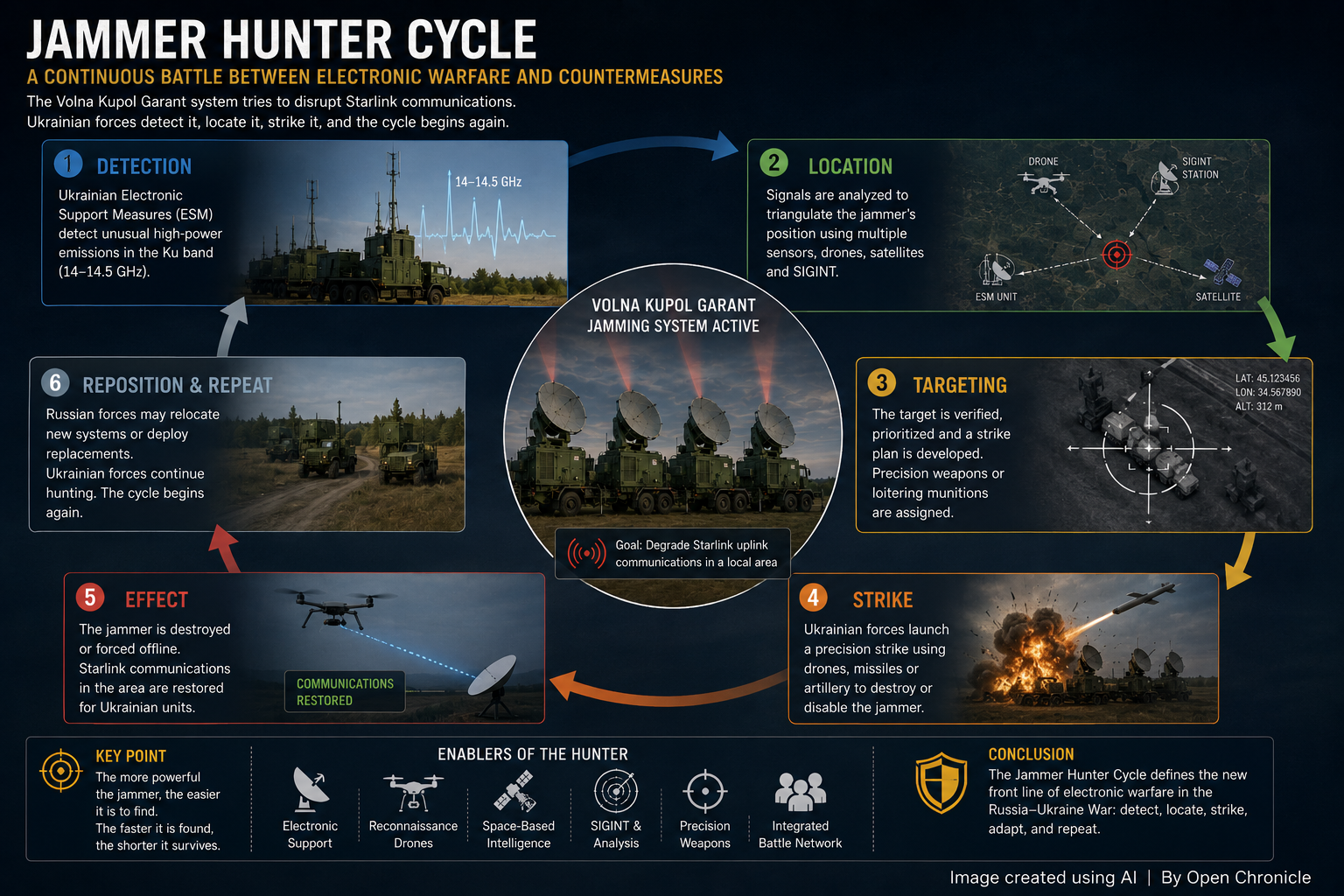
The Jammer Paradox
Electronic warfare systems face a persistent paradox.
The more powerful the jammer becomes, the more effective it may be.
The more powerful it becomes, however, the easier it may also become to detect.
A high powered transmitter can produce a significant electromagnetic signature.
Modern electronic support systems can search for unusual emissions.
Once a location is calculated, drones, missiles or artillery can be directed towards it.
Volna Kupol Garant therefore operates within a continuous cycle.
It attempts to disrupt drones.
Drones and electronic intelligence attempt to locate the jammer.
Strike systems then attempt to destroy it.
The defending force must relocate, conceal or replace the system.
Economic Considerations
Some Ukrainian and open source estimates place the cost of a single Volna Kupol Garant system at approximately 1.5 million United States dollars, equivalent to around 100 million rubles under the estimates cited.
This figure has not been independently confirmed through Russian procurement documentation.
Nevertheless, the economic relationship between jammer and attacker is strategically important.
A relatively expensive electronic warfare site can be attacked by comparatively inexpensive unmanned systems.
However, the jammer may protect infrastructure worth far more than the system itself.
Cost effectiveness therefore cannot be determined simply by comparing the price of the jammer with the price of the drone that destroys it.
The correct comparison includes the value of whatever the jammer prevents from being attacked.
Serial Production
On 28 August 2026, Russian state news agency TASS reported that serial production of Volna Kupol Garant had begun.
The report cited an unnamed Russian defence industry source claiming that the system had demonstrated sufficient effectiveness to justify larger scale production and deployment.
The announcement represents a significant development if accurate.
Moving from limited production into serial manufacture would indicate that Russia considers the concept operationally valuable.
However, statements from unnamed defence industry sources should not be treated as independent confirmation of either production volume or battlefield effectiveness.
No publicly verified production totals were available at the time of writing.
Russian Claims
Russian reporting has made increasingly ambitious claims about the system.
Some sources have described Volna Kupol Garant as capable of blocking Starlink wherever required.
Other claims have suggested that relatively small numbers of systems could dramatically restrict Starlink availability across large areas.
These statements exceed what is presently demonstrated by independent evidence.
Starlink consists of thousands of satellites.
Its architecture is designed to provide redundancy.
A jammer capable of interfering with one satellite or one localized communications cell is not equivalent to a system capable of disabling the entire constellation.
Russian claims concerning strategic scale effects should therefore be treated as wartime claims unless supported by independent technical evidence.
Ukrainian Claims
Ukrainian sources also operate within a wartime information environment.
Statements concerning the number of systems destroyed, their cost and their precise capabilities may contain incomplete or operationally motivated information.
However, Ukrainian reporting has provided specific technical descriptions, imagery and accounts of battlefield encounters.
Reuters reporting based upon interviews with Ukrainian personnel provides additional confidence that some form of specialised Starlink interference system is operationally present.
The strongest conclusion is therefore not that every published specification is correct.
The strongest conclusion is that Russia has deployed specialised electronic warfare systems intended to interfere with Starlink, and that Volna Kupol Garant is one of the identified systems associated with that mission.
Technical Feasibility
The basic concept of uplink jamming is technically plausible.
Satellite receivers must distinguish legitimate signals from background noise and interference.
If enough interfering energy reaches a receiver within the relevant frequency range, its signal to noise ratio can deteriorate.
Communications can therefore become unreliable.
The difficult question is not whether uplink jamming is possible.
It is how reliably Volna Kupol Garant can achieve it against a large, adaptive low Earth orbit constellation under operational conditions.
Specialist analysis published by Inside GNSS examined precisely this issue, noting that the reported architecture is technically plausible while also highlighting the fundamental challenge posed by the scale and movement of the Starlink constellation.
Why Starlink Remains Resilient
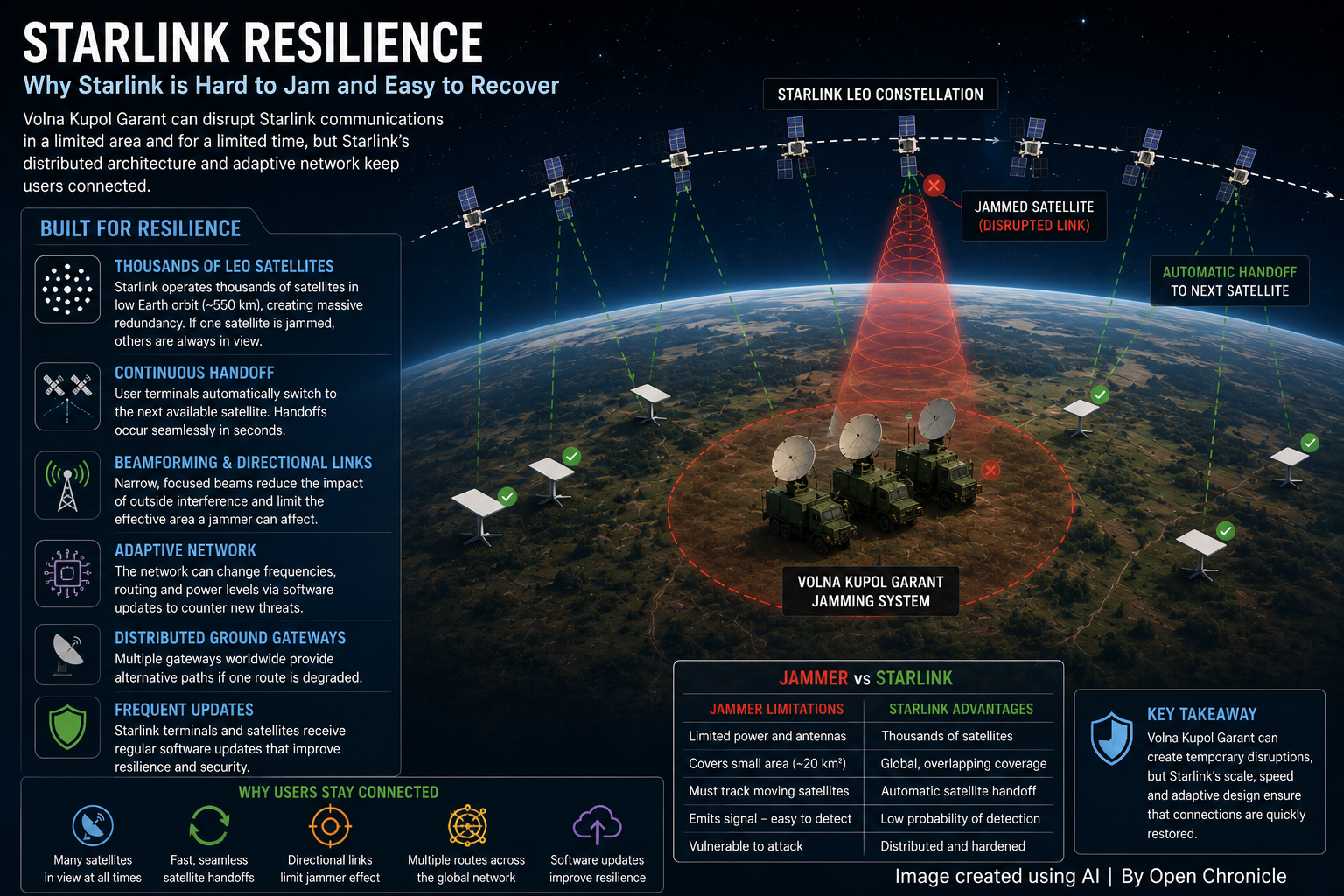
Starlink possesses several characteristics that complicate sustained jamming.
There are many satellites.
They move rapidly.
Terminals can transition between spacecraft.
Beams are directional.
Network management is software controlled.
Frequencies and communications behaviour can potentially be adjusted.
SpaceX can update terminal and satellite software.
New satellites can introduce different technical characteristics.
This produces a continuous competition between electronic attack and communications adaptation.
A jammer that works effectively against one configuration may become less effective after network changes.
The communications provider can also modify operational procedures after observing hostile interference.
Can Volna Kupol Garant Disable a Starlink Satellite?
Descriptions frequently use words such as blind or deafen.
These terms should not be interpreted as meaning physical damage to the spacecraft.
The reported effect is electronic and temporary.
The jammer attempts to prevent the satellite receiver from correctly processing legitimate terminal signals.
Once interference stops or the satellite moves beyond effective jamming geometry, normal communication may return.
There is presently no credible public evidence that Volna Kupol Garant physically damages Starlink satellites.
It should therefore be classified as a communications denial system rather than an anti satellite weapon in the destructive sense.
Counterspace Implications
Nevertheless, the system has counterspace significance.
Counterspace operations do not necessarily require destroying satellites.
A state can attempt to reduce the military usefulness of space systems by attacking communications links.
These links include the connection between ground stations and satellites, the connection between satellites and users, navigation signals and data relay networks.
Volna Kupol Garant demonstrates how electronic warfare on Earth can directly affect the operational use of spacecraft.
This blurs the traditional boundary between terrestrial electronic warfare and space warfare.
Starlink and Military Dependence
The emergence of specialised anti Starlink systems highlights another strategic development.
Commercial satellite infrastructure has become deeply integrated into military operations.
A commercial communications constellation can provide battlefield resilience that previously required expensive dedicated military satellites.
This produces significant advantages.
It also creates new forms of dependence.
Once armed forces rely heavily upon a particular network, disrupting that network becomes an attractive objective for the adversary.
Volna Kupol Garant exists because Starlink became militarily important enough to justify a dedicated countermeasure.
Electronic Warfare Moving Upward
Historically, tactical electronic warfare focused largely upon terrestrial systems.
Radios were jammed.
Radar was deceived.
Navigation signals were disrupted.
Drone control links were attacked.
The increasing military use of low Earth orbit communications means electronic warfare must now account for transmitters and receivers separated vertically by hundreds of kilometres.
The battlefield electromagnetic environment therefore extends from the ground into space.
Volna Kupol Garant is an example of this transition.
Volna Kupol Garant versus Traditional Drone Jamming
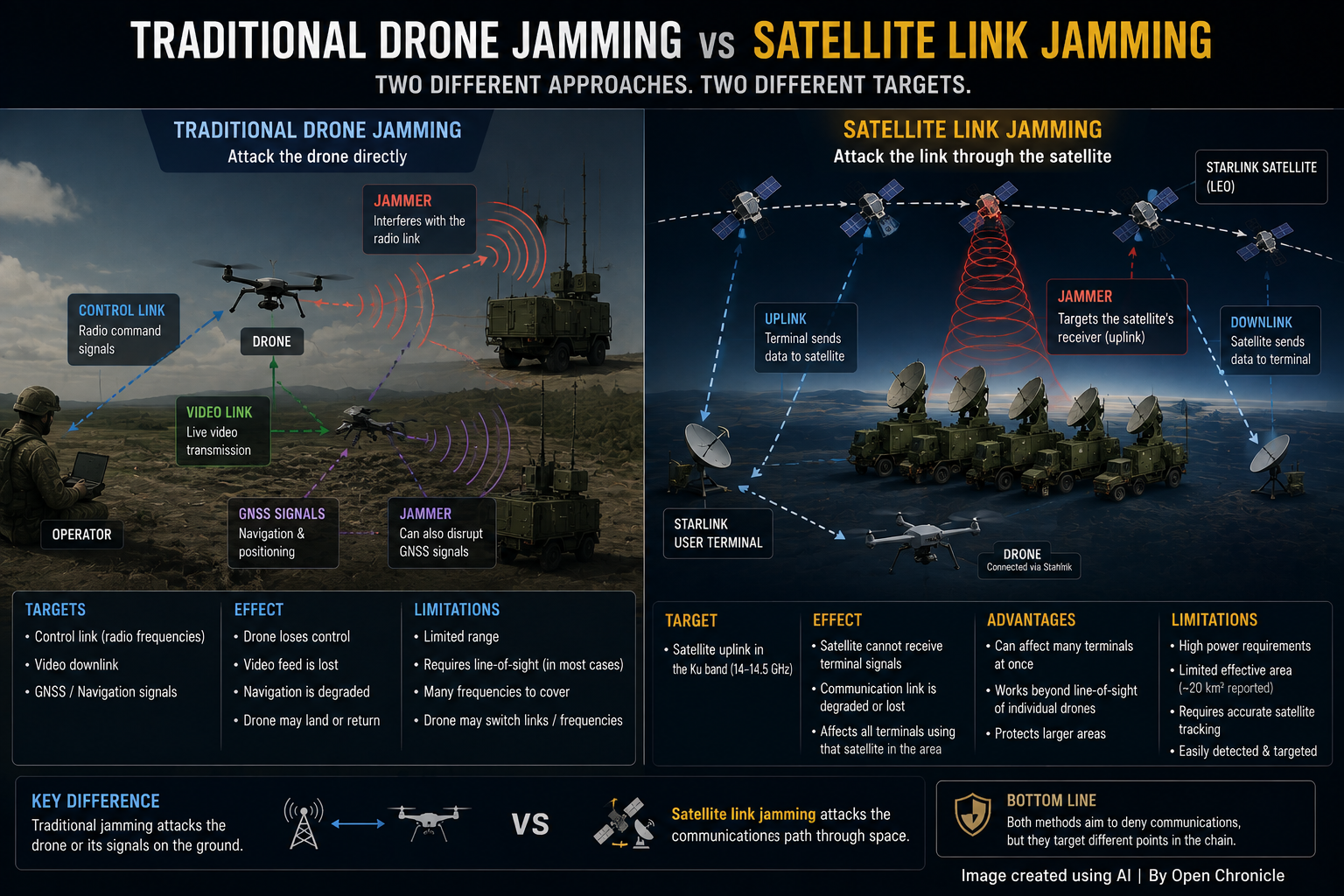
Traditional drone electronic warfare frequently targets three elements.
The command link can be disrupted.
Satellite navigation can be jammed.
Video transmission can be interrupted.
A drone connected through Starlink can reduce its dependence upon conventional long range radio links.
It can potentially maintain control through the satellite network.
Volna Kupol Garant attacks that alternative architecture.
The conceptual difference is important.
Traditional jammer:
Operator → terrestrial radio link → drone
Volna Kupol Garant target architecture:
Operator → Starlink network → satellite → drone terminal
The jammer attempts to interfere with the space segment of the communications chain rather than concentrating exclusively on the aircraft.
Known and Reported Characteristics
System: Volna Kupol Garant
Origin: Russia
Status: Operationally reported
Role: Satellite communications electronic warfare
Primary reported target: Starlink
Reported manufacturer: Rossiysky Kupol LLC
Reported location of manufacturer: Simferopol
Operating principle: Directional uplink interference
Primary frequency range: Approximately 14 to 14.5 GHz, reported
Number of channels: Eight, reported
Bandwidth per channel: Approximately 62.5 MHz, reported
Antenna system: Multiple steerable satellite dishes
Physical configuration: Six trailer based modules commonly reported
Number of antennas: Eight active channels commonly described, up to twelve physical antennas reported in some configurations
Power: Generator or external electrical supply reportedly supported
Target tracking: Moving low Earth orbit satellites
Reported effective area: Approximately 20 square kilometres
Estimated cost: Approximately 1.5 million United States dollars reported by Ukrainian sources
First experimental activity: Earlier Russian Starlink jamming efforts reported during the war
Significant renewed deployment: 2026
Systems detected: Approximately ten reported by Ukrainian officials by July 2026
Serial production: Claimed by Russian defence industry source, August 2026
Confidence Assessment
Existence of a Russian specialised Starlink jamming system: High confidence
Identification as Volna Kupol Garant: High confidence
Operational deployment during 2026: High confidence
Use of multiple directional antennas: High confidence
Uplink oriented jamming concept: High confidence
Operating range around 14 to 14.5 GHz: Medium to high confidence
Eight channel architecture: Medium to high confidence
Approximately 20 square kilometre coverage: Medium confidence
Approximately 1.5 million dollar unit cost: Medium to low confidence
Ability to suppress Starlink consistently under all conditions: Unknown
Ability to disable Starlink over entire regions using only a small number of systems: Low confidence
Ability to physically damage satellites: No credible evidence
Operational Strengths
The system potentially offers several advantages.
It can attack satellite communications without needing to locate every individual user terminal.
Its directional antennas can concentrate energy.
It can interfere with an important communications architecture supporting unmanned systems.
It can protect selected logistics corridors or high value installations.
It can be relocated using trailer modules.
It attacks a communications layer that many traditional tactical jammers do not reach.
Operational Weaknesses
The system also appears to have important disadvantages.
It requires considerable power.
It uses multiple relatively large antenna modules.
It must track fast moving satellites.
It can transmit a strong electromagnetic signature.
Its physical components may be vulnerable to drone or missile attack.
Its effective geographical area appears limited.
The Starlink constellation offers substantial redundancy.
SpaceX can adapt software and communications behaviour.
Replacing destroyed jammer systems may impose significant economic and logistical costs.
Strategic Significance
The strategic importance of Volna Kupol Garant extends beyond whether its exact reported coverage is 10, 20 or 30 square kilometres.
Its importance lies in what it represents.
The Russia Ukraine War has increasingly become a contest between connected systems.
Drones depend upon communications.
Artillery depends upon targeting information.
Commanders depend upon data networks.
Sensors depend upon transmission links.
Commercial satellite networks have become part of that military infrastructure.
Electronic warfare consequently attacks the network itself.
Volna Kupol Garant represents a deliberate attempt to extend battlefield electronic attack into low Earth orbit communications.
Technology Spotlight: Uplink Jamming
Imagine two people trying to speak to someone located far away.
A conventional jammer stands beside the listener and creates noise.
The listener cannot hear the speaker.
Uplink jamming approaches the problem differently.
The jammer places interference near the receiving point of the distant communications relay.
In satellite communications, that receiving point is hundreds of kilometres above Earth.
Directional antennas compensate partly for this enormous distance by concentrating radio energy.
The challenge is accurately placing enough energy into the receiving beam while the satellite moves across the sky.
This explains why Volna Kupol Garant requires satellite tracking antennas rather than ordinary terrestrial jamming transmitters.
Technology Spotlight: Low Earth Orbit
Starlink satellites operate in low Earth orbit rather than the much higher geostationary orbit used by many traditional communications satellites.
Low orbit reduces communication latency.
It also means satellites move rapidly relative to ground users.
A geostationary satellite remains approximately fixed above one region of Earth.
A Starlink satellite passes overhead and disappears beyond the horizon.
Another takes its place.
For communications users, this creates a seamless network.
For a jammer, it creates a moving series of targets.
The jammer must constantly track, reacquire and adapt.
Technology Spotlight: Electronic Warfare versus Networks
Electronic warfare increasingly resembles competition between networks rather than individual machines.
One side changes frequencies.
The other searches for those frequencies.
One side increases transmitter power.
The other improves filtering.
One side develops directional antennas.
The other changes beam management.
One side introduces a new jammer.
The other changes software.
This cycle can occur far more quickly than the traditional process of developing an entirely new aircraft, missile or armoured vehicle.
Volna Kupol Garant therefore belongs as much to the history of software defined warfare as to the history of conventional electronic warfare.
Timeline
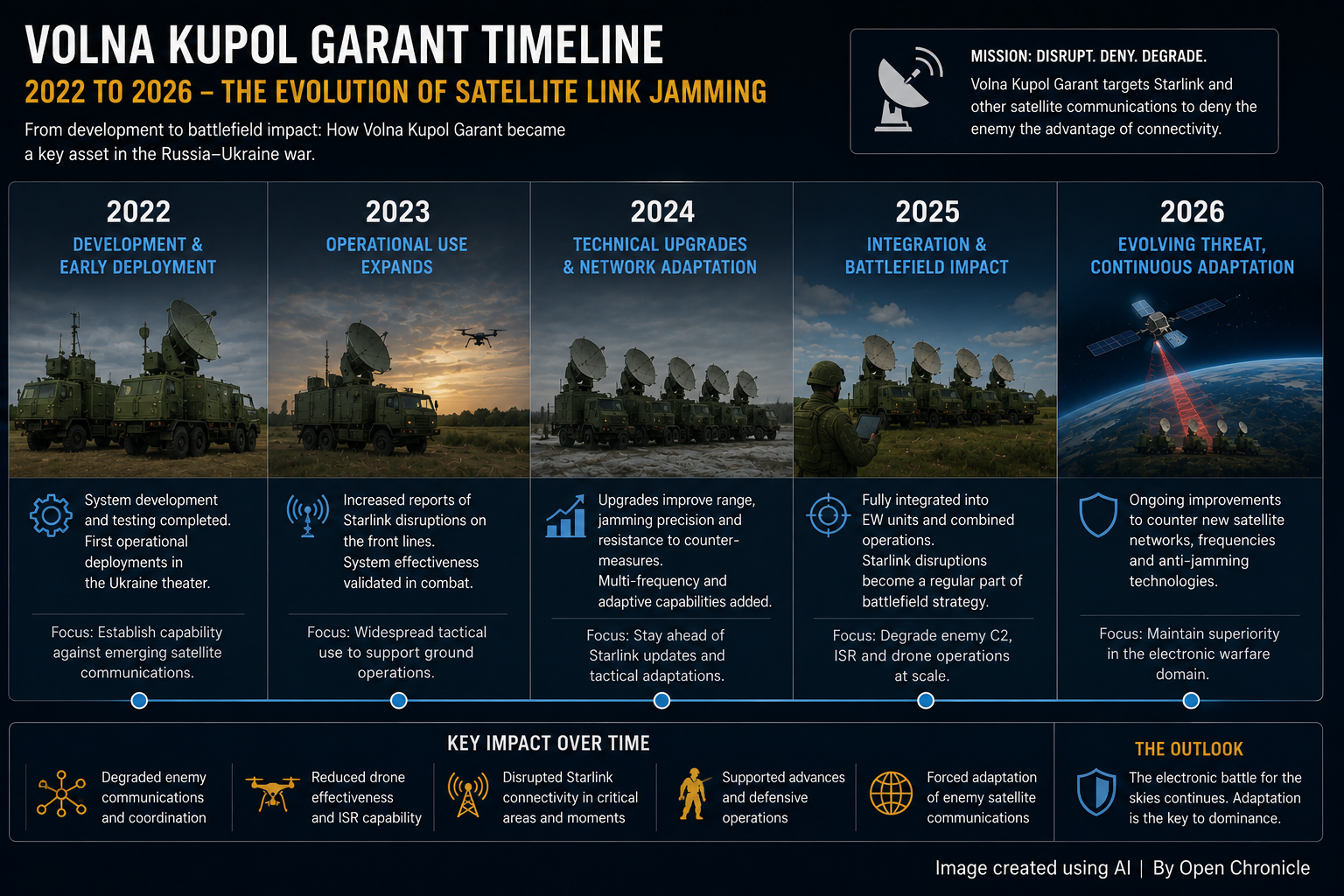
February 2022: Russia launches its full scale invasion of Ukraine.
2022: Starlink becomes increasingly important to Ukrainian military and civilian communications.
2022 to 2023: Russia experiments with different methods for interfering with Starlink and other communications systems.
2023 to 2024: Ukrainian sources report early specialised Russian Starlink interference activity, including systems detected on the Kharkiv axis.
2024 to 2025: Satellite communications become increasingly integrated into Ukrainian unmanned operations.
Early 2026: Ukrainian long and medium range drone operations increasingly threaten Russian logistics and infrastructure.
June 2026: Ukrainian specialist Serhii Beskrestnov publicly identifies Volna Kupol Garant and describes its operating architecture.
June 2026: Ukrainian forces report attacks against Volna Kupol Garant installations.
July 2026: Reuters documents Russian use of Volna Kupol Garant against Ukrainian Starlink connected drones and reports approximately ten systems detected.
July 2026: Ukrainian drone operators describe restoration of Starlink connectivity after destruction of a jammer installation.
August 2026: Additional reports emerge concerning attacks against Volna Kupol Garant sites.
28 August 2026: TASS reports that Russia has begun serial production of the system, citing a defence industry source.
Present: The system remains part of an evolving electronic warfare contest between Russian countermeasures, Ukrainian unmanned operations and adaptive commercial satellite communications.
Did You Know?
Volna Kupol Garant reportedly targets signals travelling towards Starlink satellites rather than concentrating only on signals travelling down towards ground terminals.
The commonly reported frequency range covers approximately 500 MHz.
Reports describe this range as divided into eight channels of roughly 62.5 MHz each.
The system reportedly requires several trailer mounted antenna modules.
Its reported 20 square kilometre denial area corresponds to a radius of only approximately 2.5 kilometres if represented as a simple circle.
Starlink’s enormous number of satellites makes constellation wide jamming fundamentally different from disrupting one communications satellite.
The jammer itself can become a target because powerful electronic emissions may reveal its position.
Ukrainian forces have reported specifically hunting Volna Kupol Garant installations.
Russian sources claimed serial production had begun in August 2026.
The system does not need to physically damage a satellite to produce military effects.
Open Chronicle Perspective
Volna Kupol Garant illustrates one of the most important technological lessons emerging from the Russia Ukraine War.
Modern warfare is increasingly dependent upon connectivity.
A weapon may have exceptional range.
A drone may have sophisticated sensors.
A command centre may possess powerful computers.
None of those systems reaches its full potential if information cannot move between them.
Starlink changed the battlefield because it provided Ukraine with a communications network that was difficult to eliminate using traditional methods.
Russia’s response was therefore predictable.
If individual terminals are difficult to suppress, attack the communications architecture.
Volna Kupol Garant represents one answer to that problem.
Whether it ultimately proves highly effective or only locally useful is less important historically than the concept it demonstrates.
Electronic warfare is expanding beyond radio towers, radars and navigation signals.
Commercial satellite constellations have become part of the battlespace.
Their uplinks can be attacked.
Their downlinks can be attacked.
Their ground terminals can be attacked.
Their software can be contested.
Their orbital architecture can influence military planning.
This creates an unusual technological competition.
A Russian jammer costing perhaps more than a million dollars can attempt to interfere with a satellite costing far more.
That satellite belongs to a constellation containing thousands of spacecraft.
A Ukrainian drone costing far less can then attempt to destroy the jammer.
SpaceX can subsequently modify network software or operating parameters.
Russia can modify the jammer.
Ukraine can change drone communications.
The cycle begins again.
This is not conventional electronic warfare in the Cold War sense.
It is network warfare extending from the ground into low Earth orbit.
Volna Kupol Garant may therefore become historically important even if its individual operational performance proves limited.
It represents the emergence of a battlefield where controlling electromagnetic access to commercial space infrastructure can directly influence operations on the ground.
The fight for the electromagnetic spectrum is no longer confined to Earth.
References
Reuters reporting concerning Russian attempts to jam Starlink communications used by Ukrainian drones, July 2026.
Interfax Ukraine reporting based upon statements by Ukrainian radio technology specialist Serhii Beskrestnov concerning Volna Kupol Garant architecture and deployment.
Inside GNSS technical analysis examining the feasibility and limitations of Russian uplink jamming against the Starlink constellation.
Ukrainska Pravda reporting concerning Volna Kupol Garant deployments, attacks against identified systems and technical descriptions.
TASS reporting of 28 August 2026 concerning claimed Russian serial production of Volna Kupol Garant.
Open source technical analysis concerning Starlink Ku band uplink architecture, directional interference and low Earth orbit satellite communications.
Explore this subject
Continue exploring related Open Chronicle Encyclopedia entries through the categories associated with this article.

Staff Writers at Open Chronicle produce trusted journalism, strategic analysis and authoritative reference content across global affairs, geopolitics, defense, science, history, technology, business, culture and sport. Their work combines accurate reporting with historical perspective and analytical depth, helping readers understand not only what is happening, but why it matters. Beyond daily news coverage, Staff Writers contribute to the Open Chronicle Encyclopedia, investigative features, original research projects and long-form reports, building a comprehensive knowledge platform designed to inform, educate and preserve reliable information for a global audience.