
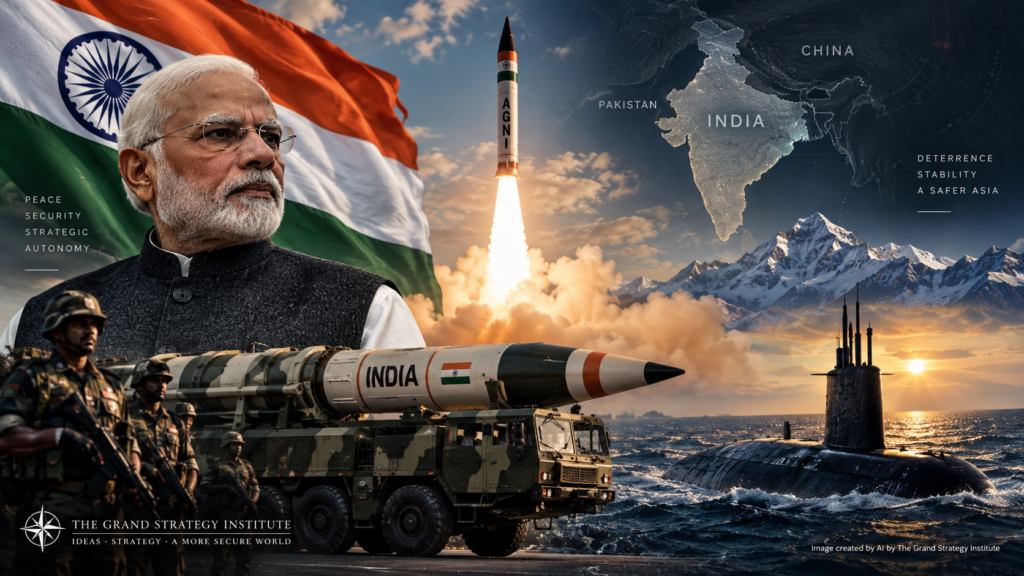
A new assessment estimates that India may possess around 190 nuclear warheads and enough weapons-grade plutonium for as many as 225. The numbers matter, but the deeper strategic transformation lies in New Delhi’s increasingly sophisticated land, air and sea-based deterrent as it prepares simultaneously for Pakistan and a more powerful China.
By The Grand Strategy Institute Research Division
Grand Strategy Analysis | 10 September 2026
India is quietly becoming a more consequential nuclear power.
A new assessment published by researchers from the Federation of American Scientists’ Nuclear Information Project estimates that India may have assembled approximately 190 nuclear warheads, with more than 160 associated with operational launchers and additional weapons intended for missile systems entering production. The researchers estimate that India’s available military plutonium could theoretically support somewhere between 140 and 225 warheads, although they explicitly caution that this range should not be interpreted as the number of weapons India actually possesses.
That distinction is essential.
India has not announced that it possesses 190 nuclear weapons.
The figure is an open-source analytical estimate produced by Hans M. Kristensen, Matt Korda, Eliana Johns and Mackenzie Knight-Boyle using publicly available information, government-originating data, satellite imagery, estimates of fissile material and assessments of India’s nuclear delivery systems.
But the number is significant.
It reinforces a broader trend that has been developing for years.
India is modernising virtually every component of its nuclear forces.
New missiles are appearing.
Longer-range systems are being developed.
Sea-based nuclear deterrence is becoming increasingly credible.
Delivery systems are becoming more survivable.
And India’s nuclear strategy, historically dominated by Pakistan, increasingly has to account for China.
The result is not simply a larger Indian arsenal.
It is the emergence of a more sophisticated nuclear force designed to survive, retaliate and operate across a strategic environment containing two nuclear-armed competitors.
That transformation has consequences far beyond South Asia.
190 Is an Estimate, Not an Official Count
The first question is how anyone outside the Indian government can know how many nuclear weapons India possesses.
The answer is that they cannot know with certainty.
India does not publish a detailed inventory of its nuclear stockpile.
Unlike the United States and Russia during periods of extensive arms-control verification, there is no comparable transparency regime providing outside researchers with precise information about India’s assembled warheads.
The FAS estimate therefore relies on several categories of evidence.
Researchers examine the number and type of nuclear-capable delivery systems.
They analyse satellite imagery of military facilities.
They monitor missile development and production.
They study publicly available government information.
And they estimate the amount of weapons-grade fissile material available to India.
Combining these elements allows researchers to construct an approximate force structure.
For 2026, the result is approximately 190 warheads.
This happens to align with another prominent estimate. The Arms Control Association also lists India’s arsenal at roughly 190 warheads as of June 2026.
That convergence does not transform an estimate into an official fact.
But it strengthens the assessment that India’s arsenal has reached roughly this scale.
The 225 Figure Requires Even Greater Caution
The figure of 225 warheads is particularly easy to misunderstand.
The new assessment does not say India possesses 225 nuclear weapons.
Instead, it estimates the theoretical number of weapons that India’s accumulated weapons-grade plutonium might support.
The International Panel on Fissile Materials estimated that India had produced approximately 730 kilograms of weapons-grade plutonium by the beginning of 2026, with an uncertainty of approximately 170 kilograms in either direction.
Using an illustrative assumption of approximately four kilograms of plutonium per weapon, FAS researchers calculate that the material could theoretically support roughly 140 to 225 warheads.
But several uncertainties make a direct conversion impossible.
Different nuclear weapon designs require different quantities of fissile material.
India may retain significant plutonium reserves rather than converting everything into weapons.
And there is no strategic reason to manufacture large numbers of warheads without sufficient delivery systems to employ them.
The analytically defensible conclusion is therefore:
India may possess approximately 190 nuclear warheads today, while its fissile-material base could potentially support further expansion.
That is more important than the headline figure of 225.
India Is Building a Nuclear Triad
The transformation becomes clearer when the arsenal is considered as a system rather than a number.
India is developing the three traditional components of a nuclear triad:
air-delivered weapons,
land-based ballistic missiles,
and submarine-launched ballistic missiles.
A nuclear triad exists primarily to make deterrence more survivable.
An adversary attempting a disarming first strike must locate and destroy several different categories of nuclear forces operating across different environments.
Aircraft can disperse.
Mobile land missiles can move.
Ballistic missile submarines can disappear beneath the ocean.
The more survivable these forces become, the more difficult it becomes for an adversary to believe it could eliminate India’s ability to retaliate.
That strengthens second-strike capability.
And second-strike capability sits at the heart of credible nuclear deterrence.
Pakistan Was the Original Nuclear Problem
India’s nuclear strategy cannot be understood without Pakistan.
The two states have fought multiple wars since partition in 1947.
Both possess nuclear weapons.
Both maintain ballistic missile forces.
Both face unresolved territorial disputes.
And both have experienced repeated military crises.
The FAS researchers describe India-Pakistan tensions as one of the world’s most serious nuclear flashpoints and point to their open hostilities as recently as May 2025.
Geography makes the problem particularly dangerous.
Distances are short.
Decision times can be compressed.
Ballistic missiles can reach targets quickly.
Conventional military operations can escalate before political leaders fully understand the opponent’s intentions.
And both sides must interpret military movements while assuming that some of those movements could have nuclear significance.
For decades, this relationship formed the centre of India’s nuclear planning.
But India now faces another strategic problem.
China.
China Is Changing the Logic of India’s Arsenal
China possesses a much larger and rapidly modernising nuclear arsenal.
The 2026 Nuclear Notebook assessment of China estimates approximately 620 nuclear warheads, alongside continued expansion of missile forces, new silo fields and improvements to China’s submarine-based deterrent.
That creates a fundamentally different challenge for India.
Pakistan is geographically close and has a smaller strategic footprint.
China is a continental-scale military power with intercontinental systems, ballistic missile submarines, extensive conventional capabilities and an expanding nuclear force.
India therefore needs nuclear systems capable of surviving and reaching strategically important targets at considerably greater distances.
This helps explain why longer-range Indian missile development matters.
New Delhi is no longer designing its nuclear posture exclusively around Islamabad.
Indian nuclear strategy increasingly has two geographical horizons: Pakistan to the west and China to the north and east.
That change may ultimately prove more consequential than whether the stockpile contains 180, 190 or 200 warheads.
The Agni Family Is Central to the Transformation
India’s land-based deterrent is built around an increasingly sophisticated family of ballistic missiles.
Earlier systems were particularly suited to regional deterrence against Pakistan.
Newer Agni systems provide substantially greater range and flexibility.
This changes the strategic geometry.
A longer-range missile does not merely reach more distant targets.
It allows launchers to operate from deeper inside Indian territory.
That improves survivability.
It complicates enemy surveillance.
It provides commanders with more deployment options.
And it reduces the requirement to position strategic forces close to vulnerable borders.
This is especially important in relation to China.
India’s development of increasingly capable land-based missiles therefore serves both offensive reach and defensive survivability.
MIRVs Could Change the Equation Further
Another technological development deserves close attention.
India has been developing multiple independently targetable re-entry vehicle, or MIRV, capability.
A MIRVed missile can carry multiple nuclear warheads capable of being directed toward separate targets.
This can dramatically alter force calculations.
Instead of assuming that one missile corresponds to one potential target, adversary planners must account for several warheads carried by a single launcher.
MIRVs can therefore increase the potential striking capacity of a missile force without requiring an equivalent increase in launcher numbers.
They also complicate missile defence.
But MIRVs create their own strategic problems.
They can increase pressure to expand warhead inventories.
They can make nuclear forces appear more threatening.
And they can intensify arms competition because adversaries may respond by increasing their own forces or improving counterforce capabilities.
If India moves toward significant MIRV deployment, the consequences could therefore extend well beyond technical modernisation.
It could change the numerical logic of its nuclear arsenal.
The Sea Is Becoming the Most Important Part of India’s Deterrent
Perhaps the most consequential transformation is occurring underwater.
India has invested heavily in developing nuclear-powered ballistic missile submarines.
The strategic purpose is straightforward.
Land-based nuclear forces can potentially be located.
Airbases can be attacked.
Fixed installations can be targeted.
A ballistic missile submarine operating beneath the ocean is much harder to find.
That gives India a survivable retaliatory force.
Even if an adversary were somehow able to destroy a large proportion of India’s land-based nuclear forces, submarines at sea could remain capable of retaliation.
This is the essence of assured second-strike deterrence.
India’s development of its Arihant-class submarines and submarine-launched ballistic missiles therefore represents more than naval modernisation.
It changes the credibility of India’s entire nuclear posture.
But Nuclear Submarines Create New Risks
Sea-based deterrence is not automatically stabilising.
A submarine must communicate with national command authorities.
Crews must operate nuclear weapons safely.
Political leaders must maintain positive control.
Adversaries may attempt to track ballistic missile submarines.
Anti-submarine warfare forces may hunt them.
Conventional and nuclear naval operations may overlap.
This creates what strategists call entanglement.
Imagine an adversary attacking an Indian submarine during a conventional conflict without knowing whether it carries nuclear weapons.
India might interpret the attack as an attempt to destroy its nuclear deterrent.
A conventional naval engagement could suddenly acquire nuclear significance.
As India, China and Pakistan develop more sophisticated maritime capabilities, the Indian Ocean may therefore become increasingly important to Asian nuclear stability.
Credible Minimum Deterrence
India continues publicly to describe its nuclear doctrine through the concept of credible minimum deterrence.
The idea is deliberately different from seeking numerical parity with larger nuclear powers.
India does not need as many nuclear weapons as Russia or the United States.
It needs enough survivable weapons to convince an adversary that attacking India with nuclear weapons would produce unacceptable retaliation.
The word minimum, however, is inherently flexible.
Minimum relative to what?
Pakistan?
China?
Both simultaneously?
An adversary’s missile defence?
An adversary’s growing arsenal?
The survivability of India’s own forces?
As the strategic environment changes, the number required to maintain a credible minimum can change with it.
This is why an expanding arsenal does not necessarily mean India has formally abandoned minimum deterrence.
It may mean that New Delhi’s interpretation of what constitutes a credible minimum is evolving.
No First Use Remains Official Policy
India’s nuclear doctrine also contains one of its most important declaratory principles:
No First Use.
India maintains that nuclear weapons would not be used first in a conflict and that its arsenal exists principally to retaliate against nuclear attack.
Indian government statements continue to reaffirm credible minimum deterrence and a No First Use posture. India’s diplomatic mission reiterated this position in its official disarmament statement, describing the country as committed to credible minimum deterrence, No First Use and non-use against non-nuclear weapon states.
This differentiates India’s declaratory posture from Pakistan’s.
Pakistan has historically refused to adopt No First Use because it views nuclear weapons partly as a counterweight to India’s superior conventional forces.
That asymmetry creates an unusual deterrence relationship.
India declares that it will not initiate nuclear use.
Pakistan retains nuclear first-use options.
The credibility of each side’s doctrine therefore becomes central during crises.
Doctrine Is Not the Same as Capability
Nuclear strategy requires analysts to distinguish between what governments say and what their forces allow them to do.
A No First Use policy can coexist with increasingly sophisticated nuclear capabilities.
More accurate missiles.
More survivable launchers.
MIRVs.
Submarine-based systems.
Improved command and control.
Faster readiness.
None of these developments automatically prove that India intends to abandon No First Use.
But they increase India’s range of nuclear options.
This matters because deterrence is shaped not only by declared intentions but by adversary perceptions.
Pakistan and China must plan against what India could potentially do, not simply what New Delhi says it intends to do.
The same applies in reverse.
This is one reason nuclear modernisation can generate arms competition even when governments insist their programmes are defensive.
The 1998 Tests Still Cast a Long Shadow
India’s modern nuclear status was established decisively through the Pokhran-II tests of May 1998.
Those tests demonstrated India’s willingness to openly establish itself as a nuclear-armed state.
Pakistan responded with its own nuclear tests shortly afterwards.
South Asia had entered an overt nuclear era.
But important technical uncertainties remain.
The new FAS assessment notes that the 1998 tests reliably demonstrated a functioning fission design, while India’s progress toward boosted-fission and thermonuclear weapon designs remains difficult for outside researchers to establish confidently.
This uncertainty matters when estimating warhead numbers.
More sophisticated weapon designs may use fissile material differently.
Without knowing the composition of India’s arsenal, analysts cannot simply divide total plutonium stocks by a fixed amount and obtain a reliable weapon count.
That is another reason the 225 figure must be treated as theoretical capacity rather than an inventory.
India Remains Outside the NPT
India occupies an unusual position in the international nuclear order.
It possesses nuclear weapons but is not recognised as one of the five nuclear-weapon states under the Nuclear Non-Proliferation Treaty.
India never joined the NPT as a non-nuclear-weapon state, arguing that the treaty institutionalised an unequal nuclear hierarchy.
This distinguishes India from states such as North Korea, which joined and later withdrew, and from recognised NPT nuclear powers such as the United States, Russia, China, France and Britain.
India has nevertheless developed increasingly extensive international nuclear relationships while maintaining its weapons programme.
Its nuclear status has gradually become embedded within the geopolitical realities of the international system even without formal NPT recognition.
That represents one of the most significant accommodations in the modern non-proliferation order.
India Does Not Need to Match China Warhead for Warhead
China’s larger arsenal creates an obvious question.
Will India attempt to catch up?
Probably not in simple numerical terms.
Nuclear deterrence does not require equality.
If India can preserve enough weapons after a Chinese first strike to inflict unacceptable damage in retaliation, deterrence can theoretically function even with a considerably smaller arsenal.
The crucial variables are therefore survivability, penetration capability, command and control, range and confidence in retaliation.
This explains why submarines and mobile missiles may matter more than raw warhead numbers.
One hundred highly survivable weapons can have greater deterrent value than several hundred vulnerable ones.
India’s nuclear modernisation should therefore be analysed qualitatively as well as quantitatively.
Pakistan Cannot Ignore the China Driven Modernisation
This creates one of the most difficult dynamics in South Asian deterrence.
India may develop longer-range missiles primarily because of China.
Pakistan sees India developing better missiles.
India may develop MIRVs partly because of Chinese missile defences and strategic capabilities.
Pakistan sees Indian MIRVs.
India may expand submarine-based deterrence to ensure survivability against China.
Pakistan sees Indian ballistic missile submarines.
An Indian capability designed for one adversary therefore affects the calculations of another.
This is a classic security dilemma.
India responds to China.
Pakistan responds to India.
India then responds to Pakistan’s response.
China observes India’s expansion.
The cycle can continue without any state originally seeking an unconstrained arms race.
China Faces the Same Problem in Reverse
Beijing also cannot completely separate its Indian nuclear calculations from its competition with the United States.
China’s nuclear expansion is heavily influenced by concerns involving American missile defence, conventional precision strike, nuclear capabilities and strategic competition.
India observes China’s expansion and adjusts.
Pakistan observes India.
Three nuclear relationships therefore become partially interconnected:
United States and China
China and India
India and Pakistan
Changes at the top can propagate downward.
This is increasingly important because the global nuclear system is no longer dominated exclusively by the bilateral U.S.-Russian relationship that structured much of the Cold War.
Asia is becoming a central nuclear theatre.
190 Warheads Therefore Tell Only Half the Story
The headline number is important.
But it risks obscuring the transformation underneath.
India’s strategic force is becoming:
more geographically dispersed,
more technologically sophisticated,
more survivable,
more maritime,
longer ranged,
and increasingly oriented toward two adversaries rather than one.
That is a qualitative change.
The difference between 180 and 190 weapons is relatively small.
The difference between a predominantly regional arsenal and a survivable land-air-sea deterrent capable of addressing China is much larger.
This is the real story of India’s nuclear modernisation.
Strategic Autonomy Has a Nuclear Foundation
India’s nuclear programme also connects directly to its broader grand strategy.
New Delhi has long pursued strategic autonomy.
It cooperates closely with the United States but is not an American treaty ally.
It participates in the Quad alongside the United States, Japan and Australia.
It maintains important relations with Russia.
It competes with China.
It maintains its own independent foreign policy.
A credible nuclear deterrent reinforces this autonomy.
Nuclear weapons reduce the degree to which India must rely on another power for ultimate security guarantees.
They give New Delhi greater freedom to navigate between major powers.
In this sense, India’s nuclear arsenal is not merely a military instrument.
It is one of the foundations of India’s claim to independent great-power status.
The Arsenal Reflects India’s Changing Place in the World
India in 1998 was an emerging regional power.
India in 2026 has a very different international position.
Its economy is substantially larger.
Its military reach is expanding.
Its space capabilities are advancing.
Its navy operates across a strategically critical Indian Ocean.
Its geopolitical importance to Washington, Moscow, European capitals and Indo-Pacific partners has increased.
And its principal strategic competitor is increasingly China rather than Pakistan alone.
A more capable nuclear arsenal is therefore partly the military expression of a larger geopolitical transformation.
India increasingly thinks like a state that expects to remain one of the major centres of power in the international system.
Its nuclear forces are adapting accordingly.
GSI Strategic Assessment
The Grand Strategy Institute assesses that the significance of the new 190-warhead estimate lies less in the precise number than in the structural transformation of India’s nuclear deterrent.
First, India appears to be expanding its nuclear stockpile gradually rather than pursuing explosive numerical growth.
The FAS estimate of approximately 190 warheads is consistent with a continuing but measured expansion.
Second, India possesses the fissile-material potential for additional growth.
Approximately 730 kilograms, subject to substantial uncertainty, of estimated weapons-grade plutonium could theoretically support a larger arsenal, although there is no evidence that all available material has been weaponised.
Third, the transformation of delivery systems is more strategically significant than the headline warhead number.
India is strengthening land-based missiles, nuclear-capable aviation and particularly its sea-based deterrent.
Fourth, China is increasingly important to Indian nuclear planning.
Pakistan remains an immediate nuclear competitor, but longer-range and more survivable systems reflect requirements that extend beyond the traditional India-Pakistan balance.
Fifth, India’s emerging nuclear triad strengthens second-strike capability.
This can improve deterrence by reducing incentives for an adversary to believe India’s nuclear forces could be eliminated in a first strike.
Sixth, greater capability can simultaneously create new escalation risks.
Submarine operations, MIRVs, improved readiness and increasingly sophisticated delivery systems complicate adversary calculations.
Seventh, India’s official No First Use doctrine remains important.
New Delhi continues publicly to affirm credible minimum deterrence and No First Use.
Eighth, the meaning of “minimum” is evolving.
A minimum deterrent against Pakistan alone is not necessarily the same force required to deter Pakistan and a rapidly expanding Chinese nuclear arsenal simultaneously.
Ninth, India’s modernisation cannot be understood as a bilateral arms race.
The nuclear dynamics of the United States, China, India and Pakistan are increasingly connected.
Tenth, India’s nuclear arsenal is becoming an instrument of great-power autonomy.
A survivable independent deterrent reinforces New Delhi’s ability to avoid dependence on external nuclear guarantees.
The central strategic conclusion is therefore not that India suddenly possesses an enormous nuclear arsenal.
It does not.
Russia and the United States remain in an entirely different numerical category, while China’s arsenal is substantially larger.
The important development is that India is moving from possessing nuclear weapons toward possessing an increasingly mature nuclear force.
That distinction will shape Asian security for decades.
Key Judgements
- FAS researchers estimate that India may have assembled approximately 190 nuclear warheads in 2026. More than 160 are assessed as associated with operational launchers, with additional weapons linked to new missile production.
- The figure is an analytical estimate, not an official Indian declaration.
- The frequently reported 225 figure represents theoretical production potential, not an estimate of India’s current stockpile. FAS estimates India’s weapons-grade plutonium could theoretically support approximately 140 to 225 weapons.
- The plutonium calculation contains substantial uncertainty because the exact quantity of material, weapon designs and amount retained in reserve are unknown.
- India continues to modernise all three components of its nuclear deterrent, including aircraft, land-based missiles and sea-based systems.
- The development of a more credible sea-based deterrent is particularly important because it increases the survivability of India’s retaliatory capability.
- Pakistan remains central to Indian nuclear planning, but China increasingly shapes India’s force requirements.
- China’s much larger and expanding nuclear arsenal creates pressure for India to improve range, survivability and penetration capability rather than necessarily seek numerical parity.
- Indian systems developed principally with China in mind can nevertheless provoke Pakistani countermeasures, creating a cascading regional security dilemma.
- India continues officially to maintain credible minimum deterrence and a No First Use posture.
- Modernisation does not by itself demonstrate abandonment of No First Use, although increasingly capable forces expand India’s potential nuclear options.
- The definition of credible minimum deterrence is inherently dynamic. Changes in Chinese and Pakistani forces can alter India’s assessment of the minimum force required.
- India’s nuclear arsenal supports its wider doctrine of strategic autonomy, reducing dependence on external security guarantees.
- The central trend is qualitative as much as quantitative. India’s nuclear force is becoming more survivable, sophisticated, longer ranged and increasingly maritime.
- Asia is emerging as an increasingly interconnected nuclear system in which U.S.-China competition can influence China-India competition, which in turn affects India-Pakistan deterrence.
Conclusion
The number 190 will attract attention.
The number 225 will attract even more.
But neither captures the most important development.
India is not simply accumulating nuclear warheads.
It is constructing a nuclear system.
Land-based missiles provide mobility and reach.
Aircraft provide flexibility.
Ballistic missile submarines promise survivability.
New missile technologies can complicate interception.
Greater ranges bring more of China within India’s strategic horizon.
And continued fissile-material production preserves the option to expand further.
Yet India continues publicly to describe this growing capability as credible minimum deterrence.
That apparent contradiction reveals the central question surrounding India’s nuclear future.
Minimum deterrence is not a fixed number.
It is a relationship between capability, vulnerability and perceived threat.
When Pakistan changes its forces, India’s minimum can change.
When China expands its arsenal, India’s minimum can change again.
When missile defence improves, penetration requirements change.
When submarines become more capable, survivability calculations change.
The result is a nuclear arsenal that can expand without India ever formally declaring that it has abandoned the principle of minimum deterrence.
That is why the new estimate matters.
It provides another indication that India’s strategic requirements are changing.
New Delhi no longer faces a single nuclear problem.
It faces Pakistan, a neighbouring nuclear power with which it has repeatedly fought.
It faces China, a much larger nuclear power with growing military capabilities and an unresolved border dispute.
And it faces an emerging Asian nuclear environment in which decisions made in Washington and Beijing can eventually alter calculations in New Delhi and Islamabad.
India’s answer is becoming increasingly clear.
Not numerical parity.
Not Cold War-scale nuclear accumulation.
But a more survivable, more flexible and more technologically sophisticated deterrent capable of addressing multiple strategic directions.
India’s estimated 190 warheads therefore represent something larger than an arsenal count. They mark another stage in the transformation of India from a regional nuclear power into one of the central actors shaping the emerging nuclear order of Asia.
The Grand Strategy Institute
Continue Exploring Strategic Analysis
Return to The Grand Strategy Institute for strategic assessments, long-form analysis and research examining geopolitics, military affairs, international security, emerging technologies and the changing international order.
← Back to The Grand Strategy Institute