
By Open Chronicle History Desk
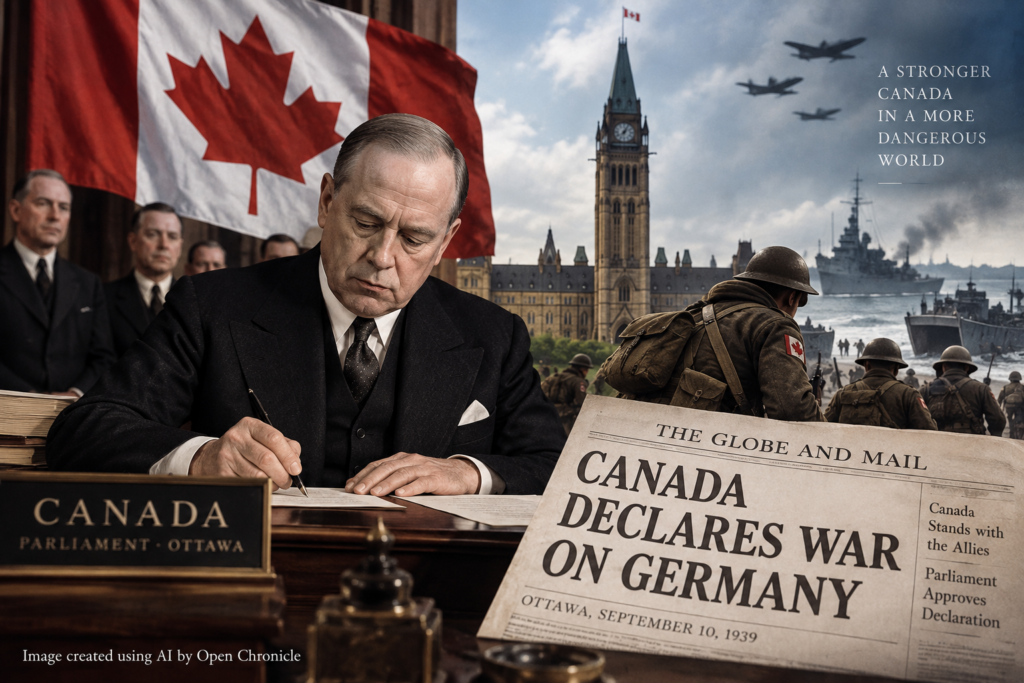
On September 10, 1939, Canada declared war on Nazi Germany.
At first glance, the event might appear to be simply another step in the rapid expansion of the European conflict that had begun nine days earlier with Germany’s invasion of Poland.
But Canada’s declaration carried a deeper historical significance.
When Britain declared war on Germany on September 3, Canada did not automatically follow.
Instead, the Canadian Parliament debated the question. The government of Prime Minister William Lyon Mackenzie King made its own decision, and King George VI issued Canada’s declaration of war on September 10 on the advice of his Canadian ministers.
It was a powerful demonstration of Canada’s evolving sovereignty.
Twenty five years earlier, when Britain entered the First World War in 1914, Canada had automatically been at war as part of the British Empire.
In 1939, things were different.
Canada entered the Second World War as a country making its own decision.
And over the following six years, a nation of approximately 11 million people would mobilise more than one million men and women for military service and become a major participant in the Allied victory.
September 1, 1939
The crisis began before dawn on September 1, when German forces invaded Poland.
Adolf Hitler’s expansionist policies had already transformed Europe.
Germany had remilitarised the Rhineland, annexed Austria and dismantled Czechoslovakia.
Britain and France had attempted to avoid another European war through negotiation and appeasement.
The invasion of Poland made that policy impossible to sustain.
Britain and France had guaranteed Polish independence.
After Germany ignored demands to withdraw, Britain declared war on September 3.
France followed.
The Second World War in Europe had begun.
Across the Atlantic, Canada now faced its own decision.
Canada Was No Longer 1914 Canada
The constitutional situation had changed dramatically since the First World War.
In August 1914, Britain declared war on Germany.
Because Canada remained a dominion within the British Empire, Britain’s declaration automatically placed Canada at war.
Canadians could decide how much they contributed.
They could not independently decide whether the country was technically at war.
Canada nevertheless made an enormous contribution to the conflict.
More than 600,000 Canadians served during the First World War, and the battles of Ypres, the Somme, Vimy Ridge and Passchendaele became deeply embedded in Canadian national memory.
The cost was immense.
More than 60,000 Canadian service personnel died.
The experience also accelerated Canada’s political development.
From Dominion to Greater Independence
The First World War changed the relationship between Britain and its dominions.
Canada signed the Treaty of Versailles separately and became an individual member of the League of Nations.
During the following decade, the dominions demanded greater control over their own foreign policies.
A decisive moment came with the Balfour Declaration of 1926, which recognised Britain and the dominions as autonomous communities within the British Empire, equal in status.
That principle was given legislative force through the Statute of Westminster in 1931.
Canada remained connected to Britain and shared the same monarch.
But the constitutional relationship had fundamentally changed.
Foreign policy increasingly belonged to the Canadian government.
September 1939 would provide one of the clearest demonstrations of that transformation.
Mackenzie King and the Memory of the First World War
Prime Minister William Lyon Mackenzie King understood how politically dangerous another European war could be for Canada.
He had good reason.
The First World War had produced a severe domestic crisis over conscription.
In 1917, the Canadian government introduced compulsory military service as casualties mounted overseas.
The issue sharply divided the country.
Support for conscription was particularly strong among many English speaking Canadians.
Opposition was especially intense in Quebec, where many French Canadians felt little attachment to Britain’s European war.
The political scars remained.
Mackenzie King was determined not to repeat the crisis if he could avoid it.
Canada’s Parliament Decides
When Britain declared war on September 3, Canada did not immediately issue its own declaration.
That delay was deliberate.
Mackenzie King wanted Parliament to participate in the decision.
Parliament was recalled and met in special session on September 7.
The government presented its case for Canadian participation.
Germany’s attack on Poland was portrayed not simply as a distant European dispute but as a threat to the international order and the democratic states.
Debate followed.
There was opposition, particularly from figures who feared Canada would again become trapped in Britain’s wars.
But support for participation was overwhelming.
Both houses of Parliament approved the government’s position.
Canada would go to war.
September 10, 1939
On September 10, the formal declaration was issued.
Canada was at war with Germany.
The nine day interval between Germany’s invasion of Poland and Canada’s declaration was historically important.
Canada had reached the same conclusion as Britain.
But it had done so through its own constitutional process.
The distinction was subtle but profound.
Canada was not entering the war merely because London had done so.
Its Parliament had debated the matter.
Its government had recommended action.
The Crown acted on Canadian advice.
The country had exercised its own foreign policy.
A Country of Eleven Million
Canada entered the conflict with a relatively small population.
Approximately 11 million people lived in the country in 1939.
Its permanent armed forces were limited.
The Royal Canadian Navy was small.
The Royal Canadian Air Force was modest.
The Canadian Army was not prepared for a conflict on the scale that would follow.
But Canada possessed other enormous advantages.
It had vast natural resources.
It had significant industrial potential.
It was geographically protected from direct German invasion.
And it maintained exceptionally close economic and strategic relationships with both Britain and the United States.
Those advantages would transform Canada into one of the Allied coalition’s important military and industrial bases.
Mobilisation Begins
The Canadian government began expanding the armed forces.
Recruitment offices received volunteers.
Training camps expanded.
Factories prepared for wartime production.
Ships were constructed.
Aircraft manufacturing increased.
Agricultural production became strategically important.
The Canadian economy gradually shifted towards war.
By the end of the conflict, more than one million Canadians had served in uniform, an extraordinary mobilisation for a country of Canada’s population.
Tens of thousands would never return.
The First Canadian Troops Reach Britain
The 1st Canadian Infantry Division began crossing the Atlantic in late 1939.
Canadian soldiers arrived in Britain while Western Europe was experiencing the strange period later called the Phoney War.
Britain and France were technically at war with Germany, but major fighting on the Western Front had not yet begun.
That changed dramatically in May 1940.
Germany attacked the Netherlands, Belgium, Luxembourg and France.
Within weeks, the strategic situation collapsed.
France fell.
Britain faced the possibility of invasion.
Canadian troops suddenly found themselves among the forces defending the British Isles.
Canada and the Battle of the Atlantic
Canada’s most sustained military contribution occurred at sea.
Britain depended on Atlantic shipping for food, fuel, weapons, raw materials and troops.
German U boats attempted to sever that lifeline.
The Battle of the Atlantic became the longest continuous campaign of the Second World War.
Canada played a central role.
The Royal Canadian Navy expanded at extraordinary speed.
From a small prewar force, it grew into one of the world’s largest navies by the end of the conflict.
Canadian warships escorted convoys across the Atlantic.
They hunted submarines.
They rescued survivors.
They endured storms, freezing temperatures and the constant possibility of torpedo attack.
The Atlantic was Canada’s battlefield for almost the entire war.
The British Commonwealth Air Training Plan
Canada also became one of the great training grounds of the Allied air war.
Its enormous territory, distance from enemy aircraft and existing connections with Britain made it ideal for aviation training.
The British Commonwealth Air Training Plan established a vast network of flying schools and training facilities across Canada.
Pilots, navigators, radio operators, bomb aimers and other aircrew from Canada and other Commonwealth countries trained there.
The programme became one of Canada’s most important contributions to Allied air power.
Thousands of aircrew trained in Canadian skies before entering combat overseas.
Hong Kong
Canada’s war was not confined to Europe.
In late 1941, Canadian troops were sent to reinforce the British garrison at Hong Kong.
On December 8, 1941, Japanese forces attacked.
After intense fighting, the defenders surrendered on Christmas Day.
Canadian soldiers suffered heavy casualties.
Survivors endured brutal conditions as prisoners of war.
The battle demonstrated that Canada’s war had become truly global.
The country was fighting Germany and Italy in Europe and Japan in Asia and the Pacific.
Dieppe
One of the most painful episodes of Canada’s war came on August 19, 1942.
Canadian troops formed the main assault force in the raid on the French port of Dieppe.
The operation ended disastrously.
German defences inflicted severe losses.
Of approximately 5,000 Canadians who participated, hundreds were killed and many more wounded or captured.
Dieppe became a national tragedy.
Military planners later argued that lessons from the failed raid influenced preparations for the Normandy landings.
For Canadian families in 1942, however, the immediate reality was devastating.
Canadians in Italy
In 1943, Canadian forces participated in the invasion of Sicily.
They then fought their way into mainland Italy.
The Italian Campaign confronted Canadian troops with difficult terrain, fortified German positions and brutal close combat.
Battles including Ortona became famous in Canadian military history.
Canadian soldiers fought through Sicily and Italy as Allied forces slowly pushed north.
The campaign was costly and often overshadowed by events elsewhere in Europe.
But it represented a major Canadian commitment to defeating Nazi Germany.
June 6, 1944
Canada played a crucial role in one of the decisive operations of the war.
On D Day, June 6, 1944, Allied forces landed on the Normandy coast.
American troops assaulted Utah and Omaha beaches.
British forces landed at Gold and Sword.
Canadian forces were assigned Juno Beach.
The Canadians faced German fortifications, mines, artillery and machine gun positions.
Casualties were substantial.
But Canadian troops broke through the coastal defences and advanced inland.
By the end of the day, they had secured their beachhead.
Canada had returned to continental Europe.
The Battle of Normandy
D Day was only the beginning.
Canadian forces participated in the difficult campaign to break out of Normandy.
They fought around Caen and helped close the Falaise Pocket, where large German forces were trapped during the Allied advance.
The fighting was intense.
Normandy’s fields, villages and narrow roads became battlefields.
By late summer, the German position in France was collapsing.
Paris was liberated.
Allied armies moved towards Belgium and the Netherlands.
Canadian troops moved with them.
The Scheldt
One of Canada’s most important campaigns followed in the autumn of 1944.
The Allies had captured the major Belgian port of Antwerp.
But ships could not safely reach it because German forces controlled the approaches along the Scheldt estuary.
Canadian forces were given the difficult task of clearing them.
The Battle of the Scheldt involved flooded terrain, fortified positions and bitter fighting.
The Canadians eventually succeeded.
Opening Antwerp provided the Allies with a major logistical port close to the advancing front.
It was a strategically vital achievement.
The Liberation of the Netherlands
Canadian forces became particularly associated with the liberation of the Netherlands.
During the final months of the war, they helped drive German forces from Dutch territory.
The Netherlands had suffered severely under occupation.
The winter of 1944 to 1945 brought desperate food shortages in parts of the country.
Canadian troops were greeted as liberators.
The relationship created during those months became one of the most enduring legacies of Canada’s participation in the European war.
Even generations later, Canadian sacrifice remains an important part of Dutch wartime remembrance.
War on the Home Front
The war transformed Canada internally as well.
Factories expanded.
Shipyards worked at extraordinary rates.
Women entered industrial employment in large numbers.
Agricultural production supported both domestic needs and Allied countries overseas.
Government spending increased dramatically.
New industries emerged.
Canada became an important producer of military vehicles, aircraft, ships, weapons and raw materials.
The war accelerated the country’s transition from a largely agricultural and resource based economy towards a modern industrial power.
Women and the War
Women played essential roles throughout the mobilisation.
They worked in factories, offices, farms, hospitals and communications networks.
Women also entered the armed services in unprecedented numbers through organisations including the Canadian Women’s Army Corps and women’s divisions of the Royal Canadian Air Force and Royal Canadian Navy.
Their wartime participation challenged traditional assumptions about women’s work.
Many women were expected to return to domestic roles after the conflict, but the social changes produced by wartime mobilisation could not simply be reversed.
Conscription Returns
Mackenzie King’s hope of avoiding the divisive issue of conscription ultimately proved impossible.
The government initially promised that compulsory service would not require Canadians to fight overseas.
As the war continued, pressure increased.
In 1942, the government held a national plebiscite asking Canadians to release it from its earlier commitment.
The results exposed the country’s linguistic and regional divisions.
Most English speaking Canadians supported releasing the government from the promise.
Quebec overwhelmingly opposed it.
In 1944, the government eventually sent a limited number of conscripted soldiers overseas.
The political crisis was serious, but it never reached the intensity of 1917.
The Cost of War
Canada’s contribution came at a high price.
More than 45,000 Canadian service members died during the Second World War.
Many more were wounded.
Families across the country lost sons, brothers, husbands and fathers.
Communities received casualty telegrams from battles thousands of kilometres away.
The scale of Canada’s mobilisation meant that few parts of society remained untouched.
The war became a national experience.
A Darker Home Front
Canada’s wartime history also contains episodes that cannot be separated from the broader story.
Following Japan’s attack on Pearl Harbor, the Canadian government forcibly removed thousands of Japanese Canadians from the Pacific coast.
Families lost homes, businesses and property.
Many were sent to internment sites or dispersed elsewhere in the country.
The policy was justified at the time in the language of wartime security.
It is now widely recognised as a grave injustice driven by racism and fear.
The contradiction is historically significant.
Canada fought overseas against authoritarian regimes while violating the rights of some of its own citizens at home.
Canada’s International Position Changes
The war accelerated Canada’s emergence as an independent international actor.
Its armed forces fought on several continents.
Its navy operated across the Atlantic.
Its economy supplied the Allied war effort.
Its diplomats participated in major international discussions.
Canada’s relationship with the United States also deepened considerably.
Geography and wartime necessity encouraged increasing economic and defence cooperation between the two North American countries.
Canada remained closely connected to Britain.
But by 1945, its international position was no longer defined primarily through the British Empire.
Victory in Europe
Nazi Germany surrendered in May 1945.
For Canadians who had been at war since September 1939, Victory in Europe Day brought celebration and relief.
The European war was over.
The war against Japan continued until August.
Japan’s surrender finally ended the Second World War.
Canada had fought for almost six years.
The country that emerged from the conflict was profoundly different from the one that had entered it.
From Empire to Middle Power
Before the war, Canada remained closely associated with Britain’s imperial system.
Afterwards, it increasingly acted as what would become known as a middle power.
Canada became a founding member of the United Nations.
It participated in the construction of the postwar international system.
It later became a founding member of NATO.
Canadian diplomacy developed a reputation for multilateral engagement, alliance politics and eventually peacekeeping.
None of this meant that British influence disappeared.
But Canada’s political identity had evolved.
The decision taken in September 1939 symbolised that transformation.
Why September 10 Matters
The significance of September 10, 1939 therefore extends far beyond the declaration of war itself.
Canada’s entry helped build the coalition that would eventually defeat Nazi Germany.
It began six years of enormous military sacrifice.
It transformed Canadian industry.
It expanded the country’s navy and air force.
It changed the lives of women.
It produced both heroic achievements and serious injustices.
It strengthened Canada’s international position.
But above all, the manner in which Canada entered the conflict revealed how much the country had changed.
In 1914, Britain had declared war and Canada was automatically involved.
In 1939, Britain declared war on September 3.
Canada waited.
Its Parliament met.
Its representatives debated.
Its government decided.
And on September 10, Canada issued its own declaration.
That week between the British and Canadian declarations represented decades of constitutional evolution.
September 10, 1939
No one in Ottawa that Sunday could know exactly what the decision would require.
They could not foresee Canadian sailors escorting convoys through the Atlantic.
They could not foresee Hong Kong or Dieppe.
They could not foresee Canadian troops climbing ashore at Juno Beach.
They could not foresee the Scheldt or the liberation of the Netherlands.
Nor could they know that more than 45,000 Canadian service personnel would lose their lives before the conflict ended.
But the decision made on September 10 placed Canada inside the greatest war in human history.
Six years later, Canada emerged with larger armed forces, greater industrial capacity, stronger international influence and a clearer sense of itself as an independent country.
That is why September 10, 1939 deserves to be remembered as more than the day Canada joined the Second World War.
It was also one of the moments when Canada demonstrated that it would decide for itself when, why and how it went to war.