
By Open Chronicle News Desk
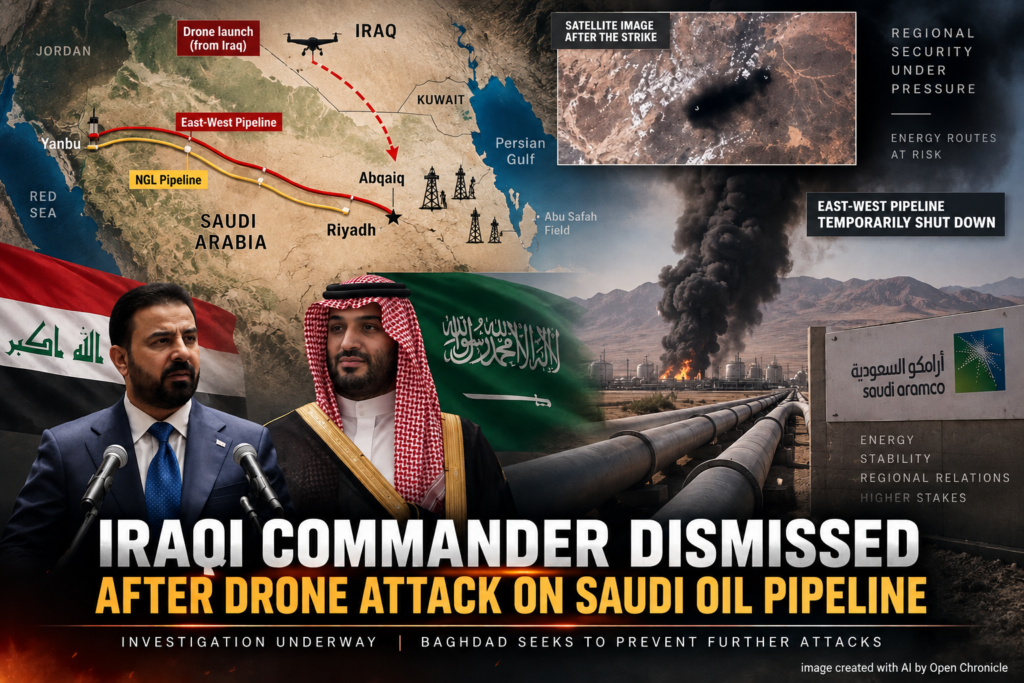
Iraq’s prime minister has dismissed a senior military commander after authorities concluded that a drone attack targeting Saudi Arabia’s critical East West oil pipeline was launched from Iraqi territory, an incident that has raised fresh concerns about regional escalation and Baghdad’s ability to prevent armed groups from using the country as a base for attacks abroad.
Prime Minister Ali al-Zaidi ordered the removal of the Operations Commander responsible for the area from which the drones were reportedly launched, according to a statement from his office.
The Iraqi government also announced an investigation into the Maysan Operations Command as Baghdad attempts to establish responsibility for an attack that temporarily disrupted one of Saudi Arabia’s most strategically important pieces of energy infrastructure.
Several people were injured in the attack, according to Saudi authorities.
Baghdad confirms drones were launched from Iraqi territory
The decision to dismiss the commander followed an Iraqi investigation that determined the attack originated from a location inside the relevant province.
Al-Zaidi’s office said the prime minister ordered the commander removed “following confirmation that the attacks targeting the brothers in the Kingdom of Saudi Arabia were launched from one of the sites within the province.”
The government did not identify the individuals or organization suspected of carrying out the attack in the information released so far.
Al-Zaidi also ordered the creation of an investigative committee to examine the Maysan Operations Command and determine how Iraqi territory was used to launch the drones.
The findings could prove politically sensitive in a country where the government must balance relations with neighboring states while confronting the influence of powerful armed groups.
Saudi Arabia refrains from retaliation
The incident had the potential to trigger a significantly wider confrontation.
Saudi Arabia condemned the attack but decided not to retaliate after receiving a request from the Iraqi prime minister, according to statements issued Friday.
Baghdad subsequently thanked Riyadh for exercising restraint.
Saudi Arabia’s decision provides Iraqi authorities with an opportunity to investigate the incident domestically while reducing the immediate danger that military retaliation could turn Iraqi territory into another front in the region’s widening conflicts.
The episode nevertheless demonstrates how quickly an attack launched by an unidentified actor can create tensions between neighboring governments.
Iraq promises action against those responsible
The Iraqi government issued a strong condemnation of the attack and emphasized that it would not permit the country to become a launching ground for operations against its neighbors.
Baghdad said it rejected any action that harms Saudi Arabia’s security and stability or damages the longstanding relationship between the two countries.
Al-Zaidi is also considering legal action against those responsible, according to his office.
The government said the state would not tolerate activities that place Iraq or its relations with friendly countries at risk.
“Iraq renews its affirmation that its territories and airspace will not be a launching point for aggression against any country,” the prime minister’s office said.
Baghdad added that its regional policy was based on respecting state sovereignty and turning relations with neighboring countries into a source of cooperation and stability rather than conflict.
East West Pipeline temporarily shut
The target of the attack makes the incident particularly significant.
Saudi Arabia’s Energy Ministry said the East West Pipeline was temporarily shut following the drone strikes. Several people were reportedly injured.
The pipeline is one of the most strategically important components of Saudi Arabia’s energy infrastructure because it allows oil produced in the eastern part of the kingdom to be transported across the country to the Red Sea coast.
That gives Riyadh an alternative to exporting crude through the Strait of Hormuz.
The ability to bypass Hormuz has become especially important during the current regional conflict, as instability around the Gulf has increased the risks facing tankers and energy infrastructure.
Any sustained disruption of the East West Pipeline would therefore have consequences extending beyond Saudi Arabia itself.
Saudi oil routes face growing pressure
The attack comes at an especially difficult moment for Saudi energy security.
The kingdom has increasingly relied on its Red Sea export infrastructure as an alternative to routes through the Strait of Hormuz. At the same time, Houthi advances in Yemen have increased concerns about shipping through the Bab el Mandeb Strait at the southern entrance to the Red Sea.
That means Saudi Arabia is facing potential pressure around both of the maritime corridors that underpin its ability to deliver oil to international markets.
An attack on the East West Pipeline adds a third vulnerability by threatening the land based infrastructure designed specifically to provide flexibility when maritime routes are disrupted.
The strategic implications help explain why Riyadh and Baghdad have moved quickly to contain the diplomatic fallout.
Questions over who launched the attack
Although Iraqi authorities say they have established that the drones originated from Iraqi territory, the information released so far does not identify who launched them or establish the motivation behind the operation.
That distinction is important.
An attack originating from Iraq does not necessarily mean it was authorized by the Iraqi government or carried out by Iraqi state forces. Baghdad’s condemnation, investigation and dismissal of a military commander indicate that the government is treating the operation as unauthorized.
Determining which organization controlled the drones, how they reached their launch site and whether security personnel failed to detect or prevent the operation will now be central to the investigation.
The decision to investigate the Maysan Operations Command also raises questions about whether negligence, security failures or other factors allowed the attack to proceed.
Iraq tries to stay outside widening regional conflict
For Baghdad, the incident highlights one of the most difficult strategic challenges facing the country.
Iraq sits between Iran and the Arab Gulf states and maintains important political and economic relationships across both sides of the regional divide.
A wider confrontation involving Iran, Saudi Arabia, Yemen and the United States increases the risk that Iraqi territory could become entangled in conflicts Baghdad does not want to join.
The government’s rapid response appears designed to send a message both domestically and internationally: attacks against neighboring countries launched from Iraq will not be accepted as legitimate extensions of regional conflicts.
Saudi Arabia’s decision not to retaliate has, for the moment, prevented the drone strike from producing a direct confrontation between Riyadh and actors operating inside Iraq.
Whether that restraint holds could depend heavily on Baghdad’s ability to identify those responsible and demonstrate that it can prevent further attacks.
The dismissal of the military commander is therefore more than a disciplinary measure. It is an attempt by the Iraqi government to reinforce control over its territory at a moment when the widening regional conflict threatens to pull additional countries into its orbit.