
By Open Chronicle News Desk
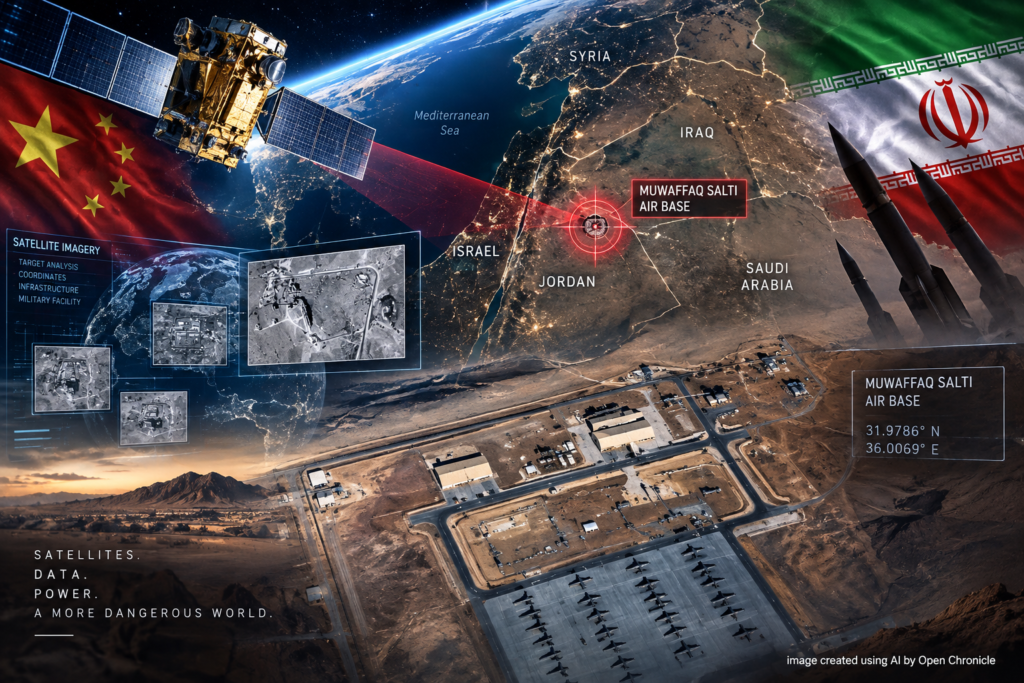
The United States has linked high resolution satellite imagery supplied by Chinese entities to an Iranian ballistic missile strike that killed three American service members and wounded four others at Muwaffaq Salti Air Base in Jordan, according to a Wall Street Journal report citing US officials.
The reported findings represent one of the most serious allegations to emerge concerning possible Chinese commercial or technological assistance to Iran during its war with the United States.
US officials have not accused the Chinese government of directly participating in the July 17 attack. Instead, their investigation is reportedly focused on satellite imagery obtained by Tehran from unidentified Chinese entities before and after the strike.
Beijing has rejected attempts to connect China to the conflict and has demanded evidence supporting the American allegations.
Satellite imagery reportedly obtained before and after attack
According to the Wall Street Journal report, Iran obtained high resolution imagery of Muwaffaq Salti Air Base before and after the July 17 missile attack.
The facility in Jordan hosts US military personnel and has played an important role in American operations across the Middle East.
Ballistic missiles struck a housing area at the base during the attack, killing three US service members and injuring four others.
US officials cited by the Journal reportedly regard the imagery as the clearest evidence identified so far of assistance from Chinese entities to Iran that may have contributed to an attack with lethal consequences for American forces.
However, the publicly available information does not establish exactly how the satellite images were used during Iranian targeting or whether the imagery directly enabled the successful strike.
No allegation of direct Chinese government involvement
The distinction between Chinese companies and the Chinese state is crucial.
The officials cited in the report did not identify the entities allegedly responsible for supplying the imagery, nor did they accuse President Xi Jinping’s government of ordering or directly participating in the activity.
Senior US officials nevertheless raised the issue with Chinese counterparts.
According to the report, Chinese officials denied the allegations and asked Washington to provide evidence.
China’s Foreign Ministry has also rejected attempts to associate Beijing with the Iran conflict.
The allegations could become especially sensitive because commercial satellite imagery has become an increasingly important component of modern warfare. High resolution images can potentially provide information about military installations, aircraft, ships, infrastructure and changes in activity at sensitive locations.
Earlier US sanctions targeted Chinese satellite companies
Washington’s concerns about Chinese assistance to Iran predate the reported Jordan attack.
In May, the US Treasury imposed sanctions on several Chinese entities, including The Earth Eye Co. and Chang Guang Satellite Technology, accusing them of providing support connected to Iran’s conventional weapons activities.
Those measures indicated that American authorities were already scrutinizing the relationship between Iran and Chinese providers of satellite and other advanced technologies.
The latest allegations could significantly increase that scrutiny, particularly if investigators determine that imagery supplied from China was used for operational military targeting.
US examining possible tracking of warships
American officials are reportedly investigating another potentially consequential question: whether Chinese supplied satellite imagery is helping Iran locate and monitor US naval vessels operating across the Middle East.
That possibility could carry implications beyond the July attack in Jordan.
US warships operate throughout the Gulf, Arabian Sea, Red Sea and surrounding waters. Their movements have become particularly sensitive during the Iran war as American naval forces defend regional bases, commercial shipping and other military assets.
Modern commercial satellites can revisit strategically important areas frequently, potentially providing governments and other customers with information that once required highly sophisticated national intelligence capabilities.
If Iran has obtained sufficiently current imagery of American naval deployments, Washington will want to determine whether that information has been incorporated into Iranian surveillance and targeting networks.
There is not yet publicly presented evidence establishing that Chinese imagery has enabled Iran to successfully target US warships.
Commercial technology complicates modern warfare
The allegations highlight a growing problem for governments attempting to control the flow of military relevant information.
Satellite reconnaissance was once overwhelmingly dominated by major states. The rapid expansion of commercial space companies has transformed that environment.
Customers can now purchase increasingly detailed imagery of locations around the world, creating significant civilian benefits but also providing information that can potentially be exploited for military purposes.
The central issue in the Iran case will therefore be whether Chinese entities knowingly provided support for military targeting, whether they were ordinary commercial transactions, or whether some other relationship existed.
Those distinctions could determine Washington’s response.
A new source of tension before possible Xi visit
The dispute comes at a sensitive moment in relations between Washington and Beijing.
President Donald Trump announced in July that Chinese President Xi Jinping is expected to visit Washington on September 24, although Beijing has not publicly confirmed all details surrounding the trip.
If the meeting proceeds, the reported satellite assistance is likely to add another difficult issue to an already extensive bilateral agenda.
The United States and China remain divided over trade, Taiwan, technology controls, military activity in the Indo Pacific and their competing visions of the international order.
Allegations that Chinese entities contributed information connected to an Iranian attack that killed American troops could introduce a much more immediate national security dispute.
Much depends on what Washington can prove
For now, several important questions remain unanswered.
The Chinese entities allegedly involved have not been publicly identified in connection with the July strike. The exact satellite imagery supplied to Iran has not been publicly released. Nor has Washington demonstrated publicly how the information was incorporated into Iranian targeting.
There is also no public evidence in the material provided that China’s government authorized the alleged assistance.
Those uncertainties make careful attribution essential.
What has emerged is a US assessment that satellite imagery originating from Chinese entities was obtained by Iran around the time of a ballistic missile strike that killed American personnel.
If Washington ultimately produces evidence showing that the imagery was knowingly supplied for military targeting, the implications could extend well beyond sanctions against individual companies.
The dispute would raise a larger question increasingly confronting governments in modern conflicts: where commercial technological support ends and participation in another state’s military operations begins.
With the Iran war already placing American forces under pressure across the Middle East, Washington’s investigation into the Chinese connection could now become another significant fault line between the world’s two largest powers.