
By Open Chronicle Explained
Look at a nuclear power station from the outside and the technology can seem almost mysterious.
Massive concrete buildings.
Cooling towers releasing enormous clouds of water vapour.
Security systems.
Control rooms filled with instruments.
Deep inside the facility sits something very different from the furnaces used in conventional power stations.
A nuclear reactor.
There is no coal being burned.
There is no natural gas flame heating a boiler.
Instead, energy is being released from atomic nuclei.
That sounds like an entirely different way of generating electricity.
But follow the energy through the power station and something surprising becomes clear.
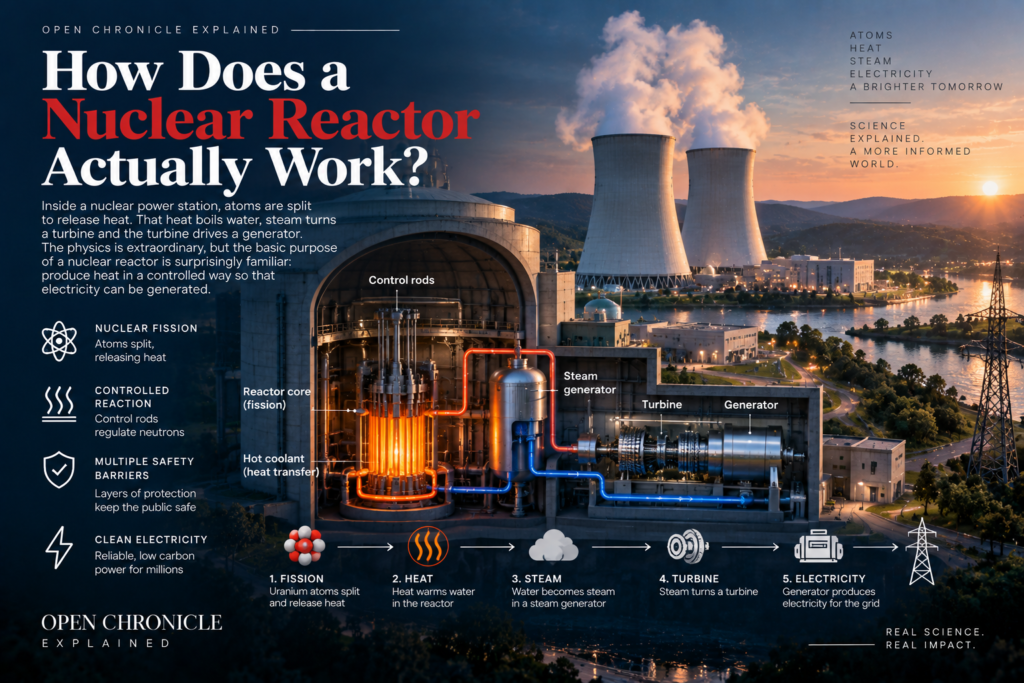
A nuclear power station ultimately produces electricity in much the same way as many other thermal power stations.
It creates heat.
The heat produces steam.
The steam spins a turbine.
The turbine turns a generator.
The generator produces electricity.
The revolutionary part is where the heat comes from.
First, what is an atom?
Everything around us is made from atoms.
Water.
Air.
Steel.
Concrete.
Your body.
The device you are using to read this article.
Atoms are extraordinarily small.
At their centre is a nucleus containing protons and neutrons.
Electrons occupy the region around that nucleus.
Most atoms are stable.
But some very heavy atomic nuclei can be split.
That process is called nuclear fission.
And fission is the fundamental process inside most nuclear power reactors operating today.
What is nuclear fission?
Imagine the nucleus of a uranium atom.
A neutron strikes it.
Under the right conditions, the nucleus becomes unstable and splits into smaller nuclei.
When this happens, several things are released.
Energy.
Radiation.
And additional neutrons.
Those new neutrons can then strike other uranium nuclei.
Those nuclei split.
More energy is released.
More neutrons appear.
Those neutrons can trigger further fissions.
A chain reaction has begun.
Isn’t that what happens in a nuclear weapon?
Both nuclear weapons and nuclear reactors can involve fission chain reactions, but the systems are designed for fundamentally different purposes and operating conditions.
A nuclear reactor is engineered to maintain a controlled chain reaction.
Its objective is not to release the available energy instantaneously.
It is to produce heat continuously and predictably.
That distinction is fundamental.
A power reactor is an energy system built around controlled nuclear fission.
What fuel does a nuclear reactor use?
Many commercial nuclear reactors use uranium.
Uranium is a naturally occurring element found in the Earth’s crust.
Natural uranium contains different isotopes.
An isotope is a version of an element with the same number of protons but a different number of neutrons.
One particularly important isotope for many reactors is uranium 235.
Uranium 235 can undergo fission relatively easily after absorbing a neutron.
For many reactor designs, uranium is processed so that the proportion of uranium 235 is increased above its natural level.
This process is called enrichment.
The enriched uranium is then manufactured into reactor fuel.
What does nuclear fuel look like?
It does not usually look like a glowing science fiction substance.
In many reactors, uranium fuel is manufactured into small ceramic pellets.
These pellets are stacked inside long metal tubes.
The tubes are called fuel rods.
Many fuel rods are arranged together into fuel assemblies.
Dozens or hundreds of fuel assemblies can then form the reactor core.
The core is where the controlled chain reaction takes place.
A relatively compact volume of nuclear fuel can produce enormous amounts of energy.
Why does splitting an atom release energy?
Atomic nuclei are held together by powerful nuclear forces.
When certain heavy nuclei split into smaller nuclei, the final products have slightly less mass than the original system.
That tiny difference in mass is converted into energy.
This relationship is described by one of the most famous equations in physics:
E = mc²
Energy equals mass multiplied by the speed of light squared.
Because the speed of light squared is an enormous number, a very small amount of mass can correspond to a large amount of energy.
This is why nuclear fuel contains such extraordinary energy density.
How does the chain reaction keep going?
Remember what happens during fission.
A uranium nucleus splits and releases neutrons.
Some of those neutrons can strike other uranium nuclei.
If, on average, enough neutrons continue producing additional fissions, the chain reaction sustains itself.
Engineers describe the condition of a stable chain reaction as criticality.
The word can sound alarming in ordinary language.
In reactor physics, it has a precise meaning.
A critical reactor is one in which the chain reaction is self sustaining at a stable level.
The reactor is not necessarily in an emergency.
It may simply be operating normally.
What stops the reaction from accelerating?
This is one of the central engineering challenges of reactor design.
The number of neutrons available to cause further fissions must be controlled.
One important tool is the control rod.
Control rods are made from materials that absorb neutrons effectively.
When control rods are inserted further into the reactor core, they absorb more neutrons.
Fewer neutrons remain available to cause fission.
The reactor’s power decreases.
When control rods are withdrawn, more neutrons remain available.
Power can increase.
The chain reaction can therefore be regulated.
Can control rods shut down the reactor?
Yes.
Rapidly inserting control rods can suppress the chain reaction.
Reactor designs include shutdown systems capable of stopping sustained fission when necessary.
But there is an important complication.
Stopping the chain reaction does not mean the reactor instantly becomes cold.
The fuel continues producing heat.
Why does the reactor stay hot after shutdown?
Because radioactive fission products continue decaying.
This produces what is known as decay heat.
Immediately after shutdown, decay heat can still represent a significant amount of thermal energy.
It gradually decreases over time.
This means cooling remains essential even after the fission chain reaction has stopped.
Understanding this point is crucial to understanding nuclear safety.
A reactor can be shut down and still require continuous heat removal.
What does the water inside a reactor do?
In many reactor designs, water performs two extremely important jobs.
It carries heat away from the fuel.
And it helps manage the neutrons involved in the chain reaction.
When used to slow neutrons, a material is called a moderator.
Slower neutrons are more effective at causing fission in uranium 235 under the conditions used in many commercial reactors.
Water can therefore be both coolant and moderator.
Different reactor designs use different materials and arrangements, but the basic engineering problem remains:
control the nuclear reaction and remove the heat it produces.
How does the heat become electricity?
Now the nuclear power station begins looking much more familiar.
Heat from the reactor is transferred to water.
Steam is produced.
The steam flows through a turbine.
The turbine rotates.
That rotating shaft drives an electrical generator.
The generator converts mechanical rotation into electrical energy.
From there, transformers increase the voltage and electricity enters the transmission grid.
The nuclear reaction itself does not directly produce the electricity supplied to your home.
It produces the heat that ultimately drives the generator.
What is a turbine?
A steam turbine is essentially a sophisticated machine designed to extract energy from rapidly moving steam.
Steam passes through rows of blades.
The force causes the turbine shaft to rotate at high speed.
The shaft is connected to a generator.
Inside the generator, rotating magnetic fields and electrical conductors interact to produce electricity.
This basic principle is used in many types of power stations.
Coal.
Natural gas.
Nuclear.
Geothermal.
The heat source changes.
The turbine generator principle can remain remarkably similar.
Why are there different kinds of nuclear reactors?
Engineers have developed multiple ways of controlling fission and transferring heat.
Two historically important commercial reactor families are pressurized water reactors and boiling water reactors.
They both use nuclear fission.
But they handle water and steam differently.
How does a pressurized water reactor work?
In a pressurized water reactor, often abbreviated PWR, water flows through the reactor core under very high pressure.
The high pressure prevents this water from boiling even though it becomes extremely hot.
This hot primary water flows through a steam generator.
There it transfers heat to a separate water circuit.
The water in that second circuit boils.
The resulting steam drives the turbine.
The two water systems remain separated.
So the sequence is roughly:
reactor → hot pressurized water → steam generator → steam → turbine → generator
This design is widely used around the world.
What about a boiling water reactor?
A boiling water reactor, or BWR, uses a different arrangement.
Water boils directly inside the reactor vessel.
The steam produced there travels toward the turbine.
So the basic sequence becomes:
reactor → steam → turbine → generator
This eliminates the separate steam generator used in a typical PWR.
Both systems solve the same basic problem differently.
Take heat from nuclear fission and use it to produce electricity.
What are the enormous cooling towers for?
This is one of the most misunderstood parts of a nuclear power station.
The giant white clouds emerging from cooling towers are primarily water vapour, not smoke from nuclear fuel.
After steam passes through the turbine, it needs to be cooled so that it can condense back into liquid water.
That water can then be reused in the cycle.
A cooling system removes the waste heat.
Some power stations use cooling towers.
Others use water from rivers, lakes or the sea.
And cooling towers are not unique to nuclear energy.
Other thermal power stations can use them too.
Why can’t all the heat become electricity?
Because no thermal power station can convert all heat into useful electrical energy.
Thermodynamics imposes fundamental limits.
Some energy must be rejected as waste heat.
That is why power stations need cooling systems.
The same general issue exists whether the original heat came from burning coal, burning gas or splitting uranium atoms.
Is the water coming from a cooling tower radioactive?
Under normal operation in systems where cooling water is separated from reactor coolant, the visible plume from a cooling tower is not radioactive steam from the reactor core.
It is part of the station’s heat rejection system.
The dramatic appearance of cooling towers has made them a visual symbol of nuclear power.
But the tower itself is not where nuclear fission occurs.
The reactor is inside heavily engineered structures elsewhere in the plant.
Why does a nuclear plant have so many barriers?
Nuclear engineering uses multiple layers of protection.
Fuel itself provides one barrier.
Fuel cladding provides another.
The reactor coolant system provides further containment.
The reactor is housed inside robust structures designed to limit the release of radioactive material.
This approach is often described through the concept of defence in depth.
The philosophy assumes that no single safety measure should be relied upon completely.
If one layer fails, another should remain.
What is the containment building?
The containment building is one of the most recognizable structures at many nuclear power stations.
It surrounds critical reactor systems.
It is engineered to withstand high pressures and help prevent radioactive material from escaping during serious accidents.
Containment structures can use thick reinforced concrete and steel.
They represent one of the final physical barriers between reactor systems and the external environment.
What happens if electricity to the plant is lost?
A reactor needs electricity for many systems, including pumps, instrumentation and control equipment.
Nuclear power stations therefore have multiple sources of electrical power.
The grid can supply electricity.
Emergency diesel generators can provide backup.
Battery systems can support essential equipment.
Modern designs may also use passive safety features that rely more heavily on gravity, natural circulation or stored energy rather than continuously powered pumps.
Why so much redundancy?
Because cooling must continue even after the reactor shuts down.
Why was Fukushima so serious?
The 2011 Fukushima Daiichi accident in Japan demonstrated the importance of post shutdown cooling.
The reactors shut down following a major earthquake.
But the subsequent tsunami disabled critical electrical and backup systems.
Without adequate cooling, decay heat caused reactor fuel temperatures to rise severely.
Core damage occurred.
Hydrogen accumulated and explosions damaged reactor buildings.
The disaster was not simply about whether the fission chain reaction could be stopped.
The reactors had shut down.
The challenge was removing heat afterwards.
What happened at Chernobyl?
The 1986 Chernobyl disaster involved a very different reactor design and sequence of events.
During a test, a combination of reactor characteristics, operational decisions and safety deficiencies produced an uncontrolled power surge.
The reactor was destroyed.
A major release of radioactive material followed.
Chernobyl profoundly shaped global perceptions of nuclear energy.
Modern reactor designs and regulatory systems differ significantly from the RBMK reactor and circumstances involved in that disaster.
Comparing nuclear accidents therefore requires understanding the reactor design and the specific failure mechanisms involved.
Can a nuclear power reactor explode like an atomic bomb?
A commercial nuclear power reactor is not configured like a nuclear weapon.
The fuel composition, geometry and operating conditions are fundamentally different.
Severe reactor accidents can produce explosions through other mechanisms, including hydrogen accumulation or steam pressure.
Those explosions can damage facilities and contribute to radioactive releases.
But they are not nuclear detonations comparable to atomic weapons.
This distinction matters when discussing nuclear safety accurately.
What is radiation?
Radiation is energy transmitted through particles or electromagnetic waves.
Radiation exists naturally around us.
Some radioactive materials emit ionizing radiation capable of damaging biological tissue at sufficient doses.
Nuclear power therefore requires careful management of radioactive materials and exposure.
Workers use shielding, monitoring, distance and operating procedures to control radiation doses.
Regulators establish exposure limits.
The objective is to keep radiation exposure within strict safety requirements.
Does a nuclear plant release radiation during normal operation?
Nuclear facilities are designed to control radioactive materials.
Small regulated releases can occur during normal operations, depending on the facility and national rules, but these are monitored and subject to regulatory limits.
Radiation also exists naturally in the environment.
When assessing nuclear risk, the relevant question is not simply whether radiation exists.
It is the type, dose, duration and pathway of exposure.
What happens to used nuclear fuel?
Eventually, fuel assemblies become less effective for reactor operation and are removed.
But used nuclear fuel remains highly radioactive and continues generating heat.
Initially, it is commonly stored underwater in spent fuel pools.
Water provides cooling and radiation shielding.
After sufficient cooling, fuel may later be transferred to dry storage systems.
Long term management depends on national policy.
Some countries plan or develop deep geological repositories.
Others reprocess some used fuel to recover materials that can be reused.
Why is nuclear waste such a difficult issue?
Because some radioactive materials remain hazardous for very long periods.
The engineering challenge is therefore unusually long term.
Waste must be isolated from people and the environment.
Different categories of nuclear waste require different management strategies.
Much of the volume of radioactive waste is not high level spent fuel.
But spent nuclear fuel contains a large share of the long lived radioactivity and receives particular attention.
Deep geological disposal is designed around a simple principle:
place high level waste inside multiple engineered barriers in stable geological formations where it can remain isolated for extremely long periods.
How much fuel does a nuclear plant need?
Far less by mass than a fossil fuel plant producing comparable amounts of energy.
This is one of nuclear energy’s defining characteristics.
Nuclear fuel has extremely high energy density.
A coal power station requires continuous deliveries of enormous quantities of fuel.
A nuclear reactor can operate for long periods with a comparatively small volume of uranium fuel.
That reduces fuel transportation requirements.
But it creates the need for specialized handling, security and long term waste management.
Does nuclear power produce carbon dioxide?
The fission reaction itself does not burn carbon based fuel and therefore does not produce carbon dioxide in the way coal or natural gas combustion does.
Emissions still occur across the nuclear lifecycle.
Uranium must be mined.
Fuel must be processed.
Concrete and steel are required.
Plants must be built and eventually decommissioned.
But nuclear power is generally classified as a low carbon source of electricity because lifecycle greenhouse gas emissions are much lower than those from fossil fuel generation.
Why can nuclear plants run for so long?
Reactors can operate continuously for long periods between refuelling outages.
Fuel is not normally replaced every day or week.
During scheduled outages, part of the fuel may be replaced and maintenance performed.
This allows nuclear plants to provide large amounts of continuous electricity.
Historically, this characteristic has made nuclear power particularly useful for supplying steady generation to electricity grids.
Can nuclear power follow electricity demand?
Some nuclear plants can vary output.
But reactor economics and engineering have often favoured operating at high output for long periods.
Electricity systems with growing shares of variable wind and solar generation are creating new discussions about how nuclear power can interact with flexible grids, storage and demand management.
Different reactor designs and electricity markets approach this differently.
What are small modular reactors?
Small modular reactors, commonly called SMRs, are a broad category of proposed and developing reactor technologies intended to use smaller standardized units than traditional large nuclear power plants.
The idea is that components could be manufactured more systematically and deployed in modules.
Supporters argue this could reduce construction risk, improve flexibility and open new applications.
Whether particular SMR designs achieve those goals depends on engineering, regulation, financing and successful commercial deployment.
The underlying physics remains nuclear fission.
The architecture changes.
What is a fast reactor?
Most conventional reactors use a moderator to slow neutrons.
Fast reactors are designed to sustain fission using higher energy neutrons.
This changes the types of fuel cycles that become possible.
Fast reactor technologies can potentially make different use of uranium resources and certain nuclear materials.
They are technically more complex and have been developed in several forms over decades.
They illustrate how “nuclear reactor” describes a family of technologies rather than one machine.
What about thorium?
Thorium is another naturally occurring element that can potentially be used in nuclear fuel cycles.
Thorium itself is not fissile in the same way as uranium 235, but it can be converted into uranium 233, which can undergo fission.
Thorium based systems have attracted interest because of potential fuel availability and reactor characteristics.
But uranium based fuel cycles dominate today’s commercial nuclear industry.
Thorium is therefore better understood as a possible alternative nuclear fuel pathway than as a simple replacement already ready to transform the energy system.
And nuclear fusion?
Fusion is fundamentally different.
Fission splits heavy atomic nuclei.
Fusion combines light nuclei.
The Sun produces energy through fusion.
Scientists and engineers are attempting to reproduce useful fusion energy on Earth.
If commercially practical fusion power becomes possible, it would represent a different class of nuclear energy technology.
Today’s commercial nuclear power stations use fission.
Who controls the reactor?
A nuclear plant is operated from a control room.
Operators monitor reactor power.
Coolant temperatures.
Pressure.
Water levels.
Electrical systems.
Radiation measurements.
Turbine conditions.
Safety systems.
Thousands of measurements provide information about the state of the plant.
Computer systems automate many functions.
But trained human operators remain central to supervision and decision making.
Operating procedures define responses to normal events, abnormal conditions and emergencies.
What happens if something goes wrong?
Safety systems are designed to detect abnormal conditions.
The reactor can shut down automatically.
Control rods can rapidly reduce the chain reaction.
Emergency cooling systems can remove heat.
Backup electrical systems can activate.
Containment provides another layer of protection.
The precise response depends on the reactor design and the nature of the event.
Nuclear safety is built around anticipating failures rather than assuming failures will never occur.
Who makes sure nuclear plants are safe?
Countries operating nuclear power plants have national nuclear regulators responsible for safety oversight.
Operators must comply with licensing requirements.
Facilities are inspected.
Safety systems are tested.
Events are reported and investigated.
International organizations also support cooperation and safety standards.
The International Atomic Energy Agency plays an important role in international nuclear safety, security and safeguards frameworks.
But responsibility for operating a plant safely remains with the operator under national regulation.
What are nuclear safeguards?
Safety and safeguards are related but different concepts.
Nuclear safety concerns preventing accidents and protecting people and the environment.
Nuclear security concerns protecting nuclear materials and facilities against malicious acts.
Nuclear safeguards concern verifying that nuclear materials used for peaceful purposes are not diverted toward prohibited military activities.
Understanding these distinctions is important because civilian nuclear technology sits at the intersection of energy, engineering and international security.
Why is uranium enrichment politically sensitive?
Because enrichment technology has both civilian and proliferation implications.
Commercial reactor fuel generally uses uranium enriched to relatively low levels compared with material associated with nuclear weapons.
But the ability to enrich uranium is strategically significant.
International safeguards, inspections and agreements therefore play an important role in monitoring nuclear programmes.
The same fundamental nuclear physics can have very different applications depending on materials, enrichment levels, technology and intent.
Why do countries still build nuclear reactors?
The answer varies.
Some want large quantities of low carbon electricity.
Some want greater energy independence.
Some have limited domestic fossil fuel resources.
Some value nuclear power’s ability to generate electricity regardless of weather conditions.
Some see nuclear technology as part of industrial or strategic policy.
But nuclear projects also face challenges.
Large conventional plants can be extremely expensive.
Construction can take years.
Financing is difficult.
Regulation is demanding.
Waste must be managed.
Public acceptance can be politically important.
Nuclear energy therefore combines remarkable technical capability with unusually complex economic and political questions.
Why do some countries abandon nuclear power?
Governments make different assessments of cost, safety, public opinion, waste, energy security and alternative technologies.
Some countries have expanded nuclear programmes.
Others have reduced or ended them.
The same technology can therefore occupy completely different positions in national energy strategies.
There is no purely technical answer to whether a country “should” use nuclear energy.
It is a policy choice involving engineering, economics, environmental objectives and risk tolerance.
How long can a reactor operate?
Individual nuclear plants can operate for decades.
Original operating licences may be extended after technical reviews and upgrades.
Components are inspected, maintained and replaced.
Eventually, a reactor reaches the end of its operating life.
Then decommissioning begins.
Fuel is removed.
Radioactive systems are managed.
Facilities are dismantled or made safe according to regulatory plans.
Like construction, decommissioning can be a long process.
Why does nuclear power feel more complicated than other electricity generation?
Partly because the underlying physics is less familiar.
Most people understand fire intuitively.
Burn fuel.
Create heat.
Boil water.
Nuclear fission begins inside atomic nuclei, something no human can see directly.
Radiation is invisible.
Safety consequences can extend over long periods.
Nuclear technology also intersects with the history of nuclear weapons.
That gives it a cultural and political weight unlike almost any other energy technology.
But strip away that history for a moment and follow the energy.
The basic sequence becomes surprisingly understandable.
The Bigger Picture
A nuclear reactor is one of humanity’s most sophisticated machines.
But its purpose can be described in a few steps.
A neutron strikes a uranium nucleus.
The nucleus splits.
Energy is released as heat.
More neutrons continue a controlled chain reaction.
Coolant carries the heat away.
Water becomes steam.
Steam turns a turbine.
The turbine turns a generator.
Electricity enters the grid.
Behind those simple steps lies an enormous engineering system designed to control something extraordinary:
energy stored inside atomic nuclei.
Control rods regulate neutrons.
Cooling systems remove heat.
Containment structures isolate radioactive materials.
Backup systems prepare for failures.
Operators monitor the reactor continuously.
Regulators oversee the facility.
Used fuel remains carefully managed long after it leaves the core.
The cooling towers and concrete buildings may dominate the skyline.
But the fundamental process begins at a scale far too small to see.
An atom splits.
Heat appears.
A turbine turns.
And electricity eventually reaches millions of homes.
Open Chronicle Explained
Science
Understanding the science behind the technologies and natural processes shaping our world.
Categories: Science
Tags: nuclear reactor, nuclear power, nuclear energy, nuclear fission, uranium, uranium 235, nuclear fuel, nuclear power station, electricity generation, pressurized water reactor, boiling water reactor, control rods, reactor core, steam turbine, radiation, nuclear safety, nuclear waste, spent nuclear fuel, cooling towers, small modular reactors, SMR, nuclear fusion, energy, science
Understanding the systems behind the headlines.
Explore Open Chronicle Explained →