
By Open Chronicle Explained
Thousands of kilometres above your head, satellites are moving through space at extraordinary speeds.
Some photograph storms.
Some carry television signals.
Some provide internet connections.
Some observe forests, oceans and ice.
Others help your phone determine where you are.
They appear to float effortlessly above Earth.
But they are not floating.
They are falling.
Every second.
The strange part is that they keep falling without reaching the ground.
Understanding why reveals one of the most beautiful principles in orbital mechanics.
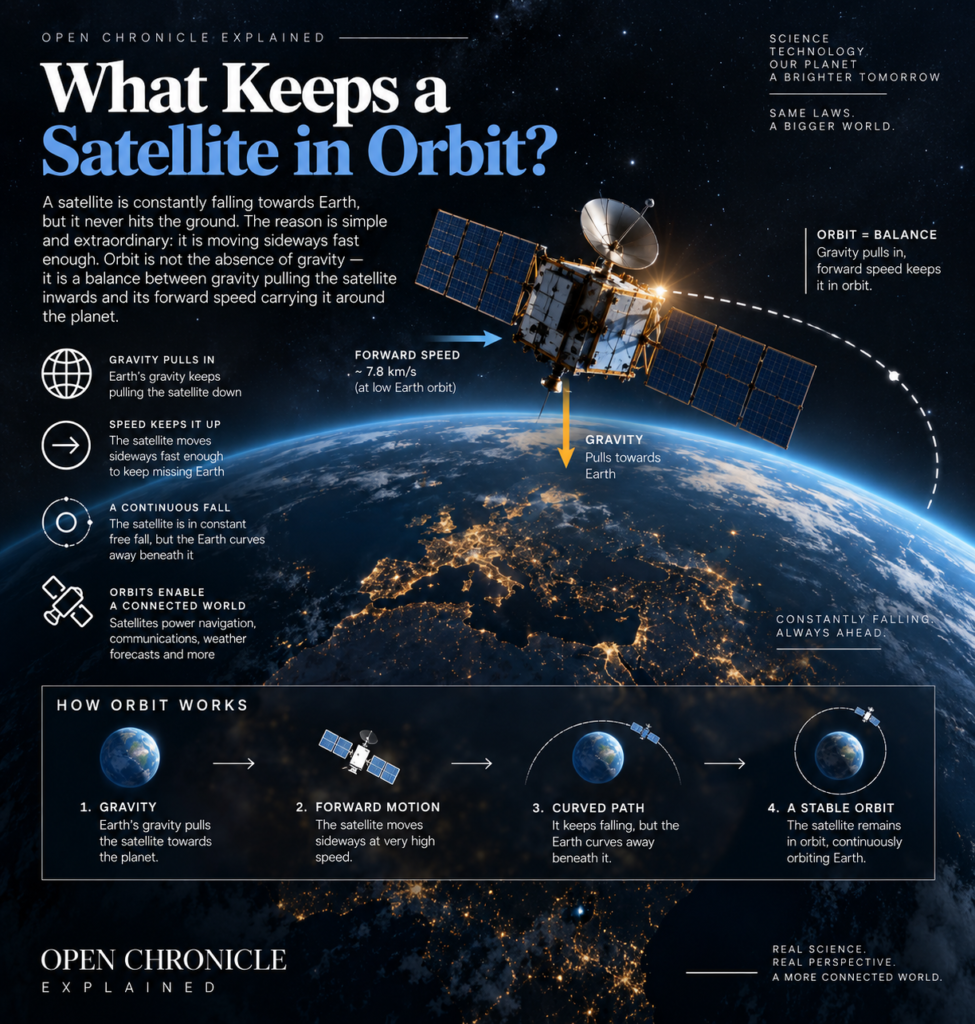
A satellite stays in orbit because two things happen simultaneously.
Gravity pulls it towards Earth.
Its forward motion carries it sideways.
When those effects are balanced correctly, the satellite continually falls around the planet.
That is an orbit.
First, what is a satellite?
A satellite is simply an object orbiting another object.
The Moon is a natural satellite of Earth.
Earth is effectively a satellite of the Sun.
Humanity has also placed thousands of artificial satellites into orbit.
These machines perform many different missions.
Communications.
Navigation.
Weather forecasting.
Scientific research.
Military reconnaissance.
Earth observation.
Astronomy.
Internet services.
But regardless of what they do, every satellite depends on the same basic physics.
Gravity and motion.
Why doesn’t a satellite fall to Earth?
It does.
This is the key to understanding orbit.
Earth’s gravity is constantly pulling the satellite towards the planet.
If gravity suddenly disappeared, the satellite would not remain circling Earth.
It would continue travelling through space along a different path.
Gravity bends that motion.
The satellite keeps moving forward while gravity continually pulls it inward.
The result is a curved path around Earth.
The satellite is therefore falling towards the planet while moving sideways fast enough to keep missing it.
Imagine throwing a ball
Suppose you stand on a very high mountain and throw a ball horizontally.
It travels forward.
Gravity pulls it downward.
Eventually, it hits the ground.
Throw it faster and it travels farther before landing.
Throw it much faster and it travels farther still.
Now imagine an impossibly high mountain above the atmosphere and an Earth with no obstacles.
Throw the ball fast enough and something remarkable happens.
As the ball falls, Earth’s surface curves away beneath it.
The ball continues falling.
But the ground keeps curving away.
Instead of hitting Earth, the ball circles the planet.
The ball is now in orbit.
This thought experiment is famously associated with Isaac Newton.
Centuries later, rockets turned the idea into reality.
So orbit is really falling?
Yes.
An orbiting spacecraft is in continuous free fall.
This is one of the most counterintuitive ideas about spaceflight.
Satellites are not being held up by some invisible platform.
There is no force pushing them upward continuously.
Gravity is pulling them down.
Their sideways velocity prevents them from reaching the surface.
Orbit is therefore a balance between gravity and inertia.
How fast must a satellite travel?
That depends on its altitude.
A satellite in low Earth orbit typically travels at roughly 7.5 to 8 kilometres per second.
That is around 27,000 kilometres per hour.
At those speeds, a spacecraft can circle Earth in roughly 90 minutes, depending on its altitude.
This means astronauts aboard the International Space Station can experience many sunrises and sunsets during a single Earth day.
Higher satellites generally orbit more slowly.
That may seem surprising.
But the farther a satellite is from Earth, the weaker Earth’s gravitational pull becomes.
A lower orbital speed can therefore maintain the larger orbit.
Why don’t satellites need engines running constantly?
Because once a satellite has the correct velocity, inertia keeps it moving.
Space contains extremely little atmospheric resistance compared with Earth’s surface.
There is therefore much less drag slowing the spacecraft.
A satellite does not need an engine continuously pushing it around Earth.
Its momentum carries it forward.
Gravity bends that forward motion into an orbit.
Engines or thrusters are still useful for changing or maintaining the orbit.
But they are not normally required simply to keep a satellite moving every second.
How does a satellite reach orbit?
This is where rockets become essential.
A rocket does not merely have to lift a satellite upward.
It must also accelerate it sideways to enormous speed.
This is a crucial distinction.
Reaching space and reaching orbit are not the same thing.
A vehicle can travel above the conventional boundary of space and then fall back to Earth.
That is a suborbital flight.
To remain in orbit, the spacecraft needs sufficient horizontal velocity.
Rockets therefore gradually tilt during launch.
They begin travelling mostly upward to escape the dense lower atmosphere.
Then they increasingly accelerate horizontally.
The goal is not simply altitude.
The goal is orbital velocity.
Why can’t a rocket just fly straight upward?
Because altitude alone does not create an orbit.
Imagine launching a spacecraft directly upward to several hundred kilometres above Earth and then stopping it.
For a brief moment, it might appear stationary.
Then gravity would pull it back down.
Without sufficient sideways speed, it would return to Earth.
Orbit requires both altitude and velocity.
This is why most of the energy required to reach orbit is used not simply to climb but to accelerate.
What is orbital velocity?
Orbital velocity is the speed required for an object to maintain a particular orbit under given conditions.
For a circular orbit around Earth, the required velocity depends primarily on the distance from Earth’s centre.
Closer satellites need higher orbital speeds.
More distant satellites travel more slowly.
The relationship comes from gravity.
Close to Earth, gravity is stronger.
The satellite must move faster to continually fall around the planet rather than descend.
Does gravity exist in space?
Absolutely.
This is another common misconception.
Gravity does not suddenly disappear when you leave Earth’s atmosphere.
The International Space Station orbits only a few hundred kilometres above Earth.
At that altitude, Earth’s gravity is still very strong.
The astronauts appear weightless because the station and everything inside it are falling together.
They are all in continuous free fall around Earth.
Then why do astronauts float?
Because everything around them is accelerating together under gravity.
Imagine being inside a falling elevator, ignoring air resistance and the obvious danger of the example.
You and the elevator would fall together.
Relative to the elevator, you would appear to float.
Something similar happens in orbit.
The spacecraft is falling towards Earth.
The astronauts are falling towards Earth.
Objects inside the spacecraft are falling towards Earth.
Because everything is falling together, occupants experience what is commonly called microgravity.
Why is it called microgravity rather than zero gravity?
Because gravity is still present.
The environment is not perfectly free from all gravitational effects.
Small forces remain.
Atmospheric drag.
Vibrations.
Gravitational differences across the spacecraft.
Movement of equipment.
Other disturbances.
“Microgravity” therefore describes the extremely low apparent weight experienced in orbit more accurately than “zero gravity.”
Are all satellite orbits the same?
No.
Satellites occupy many different types of orbit.
The orbit chosen depends on the mission.
Some need detailed images of Earth.
Some need to remain over approximately the same region.
Some need global coverage.
Some need low communication latency.
Some observe the poles.
Some travel far beyond the region where most satellites operate.
Orbital architecture is therefore part of satellite design.
What is low Earth orbit?
Low Earth orbit, usually abbreviated LEO, covers the region relatively close to Earth.
There is no single universally defining boundary used for every purpose, but many operational satellites in LEO orbit from a few hundred kilometres to around 2,000 kilometres above Earth.
The International Space Station operates in LEO.
Many Earth observation satellites operate there.
Large satellite internet constellations also use low Earth orbit.
LEO offers important advantages.
The satellites are relatively close to Earth.
That allows high resolution observations and lower communication delays.
But there is a tradeoff.
A single satellite moves rapidly across the sky and covers a limited region at any given moment.
Large constellations may therefore be required for continuous global service.
What is medium Earth orbit?
Medium Earth orbit, or MEO, lies above low Earth orbit and below geostationary regions.
Navigation satellites commonly operate in this broad region.
GPS satellites, for example, orbit much higher than the International Space Station.
At these altitudes, each satellite can cover a larger portion of Earth.
A constellation of satellites allows receivers on the ground to see several satellites simultaneously.
That makes global navigation possible.
What is geostationary orbit?
Geostationary orbit is one of the most useful orbits humanity has discovered.
A satellite in geostationary orbit circles Earth above the equator at an altitude of roughly 35,786 kilometres.
Its orbital period matches Earth’s rotation.
As a result, the satellite appears to remain above the same point on Earth’s equator.
From the ground, it seems almost stationary in the sky.
This is extremely useful for communications and weather observation.
A satellite dish can point at one fixed position rather than continuously tracking a spacecraft moving across the sky.
Why exactly that altitude?
Because orbital period depends on orbital size.
Closer satellites orbit Earth quickly.
Farther satellites take longer.
At approximately 35,786 kilometres above the equator, a circular satellite orbit can be synchronized with Earth’s rotation.
The satellite and Earth turn together.
That creates the geostationary effect.
Move significantly closer and the satellite would orbit too quickly.
Move farther away and it would orbit too slowly.
Are geostationary and geosynchronous the same thing?
Not exactly.
A geosynchronous satellite has an orbital period matching Earth’s rotation.
But its orbit may be inclined or elliptical.
A geostationary satellite is a special type of geosynchronous satellite.
It must orbit in a circular path above the equator in the same direction Earth rotates.
That allows it to appear fixed over one longitude.
What is a polar orbit?
A polar orbit passes approximately over Earth’s polar regions as the satellite circles the planet.
Meanwhile, Earth rotates beneath it.
Over time, the satellite can observe large portions of the planet.
This makes polar and near polar orbits useful for Earth observation, mapping, environmental monitoring and reconnaissance.
What is a Sun synchronous orbit?
A Sun synchronous orbit is designed so that a satellite passes over locations at approximately the same local solar time.
That provides similar lighting conditions from one pass to another.
For imaging satellites, this can be extremely valuable.
Scientists can compare images taken days or months apart without large changes in shadows caused simply by different times of day.
Many Earth observation satellites use this type of orbit.
Can an orbit be elliptical?
Yes.
Orbits do not need to be perfect circles.
Many are elliptical.
In an elliptical orbit, the satellite’s distance from Earth changes.
The closest point is called perigee.
The farthest point is called apogee.
The satellite also changes speed.
It travels faster when closer to Earth and more slowly when farther away.
This behaviour follows the laws of orbital mechanics described by Johannes Kepler centuries ago.
Why does the satellite speed change?
Because gravitational potential energy and kinetic energy are continuously exchanged.
As the satellite moves closer to Earth, gravity accelerates it.
Its speed increases.
As it moves away, it slows.
This relationship is one expression of conservation of energy.
The orbit may look like a simple curve on a diagram.
But the satellite is constantly exchanging forms of energy as it moves through Earth’s gravitational field.
Can a satellite stay in orbit forever?
Not necessarily.
The answer depends strongly on altitude and environment.
Low Earth orbit is not completely empty.
Extremely thin traces of Earth’s atmosphere remain.
Those particles create drag.
The drag slowly removes energy from the satellite’s orbit.
The orbit becomes lower.
At lower altitude, atmospheric density increases.
Drag becomes stronger.
Eventually, without intervention, the spacecraft can reenter Earth’s atmosphere.
Is that why the International Space Station needs orbital boosts?
Yes.
The International Space Station experiences small amounts of atmospheric drag.
Over time, this reduces its orbital altitude.
Spacecraft engines are periodically used to raise the station’s orbit.
These manoeuvres are often called reboosts.
Without them, the orbit would gradually decay.
What affects atmospheric drag in space?
The upper atmosphere changes.
Solar activity can heat and expand it.
When solar activity increases, atmospheric density at satellite altitudes can rise.
That increases drag.
Satellites in low orbit may then lose altitude faster.
Space weather can therefore affect satellite operations in ways that are not immediately obvious from the ground.
What is orbital decay?
Orbital decay is the gradual reduction of an orbit’s altitude due to energy loss.
Atmospheric drag is an important cause for low altitude satellites.
As the spacecraft loses orbital energy, its orbit changes.
Eventually, it may encounter enough atmosphere to begin uncontrolled reentry.
Operators can sometimes counteract decay with propulsion.
Satellites without propulsion cannot.
How do satellites change orbit?
By changing velocity.
This sounds simple, but orbital manoeuvres are often counterintuitive.
A spacecraft can fire thrusters to increase or decrease its speed.
That changes the shape and altitude of its orbit.
To move from one circular orbit to another, spacecraft commonly use carefully timed burns.
One burn changes the orbit into an ellipse.
Another burn later circularizes the orbit at the new altitude.
Spaceflight is therefore less like driving through empty space and more like reshaping a continuously falling path.
What is a transfer orbit?
A transfer orbit connects two different orbital regions.
One famous example is the Hohmann transfer, an efficient way of moving between two circular orbits using an elliptical intermediate orbit.
A spacecraft performs one burn to enter the transfer ellipse.
It coasts.
Then it performs another burn to enter the new circular orbit.
Much of the journey happens without the engine running.
Gravity and momentum do most of the work.
Why is fuel so important in space?
Because changing velocity requires propulsion.
And satellites carry limited propellant.
Every major manoeuvre consumes some of that resource.
Orbit raising.
Collision avoidance.
Station keeping.
Orientation control.
End of life disposal.
Mission planners therefore manage fuel carefully.
A satellite may remain electronically functional but become operationally useless if it can no longer maintain the required orbit or orientation.
What is station keeping?
Even a satellite in a useful orbit can slowly drift.
The gravity of the Moon and Sun can influence it.
Earth’s gravitational field is not perfectly uniform.
Solar radiation can exert tiny forces.
Other perturbations accumulate.
Satellites therefore perform small corrective manoeuvres known as station keeping.
For geostationary satellites, this helps maintain the spacecraft near its assigned orbital position.
Can sunlight really move a satellite?
Yes, slightly.
Light carries momentum.
When photons strike a spacecraft, they exert a tiny pressure.
This is called solar radiation pressure.
The effect is extremely small compared with everyday forces on Earth.
But in space, tiny forces acting continuously over long periods can change a spacecraft’s trajectory.
Orbital calculations therefore account for effects that would be negligible in ordinary life.
Does the Moon affect satellites?
Yes.
The Moon’s gravity influences spacecraft around Earth.
So does the Sun.
These gravitational effects can gradually alter orbital parameters.
For some missions, those perturbations are problems that require correction.
For others, engineers can deliberately use gravitational interactions to help shape trajectories.
Spaceflight often involves working with gravity rather than simply fighting against it.
How does a satellite know where it is?
Modern satellites use several methods.
They may use satellite navigation signals.
Ground stations can track them.
Radar and optical telescopes can determine their positions.
Onboard sensors measure orientation.
Computers combine this information to estimate the spacecraft’s position and motion.
Knowing where the satellite is matters because even small errors can become important over time.
How does a satellite know which way it is pointing?
This is called attitude determination.
A satellite can use star trackers that recognize patterns of stars.
Sun sensors locate the Sun.
Earth sensors can detect the planet.
Gyroscopes measure rotation.
Magnetometers measure Earth’s magnetic field.
The spacecraft’s computer combines these measurements to determine orientation.
How does it turn without wings?
Satellites can use several technologies.
Small thrusters can rotate the spacecraft.
Reaction wheels are also common.
A reaction wheel is a spinning wheel inside the spacecraft.
When the wheel changes speed, the satellite rotates in the opposite direction because angular momentum is conserved.
Magnetorquers can interact with Earth’s magnetic field to create rotational forces.
These systems allow satellites to point antennas, cameras or solar panels accurately.
Why must satellites point so precisely?
Because many missions depend on accuracy.
A communications antenna may need to point towards Earth.
A telescope may need to observe a distant star.
A camera may need to photograph a specific location.
Solar panels need useful exposure to sunlight.
A navigation satellite must broadcast precisely characterized signals.
A satellite can be in the correct orbit and still fail its mission if it cannot control its orientation.
Where does a satellite get electricity?
Most long duration satellites use solar panels.
Solar cells convert sunlight into electricity.
Batteries store energy for periods when the spacecraft passes through Earth’s shadow.
The electrical system powers computers.
Radios.
Sensors.
Heaters.
Navigation equipment.
Scientific instruments.
Propulsion systems, depending on design.
A satellite is essentially a self contained machine operating remotely for years.
Why does temperature matter in space?
Spacecraft can experience extreme thermal conditions.
In sunlight, surfaces can become hot.
In shadow, they can become extremely cold.
There is no surrounding atmosphere to distribute heat in the way air does on Earth.
Satellites therefore use thermal engineering.
Insulation.
Radiators.
Heaters.
Reflective surfaces.
Careful component placement.
Maintaining temperature can be as important as maintaining orbit.
What happens when satellites collide?
At orbital speeds, even small objects can cause severe damage.
Two objects travelling at several kilometres per second relative to one another carry enormous kinetic energy.
A collision can destroy satellites and create thousands of fragments.
Those fragments become new hazards.
This is the problem of space debris.
What is space debris?
Space debris includes human made objects in orbit that no longer serve a useful purpose.
Defunct satellites.
Spent rocket stages.
Fragments from explosions.
Pieces produced by collisions.
Even relatively small debris can damage functioning spacecraft because orbital velocities are so high.
Tracking debris has therefore become an important part of space operations.
How do satellites avoid collisions?
Operators receive tracking information about nearby objects.
If calculations show a significant risk of collision, a satellite with propulsion may perform a collision avoidance manoeuvre.
This changes its orbit slightly so that the objects pass safely apart.
Large satellite constellations make this problem increasingly important.
The more objects occupy similar orbital regions, the more carefully traffic must be managed.
Could collisions make orbit unusable?
In an extreme scenario, collisions could create debris that causes additional collisions.
This cascading concept is commonly associated with the Kessler syndrome.
It does not mean that one collision instantly traps humanity on Earth.
But it highlights a genuine long term problem.
If certain orbital regions become filled with enough debris, operating satellites there becomes increasingly difficult and dangerous.
Space sustainability therefore matters.
What happens when a satellite reaches the end of its life?
Responsible disposal depends on the orbit.
Some low Earth orbit satellites can be deliberately lowered so that they reenter the atmosphere.
Much of the spacecraft may burn up during reentry.
Larger objects may require controlled reentry to reduce risk to populated areas.
Geostationary satellites cannot simply be brought back easily.
Instead, they may be moved to a higher graveyard orbit away from the operational geostationary region.
The objective is to leave valuable orbital space usable for future missions.
Why don’t satellites fall straight down when they slow?
They can eventually descend, but orbital mechanics makes the process less intuitive than simply losing altitude vertically.
When a satellite loses energy through drag, its orbit becomes lower.
As it descends into denser atmosphere, drag increases.
The process accelerates.
Eventually, the spacecraft encounters enough atmosphere that orbital flight can no longer be maintained.
Then reentry begins.
What happens during reentry?
At orbital velocity, a spacecraft encounters the atmosphere at enormous speed.
Air in front of the object is compressed and heated intensely.
The spacecraft experiences extreme thermal and aerodynamic forces.
Small satellites may largely burn up.
Larger spacecraft can have components survive to the surface.
Controlled reentries are therefore sometimes used to direct surviving debris towards remote ocean regions.
Can something orbit the Moon instead?
Yes.
The same fundamental physics applies.
The Moon has gravity.
A spacecraft travelling at the correct velocity can orbit it.
Spacecraft can also orbit Mars.
Jupiter.
The Sun.
Asteroids.
Other celestial bodies.
The required velocities and orbital characteristics change because each object’s mass and gravitational environment are different.
But the underlying principle remains.
Forward motion plus gravity produces orbit.
Does Earth orbit the Sun for the same reason?
Yes.
Earth is continuously falling towards the Sun.
Its sideways motion prevents it from falling directly into the Sun.
The result is Earth’s orbit.
The Moon is falling around Earth.
Earth is falling around the Sun.
The Sun itself moves through the Milky Way.
Orbital motion is not an unusual special case created by spacecraft.
It is one of the fundamental structures of the universe.
Why doesn’t Earth eventually fall into the Sun?
Because in the near term, there is almost no friction removing significant orbital energy from Earth’s motion around the Sun.
Earth therefore continues along its orbit.
The same principle allows planets to remain in stable orbital systems for extremely long periods.
Gravity does not merely pull objects together.
Combined with motion, it organizes planets, moons and satellites into orbital systems.
What is escape velocity?
Orbit and escape are related but different.
If an object travels fast enough, its trajectory can become unbound from Earth.
It no longer returns to orbit the planet.
The commonly quoted escape velocity near Earth’s surface is about 11.2 kilometres per second, assuming an idealized instantaneous launch without atmospheric resistance.
Spacecraft do not normally achieve interplanetary missions by simply accelerating vertically to that exact number.
Orbital mechanics and staged propulsion make real trajectories more complex.
But the concept is important.
Below certain energy levels, gravity keeps the object bound to Earth.
With enough energy, the spacecraft can escape Earth’s gravitational dominance and travel elsewhere.
Does escaping Earth mean escaping gravity?
No.
Gravity extends indefinitely.
It becomes weaker with distance but never simply switches off.
A spacecraft leaving Earth enters a region where the Sun’s gravity becomes increasingly important to its trajectory.
A probe travelling through the Solar System is still moving through gravitational fields.
Spaceflight is therefore not about reaching a place with no gravity.
It is about navigating through gravity.
Why are orbital calculations so precise?
Because tiny errors can become large over time.
A slight velocity difference can shift where a satellite will be minutes, hours or days later.
A small orientation error can affect a scientific observation.
An inaccurate manoeuvre can waste precious propellant.
A navigation satellite must maintain extremely precise timing and orbital information.
Spacecraft operations therefore depend heavily on mathematics, physics and continuous tracking.
How important are satellites to modern life?
Far more important than most people realize.
Navigation systems depend on them.
Weather forecasting depends heavily on them.
Television and communications use them.
Financial networks use satellite timing.
Emergency responders use satellite navigation.
Farmers use satellite positioning and imagery.
Scientists monitor climate and ecosystems from orbit.
Militaries rely on satellites for communications, intelligence, navigation and warning.
Much of modern civilization now extends into orbital space.
What would happen if satellites disappeared?
The world would continue functioning.
But many systems would become less efficient or lose important capabilities.
Navigation would be disrupted.
Weather forecasting would deteriorate.
Some communications would be affected.
Financial and telecommunications networks could lose important timing sources.
Military operations would become more difficult.
Earth observation would suffer.
The importance of satellites is often invisible precisely because their services have become so routine.
Why are countries building so many satellites?
Satellites have become smaller and launch costs have changed significantly.
Modern electronics allow capabilities that once required enormous spacecraft to fit into much smaller platforms.
Commercial companies deploy large constellations.
Governments expand Earth observation and military capabilities.
Universities launch research spacecraft.
Private organizations operate communications networks.
Space is becoming infrastructure.
Not merely exploration.
What are satellite constellations?
A constellation is a group of satellites designed to work together.
GPS is a constellation.
Other navigation systems use constellations.
Modern satellite internet systems can involve hundreds or thousands of spacecraft.
Instead of relying on one satellite, the service depends on coordinated coverage from many.
Constellations can provide global or near global availability.
But they also increase the importance of orbital traffic management and debris prevention.
Can satellites remain above one city forever?
A geostationary satellite can appear fixed above a particular longitude, but only from an orbit above the equator.
It cannot simply hover over any arbitrary city using normal orbital motion.
A spacecraft trying to remain motionless over a location away from the geostationary geometry would require continuous propulsion or another specialized solution.
Orbit is constrained by physics.
We cannot place satellites wherever we want and expect them to remain there naturally.
Why is orbit valuable?
Because specific orbital regions offer specific advantages.
Low Earth orbit provides proximity.
Geostationary orbit provides persistent coverage of the same region.
Polar orbits provide broad Earth observation.
Navigation constellations require carefully designed orbital arrangements.
These locations are therefore not merely empty space.
They are strategic infrastructure.
Countries and companies compete for access to useful orbital positions, radio frequencies and launch opportunities.
The Bigger Picture
A satellite appears to defy gravity.
It hangs above Earth.
It crosses continents without touching the ground.
It can remain in space for years.
But nothing about orbit requires gravity to disappear.
Quite the opposite.
Without gravity, orbit would not exist.
Earth pulls the satellite inward.
The satellite’s momentum carries it forward.
It falls.
Earth curves away.
It falls again.
Earth curves away again.
And this continues around the entire planet.
Every orbit is therefore a compromise between falling and moving.
Too little sideways speed and the spacecraft descends.
Too much energy and it can escape.
At the right velocity, the satellite keeps missing Earth.
Again.
And again.
And again.
That simple physical relationship supports an extraordinary technological civilization above our heads.
Weather satellites watch storms forming over oceans.
Navigation satellites help aircraft cross continents.
Communications satellites connect distant communities.
Scientific satellites study Earth and the universe.
Military satellites watch for threats.
Internet constellations move data around the planet.
All because humanity learned how to perform one remarkable trick.
We learned how to make something fall towards Earth and keep missing it.
Open Chronicle Explained
Space
Understanding the physics, technologies and systems that connect humanity with space.
Understanding the systems behind the headlines.
Explore Open Chronicle Explained →