
By Open Chronicle Explained
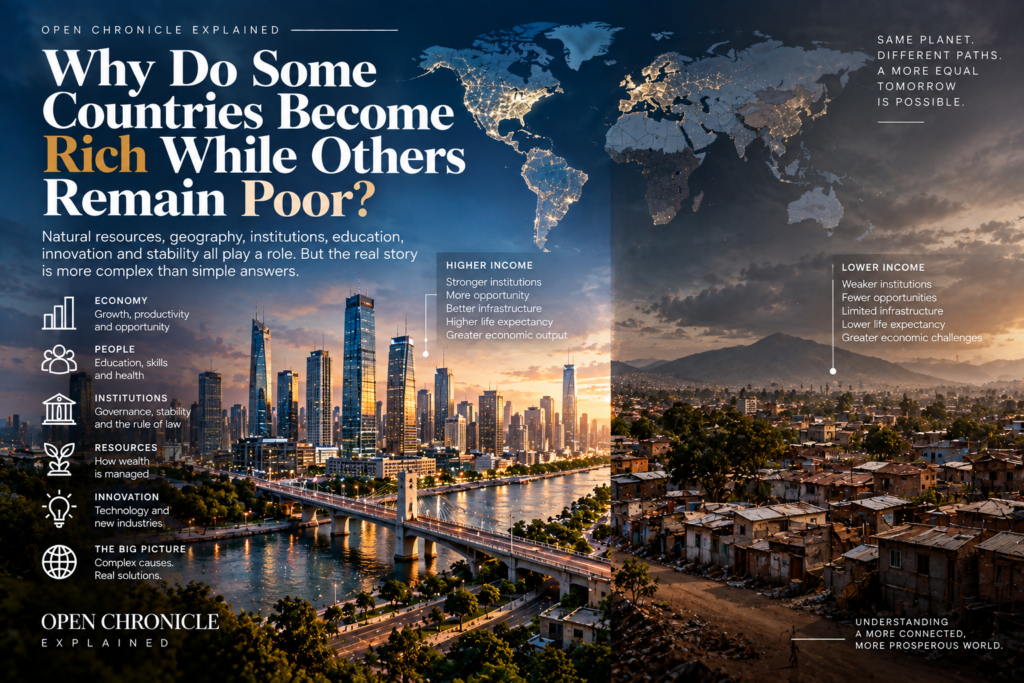
Look at the world at night from space.
Some regions glow with enormous networks of cities, roads, factories and infrastructure.
Others remain much darker.
Return to Earth and the differences become even more striking.
In one country, most people may have reliable electricity, clean water, advanced hospitals, universities, highways and high speed internet.
Across a border, families may struggle with unreliable power, limited healthcare, poor roads and fewer economic opportunities.
The difference can be enormous.
Why?
Why are some countries rich while others remain poor?
It sounds like a simple question.
It may be one of the most complicated questions in economics, history and political science.
There is no single answer.
Countries do not become wealthy simply because they possess oil.
Or because they have democracy.
Or because they trade.
Or because their citizens work harder.
Prosperity emerges from interactions between geography, history, institutions, human capital, technology, political stability, investment and countless decisions accumulated over generations.
To understand why countries become rich, we first need to understand what “rich” actually means.
What does it mean for a country to be rich?
One common measure is Gross Domestic Product, or GDP.
GDP measures the monetary value of final goods and services produced within an economy over a particular period.
But comparing total GDP can be misleading.
A country with 300 million people will naturally tend to produce more than a country with three million.
Economists therefore often use GDP per capita.
That divides economic output by population.
It provides a rough measure of average economic production per person.
But even GDP per capita does not tell the entire story.
Is GDP the same as quality of life?
No.
Two countries can have similar GDP per capita while providing very different living conditions.
Income distribution matters.
Healthcare matters.
Education matters.
Housing matters.
Security matters.
Environmental quality matters.
Working conditions matter.
Public infrastructure matters.
Life expectancy matters.
GDP is useful because economic production strongly influences what societies can afford.
But wealth is a means, not the entire definition of human wellbeing.
Why does productivity matter so much?
Because in the long run, living standards depend heavily on how much value people can produce with their time and resources.
Imagine two farmers.
One works with simple hand tools.
The other has modern machinery, irrigation, improved seeds, fertilizers, weather data and access to efficient transport networks.
Both may work equally hard.
But the second farmer can produce far more.
The difference is productivity.
The same principle applies across an economy.
A worker with better machinery, technology, infrastructure, education and organization can produce more value per hour.
Higher productivity makes higher wages and higher living standards more sustainable.
So rich countries are simply more productive?
At a broad level, high income economies tend to have high productivity.
But that creates another question.
Why are some countries more productive?
Now the explanation expands.
Capital.
Education.
Infrastructure.
Technology.
Institutions.
Management.
Trade.
Health.
Political stability.
Access to finance.
All can influence how productive workers and businesses become.
What is capital?
In economics, capital does not simply mean money.
It includes productive assets.
Factories.
Machines.
Computers.
Vehicles.
Power systems.
Ports.
Telecommunications networks.
Tools.
A worker equipped with advanced machinery can usually produce more than a worker relying only on physical labour.
Countries become more productive partly by accumulating capital.
But capital requires investment.
And investment requires confidence that the future is sufficiently predictable.
Why does investment matter?
Suppose you are considering building a factory.
It may take ten years to recover your investment.
You need to know several things.
Will your property remain yours?
Will contracts be enforced?
Will electricity be reliable?
Can goods reach customers?
Will the currency remain reasonably stable?
Can employees be hired?
Can profits be transferred?
Will the government suddenly confiscate the business?
If the answers are uncertain, you may not invest.
Multiply that decision across thousands of businesses and the institutional environment begins shaping the entire economy.
What are institutions?
Institutions are the rules and organizations that structure society.
Governments.
Courts.
Property rights.
Regulators.
Tax systems.
Central banks.
Parliaments.
Public administrations.
Commercial law.
Political conventions.
But institutions are more than buildings and written laws.
What matters is whether the rules actually function.
A constitution may promise property rights.
The important question is whether courts reliably protect them.
A law may prohibit corruption.
The important question is whether officials actually obey it.
Why does the rule of law matter economically?
Because economic activity depends on trust.
Suppose a company signs a contract with a supplier.
What happens if the supplier refuses to deliver?
In a functioning legal system, the company can seek enforcement through courts.
Now imagine contracts are rarely enforced unless someone pays a bribe.
Business becomes riskier.
Transactions become more expensive.
People rely on personal connections instead of open markets.
Investment declines.
The rule of law reduces uncertainty and allows strangers to cooperate economically.
That is an enormous advantage.
Do property rights make countries rich?
Secure property rights can encourage investment.
If farmers believe their land may be seized arbitrarily, they have less incentive to improve it.
If entrepreneurs fear their companies can be confiscated, they may move money elsewhere.
If inventors cannot benefit from innovations, incentives to create may weaken.
But property rights alone are not sufficient.
They need to exist alongside functioning markets, public infrastructure, education, competition and institutions capable of adapting to change.
What is corruption?
Corruption is the abuse of entrusted power for private benefit.
It can take many forms.
Bribery.
Embezzlement.
Nepotism.
Political patronage.
Public contracts awarded for personal gain.
Corruption can act like an unofficial tax on economic activity.
Businesses spend resources navigating political connections rather than improving products.
Public money intended for roads, hospitals or schools can disappear.
Citizens lose trust.
But corruption is also difficult to reduce because people may participate simply to navigate a system where everyone expects it.
Are natural resources the key to becoming rich?
Sometimes they help enormously.
Oil.
Natural gas.
Minerals.
Fertile land.
Forests.
Fisheries.
Natural resources can generate exports and government revenue.
Several wealthy countries have benefited greatly from resource endowments.
But resources do not guarantee prosperity.
Some resource rich countries remain poor.
Others experience corruption, conflict or economic instability.
This phenomenon is often associated with the idea of the resource curse.
How can resources become a curse?
Imagine a government receives enormous revenue from oil.
It may need citizens’ taxes less.
That can weaken the relationship between taxation and political accountability.
Political groups may compete to control the state because controlling government means controlling resource wealth.
The currency may strengthen, making other exports less competitive.
Corruption may increase.
The economy may fail to diversify.
Then oil prices fall.
Suddenly the country’s finances collapse.
Natural wealth creates opportunity.
Institutions determine how much of that opportunity becomes broad prosperity.
Can a country become rich without many natural resources?
Absolutely.
Some highly developed economies have relatively limited natural resources.
They compensate through human capital, manufacturing, services, trade, technology and strong institutions.
A country does not necessarily need valuable minerals beneath its soil.
Its most important economic resource may be the knowledge and capabilities of its people.
What is human capital?
Human capital refers to the skills, knowledge, health and capabilities people accumulate.
Education is central.
So is healthcare.
A child suffering from chronic malnutrition may struggle to develop fully.
A child without basic education may have fewer economic opportunities.
A skilled engineer can design complex systems.
A trained nurse can provide advanced healthcare.
A technician can operate sophisticated machinery.
When millions of people acquire skills, the productive capacity of the entire economy changes.
Does simply spending more on education make a country richer?
Not automatically.
Quality matters.
Students need to actually learn.
Schools need capable teachers.
Curricula need useful knowledge and skills.
Education systems must connect with the needs of society and the economy.
A country can increase school attendance without producing equivalent improvements in learning.
Human capital is about capabilities, not simply years spent inside classrooms.
Why does healthcare affect economic development?
Healthy people can learn, work and innovate more effectively.
High child mortality affects families and communities.
Disease can reduce labour productivity.
Poor sanitation can spread illness.
Lack of maternal healthcare can have lifelong consequences.
Public health improvements therefore have economic effects as well as humanitarian benefits.
Clean water may be economic infrastructure just as much as a highway.
Does geography determine whether a country becomes rich?
Geography matters.
But it is not destiny.
Countries differ in access to oceans.
Climate.
Disease environments.
Agricultural conditions.
Navigable rivers.
Natural resources.
Mountain ranges.
Distance from major markets.
A landlocked country may face higher transportation costs.
A country with navigable rivers may move goods cheaply.
A tropical disease burden can historically affect health and productivity.
But societies can overcome many geographical disadvantages through technology, infrastructure and institutions.
Why is access to the sea important?
Shipping is extraordinarily efficient for moving large quantities of goods.
A coastal country can build ports connecting domestic producers directly to global markets.
A landlocked country depends on neighbouring states for access to ports.
That can add transport costs.
Border procedures.
Political risk.
Infrastructure dependencies.
Landlocked geography does not make prosperity impossible.
But it can make economic development more challenging.
Why are ports so important?
A modern port connects a national economy to global supply chains.
Containers can carry manufactured goods outward.
Energy and raw materials can arrive.
Factories can integrate with international production networks.
Efficient ports reduce the cost of trade.
But a port alone is not enough.
It needs roads.
Railways.
Warehouses.
Customs systems.
Electricity.
Digital networks.
Logistics companies.
Infrastructure works as a system.
Why do roads matter for development?
Imagine a farmer who produces more food than the family needs.
That surplus has value only if it can reach a market.
Without reliable roads, transportation may cost more than the crop is worth.
The farmer remains trapped in subsistence production.
Build a road and suddenly markets become accessible.
Inputs become cheaper.
Children can reach schools.
Patients can reach hospitals.
Businesses can reach customers.
Infrastructure changes economic geography.
Why is electricity so important?
Modern economies depend on reliable energy.
Factories need power.
Hospitals need power.
Data centres need power.
Telecommunications networks need power.
Shops need refrigeration.
Students need lighting.
Businesses need computers.
Frequent blackouts reduce productivity and discourage investment.
Electricity is therefore not simply another service.
It is a platform on which much of the modern economy operates.
What role does technology play?
Technology allows societies to produce more with the same resources.
The steam engine transformed industrial production.
Electricity transformed factories and cities.
Railways transformed transport.
Computers transformed information processing.
The internet transformed communications.
Artificial intelligence may transform many forms of knowledge work.
Countries that develop, adopt and effectively use productive technologies can grow faster.
But importing a machine does not automatically create development.
Workers need skills.
Companies need management.
Infrastructure must support the technology.
Institutions must allow businesses to use it productively.
Why is innovation so important?
Eventually, simply adding more machines produces diminishing returns.
Long term growth increasingly depends on finding better ways to produce things.
New technologies.
New business models.
New medicines.
New materials.
Better organization.
More efficient processes.
Innovation allows productivity to continue increasing.
This is one reason research institutions, universities, competitive markets and entrepreneurship can become important parts of advanced economies.
Why did the Industrial Revolution matter so much?
For most of human history, economic growth was slow.
Agricultural productivity limited how many people could be supported.
Most people lived close to subsistence.
Then industrialization transformed production.
Machines multiplied human labour.
Fossil energy provided enormous quantities of power.
Factories enabled mass production.
Transport costs fell.
Scientific and technological innovation accelerated.
Some countries industrialized earlier than others.
Those differences produced enormous gaps in wealth.
The modern global economy still reflects parts of that history.
Why did industrialization begin in some places first?
Historians continue debating the relative importance of many factors.
Coal.
Institutions.
Trade.
Colonialism.
Scientific culture.
Capital markets.
Wages.
Political structures.
Geography.
Agricultural productivity.
No single explanation has settled the debate.
The important lesson is that economic transformation usually results from several conditions interacting rather than one magical ingredient.
How important is history?
Extremely.
Economies inherit institutions and infrastructure from the past.
Borders.
Legal systems.
Land ownership.
Education systems.
Political cultures.
Trade relationships.
Colonial institutions.
Wars.
Migration patterns.
A decision made centuries ago can influence economic conditions today.
Economists sometimes describe this as path dependence.
Where a society begins can influence which options become available later.
How did colonialism affect development?
Colonialism shaped economies across much of the world.
Colonial powers created political borders.
Extracted resources.
Built some infrastructure.
Restructured trade.
Moved populations.
Established legal and administrative systems.
In many cases, institutions were designed primarily to extract wealth rather than create inclusive domestic development.
The effects varied enormously across regions and empires.
But colonial history remains an important part of understanding why modern economies began the postcolonial era with very different institutions and economic structures.
Does that mean poor countries are trapped by history?
No.
History constrains possibilities.
It does not completely determine them.
Countries have transformed dramatically within a few generations.
Poor economies have become industrial powers.
Formerly wealthy countries have stagnated.
Institutions change.
Technology changes.
Policies change.
Trade patterns change.
Human capital accumulates.
Economic development is difficult, but it is not predetermined.
Why is political stability important?
Investment looks toward the future.
Businesses hesitate to build factories if civil war may begin next year.
Families may avoid long term investments if governments constantly collapse.
Infrastructure can be destroyed by conflict.
Skilled workers may emigrate.
Capital may leave.
Tourism disappears.
Government revenue falls.
Political stability therefore creates the predictability needed for long term economic decisions.
But stability alone does not guarantee prosperity.
A stable government can still pursue disastrous policies.
How destructive is war to economic development?
Potentially devastating.
War destroys physical capital.
Roads.
Factories.
Homes.
Power stations.
Hospitals.
It also destroys human capital.
People die.
Children miss school.
Professionals leave.
Investment disappears.
Government spending shifts towards military needs.
Trade routes are disrupted.
The economic effects can continue long after the fighting ends.
Peace is therefore one of the most fundamental conditions for sustained development.
Does democracy make countries richer?
The relationship is complicated.
Many wealthy countries are democracies.
But some countries experienced rapid economic growth under authoritarian governments.
Democracy can provide accountability, peaceful political competition and institutional checks.
But elections alone do not guarantee competent government or economic success.
Likewise, authoritarianism can sometimes produce rapid decisions while also creating corruption, policy mistakes and catastrophic concentrations of power.
The quality of institutions matters alongside the formal political system.
What are inclusive institutions?
One influential idea distinguishes between institutions that broadly enable participation and those primarily designed to extract wealth for a narrow elite.
Inclusive economic institutions tend to provide wider access to education, markets, property rights and opportunity.
Extractive institutions concentrate power and economic benefits.
If people believe success depends mainly on political connections rather than innovation or effort, incentives change.
Talent may move into politics and rent seeking rather than productive enterprise.
What is rent seeking?
Rent seeking occurs when individuals or organizations try to increase wealth through control of political or economic privileges rather than by creating additional value.
A company might lobby to block competitors.
An official might demand payments for licences.
An elite might monopolize valuable resources.
Energy that could have gone into innovation becomes focused on capturing existing wealth.
When rent seeking dominates an economy, productivity can suffer.
Why does competition matter?
Competition forces businesses to improve.
Lower prices.
Better products.
More efficient processes.
New technologies.
If a company knows customers have no alternative, it has less incentive to innovate.
Monopolies can sometimes emerge naturally in certain industries, and some sectors require regulation.
But economies where political connections permanently protect inefficient firms can struggle to raise productivity.
Creative destruction becomes important.
What is creative destruction?
The economist Joseph Schumpeter used the concept to describe how innovation continuously transforms capitalism.
New technologies create industries.
Old industries decline.
New companies replace established ones.
Jobs disappear.
Different jobs emerge.
This process increases productivity but creates disruption.
Governments face a difficult balance.
Allow economic transformation while helping people adapt to its costs.
Societies that prevent all change may protect existing jobs temporarily but risk long term stagnation.
Why do some countries fail to adopt better technology?
Technology adoption requires more than purchasing equipment.
Workers need skills.
Managers need knowledge.
Businesses need financing.
Electricity must work.
Internet access may be necessary.
Supply chains must function.
Regulations must allow new business models.
The technology may also threaten powerful existing interests.
An innovation that makes society richer overall can still be blocked by groups that expect to lose power or income.
How does trade help countries become richer?
Trade allows specialization.
Countries can focus more resources on goods and services they produce relatively efficiently and exchange them for other products.
Trade also provides access to larger markets.
A company serving ten million domestic customers has one opportunity.
A company able to reach billions of global consumers has another.
International competition can also encourage productivity improvements.
But trade creates winners and losers within countries.
That political reality matters.
Can protectionism help development?
Sometimes governments use tariffs or industrial policy to support emerging industries.
Historically, several countries protected particular sectors during periods of industrialization.
But protection can also preserve inefficient firms indefinitely.
If companies know they will never face competition, incentives to improve may weaken.
The difficult question is not whether governments should ever intervene.
It is whether intervention creates industries capable of eventually competing or merely permanent dependence on protection.
Why are supply chains important?
Modern products are rarely made entirely in one country.
A smartphone can involve minerals from one continent.
Semiconductors from another.
Software developed elsewhere.
Assembly in another country.
Global shipping connects the entire system.
Countries can develop by entering particular stages of these production networks.
Over time, they may attempt to move into more valuable activities.
Design.
Engineering.
Advanced manufacturing.
Research.
Branding.
Services.
This process is often described as moving up the value chain.
Why do exports matter?
Exports bring foreign demand into the domestic economy.
Manufacturing exports played an important role in the development strategies of several rapidly growing economies.
Exporting firms must often meet international standards and compete globally.
That can increase productivity.
Export revenue also provides foreign currency needed to purchase machinery, technology and other imports.
But an economy dependent on only one export can become vulnerable to price shocks.
Diversification matters.
What is the middle income trap?
Some countries grow rapidly from low income to middle income status and then slow down.
Early growth can come from moving workers from low productivity agriculture into factories.
Importing existing technology.
Building basic infrastructure.
Expanding education.
But eventually wages rise.
The country can no longer compete primarily through cheap labour.
To keep growing, it must become more innovative and productive.
That transition can be difficult.
This challenge is often described as the middle income trap.
Why is saving important?
Investment requires resources.
Domestic savings can help finance factories, infrastructure and businesses.
But extremely high saving is not automatically desirable either.
People also need consumption.
The important issue is whether financial systems can transform savings into productive investment.
Money sitting idle or flowing into unproductive speculation does not necessarily increase long term productive capacity.
What do banks contribute to development?
Banks connect savers with borrowers.
A household deposits money.
The bank can lend to a business.
The business buys machinery.
Production increases.
In reality, modern banking is more complicated, but the central economic function remains important.
Financial systems allocate capital.
If banks lend mainly according to political connections, productive businesses may be starved of finance.
If banking systems collapse, entire economies can suffer.
Why are central banks important?
Central banks help manage monetary systems.
Their responsibilities vary, but they may influence interest rates, issue currency, manage reserves and support financial stability.
High and unpredictable inflation can make long term economic planning difficult.
People lose confidence in money.
Savings can be destroyed.
Contracts become harder to price.
Stable monetary institutions therefore support economic development by reducing uncertainty.
Is inflation why some countries remain poor?
Not by itself.
But persistent very high inflation can severely damage an economy.
Governments may struggle to collect taxes.
Businesses shorten planning horizons.
Citizens move savings into foreign currencies or physical assets.
Investment falls.
Hyperinflation can destroy confidence in the monetary system almost completely.
Macroeconomic stability does not guarantee development.
But instability can make development much harder.
Why does government capacity matter?
A government may have excellent laws on paper but lack the ability to implement them.
Can it collect taxes?
Register property?
Maintain roads?
Operate schools?
Enforce regulations?
Provide security?
Manage public finances?
Respond to disasters?
This is state capacity.
Countries with capable public institutions can implement policies more effectively.
Weak state capacity can turn even sensible policies into failures.
Why are taxes important for development?
Taxes finance public goods.
Schools.
Hospitals.
Roads.
Courts.
Police.
Defence.
Infrastructure.
Government administration.
A state unable to collect sufficient revenue has limited capacity.
But tax systems also need legitimacy.
If citizens believe taxes are stolen or wasted, compliance declines.
A functioning fiscal system therefore depends partly on trust between citizens and government.
Why does inequality matter?
Some inequality can emerge naturally from differences in skills, entrepreneurship, risk and investment.
But extreme inequality can create economic and political problems.
Large parts of the population may lack access to education or capital.
Political influence can become concentrated.
Social mobility can decline.
Talented people born into poor families may never reach their potential.
The issue is therefore not simply how much wealth a country produces.
It is also whether people have realistic opportunities to participate in producing and benefiting from that wealth.
What is social mobility?
Social mobility describes how easily people can move between economic or social positions.
In a society with high mobility, a child’s future depends less strongly on the family’s starting position.
Education can matter.
Skills can matter.
Entrepreneurship can matter.
In a society with very low mobility, wealth and poverty can reproduce themselves across generations.
Broad access to opportunity can help countries use more of their population’s talent.
Why are women important to economic development?
Because excluding half the population from education, employment, property ownership or entrepreneurship wastes enormous human potential.
When women have greater access to education and economic opportunities, the labour force gains skills and productivity.
Household incomes can rise.
Health and education outcomes for children can improve.
Economic development is therefore strongly connected to whether societies allow people to contribute regardless of gender.
Why does population growth matter?
Population can be an advantage.
More workers.
More consumers.
Larger markets.
But rapid population growth also creates pressure.
More schools are needed.
More jobs.
More housing.
More infrastructure.
If economic growth fails to keep pace, income per person may stagnate.
Demography creates opportunities and constraints depending on how economies respond.
What is the demographic dividend?
When birth rates fall after a period of high population growth, a country can temporarily have a large working age population relative to children and older people.
If those workers are healthy, educated and employed productively, economic growth can accelerate.
This is called a demographic dividend.
But it is not automatic.
Without jobs and education, a large young population can instead face unemployment and frustration.
Does culture determine prosperity?
Culture can influence economic behaviour.
Trust.
Attitudes towards education.
Entrepreneurship.
Saving.
Work.
Family networks.
But cultural explanations require caution.
Cultures change.
The same society can move from poverty to prosperity without its people somehow becoming an entirely different culture.
Institutions and economic incentives also influence behaviour.
Using culture as a simple explanation can hide more measurable political and economic causes.
Why does trust matter?
Economic systems depend on cooperation.
If people generally trust that contracts will be honoured and institutions will function, transactions become easier.
Businesses can cooperate with strangers.
Credit becomes possible.
Complex organizations become easier to manage.
Low trust environments require more monitoring, security and personal relationships.
That increases transaction costs.
Trust is therefore a form of invisible economic infrastructure.
Why do cities often drive economic growth?
Cities bring people and businesses close together.
Workers can find specialized jobs.
Companies can find specialized employees.
Suppliers can serve many customers.
Ideas spread quickly.
Universities interact with businesses.
Transport networks converge.
Economists call some of these benefits agglomeration effects.
This helps explain why major cities often produce a disproportionate share of national economic output.
But why do megacities also contain enormous poverty?
Because urbanization can happen faster than economic development and infrastructure construction.
People move to cities seeking opportunity.
Housing supply may not keep pace.
Informal settlements grow.
Transport systems become overloaded.
Public services struggle.
Urbanization creates enormous economic potential, but managing it requires capable institutions and investment.
Why do talented people leave poor countries?
This is often called brain drain.
Doctors.
Engineers.
Scientists.
Entrepreneurs.
Other skilled workers may move abroad seeking higher salaries, better institutions or greater opportunities.
Their departure can weaken the country that paid to educate them.
But migration can also produce benefits.
Workers send remittances home.
Diaspora communities create trade connections.
Some migrants eventually return with capital, knowledge and international networks.
Migration’s development effects are therefore complex.
What are remittances?
Remittances are money migrants send to people in their countries of origin.
For some economies, remittances represent a major source of foreign income.
Families use them for food.
Housing.
Education.
Healthcare.
Business investment.
They can reduce poverty.
But dependence on remittances can also reflect a domestic economy unable to provide enough opportunities for its own workers.
Why do some countries suddenly grow very quickly?
Rapid growth often happens when several conditions align.
Political stability improves.
Investment increases.
Workers move into more productive industries.
Exports expand.
Education improves.
Infrastructure develops.
Technology is adopted.
Foreign capital arrives.
Productivity rises.
Because poorer countries can adopt technologies already developed elsewhere, they sometimes have the potential to grow faster than rich countries.
Economists call part of this process catch up growth or convergence.
If poor countries can copy technology, why don’t they all catch up?
Because technology alone is not enough.
Imagine giving the world’s most advanced factory equipment to a country without reliable electricity.
Or skilled technicians.
Or spare parts.
Or functioning roads.
Or contract enforcement.
The machinery may never operate efficiently.
Development requires complementary systems.
Technology.
Skills.
Infrastructure.
Institutions.
Finance.
Management.
Each supports the others.
What is a poverty trap?
A poverty trap occurs when poverty itself creates conditions that make escaping poverty difficult.
A poor family cannot afford education.
Without education, children earn low incomes.
Their children also cannot afford education.
At the national level, a poor country may lack tax revenue.
Without revenue, it cannot build infrastructure.
Without infrastructure, businesses do not invest.
Without investment, incomes remain low.
Breaking such cycles may require external finance, institutional reform, public investment or other interventions.
Does foreign aid help?
Sometimes.
Aid has helped finance vaccinations, disease control, emergency relief, education, infrastructure and other programmes.
But aid can also fail.
Projects may be poorly designed.
Funds can be misused.
Donor priorities may not match local needs.
Long term dependence can create distorted incentives.
The important question is not whether aid is inherently good or bad.
It is what type of aid, delivered under what conditions, for what purpose and with what results.
What about foreign investment?
Foreign direct investment can bring capital.
Technology.
Management expertise.
Jobs.
Connections to global markets.
But benefits depend on the structure of the investment.
An isolated mining project may create fewer domestic linkages than a manufacturing industry using local suppliers and training workers.
Governments often try to maximize the knowledge and economic activity that foreign investment generates inside the country.
Can governments create economic growth?
Governments can create conditions that support growth.
Infrastructure.
Education.
Public health.
Legal systems.
Macroeconomic stability.
Research.
Regulation.
Competition policy.
Industrial strategy.
But governments can also damage growth through corruption, arbitrary regulation, unsustainable debt, confiscation, monetary instability or badly designed interventions.
The difficult question is not simply whether government should be “large” or “small.”
It is whether the state is capable, accountable and effective at the functions it performs.
Can markets solve everything?
Markets are powerful mechanisms for coordinating economic activity.
Prices communicate information.
Competition encourages efficiency.
Entrepreneurs discover opportunities.
But markets also have limitations.
Pollution.
Monopoly power.
Public goods.
Information problems.
Financial instability.
Unequal access to opportunity.
Successful economies generally combine markets with institutions that establish rules and provide public goods.
The balance varies considerably between countries.
Is there one economic model that every country should follow?
No.
Successful economies differ significantly.
Tax systems differ.
Welfare states differ.
Labour markets differ.
Industrial policies differ.
Financial systems differ.
Natural resources differ.
Geography differs.
History differs.
Policies that work in one country may fail in another because institutions and circumstances are different.
Development is not a recipe where every country simply follows identical steps.
Why are some small countries extremely rich?
Small size can offer advantages in certain circumstances.
Administration may be simpler.
Specialization can be easier.
A small country can integrate deeply into global trade.
Some benefit from natural resources.
Others become financial, technological, manufacturing or logistics hubs.
But small countries can also be vulnerable to external shocks because their economies are less diversified.
Size alone does not determine wealth.
Why aren’t all large countries rich?
Large countries have advantages.
Big domestic markets.
More resources.
Large labour forces.
Potential economies of scale.
But they can also face challenges.
Regional inequality.
Administrative complexity.
Infrastructure costs.
Political fragmentation.
A large population increases total economic potential, but prosperity depends on output per person and how effectively resources are organized.
Why can neighbouring countries be so different?
Borders can separate different institutions.
One government protects property.
Another does not.
One invests heavily in education.
Another suffers prolonged conflict.
One maintains stable monetary policy.
Another experiences repeated inflation.
One integrates with global trade.
Another becomes isolated.
Because institutions and policies accumulate over decades, two societies sharing similar geography can follow very different economic paths.
These comparisons are especially useful because they demonstrate that geography alone cannot explain everything.
Can a poor country become rich in one generation?
It can become dramatically richer.
Several economies have undergone extraordinary transformations within decades.
Industrialization can be rapid.
Education levels can rise quickly.
Infrastructure can expand.
Exports can grow.
But sustained transformation requires more than a temporary boom.
The challenge is maintaining productivity growth while institutions evolve with an increasingly sophisticated economy.
Why is getting rich different from staying rich?
A country can initially grow by copying existing technology and moving workers into more productive sectors.
An advanced economy must increasingly generate innovation itself.
It must maintain institutions.
Upgrade infrastructure.
Adapt education.
Manage ageing populations.
Respond to technological disruption.
Remain competitive.
Prosperity is not a destination permanently reached.
Economic systems must continuously adapt.
Can rich countries become poor?
Relative decline is certainly possible.
Institutions can deteriorate.
Wars can destroy wealth.
Productivity growth can stagnate.
Debt crises can destabilize economies.
Political instability can discourage investment.
Technological leadership can be lost.
History contains societies that were once centres of economic power and later declined relative to others.
Wealth is not guaranteed forever.
What is the most important factor?
There probably is no single factor.
That is the frustrating but essential answer.
Geography shapes opportunities.
History shapes starting conditions.
Institutions shape incentives.
Education builds human capital.
Infrastructure connects people and markets.
Technology increases productivity.
Trade expands opportunities.
Political stability allows long term planning.
Finance turns savings into investment.
Competition encourages innovation.
Public health strengthens human capability.
Good policy helps coordinate the system.
Development emerges from the interaction between them.
Then why do economists disagree so much?
Because separating cause and effect is difficult.
Do good institutions create wealth?
Or does wealth allow countries to build better institutions?
Does education cause growth?
Or do richer societies simply spend more on education?
Does democracy encourage prosperity?
Or does prosperity make democracy more stable?
In reality, causation often runs in both directions.
Development is a system of feedback loops.
That makes simple explanations attractive.
And frequently misleading.
The Bigger Picture
Why do some countries become rich while others remain poor?
Not because people in wealthy countries simply work harder.
Not because every rich country possesses natural resources.
Not because one political system automatically guarantees prosperity.
Not because geography alone determines destiny.
Countries become prosperous when they develop systems that allow millions of people to become increasingly productive.
Children learn.
Workers acquire skills.
Entrepreneurs create companies.
Infrastructure connects markets.
Electricity powers factories.
Banks finance investment.
Courts enforce contracts.
Governments provide public goods.
Businesses compete.
Technology spreads.
Ideas become products.
Trade connects producers with consumers around the world.
And people believe sufficiently in the future to invest in it.
None of these systems exists independently.
Weak institutions can undermine investment.
Poor education can limit technology adoption.
Bad infrastructure can isolate businesses.
Conflict can destroy decades of accumulated capital.
Corruption can redirect resources away from productive uses.
Development is therefore not one decision.
It is millions of decisions made within institutions accumulated across generations.
That is why prosperity can take decades to build.
And why it can sometimes be damaged much faster.
The global divide between rich and poor countries is not a permanent law of nature.
Countries have risen.
Countries have fallen.
Countries once considered permanently poor have transformed themselves.
The real question is not simply why some countries are rich today.
It is what allows societies to create institutions, capabilities and opportunities that make sustained prosperity possible tomorrow.
Open Chronicle Explained
World Explained
Understanding the forces, systems and historical choices that shape the world we live in.
Categories: World Explained
Tags: economic development, rich countries, poor countries, global economy, GDP per capita, productivity, institutions, economic growth, poverty, inequality, human capital, education, infrastructure, industrialization, globalization, international trade, foreign investment, rule of law, corruption, natural resources, resource curse, economic history, developing countries, emerging economies, state capacity, technology, innovation, World Explained
Understanding the systems behind the headlines.
Explore Open Chronicle Explained →