
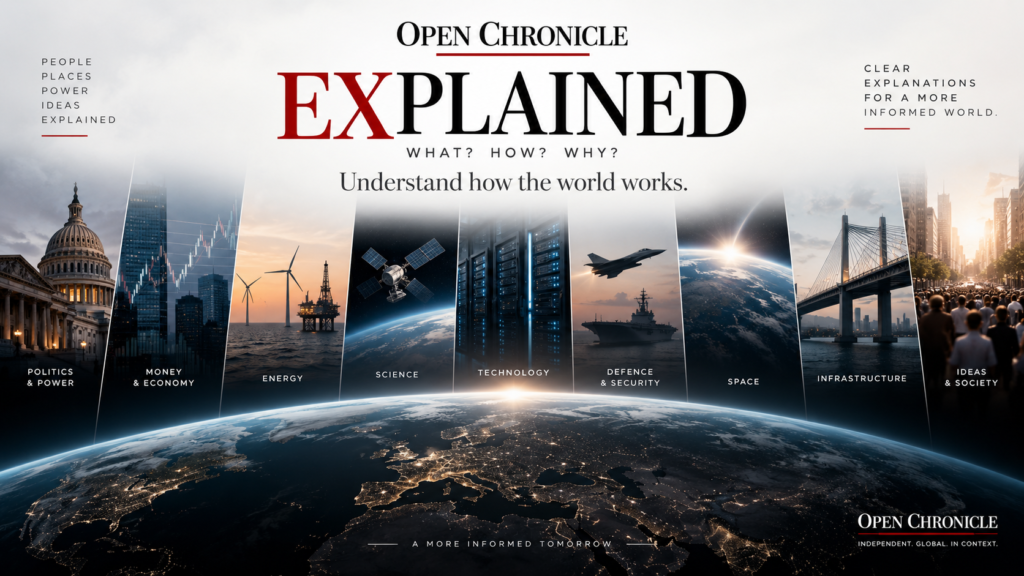
By Open Chronicle Explained
The world produces more information than ever before. Every minute brings another headline, another alert, another political crisis, another technological breakthrough, another economic indicator.
But information is not the same as understanding.
A missile is intercepted over a city. Oil prices rise after tensions in the Persian Gulf. A government suddenly collapses. A satellite keeps circling hundreds of kilometres above Earth. Electricity reaches a home at the flick of a switch. A cable lying thousands of metres beneath the Atlantic carries conversations, financial transactions and data between continents.
We see the consequences every day.
What we often do not see are the systems behind them.
That is why we created Open Chronicle Explained.
What? How? Why?
Open Chronicle Explained begins with three simple questions:
What is it?
How does it work?
Why does it matter?
They sound simple. But they are often the questions missing from the daily news cycle.
News is exceptionally good at telling us what has happened. A tanker has been attacked. A government has lost a confidence vote. A central bank has changed interest rates. A missile defence system has intercepted an incoming weapon.
Understanding those events requires another layer.
Why is one narrow stretch of water capable of influencing global energy prices?
How can a missile travelling at enormous speed be detected and intercepted?
Why can a government borrow billions for decades while another can suddenly find itself unable to finance its debt?
How does the internet actually travel between continents?
These are the questions Open Chronicle Explained was created to explore.
Behind Every Headline Is a System
Much of the modern world operates through systems that remain almost invisible until something goes wrong.
Electricity grids connect power stations to cities and homes.
Undersea cables form the physical backbone of the global internet.
Satellites provide navigation and timing signals used by transportation, communications and financial infrastructure.
Pipelines and shipping routes connect energy producers with consumers thousands of kilometres away.
Financial markets connect governments, banks, businesses and households.
Political institutions determine how power is gained, exercised and sometimes lost.
Most of the time, these systems operate quietly in the background.
Then a crisis happens.
Suddenly everyone wants to understand how they work.
Open Chronicle Explained is designed for that moment — but also for the curious reader who wants to understand the world before the next crisis arrives.
From the Strait of Hormuz to the Edge of Space
The first collection of Open Chronicle Explained articles already crosses several of the systems shaping modern life.
Readers can explore why the Strait of Hormuz has become one of the world’s most strategically important waterways and consider what might happen if it were closed.
They can discover how missile defence actually works, from detection and tracking to interception.
They can examine how a nuclear reactor produces electricity, or follow the journey electricity takes through generation, transmission and distribution before reaching a home.
Technology brings another set of questions.
How does GPS know where you are?
The answer leads from satellites orbiting Earth to atomic clocks, radio signals and mathematics.
And GPS itself raises another question:
What if it stopped working for 24 hours?
The consequences would extend far beyond drivers losing directions. Telecommunications, banking, logistics and critical infrastructure depend on the precise timing signals provided by satellite navigation systems.
The same approach takes us beneath the oceans.
How does the internet cross the Atlantic?
Not primarily through satellites, as some might imagine, but through an enormous network of fibre-optic cables lying across the seabed.
And then comes the natural next question:
What if major undersea internet cables were cut?
That progression — from understanding a system to exploring what happens when it is disrupted — is central to Open Chronicle Explained.
What If?
Some systems are easier to understand when we imagine them failing.
That idea has become one of the portal’s core series.
What If? explores hypothetical scenarios grounded in the real architecture of the modern world.
What if the Strait of Hormuz closed?
What if GPS stopped working for a day?
What if a country defaulted on its debt?
What if major undersea internet cables were severed?
These are not predictions.
They are thought experiments.
By changing one important variable, we can reveal dependencies that normally remain hidden.
A GPS outage exposes how dependent modern infrastructure has become on precise timing.
A sovereign default reveals the connections between governments, banks, bond markets, currencies and citizens.
A disruption to undersea cables demonstrates that the apparently weightless world of cloud computing still depends on physical infrastructure stretching across the ocean floor.
Sometimes the best way to understand how something works is to ask what would happen if it stopped working.
How the World Works
Another central series takes the opposite approach.
How the World Works examines the infrastructure and mechanisms that quietly make modern civilization possible.
How does electricity reach your home?
How does GPS know where you are?
How does the internet cross an ocean?
Future explainers will continue following these hidden systems — from communications and transportation to finance, energy, science and technology.
The objective is not simply to define them.
It is to make them understandable.
Politics, Money, Science, Technology and Society
Open Chronicle Explained is deliberately broad because the world itself does not divide neatly into isolated subjects.
Energy becomes geopolitics.
Technology becomes national security.
Science becomes infrastructure.
Finance becomes politics.
Geography becomes strategy.
A question such as “Why do some countries become rich while others remain poor?” can lead through institutions, geography, education, productivity, trade and political stability.
Understanding why societies become polarized requires looking at political incentives, identity, media, institutions and human behaviour.
Asking how a government actually falls opens a window into constitutions, parliamentary systems, elections, coalitions, legitimacy and political power.
The portal therefore brings together World Explained, Politics & Power, Money & Economy, Energy, Science, Technology, Defence & Security, Space, Infrastructure, and Ideas & Society.
Different subjects. One objective.
Understanding.
Built for Curiosity
Open Chronicle Explained is not intended only for specialists.
Quite the opposite.
You should not need a degree in economics to understand sovereign debt.
You should not need to be an electrical engineer to understand the power grid.
You should not need to be a physicist to understand why a satellite remains in orbit.
And you should not need to be a defence analyst to understand the basic principles behind missile defence.
Complexity is sometimes unavoidable.
Confusion is not.
Our aim is to take complicated subjects seriously without making them unnecessarily difficult to understand.
An Expanding Library of Understanding
Open Chronicle Explained begins with a foundation of explainers, but the project is designed to grow continuously.
New questions will emerge from current events.
Others will come from science, history, technology and everyday life.
Some will begin with enormous geopolitical questions.
Others may begin with something as ordinary as switching on a light.
Together, they will form an expanding library explaining the systems, institutions, technologies and ideas behind the modern world.
Because today’s background knowledge can become tomorrow’s essential context.
Understand the Story, Not Just the Headline
Open Chronicle will continue reporting events as they happen.
But some stories deserve another question after the headline:
Why?
And sometimes another:
How?
And occasionally the most revealing question of all:
What if?
That is the purpose of Open Chronicle Explained.
To move from information to understanding.
To reveal the systems behind events.
And to make a complicated world a little easier to comprehend.
The world is complicated. Understanding it shouldn’t be.
Explore Open Chronicle Explained
What? How? Why?
Understand how the world works.
Visit Open Chronicle Explained →
https://openchronicle.org/open-chronicle-explained/