
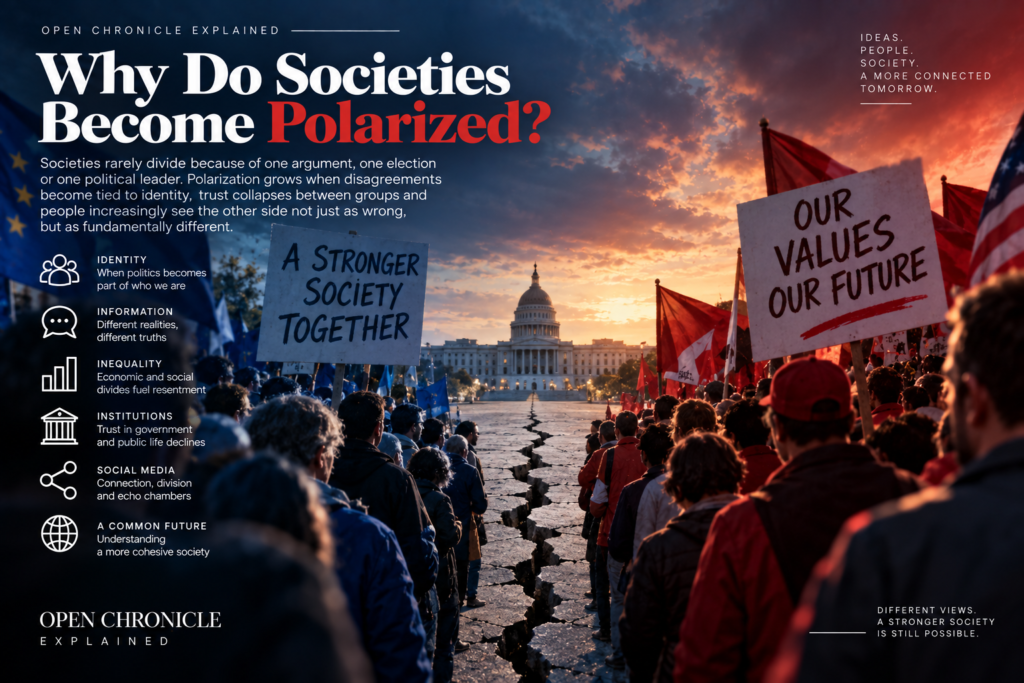
By Open Chronicle Explained
Imagine two neighbours.
They disagree about taxes.
One thinks taxes should be lower.
The other believes higher taxes are necessary to fund public services.
They argue.
Then they go home.
They may still attend the same school events.
Support the same football club.
Shop in the same stores.
Work in the same company.
They disagree politically, but politics does not define their entire relationship.
Now change the situation.
The disagreement about taxes becomes connected to immigration.
Religion.
Education.
Culture.
Media.
National identity.
Where people live.
Which institutions they trust.
Which news they believe.
Which political party they support.
Eventually, the two neighbours no longer disagree about one policy.
They begin to feel that they belong to two different social worlds.
That is when ordinary political disagreement can become something much more powerful.
Polarization.
First, what is polarization?
Polarization describes the process through which opinions, political identities or social groups become increasingly separated.
But there are several different kinds of polarization.
This distinction matters.
A society can disagree strongly about policy without necessarily becoming socially hostile.
Political scientists therefore often distinguish between ideological polarization and affective polarization.
Ideological polarization concerns differences in beliefs and policy preferences.
Affective polarization concerns how people feel about those on the opposing side.
The second can be particularly dangerous.
People may stop seeing political opponents simply as citizens with different opinions.
They may begin seeing them as people they dislike, distrust or fear.
Is disagreement the same as polarization?
No.
Disagreement is normal in a democracy.
People have different interests.
Different experiences.
Different values.
Different economic circumstances.
Different ideas about what government should do.
Democratic institutions exist partly because disagreement is inevitable.
A healthy political system does not eliminate disagreement.
It provides mechanisms for managing it.
Elections.
Parliaments.
Courts.
Negotiation.
Public debate.
Compromise.
Polarization becomes more serious when those mechanisms themselves lose legitimacy in the eyes of opposing groups.
Can political disagreement actually be healthy?
Yes.
Political competition can expose problems.
It can generate alternatives.
It allows citizens to choose between different programmes.
It forces governments to defend decisions.
A society in which everyone appears to agree may not necessarily be healthier.
Opposition can be essential to democracy.
The question is not whether people disagree.
The question is whether they continue accepting one another as legitimate participants in the same political system.
When does polarization become dangerous?
A crucial threshold is crossed when political competition becomes existential.
Instead of thinking:
“I want my side to win.”
People begin thinking:
“If the other side wins, our way of life may be destroyed.”
That changes political behaviour.
Compromise begins to look like surrender.
Negotiation can look like betrayal.
Political opponents become threats.
Elections feel less like temporary competitions for power and more like battles for survival.
Under those conditions, democratic norms can become much harder to sustain.
Why does identity matter so much?
Because human beings naturally form groups.
Family.
Community.
Religion.
Profession.
Nationality.
Political movements.
Sports clubs.
Language groups.
People derive meaning and belonging from social identities.
Politics becomes particularly powerful when political identity begins absorbing several other identities at once.
Imagine that party preference becomes strongly associated with geography, education, religion, culture and lifestyle.
Now knowing someone’s political affiliation tells you much more about their social identity.
Political disagreement becomes personal.
An attack on the party can feel like an attack on the person.
What is social sorting?
Researchers sometimes use the concept of social sorting to describe the alignment of multiple identities with political divisions.
Suppose political preferences are initially mixed across society.
People of different religions support different parties.
Cities contain supporters of both sides.
Education does not strongly predict political identity.
Over time, those patterns may become more aligned.
One political coalition becomes increasingly urban.
Another increasingly rural.
One becomes associated with certain educational backgrounds.
Another with different cultural identities.
The political divide becomes reinforced by social differences.
The result is not simply two political camps.
It can become two increasingly distinct social communities.
Why does geography matter?
Where people live influences what they experience.
A resident of a large global city may encounter different economic opportunities, cultural influences and demographic changes from someone living in a small rural community.
Industrial regions may experience economic decline differently from technology hubs.
Housing costs may dominate politics in one place.
Employment insecurity may dominate somewhere else.
When political preferences become geographically concentrated, people also encounter fewer political opponents in everyday life.
This can reinforce polarization.
Your neighbours think like you.
Your colleagues may think like you.
Your local media may reflect similar concerns.
The other side becomes increasingly distant.
Does economic inequality cause polarization?
It can contribute, but the relationship is not automatic.
Economic inequality can create perceptions that the system is unfair.
People may believe wealth and opportunity are distributed unequally.
Regions can feel abandoned.
Workers may believe economic change benefits others while leaving them behind.
Younger generations may struggle with housing.
Communities may experience deindustrialization.
These frustrations can become politically powerful.
But economic divisions do not always map neatly onto political polarization.
Identity, culture and institutional trust also matter.
Economic grievances often become most politically significant when they connect with broader stories about who is responsible and who belongs.
Why does economic change create political tension?
Because economic transformation creates winners and losers.
Globalization can expand trade and reduce prices while also exposing some industries to intense competition.
Automation can increase productivity while displacing particular jobs.
Technological change can create enormous wealth in certain regions while weakening older economic centres.
The overall economy may grow while specific communities decline.
National statistics can therefore tell one story while individual experience tells another.
If people feel that institutions ignore their losses, political resentment can grow.
Why does status matter as well as money?
People care about more than income.
They care about respect.
Recognition.
Influence.
Social standing.
A group can experience rising material living standards while still believing its social status is declining.
Cultural change can make previously dominant groups feel less influential.
Other groups may feel they have historically been excluded from recognition and power.
Politics then becomes a struggle not simply over resources, but over status.
Who is respected?
Whose values dominate?
Whose history is remembered?
Whose voice matters?
These questions can produce powerful emotional divisions.
What role does cultural change play?
Societies constantly change.
Attitudes towards religion.
Family.
Gender.
Race.
National identity.
Immigration.
Language.
Authority.
Tradition.
Generational change can accelerate these transformations.
For some citizens, change represents progress.
For others, it can feel destabilizing.
Political entrepreneurs can organize these disagreements into broader conflicts over national identity.
When cultural questions become connected to partisan identity, polarization can intensify rapidly.
Why is immigration often politically polarizing?
Because immigration touches several issues simultaneously.
Economics.
Culture.
Identity.
Borders.
Security.
Public services.
Demography.
National sovereignty.
People may disagree about immigration for very different reasons.
One person may focus on labour markets.
Another on humanitarian obligations.
Another on cultural integration.
Another on border control.
Another on population decline.
Political debate can compress all these questions into a simple division between opposing camps.
Complex policy disagreements become identity markers.
What happens when politics becomes tribal?
People begin evaluating information differently depending on who provides it.
A claim from one’s own group receives the benefit of the doubt.
The same claim from the opposing group is treated with suspicion.
Mistakes by allies are explained.
Mistakes by opponents are condemned.
Success by the other side can even become uncomfortable because it threatens the group’s political narrative.
Politics begins resembling team competition.
But unlike sport, political outcomes affect laws, institutions and everyday life.
What is affective polarization?
Affective polarization is the growing emotional distance between political groups.
People increasingly dislike supporters of opposing parties.
They may consider them less trustworthy.
Less intelligent.
Less moral.
Less patriotic.
Or more dangerous.
This can happen even when policy differences themselves have not increased dramatically.
That is why polarization cannot be measured only by comparing party manifestos.
A society can become emotionally polarized even when many citizens share similar views on individual issues.
How can people agree on issues but still hate the other side?
Because political identity is not purely about policy.
A person may identify with a party because of family history.
Culture.
Community.
Religion.
Class.
Region.
A particular leader.
Or opposition to another group.
Once that identity becomes strong, political affiliation can function like membership in a social tribe.
The emotional attachment may remain even when policy positions overlap.
What is negative partisanship?
Sometimes people support a political party less because they love it and more because they strongly oppose the alternative.
This is known as negative partisanship.
A voter may be disappointed with their own side.
They may distrust its leaders.
They may disagree with some policies.
Yet they continue voting for it because the opposing party feels unacceptable.
Politics becomes driven by fear of losing rather than enthusiasm about winning.
That can make polarization self sustaining.
Why does fear work so well politically?
Fear attracts attention.
It also simplifies complicated questions.
If people believe an opposing group threatens their jobs, rights, security, religion, identity or country, compromise becomes harder.
Political actors understand this.
Campaign messages can emphasize danger.
“If they win, you will lose.”
“If they take power, everything will change.”
Sometimes threats are genuine.
Sometimes they are exaggerated.
Either way, fear can mobilize people more effectively than detailed policy arguments.
Do politicians create polarization?
They can contribute to it.
Political leaders have incentives to mobilize supporters.
One way to do that is to emphasize differences with opponents.
Another is to portray elections as unusually consequential.
Leaders can also use divisive language to strengthen loyalty within their own coalition.
But politicians do not operate in isolation.
They respond to voters.
Media incentives.
Party systems.
Economic conditions.
Institutional structures.
Polarization is usually produced by interactions between political elites and society rather than by one leader alone.
What is elite polarization?
Elite polarization occurs when political leaders, parties and institutions become increasingly divided.
When politicians rarely cooperate across party lines, citizens receive powerful signals.
“This is what people like us believe.”
“This is what the other side believes.”
Voters can then adjust their own identities and attitudes accordingly.
Political elites do not merely reflect public opinion.
They can help organize it.
Can voters polarize politicians?
Yes.
The process works in both directions.
Highly motivated party supporters may punish politicians who compromise.
Primary elections or internal party contests can reward candidates with stronger ideological positions.
Activists may demand loyalty.
Donors can influence incentives.
Media audiences may prefer confrontation.
Politicians then become more polarized.
Their behaviour sends signals back to voters.
The cycle reinforces itself.
What role does the media play?
Media systems shape what people see and how political events are framed.
In earlier eras, large portions of the public often consumed the same newspapers, radio broadcasts or television news.
Digital media dramatically expanded choice.
People can now select information sources that closely match their interests and political views.
This has enormous benefits.
More voices can participate.
Information is easier to access.
Traditional gatekeepers have less control.
But fragmentation also creates new problems.
Different political groups can inhabit different information environments.
What is an echo chamber?
An echo chamber is an environment where people repeatedly encounter views similar to their own while opposing perspectives are limited or dismissed.
The concept is sometimes used too casually.
Most people still encounter diverse information.
But selective media consumption can nevertheless reinforce existing beliefs.
If every trusted source tells you that one political group is dangerous, corrupt or irrational, your perception of that group can become increasingly negative.
And the other side may be consuming an entirely different narrative about you.
Do social media algorithms cause polarization?
The answer is more complicated than a simple yes.
Social media platforms use recommendation systems to decide which content users are likely to engage with.
Engagement can be driven by many emotions.
Curiosity.
Humour.
Admiration.
Anger.
Outrage.
Fear.
Provocative political content can therefore spread rapidly.
But algorithms operate within existing social and political environments.
They do not create every division from nothing.
Instead, they can amplify certain content, accelerate information flows and make political conflict much more visible.
Why does outrage spread so easily?
Because emotionally powerful information captures attention.
Imagine two headlines.
“Government releases revised infrastructure proposal.”
And:
“Government’s shocking plan could destroy your community.”
The second is more likely to provoke a reaction.
People click.
Comment.
Share.
Argue.
Algorithms may interpret that engagement as evidence that the content is interesting.
The content reaches more people.
Attention becomes a reward.
Outrage can therefore become economically valuable.
What is the attention economy?
Many digital platforms compete for one scarce resource.
Human attention.
The longer users remain engaged, the more opportunities platforms have to show advertising, collect interaction data or retain users.
Political conflict can be highly engaging.
This does not mean every platform deliberately wants society polarized.
It means the incentives of attention based systems can sometimes favour emotionally intense content.
The social consequences can be unintended but significant.
Why does misinformation become powerful in polarized societies?
Because people are more likely to accept information that confirms what they already believe.
This is related to confirmation bias.
If a false story portrays the opposing political group negatively, supporters of the other side may be more willing to believe and share it.
Correction becomes difficult because the issue is no longer simply factual.
The information supports group identity.
Rejecting the story may feel like helping the enemy.
Does fact checking solve the problem?
It can help.
But facts alone cannot always resolve identity based conflicts.
Suppose two groups disagree about a statistic.
Providing accurate data may settle the factual question.
But suppose the deeper disagreement concerns trust.
One group distrusts the government.
Another distrusts the media.
Another distrusts academics.
Now presenting more information from those institutions may not persuade anyone.
Polarization can therefore become a crisis of trusted authority.
Why does institutional trust matter?
Modern societies depend on institutions citizens cannot personally verify every day.
Courts.
Election authorities.
Scientists.
Central banks.
Universities.
Police.
Public health agencies.
Statistical offices.
News organizations.
People must place some degree of trust in systems they do not directly control.
When trust collapses along partisan lines, basic facts become contested politically.
One side accepts an institution because its group trusts it.
The other rejects it because its group does not.
Shared reality begins to fragment.
What happens when people cannot agree on basic facts?
Political compromise becomes much harder.
You can negotiate over solutions to a shared problem.
But what happens if the groups cannot agree that the problem exists?
Or who won an election?
Or whether an economic statistic is legitimate?
Or whether a court has authority?
Political debate normally begins from some common factual ground.
When that foundation disappears, politics can become a competition between incompatible realities.
Why are conspiracy theories attractive during polarization?
Conspiracy theories can provide simple explanations for complicated events.
They identify villains.
They explain uncertainty.
They transform coincidence into intention.
And they can reinforce group identity.
If your group loses an election, a conspiracy theory may explain that the system was secretly manipulated.
If a policy fails, hidden enemies can be blamed.
If experts disagree with your worldview, the experts themselves can be portrayed as part of the conspiracy.
The theory becomes difficult to disprove because contradictory evidence can be interpreted as further evidence of the cover up.
Does education prevent polarization?
Not necessarily.
Education can improve analytical skills and access to information.
But educated people are still human.
They have identities.
Values.
Biases.
Political loyalties.
In some circumstances, highly informed citizens can become particularly skilled at finding arguments supporting positions they already hold.
Knowledge does not automatically eliminate motivated reasoning.
What is motivated reasoning?
Motivated reasoning occurs when people evaluate information partly according to the conclusions they want to reach.
We are often more critical of evidence that challenges our beliefs.
And more accepting of evidence that supports them.
This is not unique to any political ideology.
It is a human tendency.
Polarized environments provide powerful motivations for using it.
Why do people exaggerate how extreme the other side is?
Because most people do not personally know a representative sample of their political opponents.
They encounter some of them through media.
And media tends to show unusual events.
Angry activists.
Controversial politicians.
Viral videos.
Extreme statements.
The quiet moderate who goes to work, raises a family and holds several ordinary political opinions rarely becomes national news.
People can therefore construct an image of the opposing side from its most visible extremes.
Can social media make minorities look like majorities?
Yes.
A small but highly active group can generate enormous volumes of online content.
If its messages spread widely, observers may assume the views are much more common than they actually are.
This can create a false perception of public opinion.
Politicians and journalists can also mistake online intensity for population wide sentiment.
The result may be a feedback loop in which everyone responds to an exaggerated picture of everyone else.
What is the perception gap?
People often believe supporters of opposing political groups hold more extreme positions than those supporters actually report.
This gap between perceived and actual attitudes can deepen hostility.
If you think the other side overwhelmingly supports an extreme position, you may become more defensive.
They may be making the same mistake about you.
Polarization can therefore grow partly from mutual misunderstanding.
Does polarization happen only in two party systems?
No.
Multi party democracies can also become polarized.
The divisions may take different forms.
Several parties may organize into opposing blocs.
Anti establishment parties may challenge traditional parties.
Political competition may divide around nationalism, religion, class or regional identity.
Institutional design influences how polarization is expressed.
But no electoral system is automatically immune.
Can electoral systems affect polarization?
Yes.
Different systems create different incentives.
Winner take all systems can encourage broad coalitions but may also produce strong two camp competition.
Proportional systems allow more parties to represent distinct viewpoints but can create fragmented parliaments.
Presidential systems personalize national political competition.
Parliamentary systems can encourage coalition bargaining.
No system completely eliminates polarization.
Institutions can, however, influence whether political conflict encourages compromise or confrontation.
What happens when every issue becomes partisan?
Issues that once crossed political lines begin aligning with party identity.
Climate policy.
Foreign policy.
Public health.
Education.
Technology.
Even consumer choices.
Once an issue becomes a partisan marker, changing one’s mind becomes socially more difficult.
The question is no longer simply:
“What evidence is strongest?”
It can become:
“What do people like me believe?”
Why is compromise so difficult in polarized politics?
Because compromise imposes political costs.
Suppose a politician negotiates with the opposition.
In a less polarized environment, supporters may see this as responsible governance.
In a highly polarized environment, activists may call it betrayal.
The politician can lose support within their own camp.
As a result, leaders may prefer stalemate to agreement.
Institutions designed for negotiation become arenas of permanent confrontation.
Can polarization paralyse government?
Yes.
If political groups refuse cooperation, passing budgets or legislation can become difficult.
Appointments may be blocked.
Coalitions can collapse.
Government formation can take longer.
Executive power may expand as legislatures struggle to act.
Citizens then see institutions failing to solve problems.
Trust declines further.
That can create another feedback loop.
Polarization causes dysfunction.
Dysfunction causes distrust.
Distrust fuels more polarization.
Does polarization always lead to violence?
No.
Many polarized societies remain peaceful.
Strong disagreement does not automatically become violence.
But extreme polarization can increase risk when political opponents are dehumanized or portrayed as existential enemies.
Violence becomes easier to justify psychologically when people stop seeing the opposing group as legitimate fellow citizens.
Language therefore matters.
Political rhetoric can lower or raise barriers against violence.
What is dehumanization?
Dehumanization occurs when people describe another group as less than fully human or as inherently dangerous, contaminated or evil.
History shows why this can be dangerous.
Normal moral restraints become weaker when a group is portrayed as undeserving of empathy.
Healthy democratic competition requires a basic principle:
Your political opponent remains a citizen.
They may defeat you.
You may strongly oppose them.
But their existence is not illegitimate.
Why do political norms matter?
Not every rule of democracy is written in a constitution.
Political systems also depend on informal norms.
Accepting electoral defeat.
Respecting opposition rights.
Avoiding political violence.
Allowing peaceful transfers of power.
Recognizing institutional limits.
Using compromise when necessary.
These norms are easier to maintain when political opponents trust one another enough to believe today’s defeat is temporary.
Polarization weakens that confidence.
Why is accepting defeat so important?
Democracy depends on losers believing they will have another chance.
If you lose an election but trust that another election will occur, accepting defeat becomes rational.
If you believe your opponents will permanently destroy the system once they win, accepting defeat becomes much harder.
This is why democratic stability requires more than elections.
It requires confidence that political competition will continue.
Can strong institutions contain polarization?
They can help.
Independent courts can enforce rules.
Professional election administration can protect electoral legitimacy.
Free media can expose abuses.
Parliaments can create forums for negotiation.
Federal or decentralized systems can distribute power.
Civil society organizations can connect people across political divisions.
But institutions are not invulnerable.
They ultimately depend on citizens and leaders accepting their legitimacy.
Can civil society reduce polarization?
Potentially.
People often behave differently when they know one another personally.
A political opponent online can appear abstract and threatening.
A political opponent who is also your colleague, neighbour or football teammate is harder to reduce to a stereotype.
Organizations that bring different groups together can create what social scientists call cross cutting ties.
These relationships prevent one identity from defining every interaction.
What are cross cutting identities?
Imagine two people who vote for opposing parties.
But they support the same football team.
Work in the same profession.
Belong to the same community association.
Have children at the same school.
Their political identities divide them.
Other identities connect them.
Those overlapping relationships can moderate political hostility.
Polarization becomes more dangerous when nearly every important identity aligns along the same political boundary.
Can local communities help?
Yes.
Local politics often focuses on practical problems.
Roads.
Schools.
Waste collection.
Housing.
Public spaces.
Community safety.
Citizens with different national political views may cooperate on these issues because they share immediate interests.
Local institutions can therefore create opportunities for collaboration that national political debate sometimes lacks.
What role do workplaces play?
Workplaces bring together people who may differ politically but share professional goals.
The same can be true of schools, universities, sports clubs, religious organizations and volunteer groups.
When these institutions remain socially diverse, they create contact across political boundaries.
If society becomes increasingly segregated by politics, those encounters decline.
The other side becomes more abstract.
And abstraction makes stereotyping easier.
Can polarization decrease?
Yes.
Polarization is not necessarily permanent.
Political coalitions change.
New issues emerge.
Generations change.
Parties reorganize.
Economic conditions improve or deteriorate.
Institutions reform.
External crises can sometimes unite societies, although they can also divide them further.
Political identities that once seemed permanent can disappear surprisingly quickly.
History contains many examples of party systems and social divisions being reorganized.
What helps reduce polarization?
There is no single solution.
But several mechanisms can help.
Strong and trusted institutions.
Accurate information.
Political incentives for cooperation.
Electoral rules that reward broader coalitions in some contexts.
Contact between different social groups.
Responsible political leadership.
Media literacy.
Transparent government.
Economic opportunity.
Local civic organizations.
Shared national institutions.
Most importantly, democratic competition needs boundaries.
Winning cannot justify everything.
Losing cannot mean exclusion from the political community.
Can better social media design help?
Possibly.
Platforms can change recommendation systems.
Provide more context.
Reduce amplification of certain manipulative behaviours.
Make users more aware of sources.
Limit coordinated inauthentic activity.
Give users greater control over recommendations.
But technology alone cannot solve a social problem created by politics, economics, identity and institutions.
Changing an algorithm cannot automatically rebuild trust between citizens.
Can journalism help?
Journalism can either clarify disagreement or intensify it.
Reporting that explains complexity can help audiences understand why different groups hold different views.
Reporting focused entirely on conflict can make politics appear more hostile than it is.
Journalists also face a difficult challenge.
They must report genuinely extreme behaviour without making fringe positions appear representative of entire populations.
Accuracy involves context as well as facts.
Can political leaders deliberately depolarize?
Yes, although incentives may work against them.
Leaders can acknowledge legitimate concerns on the opposing side.
Avoid dehumanizing language.
Accept institutional constraints.
Build cross party agreements.
Distinguish political opponents from enemies.
Respect electoral outcomes.
But moderation can be politically risky when the most active supporters demand confrontation.
Depolarization therefore requires incentives as well as good intentions.
Does a common enemy unite societies?
Sometimes.
Wars, disasters or external threats can create temporary national unity.
Existing divisions may become less important.
But this effect is not guaranteed.
Citizens may disagree about responsibility, strategy or government response.
External threats can also be exploited politically to intensify internal divisions.
Shared danger can create solidarity.
It can also create suspicion.
Is polarization always bad?
Not necessarily.
Some historical political conflicts involved fundamental questions that could not simply be compromised away.
Civil rights.
Political representation.
Authoritarianism.
Slavery.
Colonial rule.
Equal citizenship.
Strong polarization can sometimes reflect real moral or institutional conflicts.
Calling for “less polarization” cannot mean that every difference should be split down the middle.
The important distinction is between strong disagreement and the destruction of democratic coexistence.
Can a democracy survive intense polarization?
Yes.
But the strain increases.
A democracy can survive bitter political competition if participants still respect constitutional rules and recognize opponents as legitimate.
Problems become much more serious when one or more groups decide that normal democratic constraints no longer apply.
At that point, polarization is no longer merely about public opinion.
It becomes a question about the survival of the political system itself.
How can you tell whether a society is becoming dangerously polarized?
There is no single measurement.
But warning signs can include several developments occurring together.
Growing hostility towards opposing voters.
Declining trust in elections.
Declining trust in courts or other institutions along partisan lines.
Political violence becoming more acceptable.
Opponents increasingly described as enemies or traitors.
Compromise becoming politically toxic.
Separate information environments becoming dominant.
Citizens believing defeat would be catastrophic.
No one indicator proves democratic breakdown.
But the pattern matters.
Why does polarization sometimes accelerate suddenly?
Because social systems can reach tipping points.
For years, divisions may grow gradually.
Then a major event occurs.
An economic crisis.
War.
A migration surge.
A corruption scandal.
A disputed election.
A pandemic.
A major social movement.
The event does not necessarily create the underlying divisions.
It activates them.
Existing distrust becomes politically organized.
People choose sides.
The polarization that seemed sudden may have been developing quietly for years.
Why is rebuilding trust so difficult?
Trust takes time to build and can disappear quickly.
If citizens believe an institution has acted unfairly, one reform may not immediately restore confidence.
If political groups have spent years describing one another as dangerous, a single conciliatory speech changes little.
Trust depends on repeated experience.
Rules being applied consistently.
Elections being administered fairly.
Institutions delivering results.
Political leaders respecting limits.
People encountering opponents who do not match the stereotypes they were taught.
Depolarization is therefore usually a process rather than an event.
The Bigger Picture
Societies do not become polarized simply because people disagree.
Disagreement has always existed.
What changes is the meaning attached to disagreement.
A tax debate becomes a question of identity.
An election becomes a battle over belonging.
A political party becomes a social tribe.
A news source becomes a marker of loyalty.
A neighbour becomes a representative of “the other side.”
Gradually, politics expands into areas of life that once connected people across political boundaries.
Geography aligns with politics.
Culture aligns with politics.
Education aligns with politics.
Media aligns with politics.
Identity aligns with politics.
And when enough identities line up along the same dividing line, compromise becomes much more difficult.
The danger is not that citizens stop disagreeing.
A free society will always disagree.
The danger comes when citizens stop believing they belong to the same society.
Democracy requires competition.
But it also requires something deeper.
The understanding that political opponents are temporary rivals, not permanent enemies.
Governments change.
Policies change.
Parties win and lose.
Arguments continue.
But the political community survives.
Polarization becomes most dangerous when that final idea begins to disappear.
Open Chronicle Explained
Ideas & Society
Understanding the ideas, identities and social forces that shape how people live together.
Understanding the systems behind the headlines.
Explore Open Chronicle Explained →