
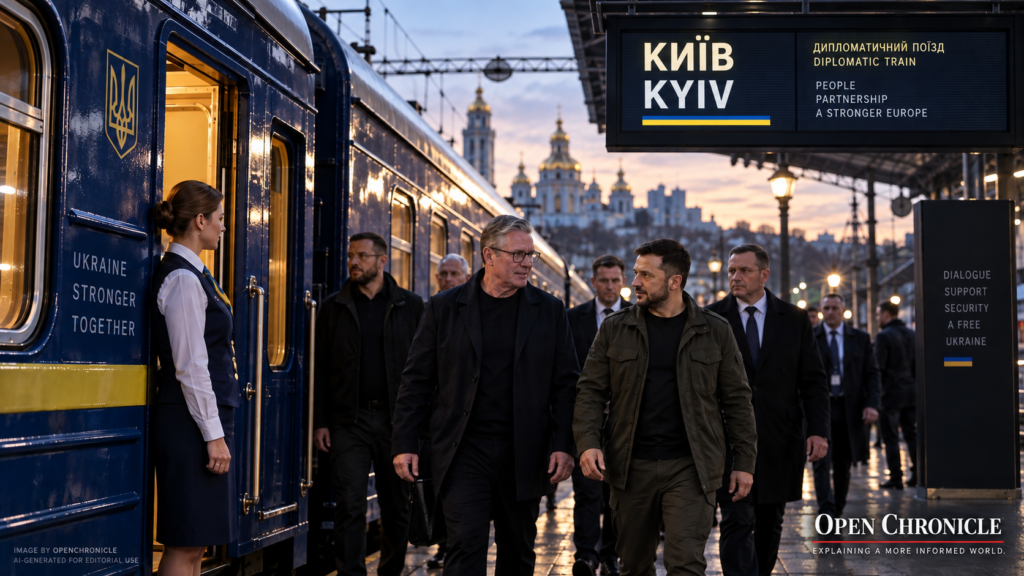
By Open Chronicle Explained
A president disappears from public view somewhere in Europe.
Hours later, photographs appear from Kyiv.
The leader is standing beside Ukrainian President Volodymyr Zelenskyy — hundreds of kilometres inside a country whose civilian airspace has effectively been closed since Russia launched its full-scale invasion in February 2022.
No presidential aircraft has landed at Kyiv’s Boryspil International Airport.
There was no conventional motorcade from an airport.
Instead, in many cases, the final part of the journey took place through one of the oldest forms of long-distance transportation in Europe:
the railway.
Since 2022, Ukraine’s rail network has quietly become one of the most important diplomatic transportation systems in the world.
Presidents, prime ministers, foreign ministers, ambassadors, military officials and international delegations have travelled through Ukraine aboard specially organised trains.
Ukrainian Railways has given the phenomenon a name:
Iron Diplomacy.
But why do some of the world’s most protected people travel into a country at war by train?
And how can such journeys take place when Russia is regularly attacking Ukrainian infrastructure?
The answer combines geography, security, secrecy, railway logistics and an extraordinary degree of coordination between governments.
Why Can’t Leaders Simply Fly to Kyiv?
Before the war, the obvious way for a foreign leader to reach Kyiv was by aircraft.
That changed on 24 February 2022.
With Russian and Ukrainian military aircraft operating over the country and missiles and drones crossing Ukrainian airspace, civilian aviation effectively disappeared from Ukrainian skies.
Kyiv’s major airports stopped functioning as normal international gateways.
That creates an unusual logistical problem.
A visiting president may travel thousands of kilometres aboard a government aircraft — only to discover that the final several hundred kilometres cannot safely be completed by air.
The journey therefore becomes a combination of transportation systems.
Typically:
Aircraft → neighbouring country → secure ground transfer → Ukraine → Kyiv
And for many delegations, the most important part of that chain is the train.
Why Poland Became the Gateway to Kyiv
Geography explains much of the system.
Poland borders western Ukraine while also possessing major airports and transport infrastructure connected with the rest of Europe.
Cities in southeastern Poland therefore became important logistical gateways following the invasion.
Foreign delegations can fly into Poland and continue eastward by land.
For ordinary travellers, railway hubs such as Przemyśl and Chełm became important interchange points for services toward Ukraine.
High-level delegations can follow variations of the same geographical corridor.
But their journeys are organised under completely different security conditions.
The precise routes, timings, boarding locations and security procedures used for individual leaders are often deliberately withheld.
That secrecy is not ceremonial.
It is part of the protection system.
Why Use a Train?
At first glance, travelling by railway through a country under missile and drone attack might appear counterintuitive.
But trains offer several important advantages.
Ukraine possesses one of Europe’s largest railway networks.
The system reaches virtually every major Ukrainian city.
Railways can operate without civilian airspace.
They can move large distances overnight.
Routes can sometimes be changed when infrastructure is damaged.
And Ukraine’s railway workers have accumulated extraordinary wartime experience keeping trains operating despite repeated Russian attacks.
There is another important advantage.
A train can move continuously.
Instead of concentrating a delegation at an airport where arrival times may be relatively predictable, railway movements can be integrated into a much larger national transportation network.
This does not make the journey safe.
It makes it manageable.
What Is “Iron Diplomacy”?
During the first months of the invasion, Ukrainian Railways began organising transportation for foreign delegations travelling to Kyiv.
The programme became known as Iron Diplomacy.
Its origins can be traced to one of the most dramatic diplomatic visits of the early war.
On 15 March 2022, the prime ministers of Poland, the Czech Republic and Slovenia travelled by train to Kyiv while Russian forces were still threatening the capital.
Their journey demonstrated something important.
Ukraine could still physically receive foreign leaders.
Soon other politicians followed.
Presidents.
Prime ministers.
European officials.
Foreign ministers.
Senior diplomats.
Eventually, travelling to Kyiv by train became almost a ritual of wartime diplomacy.
The railway was no longer merely transporting people.
It was connecting Ukraine politically with the outside world.
What Does a Diplomatic Train Look Like?
There is no single magical armoured presidential train permanently waiting at the Polish border.
Ukrainian Railways operates specialised arrangements for diplomatic delegations using railway carriages adapted for long-distance travel.
Some contain sleeping compartments.
Others provide meeting areas, working spaces and accommodation for security personnel.
The interiors can be considerably more comfortable than an ordinary passenger carriage, but they remain recognisably trains rather than flying presidential palaces.
The most famous journey demonstrated this clearly.
How Did Joe Biden Reach Kyiv?
In February 2023, US President Joe Biden made an extraordinary unannounced visit to Ukraine.
Air Force One did not fly into Kyiv.
Instead, Biden travelled to Poland and then secretly boarded a train for the approximately ten-hour journey into Ukraine.
The operation was conducted under extreme secrecy.
The train became informally known as:
Rail Force One.
Only a limited number of people knew the complete travel plan.
For security reasons, normal public communications about the journey were tightly controlled.
When Biden eventually appeared in Kyiv alongside Zelenskyy, much of the world learned that the US president was in Ukraine only after he had arrived.
The episode demonstrated the basic principle governing high-level visits.
The safest itinerary is often the one the outside world does not know is happening.
Why Is Everything So Secret?
Because predictability creates vulnerability.
A presidential visit generates information:
Where will the leader cross the border?
When will the train depart?
Which route will it use?
When will it arrive?
Which station will receive the delegation?
Where will the motorcade travel afterward?
Each piece of information could theoretically help an adversary understand the movement of the delegation.
Security planners therefore try to minimise how much of that information becomes public before the journey is complete.
Sometimes visits are announced only after the leader reaches Kyiv.
Journalists accompanying delegations may operate under reporting restrictions.
Public schedules can be deliberately vague.
Exact departure times may remain undisclosed.
Even within the railway organisation, knowledge can be compartmentalised.
Ukrainian railway officials have previously said that only a very small group of employees may know the identities of passengers aboard particularly sensitive diplomatic services.
The principle is straightforward:
People should know only what they need to know.
Does Russia Know That Leaders Are Travelling?
This is one of the most sensitive questions.
For certain exceptionally high-level visits, governments may use diplomatic or military deconfliction channels intended to reduce the risk of catastrophic miscalculation.
The Biden visit provides a famous example.
The United States informed Russia shortly before Biden’s trip for deconfliction purposes.
That did not mean Washington publicly announced the journey.
The distinction matters.
Secret from the public does not necessarily mean secret from every government involved in the conflict.
Such notifications can reduce the possibility that a routine military strike accidentally produces an enormous international crisis.
But arrangements vary between visits.
There is no publicly disclosed universal procedure covering every foreign delegation travelling to Kyiv.
And there should not be.
Who Protects the Leader?
Protection does not suddenly transfer entirely to Ukraine at the border.
A visiting head of state normally travels with their own protective detail.
Ukrainian security services provide additional protection and coordinate with the visiting delegation.
Railway personnel manage the transportation component.
Diplomatic officials coordinate schedules and meetings.
Border authorities handle entry procedures.
Local security organisations manage movements inside Ukraine.
For a major visit, multiple institutions may therefore be working simultaneously.
The railway journey is only one component of a much larger security operation.
Can the Train Change Its Schedule?
Yes.
And flexibility is important.
Ukraine’s railway network operates under wartime conditions in which infrastructure can suddenly become unavailable.
Tracks may be damaged.
Stations can come under attack.
Electrical infrastructure can fail.
Air-raid alerts can affect operations.
Security information can change.
Railway dispatchers therefore retain the ability to modify operations when circumstances require it.
Public reporting has indicated that diplomatic train schedules may be adjusted for security reasons.
This makes the system less predictable than simply publishing:
The president will depart at 22:00 and arrive at 08:00.
In wartime, predictability can become a threat.
Is the Train Armoured?
This is where public information becomes much thinner.
There has been considerable speculation about the physical protection of VIP railway carriages.
But detailed technical specifications concerning armour, defensive equipment, communications, countermeasures or other security systems are generally not publicly disclosed.
That is entirely understandable.
Publishing detailed defensive characteristics would undermine the reason for having them.
What can safely be said is that the protection of a diplomatic journey does not depend on one piece of equipment.
Security comes from layers:
secrecy
intelligence
route management
schedule flexibility
protective personnel
Ukrainian security coordination
railway operations
communications
contingency planning
No individual layer guarantees safety.
Together they reduce risk.
What Happens During an Air Raid?
This is another area where exact VIP procedures are deliberately not public.
Ukraine operates an extensive air-warning system capable of identifying threats from missiles, drones and aircraft.
Railway operations are conducted within that broader national security environment.
The response to a particular threat depends on circumstances including location, type of attack, available infrastructure and intelligence assessments.
What matters is that diplomatic trains are not operating in isolation.
They exist inside Ukraine’s much larger wartime warning and transportation system.
But Aren’t Railways Being Attacked?
Yes.
This is perhaps the greatest misconception surrounding Iron Diplomacy.
The trains are not travelling through a protected bubble.
Russia has repeatedly attacked Ukrainian railway infrastructure during the war.
Stations, locomotives, tracks, bridges, electrical systems and railway facilities have all faced attacks.
And the danger remains real.
On 13 September 2026, a Russian drone struck a train near the Ukrainian-Polish border shortly after a diplomatic train carrying prominent international figures had passed through the area.
No diplomatic security system can make a railway journey through a war zone risk-free.
The objective is therefore not:
eliminate risk.
It is:
manage risk sufficiently for the mission to proceed.
That is a crucial distinction.
Why Don’t Leaders Simply Meet Zelenskyy in Poland?
Sometimes meetings do take place outside Ukraine.
But travelling to Kyiv carries enormous political symbolism.
A foreign leader standing beside Zelenskyy in London, Paris or Warsaw sends one message.
The same leader standing beside him in Kyiv sends another.
It demonstrates physically that Ukraine has not been isolated.
It demonstrates that the Ukrainian government continues to function.
It shows that foreign governments are willing to accept some risk to maintain direct political contact.
And it provides Ukrainians with a visible demonstration of international support.
This explains why the railway journey itself has become part of the diplomatic message.
Why Does Kyiv Matter Symbolically?
Russia attempted to seize Kyiv during the opening phase of the invasion.
The Ukrainian capital survived.
That transformed the city into something larger than Ukraine’s administrative centre.
For supporters of Ukraine, Kyiv became a symbol of the failure of Russia’s initial attempt to overthrow the Ukrainian government.
Every foreign president walking through central Kyiv therefore creates a powerful image.
The government is still there.
Foreign leaders can still visit it.
Diplomacy continues.
Ukraine remains connected with Europe and the wider world.
The railway makes those images possible.
The Train Has Become Part of the Message
Normally, transportation is invisible diplomacy.
Nobody particularly cares how a politician travelled to a meeting.
Ukraine changed that.
Images of leaders sitting inside Ukrainian railway carriages became part of the visual language of the war.
Emmanuel Macron.
Boris Johnson.
Ursula von der Leyen.
Olaf Scholz.
Keir Starmer.
Friedrich Merz.
Joe Biden.
And many others.
Different countries.
Different political positions.
The same railway.
Ukraine turned a logistical necessity into diplomatic symbolism.
Why Has Ukrainian Railways Been Able to Keep Doing This?
Because the railway itself has become one of Ukraine’s critical wartime institutions.
When millions fled the Russian invasion, trains carried civilians west.
When people returned, trains carried them home.
Railways transport humanitarian supplies.
They connect cities.
They maintain economic activity.
They support military logistics.
And they transport diplomats.
This makes Ukrainian Railways simultaneously a transportation company, strategic infrastructure provider and component of national resilience.
The diplomatic trains are simply its most visible international role.
Could the System Suddenly Stop Working?
Yes.
War makes guarantees impossible.
A major attack could damage an important railway corridor.
A bridge could become unusable.
Security conditions could deteriorate.
Border infrastructure could be disrupted.
That is why contingency planning matters.
The existence of alternative routes, road transportation and multiple border connections provides options.
But the exact contingency plans used for senior officials are understandably not made public.
The uncertainty itself is part of wartime logistics.
Why Is the Journey Often Overnight?
There are practical reasons.
The distance between the Polish border and Kyiv is substantial.
Rail travel takes many hours.
An overnight journey allows a delegation to depart in the evening and arrive the following morning ready for meetings.
Sleeping compartments also allow officials to rest during the journey.
But darkness can also reduce visibility surrounding movements.
Again, however, there is no universal rule.
Individual itineraries depend on security conditions, diplomatic schedules and operational requirements.
Why Not Use Helicopters?
Because helicopters would introduce another set of risks.
They would operate inside contested Ukrainian airspace.
They can be detected.
They require suitable landing locations.
They are vulnerable to air-defence systems and other weapons.
And long-distance helicopter travel from neighbouring countries would create substantial logistical and security complications.
Railways avoid many of those problems.
They remain on the ground and integrate with infrastructure Ukraine already operates continuously.
Is There Really a “Secret Train to Kyiv”?
Not exactly.
This is where dramatic headlines can become misleading.
There is not one mysterious train permanently hidden somewhere in Poland waiting for presidents.
There is instead a system.
Ukrainian Railways possesses specialised experience organising diplomatic transportation.
Different carriages and train configurations can be used.
Schedules can change.
Delegations can travel separately or together.
Routes and operational procedures can vary.
The important asset is therefore not one train.
It is the organisation behind it.
The Invisible Infrastructure of Diplomacy
When television cameras show a foreign leader stepping onto a platform in Kyiv, viewers see the final few seconds of a journey that may have required days or weeks of planning.
Behind that arrival are potentially:
foreign security services,
Ukrainian intelligence,
diplomatic protocol teams,
railway dispatchers,
train crews,
border authorities,
police,
military personnel,
communications specialists,
drivers,
and emergency planners.
The successful visit is the visible result.
The logistics remain mostly invisible.
And that is intentional.
If the system works correctly, the public learns far more about why the leader came than precisely how the leader got there.
What? How? Why?
What is Iron Diplomacy?
The wartime system developed around Ukrainian Railways for transporting foreign political and diplomatic delegations through Ukraine while civilian aviation remains severely constrained.
How do leaders reach Kyiv?
Many first travel by aircraft to a neighbouring country and then continue into Ukraine by land, frequently using Ukrainian railway services for the journey to Kyiv.
Why use trains?
Ukraine’s extensive railway network continues to operate despite the war, provides long-distance transportation without relying on civilian airspace and allows journeys to be managed flexibly.
Why are the details secret?
Because revealing routes, departure times, passenger identities and security arrangements in advance could increase the risk to the delegation and everyone travelling or working around it.
Are the trains completely safe?
No. Nothing travelling through an active war zone can be made completely safe. Russian attacks on Ukrainian railway infrastructure demonstrate that the danger is genuine.
Why do leaders accept that risk?
Because travelling personally to Kyiv has diplomatic and political value. Their physical presence demonstrates support for Ukraine and shows that the country remains connected to its allies despite the war.
The Railway That Became a Diplomatic Corridor
Russia’s invasion closed Ukraine’s skies to normal international aviation.
But it did not close Ukraine to the world.
Instead, diplomacy moved onto the rails.
What began as an emergency solution became one of the most remarkable logistical systems of the war.
A president boards an aircraft in their own country.
Somewhere near Ukraine, the familiar machinery of presidential travel changes.
The aircraft disappears.
The precise itinerary becomes quieter.
A train begins moving east.
And hours later, the doors open on a platform in Kyiv.
The cameras begin recording.
The secret part of the journey is over.
The diplomacy can begin.
Open Chronicle Explained
What? How? Why?
Understand how the world works.
Understanding the systems behind the headlines.
Explore Open Chronicle Explained →