
Dorothea Lange, Migrant Mother, Nipomo, California, March 1936. Library of Congress, Farm Security Administration Collection.
OPEN CHRONICLE ARTS MAGAZINE · PHOTOGRAPHY
By Open Chronicle Arts Magazine
In March 1936, a photographer stopped at a migrant workers’ camp in California and encountered a mother struggling to feed her children. The resulting photograph became one of the defining images of the Great Depression. But behind the famous portrait was a woman whose own story would remain largely unknown to the public for decades.
A face that became the symbol of an era
A woman sits inside a makeshift shelter, her face marked by worry. One hand rests against her cheek, while two children turn their faces away from the camera and lean against her shoulders. A baby lies in her lap.
There is no dramatic landscape, no visible machinery and no crowd of unemployed workers. The photograph contains little more than a mother and her children.
Yet the image communicates something that statistics and economic reports could not easily convey: the human consequences of the Great Depression.
The woman was Florence Owens Thompson, a 32 year old mother of seven. The photographer was Dorothea Lange, who was documenting the lives of migrant agricultural workers in California.
Their encounter in March 1936 produced the photograph now known as Migrant Mother, one of the most widely recognised images in American photographic history.
But the story of the photograph is more complicated than its familiar composition suggests.
It is a story about poverty, government intervention, photographic art and the power of images to shape public understanding. It is also a story about the distance between a photographer’s intentions and the experience of the person being photographed.
America in the Great Depression
When Lange encountered Thompson, the United States was still struggling with the consequences of the economic collapse that began in 1929.
The Great Depression had brought widespread unemployment, financial insecurity and severe hardship to millions of Americans.
Agricultural communities faced additional pressures. Falling crop prices, environmental disasters and the loss of employment forced many rural families to search for work elsewhere.
California attracted agricultural labourers hoping to find employment harvesting fruit, vegetables and other crops.
For many families, however, the journey did not lead to economic security.
Seasonal employment was unpredictable, wages were often low and living conditions in migrant camps could be extremely difficult.
The federal government began documenting these conditions through photography as part of its efforts to understand and address rural poverty.
Dorothea Lange became one of the photographers associated with this work. Her images helped make the circumstances of agricultural workers visible to a national audience.
Her assignment would eventually bring her to a migrant workers’ camp near Nipomo, California.
There, a brief encounter would produce an image that outlived the circumstances in which it was created.
The encounter at Nipomo
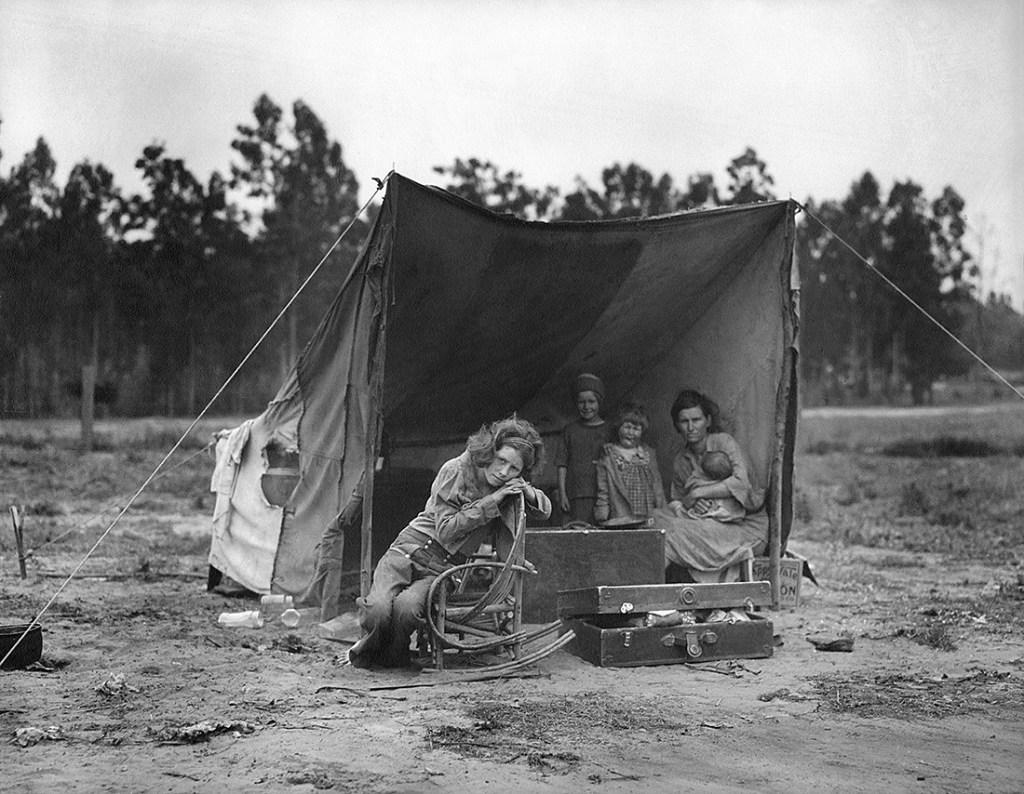
Lange was completing a photographic assignment documenting migrant agricultural labourers when she noticed a sign directing travellers towards a camp of pea pickers.
She initially continued driving, but eventually turned around and returned to the camp.
There she encountered Thompson and her children living in a temporary shelter.
The family had arrived in an area where agricultural workers were facing severe hardship after the failure of the early pea crop.
According to the original photographic captions preserved by the Library of Congress, many of the workers in the camp were destitute and had little access to food or employment.
Lange approached Thompson and began photographing her family.
The photographer later described the encounter in an account published in 1960. She recalled taking several photographs while moving progressively closer to the mother and her children.
She also recalled being told that the family had been surviving on frozen vegetables from nearby fields and birds caught by the children.
However, Lange’s recollections were written more than two decades after the encounter, and some details of her account have been disputed by Thompson and her family.
The Library of Congress preserves both the photographic sequence and historical material documenting these differing perspectives.
ting photographs offer a rare opportunity to observe how a documentary image develops through a series of deliberate compositional choices.
Six photographs, one unforgettable image

Migrant Mother was not a single spontaneous exposure.
Lange produced a series of photographs of Thompson and her children, progressively concentrating the composition around the mother’s face and the figures closest to her.
The Library of Congress preserves five images from the series and notes that two additional views were apparently never received by the institution.
The sequence reveals how Lange’s approach changed as she worked.
In the wider photographs, the viewer can see more of the family’s temporary shelter and the surrounding circumstances.
As the camera moves closer, the environment becomes less prominent.
The composition gradually focuses attention on Thompson’s expression and the physical relationship between mother and children.
In the best known photograph, two children turn away from the camera, framing their mother’s face.
Their positions create a powerful visual structure.
The viewer’s attention is directed towards Thompson, whose expression becomes the emotional centre of the image.
The children remain essential to the composition, but their hidden faces prevent them from competing with the mother’s gaze.
This arrangement gives the photograph an intimacy that distinguishes it from a conventional documentary image of a crowded migrant camp.
The wider economic crisis remains present, but it is communicated through the experience of one family.
The artistic power of Migrant Mother

Although Migrant Mother was created as documentary photography, its composition has qualities commonly associated with portraiture and fine art.
The photograph uses a closely organised arrangement of human figures to establish visual balance.
Thompson occupies the centre of the image, while the two older children form a triangular structure around her.
Their turned heads guide the viewer towards the mother’s face.
The baby in her lap reinforces the theme of maternal responsibility without becoming the principal focus.
The limited background removes visual distractions and concentrates attention on the subjects.
Light reveals the texture of Thompson’s face and clothing, while the monochrome image emphasises tonal contrast, gesture and expression.
The result is a portrait in which the emotional force of the subject and the formal organisation of the composition work together.
The photograph does not need a dramatic event to communicate urgency.
Its power comes from the visible relationship between the subjects and the suggestion of hardship beyond the frame.
This is one reason Migrant Mother occupies an important position in both documentary photography and the history of photographic art.
It demonstrates that a photograph can function simultaneously as a historical document and a carefully constructed visual composition.
Who was Florence Owens Thompson?
For years, the woman in the photograph was known primarily through the descriptive captions attached to Lange’s images.
Her identity was not central to the photograph’s early public presentation.
She became the representative figure of a much larger social crisis, while the details of her individual life remained largely outside the public narrative.
Florence Owens Thompson was born in 1903 in what is now Oklahoma.
She later moved to California with her family and experienced the difficult circumstances of migrant agricultural work during the Depression.
At the time of the photograph, she was raising seven children.
Following the Second World War, Thompson and her family settled in Modesto, California. She died in 1983.
Her life was not defined solely by the brief moment captured by Lange’s camera.
She was a mother, a worker and an individual whose experiences extended far beyond the hardship depicted in the photograph.
Understanding her identity changes the way we encounter Migrant Mother.
The image remains a historical record of economic insecurity, but it also becomes the portrait of a specific woman whose life cannot be reduced to a symbol.
The photograph that helped bring attention to a humanitarian crisis
The images Lange produced at Nipomo reached the public through newspapers and government photographic records.
The photograph was first published in a San Francisco newspaper and subsequently became associated with the hardships experienced by migrant agricultural families during the Depression.
The photographs helped draw attention to the conditions in the camp.
The connection between the images and subsequent relief efforts has become part of the history of Migrant Mother.
However, the often repeated claim that the famous photograph alone directly caused a particular relief shipment should be treated with care.
The photographs formed part of a broader documentary effort, and the surviving historical record does not establish every detail of the relationship between their publication and government assistance.
What can be established is that Lange’s work brought the circumstances of the Nipomo workers to a wider audience.
Her photographs made an economic and humanitarian crisis visible through the experiences of identifiable individuals.
The image therefore became an example of how documentary photography could contribute to public awareness of social conditions.
The woman behind the image challenged its legacy
The public success of Migrant Mother did not mean that Thompson shared the photographer’s understanding of the encounter.
Decades later, Thompson expressed dissatisfaction with the way the photograph had represented her.
The Library of Congress records that she regretted the photograph’s lasting association with a stereotype of Depression era poverty.
This disagreement raises questions that remain relevant to documentary photography.
Who controls the meaning of an image once it has been published?
What happens when a photograph becomes famous but the person depicted receives little recognition?
Can a photograph accurately communicate a social reality while presenting an incomplete account of an individual’s life?
Lange approached her work as a photographer documenting the conditions of people affected by poverty and displacement.
Thompson, however, had to live with the consequences of becoming a public symbol of those conditions.
Both perspectives are essential to understanding the photograph.
Its historical importance does not erase the complexity of the encounter, nor does Thompson’s dissatisfaction diminish the reality of the economic hardship documented in the image.
Instead, the disagreement reminds us that photographs have consequences for the people whose lives they represent.
The photograph and the ethics of documentary photography
Migrant Mother provides a particularly important case study in the ethics of photographic representation.
A documentary photograph may appear to offer direct access to reality, but every image is shaped by decisions.
The photographer chooses the subject, the framing, the moment of exposure and the circumstances in which the image will be presented.
Editors and institutions subsequently influence its meaning through captions, publication and the selection of images.
In the case of Migrant Mother, the original sequence reveals that Lange made several photographs before arriving at the composition that became famous.
The best known image does not show the entire family, the full shelter or the surrounding camp.
It concentrates on a carefully selected part of the scene.
This does not make the photograph an invention.
It demonstrates that documentary photography is both a record of actual circumstances and a form of visual interpretation.
The Library of Congress emphasises that examining the wider photographic sequence, the historical context and the perspectives of both photographer and subject helps reveal the multiple meanings of the image.
The distinction remains important in contemporary photojournalism.
A photograph may be factually authentic while still presenting only a limited part of a larger story.
Responsible interpretation requires attention to what appears within the frame and what remains outside it.
Dorothea Lange and the development of documentary photography
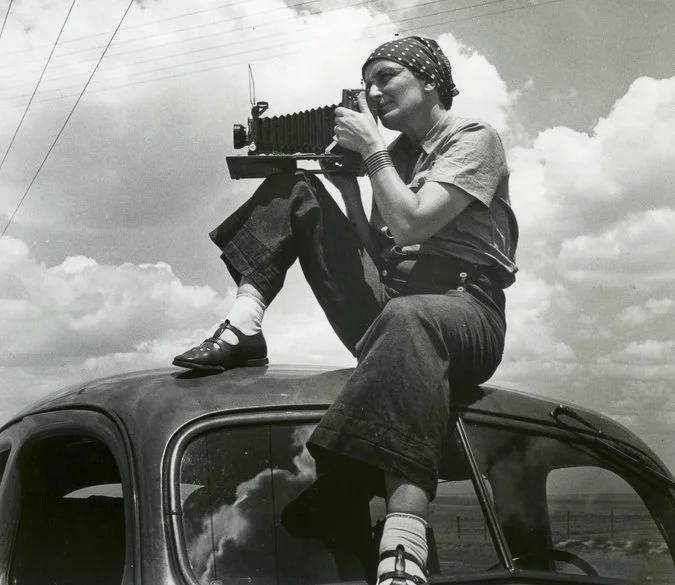
Dorothea Lange’s contribution to photography extended well beyond Migrant Mother.
Her work during the Depression helped establish documentary photography as an important means of recording social and economic conditions.
Rather than concentrating exclusively on political leaders, institutions or major public events, she directed her camera towards ordinary people whose experiences were often overlooked.
Agricultural workers, displaced families and people living in poverty became central subjects of her photographic work.
Her approach brought together visual composition and social observation.
The photographs were intended to document actual conditions, but they also demonstrated the artistic possibilities of portraiture and everyday life.
The federal photographic projects associated with the Resettlement Administration and its successor, the Farm Security Administration, produced an extensive visual record of the United States during the Depression.
That collection is now preserved by the Library of Congress.
Lange’s photographs remain important because they provide evidence of historical circumstances while also revealing the experiences of individuals living through them.
Migrant Mother became the most famous expression of this approach, but it was part of a much larger body of work.
How a photograph became part of America’s collective memory
The lasting significance of Migrant Mother is closely connected to its repeated reproduction.
The photograph appeared in newspapers, books, exhibitions and historical accounts of the Great Depression.
Over time, its original descriptive captions gave way to the shorter title by which it is now universally recognised.
Research published by the Museum of Modern Art notes that the photograph was not published under the title Migrant Mother until 1952.
That change illustrates how the image developed a public identity beyond its original documentary purpose.
It was no longer simply a photograph of a particular family in a California migrant camp.
It had become a visual reference point for an entire historical period.
The image’s widespread circulation also contributed to the recognition of photography as a medium capable of producing works with lasting artistic and cultural significance.
Its presence in museum collections and historical archives allows it to be examined from several perspectives.
As a historical document, it records the circumstances of migrant agricultural workers during the Depression.
As a portrait, it demonstrates the expressive possibilities of photographic composition.
As a cultural image, it reveals how a single photograph can become closely associated with the public memory of an era.
Yet its history also shows the importance of recovering the identities and experiences of the people represented in famous images.
Beyond the frame: remembering Florence Owens Thompson
There is a temptation to look at Migrant Mother and see only a universal image of maternal anxiety.
The composition encourages that response.
But the photograph becomes more historically meaningful when we remember the individual at its centre.
Florence Owens Thompson was not simply an anonymous figure chosen to represent poverty.
She was a woman raising her children under difficult circumstances, whose image became internationally recognised while her personal story remained largely unknown.
The distinction matters.
A photograph can communicate a powerful social truth without telling the complete story of the person it depicts.
By recovering Thompson’s identity and considering her own response to the photograph, we gain a more complete understanding of the image and the historical circumstances surrounding its creation.
This does not require us to choose between recognising Lange’s artistic achievement and acknowledging Thompson’s experience.
Both belong to the history of Migrant Mother.
A photograph that still asks us to look more closely
Nearly ninety years after its creation, Migrant Mother remains one of the defining photographs of the twentieth century.
Its visual simplicity gives it extraordinary immediacy.
A mother looks beyond the camera. Her children seek shelter against her. The surrounding world disappears from view.
The image communicates uncertainty, responsibility and the vulnerability of a family confronting economic hardship.
But its enduring importance lies in more than its emotional impact.
The photograph demonstrates how documentary photography can shape public understanding, how artistic composition can strengthen historical testimony and how an image can acquire meanings that extend far beyond the intentions of its creator.
It also reminds us that every famous photograph contains a story outside the frame.
In March 1936, Dorothea Lange photographed Florence Owens Thompson and her children at a migrant workers’ camp in California.
The image became a symbol of the Great Depression.
The woman remained a person whose life was far greater than the moment the camera recorded.
Remembering both is essential to understanding the photograph’s place in history.
PHOTOGRAPH INFORMATION
Migrant Mother
Photographer: Dorothea Lange (1895–1965)
Subject: Florence Owens Thompson and her children
Date: March 1936
Location: Nipomo, California, United States
Original medium: Black and white photographic negative
Historical project: Resettlement Administration, subsequently incorporated into the Farm Security Administration photographic collection
Archive: Library of Congress, Prints and Photographs Division
The Library of Congress preserves the original photographic series and supporting historical documentation.
OPEN CHRONICLE ARTS MAGAZINE
RESEARCH & REFERENCES
Historical Sources and Further Reading
Explore historical archives and museum research
documenting Dorothea Lange’s Migrant Mother
and the life of Florence Owens Thompson.
01 | NATIONAL GALLERY OF ART
The Real Lives of People
in Dorothea Lange’s Portraits
Discover the personal histories of the people
represented in Dorothea Lange’s photographs
and the stories behind her iconic portraits.
02 | LIBRARY OF CONGRESS
Florence Owens Thompson Papers
Archival material documenting the life
and experiences of Florence Owens Thompson,
the woman photographed in Migrant Mother.
03 | MUSEUM OF MODERN ART
Dorothea Lange:
Words & Pictures
Explore the Museum of Modern Art’s exhibition
dedicated to Dorothea Lange, her photographic
practice and her contribution to documentary
photography.
Open Chronicle Arts Magazine
Explore the world of art, creativity and culture. Discover extraordinary artists, timeless masterpieces, contemporary movements and the stories behind the works that shape our world.
Back to Arts Magazine