
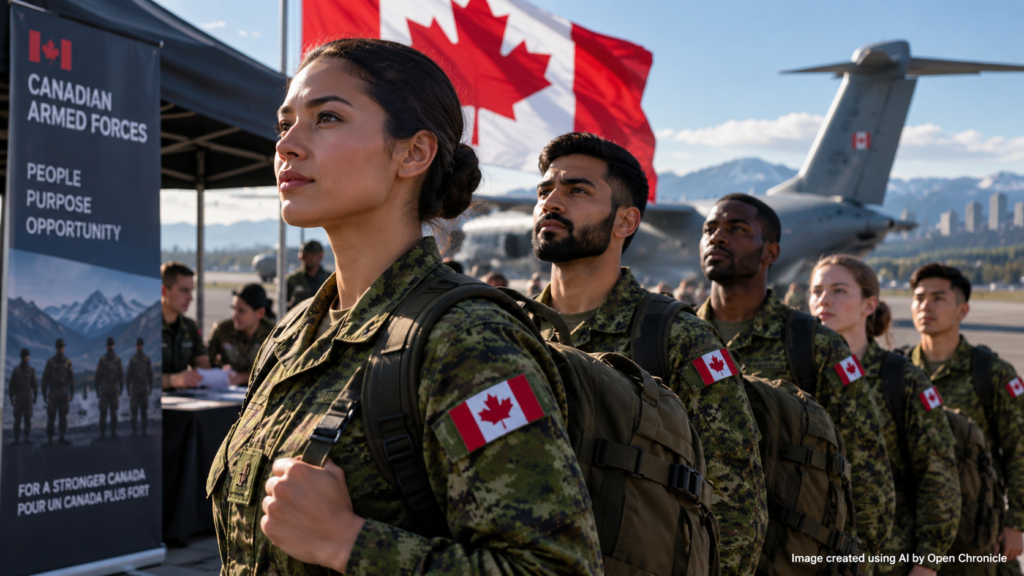
Canada has opened its armed forces to permanent residents as it works to rebuild military personnel levels. Official figures reveal both a significant recovery in recruitment and persistent shortages that affect the country’s defence capabilities.
24 September 2026 | By The Grand Strategy Institute, Research Division
Introduction: A military recruitment policy attracting international attention
Canada’s decision to allow permanent residents to join its armed forces has generated renewed international interest, particularly as NATO countries confront growing defence requirements and the challenges of maintaining sufficient military personnel.
The development has sometimes been described on social media as Canada recruiting soldiers from around the world. That description, however, requires an important clarification.
The Canadian Armed Forces (CAF) are not operating a general international recruitment programme that allows foreign nationals living anywhere in the world to enlist simply by submitting an application.
Since November 2022, Canada has allowed eligible permanent residents, alongside Canadian citizens, to apply for military service. Applicants must satisfy the relevant eligibility, security, medical and professional requirements.
In February 2026, the Canadian military further updated its eligibility rules for permanent residents to reflect the operational requirements of different military occupations.
The policy is part of a wider effort to address military personnel shortages, modernise recruitment and strengthen Canada’s capacity to meet its national and international defence commitments.
Official figures show that these efforts have already produced measurable results. They also demonstrate that Canada’s military continues to operate below its authorised personnel strength.
The central strategic question is therefore not simply why Canada is accepting permanent residents into its military. It is whether the country can recruit, train and retain enough qualified personnel to sustain the armed forces required by its defence policy.
1. What Canada has actually changed
Canada’s decision to expand military recruitment to permanent residents took effect in November 2022.
Previously, Canadian citizenship was generally required for enlistment, although certain exceptions existed for foreign nationals with specialised military qualifications.
The revised policy expanded eligibility to individuals who had already obtained permanent resident status in Canada.
This distinction is important. Permanent residents have a legally recognised immigration status that allows them to live in Canada on an ongoing basis. They are not simply foreign applicants seeking to enter the country through military enlistment.
The Canadian Armed Forces subsequently introduced administrative changes intended to facilitate the processing of these applications.
In January 2025, the Department of National Defence and Immigration, Refugees and Citizenship Canada began sharing relevant personal information about permanent residents interested in joining the military. The stated purpose was to facilitate enrolment and security screening.
The February 2026 eligibility update
On 23 February 2026, the Canadian Armed Forces updated their permanent resident enrolment requirements.
According to the Department of National Defence, most military occupations require personnel to be Canadian citizens or to have completed three years of physical residence in Canada as permanent residents before they can become fully employable.
The revised eligibility requirements reflect the operational needs of individual military occupations, including the ability to complete the relevant professional training.
The distinction between eligibility to apply and eligibility to perform particular military duties is therefore central to understanding the policy.
Canada has expanded the pool of potential military recruits, but it has not eliminated the legal and security requirements associated with military service.
2. The personnel shortage behind Canada’s recruitment reforms
The Canadian Armed Forces have faced persistent recruitment and retention difficulties.
These problems are documented in official government statistics and independent assessments of military personnel management.
In October 2025, Canada’s Auditor General published an examination of military recruitment covering the period from April 2022 to March 2025.
The audit found that the Canadian Armed Forces had failed to recruit and train enough personnel to meet their operational requirements.
During the period examined, approximately 192,000 people applied to join the military. The armed forces planned to recruit slightly more than 19,700 new personnel but recruited approximately 15,000, leaving a shortfall of around 4,700 against the recruitment target.
The audit also found that only approximately one in thirteen applicants was successfully recruited.
This finding highlights an important distinction between a shortage of applicants and an inability to convert applications into trained military personnel.
Canada was attracting considerable interest in military service, but its recruitment system was not processing enough applicants successfully.
Recruitment delays and administrative obstacles
The Auditor General identified significant delays in the recruitment process.
The Canadian Armed Forces had established a recruitment processing target of approximately 100 to 150 days.
However, the median time required to recruit an applicant during the audited period ranged from 245 to 271 days.
The audit also identified difficulties in understanding why applicants abandoned the recruitment process.
These shortcomings affected the military’s ability to fill specialised occupations, including pilots and ammunition technicians.
The findings demonstrate that expanding eligibility alone cannot resolve military personnel shortages.
Recruitment capacity, training infrastructure, administrative efficiency and the ability to retain experienced personnel are also essential.
3. The latest figures show a significant recruitment recovery
Canada’s recruitment difficulties should not be interpreted as evidence that its military personnel numbers are continuing to decline without interruption.
More recent official data show that recruitment has improved substantially.
Recruitment and Military Strength in 2026
Official Canadian military personnel figures, highlighting recruitment, permanent resident enrolment and the remaining gap in authorised force strength.
Canadian Department of National Defence. April 2026 recruitment announcement and July 2026 Canadian Armed Forces personnel statistics.
The Grand Strategy Institute | Research Division. Personnel figures reflect the official reporting periods indicated and do not represent real-time military strength.
On 20 April 2026, Canada’s Department of National Defence announced that the Regular Force had surpassed its annual recruitment target for the second consecutive year.
The military enrolled 7,310 new Regular Force members during fiscal year 2025/26, exceeding its target of 6,957.
According to the department, this represented its highest annual Regular Force recruitment in more than three decades.
The recruitment of permanent residents also increased substantially.
The increase demonstrates that permanent residents have become a measurable component of Canada’s military recruitment.
Nevertheless, these figures do not establish that permanent residents alone are responsible for the broader recruitment recovery. Canada has simultaneously introduced changes to compensation, medical eligibility, administrative procedures and recruitment processing.
The remaining personnel gap
As of 31 July 2026, the Canadian Armed Forces reported 68,473 Regular Force personnel against an authorised strength of 71,500.
The resulting shortfall was 3,027 personnel.
The Primary Reserve had an actual strength of 33,315 against a longer term target of 38,800.
Governo do Canadá
The latest figures therefore show two developments occurring simultaneously: recruitment is recovering, while the armed forces remain below their intended personnel strength.
4. Why personnel shortages matter for national defence
Military capability cannot be measured solely by the number of soldiers available for deployment.
Modern armed forces depend on an extensive network of specialised personnel responsible for maintaining aircraft, operating naval vessels, managing communications, conducting intelligence analysis, supporting logistics and sustaining military operations.
A shortage in one specialised occupation can affect the operational availability of an entire military capability.
For example, additional aircraft cannot automatically generate additional operational capacity if the armed forces lack sufficient pilots, maintenance technicians or supporting personnel.
Canada’s Auditor General explicitly warned that continuing personnel gaps could affect the ability of the Canadian Army, Royal Canadian Navy and Royal Canadian Air Force to respond to threats, emergencies and conflicts and accomplish their assigned missions.
Governo do Canadá
The consequences extend beyond conventional military operations.
Canada’s armed forces also support domestic emergency responses and national security operations.
A military personnel shortage can therefore affect the range of missions the country can sustain simultaneously, even when equipment and financial resources are available.
5. Canada’s defence responsibilities extend beyond its borders
Canada’s military recruitment policy must also be understood within the context of its international defence commitments.
As a founding member of NATO and a participant in North American continental defence through NORAD, Canada maintains military responsibilities that extend beyond the defence of its own territory.
Its armed forces contribute to collective defence, aerospace warning, maritime security and military cooperation with allied countries.
The Canadian government’s 2024 defence policy update, Our North, Strong and Free, identified the need to strengthen the foundations of the armed forces and acquire capabilities to address evolving security threats.
Governo do Canadá
The Arctic and continental defence
Canada’s geography creates distinctive military requirements.
The country possesses extensive Arctic territory, long coastlines and maritime approaches in both the Atlantic and Pacific oceans.
Maintaining an effective military presence across these areas requires personnel capable of operating in difficult environments, supporting surveillance systems and sustaining operations over considerable distances.
Recruitment and retention are therefore directly connected to Canada’s ability to implement its stated defence objectives.
An expansion in military personnel can increase the resources available for these missions, provided that recruitment is accompanied by appropriate training, equipment and operational support.
6. Does recruiting permanent residents create security risks?
The expansion of recruitment eligibility raises legitimate questions about security screening, access to sensitive information and the requirements associated with particular military occupations.
However, nationality or permanent resident status alone does not establish that an individual presents a security threat.
Military security assessments must examine applicants against the relevant legal and operational requirements.
Canada has retained screening procedures for military recruits while introducing administrative changes intended to accelerate recruitment.
In February 2025, the Department of National Defence announced that recruits could begin training during a probationary period while certain security and administrative requirements were being completed.
The department stated that recruits who subsequently failed to satisfy the necessary security clearance, medical or other eligibility requirements would be released from the armed forces.
The policy represents a change in the sequencing of recruitment and screening rather than the elimination of screening requirements.
The strategic challenge is to maintain appropriate security standards while reducing administrative delays that prevent qualified applicants from entering military service.
7. Recruitment is only one part of military readiness
Increasing the number of people entering the armed forces does not immediately produce an equivalent increase in operational military capability.
New personnel require initial training, occupational instruction and, in many cases, specialised qualifications.
Military organisations must also retain experienced personnel who provide leadership, technical knowledge and institutional continuity.
Canada has introduced measures intended to address these broader requirements.
In August 2025, the government announced a compensation and benefits package worth approximately CAD 2 billion to support recruitment, retention and the sustainability of the armed forces.
The measures included adjustments to military pay and additional compensation linked to years of service.
The Canadian Armed Forces have also been modernising recruitment procedures, including digital application systems, medical eligibility requirements and the capacity of military training institutions.
These initiatives indicate that the expansion of recruitment to permanent residents is one element of a wider personnel strategy, rather than a standalone solution.
8. What the evidence tells us about Canada’s military position
The available evidence supports several conclusions about the development of Canada’s military recruitment policy.
First, Canada has experienced documented personnel shortages that have affected its ability to meet operational requirements.
Second, the decision to accept permanent residents has expanded the pool of eligible military applicants and contributed additional recruits.
Third, the military has recorded a substantial improvement in recruitment, including its highest annual Regular Force intake in more than three decades during fiscal year 2025/26.
Fourth, personnel shortages remain despite this recovery, particularly when measured against Canada’s authorised military strength and longer term force expansion objectives.
These developments should not be confused with evidence that Canada is preparing to introduce compulsory military service or that the country has opened unrestricted military recruitment to foreign nationals worldwide.
The official documents examined establish neither claim.
They instead describe an armed force attempting to increase personnel numbers, improve recruitment efficiency and strengthen its capacity to fulfil existing defence responsibilities.
9. Strategic assessment: What should be measured next?
The significance of Canada’s recruitment reforms will become clearer through their measurable results.
The central indicators include the number of qualified applicants entering military service, the proportion completing initial and specialised training, retention rates among experienced personnel and the ability to fill occupations identified as operationally critical.
Progress toward authorised personnel strength is another relevant measure, but it does not provide a complete picture of military readiness.
An armed force can increase its overall personnel numbers while continuing to experience shortages in specific occupations.
Conversely, improvements in training capacity, equipment availability and the retention of experienced personnel can strengthen operational capability without producing an equivalent increase in total force size.
The Canadian government’s published personnel statistics and future independent audits provide a basis for examining these developments over time.
Conclusion: A changing recruitment system, not an unrestricted international military programme
Canada’s decision to recruit permanent residents reflects a documented effort to expand military recruitment and address persistent personnel shortages.
The policy has already produced measurable results, with 1,400 permanent residents joining the Canadian Armed Forces during fiscal year 2025/26.
At the same time, the military’s overall recruitment recovery has not eliminated the gap between actual personnel numbers and authorised force strength.
The available evidence does not establish that Canada is recruiting soldiers indiscriminately from around the world or that the expansion of eligibility, by itself, indicates an imminent military emergency.
It establishes that Canada is broadening its recruitment base while modernising the systems responsible for selecting, training and retaining military personnel.
For the Grand Strategy Institute, the broader issue is the relationship between military manpower and national defence capacity.
Canada’s experience illustrates how the ability to attract and retain qualified personnel remains an essential component of military readiness, even as governments invest in modern weapons, advanced technology and new defence capabilities.
The continuing evolution of Canada’s armed forces can be assessed through official personnel data, recruitment outcomes and the military’s demonstrated ability to meet its assigned operational requirements.
Sources and Further Reading
Official Canadian government publications, military personnel statistics, independent audit findings and defence policy documentation.
State of the Canadian Armed Forces
Canadian Department of National Defence. Official personnel strength, recruitment targets and enrolment statistics, including the July 2026 figures.
Government of Canada
Canadian Armed Forces Reach Highest Recruitment in 30 Years
Canadian Department of National Defence, 20 April 2026. Annual recruitment results, permanent resident enrolment figures and updated eligibility requirements.
Government of Canada
Facilitating the Recruitment of Permanent Residents in the Canadian Armed Forces
Canadian Department of National Defence, 14 May 2025. Official documentation of information sharing and security screening arrangements for permanent resident applicants.
Government of Canada
Strong, Secure, Engaged: Canada’s Defence Policy
Canadian Department of National Defence. Defence policy and the 2024 update, Our North, Strong and Free, outlining Canada’s defence priorities and capability requirements.
Government of Canada
This assessment distinguishes verified Canadian government policy and official personnel statistics from broader strategic analysis. Personnel figures refer to the reporting dates indicated and should not be interpreted as real-time military strength.
The Grand Strategy Institute
Continue Exploring Strategic Analysis
Return to The Grand Strategy Institute for strategic assessments, long-form analysis and research examining geopolitics, military affairs, international security, emerging technologies and the changing international order.
← Back to The Grand Strategy Institute