
By Open Chronicle with agencies
September 25, 2026
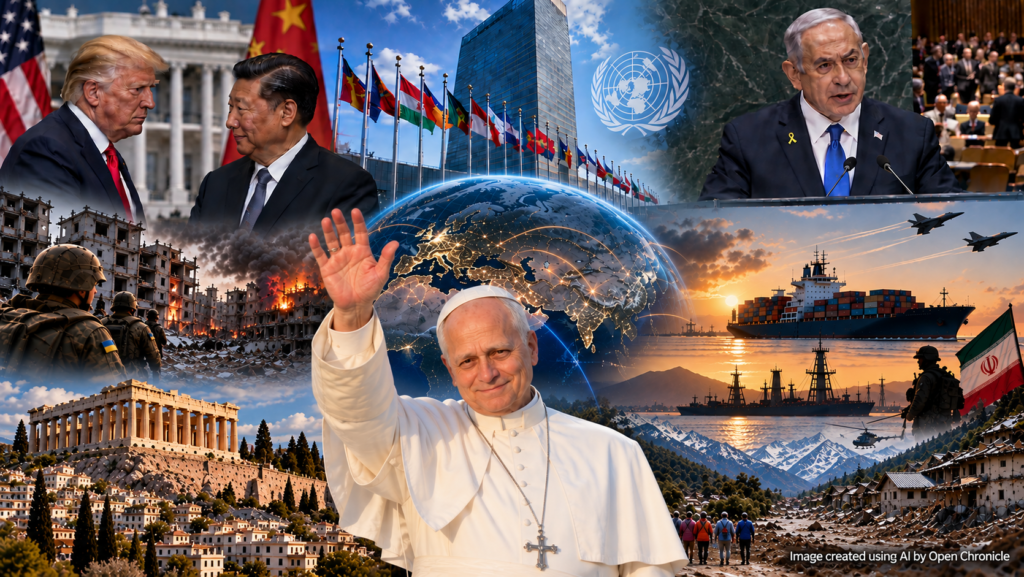
Diplomatic efforts to contain the conflict involving Iran, renewed Russian attacks on Ukraine, tensions in the Middle East and the conclusion of Chinese President Xi Jinping’s visit to Washington dominate the international news agenda on Friday, September 25.
At the United Nations, Israeli Prime Minister Benjamin Netanyahu’s address has prompted diplomatic protests, while Washington and Tehran continue exploring a possible agreement involving the Strait of Hormuz.
Meanwhile, European governments are responding to growing security concerns, and a military training accident in Kazakhstan has reportedly claimed 14 lives.
Here are the key developments shaping the world today, organised by region.
North America
United States and China: Trump and Xi conclude Washington summit
Chinese President Xi Jinping has concluded his state visit to Washington following talks with US President Donald Trump focused on trade, technological competition and the management of relations between the world’s two largest economies.
The visit included a White House state dinner and a tour of American historical landmarks, including the National Archives, where the US Constitution and Bill of Rights are preserved.
Both governments have presented continued dialogue as an important element of their bilateral relationship, despite persistent disagreements over trade restrictions, artificial intelligence and security.
Reports indicate that the two countries have extended their existing trade truce, although broader economic disagreements remain unresolved.
The summit also highlighted the strategic importance of artificial intelligence, with both countries seeking to expand their technological capabilities while managing the national security implications of increasingly advanced systems.
Taiwan remains another source of disagreement. Taiwanese authorities have challenged statements made by Xi during his discussions with Trump, reflecting continuing differences over the island’s political status and security.
United States and Iran explore a phased agreement
Diplomatic contacts between Washington and Tehran are continuing as both sides explore a possible agreement to reduce tensions surrounding the conflict involving Iran.
According to reports emerging from discussions in New York, negotiators are examining a phased arrangement that could link the reopening of the Strait of Hormuz to economic sanctions relief and other security commitments.
Iranian President Masoud Pezeshkian has expressed his country’s interest in reaching an agreement with the United States rather than continuing the conflict.
However, he has also publicly questioned Washington’s reliability as a negotiating partner.
The Strait of Hormuz remains central to the discussions because of its importance to international energy supplies and commercial shipping.
Reports indicate that Iran has presented proposals concerning the restoration of maritime traffic, although the conditions and timetable for any agreement remain subject to negotiation.
Diplomatic efforts are also taking place through regional channels, including contacts involving Egypt and other Middle Eastern governments.
The outcome of these discussions could have significant consequences for regional security, energy markets and international shipping.
Europe
Ukraine: Russian attacks hit Kyiv as diplomatic efforts continue
Russian drone attacks have struck residential areas in Kyiv, with Ukrainian reports indicating that a 14 year old boy was killed when a residential building was hit.
Additional attacks have reportedly damaged civilian infrastructure in Zaporizhzhia, including a hospital.
The strikes come as Ukrainian forces continue targeting Russian military and industrial infrastructure.
Reports indicate that Ukrainian drones attacked oil refineries and industrial facilities inside Russia, including sites associated with the production of missile components.
Moscow has claimed that its air defence systems intercepted hundreds of Ukrainian drones during the latest wave of attacks.
Meanwhile, Ukrainian President Volodymyr Zelenskyy has said that Trump approved a licence allowing the production of Patriot missile systems for Ukraine.
The precise arrangements, production timetable and scope of the reported agreement have not been detailed in the supplied reports.
Diplomatic discussions concerning the war are also continuing.
Zelenskyy has said that Washington has proposed the United Arab Emirates as a possible location for a trilateral meeting involving representatives of Ukraine, Russia and the United States.
Separately, Ukraine is reportedly discussing Black Sea shipping arrangements with several countries, including India, Turkey, Egypt and other Middle Eastern states.
No comprehensive settlement has been announced.
France announces military support for Saudi Arabia
France is preparing to deploy military personnel and defensive capabilities to Saudi Arabia to help protect the port city of Yanbu, according to reports.
The announcement follows growing concern over attacks attributed to Yemen’s Houthi movement and their implications for regional security and international energy infrastructure.
Yanbu is an important Saudi port on the Red Sea and plays a significant role in the kingdom’s energy export infrastructure.
The French deployment is intended to strengthen defensive capabilities amid concerns about further attacks.
At the same time, military officials from Saudi Arabia, Turkey and Pakistan are holding discussions concerning regional defence cooperation.
The meetings are taking place against the backdrop of continued instability in Yemen and growing concern over maritime security around the Red Sea and the Bab el Mandeb strait.
Reports also indicate that Houthi forces have expanded their activities around the Yemeni port of Mocha, although the precise military situation remains difficult to establish from the available accounts.
Russia and NATO: European air forces respond to renewed security concerns
Swedish and Finnish fighter jets have been scrambled to identify and intercept Russian military aircraft operating near their respective airspace.
The incidents come amid heightened security concerns along NATO’s northern and eastern regions.
Polish Foreign Minister Radosław Sikorski has also warned that Russia may be preparing a significant operation later this year, although the precise nature of the potential threat remains unclear.
European defence officials continue discussing closer intelligence cooperation in response to suspected hybrid operations, including sabotage, cyberattacks and threats to critical infrastructure.
NATO’s senior military leadership has called for stronger intelligence sharing among allied countries to improve the identification of and response to such activities.
The developments reflect the continuing importance of air defence, surveillance and intelligence cooperation in European security planning.
Pope Leo XIV visits France
Pope Leo XIV has arrived in France for a state visit, marking the first papal visit of its kind to the country since 2008.
The visit includes religious and diplomatic engagements and comes amid renewed public discussion about the place of religion in French society.
The pontiff has called for respect for the dignity of every human life, a message expected to feature prominently throughout his visit.
French authorities have introduced security and traffic measures in Paris ahead of the papal engagements.
The visit is also drawing attention to the relationship between France’s secular republican traditions and the public expression of religious faith.
Greece: Explosion near Athens’ Acropolis injures two
An explosion near the Acropolis in Athens has caused a building to partially collapse, injuring at least two people.
Emergency services responded to the incident, and reports indicate that two women were rescued from the damaged structure.
Initial accounts suggest that the explosion may have been caused by gas, although the circumstances remain under investigation.
The incident prompted an emergency response in an area close to one of Greece’s most visited historical landmarks.
Authorities have not provided a final assessment of the structural damage or confirmed the full circumstances surrounding the explosion.
Middle East
Netanyahu’s UN address triggers protests and diplomatic walkout
Israeli Prime Minister Benjamin Netanyahu’s address to the United Nations General Assembly has prompted protests and a walkout by delegates, reflecting continuing international disagreements over Israel’s military operations in Gaza.
During his speech, Netanyahu rejected accusations that Israel’s conduct in Gaza constitutes genocide.
His remarks drew criticism from Palestinian representatives and other political figures, while demonstrators gathered outside the United Nations headquarters in New York.
Reports indicate that several protesters, including actress Susan Sarandon, were arrested during demonstrations surrounding the address.
The speech came amid renewed reports of Israeli military operations in Gaza and continuing violence in the occupied West Bank.
Israeli military sources also reported the deaths of two soldiers in Gaza following an incident involving a drone explosion described in initial accounts as friendly fire.
Separately, reports indicate that Israeli settlers set fire to Palestinian vehicles in a village in the occupied West Bank.
The developments underscore the continuing security and humanitarian challenges facing the region, even as diplomatic efforts seek to establish a more durable political framework.
Yemen: Continuing conflict threatens maritime security
The continuing conflict in Yemen is placing additional pressure on regional security and international shipping routes.
Reports indicate that Houthi forces have expanded their activities around the Yemeni port of Mocha, although the precise military situation remains difficult to establish from the available accounts.
The fighting has renewed concerns over maritime security in the Red Sea and the Bab el Mandeb strait, an important route for international trade.
Regional governments are maintaining diplomatic and military contacts as they assess the implications of the conflict for energy infrastructure, commercial shipping and civilian populations.
The continuing instability is also placing additional pressure on Yemen’s hospitals and humanitarian services.
Asia and the Pacific
Kazakhstan confirms 14 deaths in Caspian Sea military exercise
Kazakhstan has reportedly confirmed that 14 military personnel died following an accident during a naval exercise in the Caspian Sea.
The incident occurred during military training in the Mangystau region, where a sudden deterioration in weather conditions reportedly swept servicemen into the water.
Earlier reports had placed the death toll at nine, with several personnel still missing.
The latest reports indicate that the number of confirmed fatalities has risen to 14.
The accident has raised questions about safety procedures during military exercises conducted in rapidly changing maritime conditions.
The supplied reports do not establish the final number of missing personnel or the conclusions of any official investigation.
Pakistan and Afghanistan report renewed border fighting
Pakistan has reported renewed fighting along its border with Afghanistan, saying its security forces prevented an attempted attack by Afghan Taliban fighters.
According to Pakistani accounts, several Taliban members were killed during the confrontation near the Gulistan border area.
The latest incident follows reports of Pakistani airstrikes inside Afghanistan and reciprocal accusations of cross border attacks.
The renewed hostilities add to existing tensions between Islamabad and Afghanistan’s Taliban authorities over border security and the activities of armed groups operating in the region.
The available reports do not provide independently confirmed casualty figures or establish whether further military operations are planned.
Nepal calls for international climate cooperation after devastating floods
Nepal’s leadership has used the United Nations General Assembly to call for stronger international cooperation on climate resilience following devastating floods in the Himalayan region.
Prime Minister Balen Shah has described the recent disaster as a warning about the growing vulnerability of mountainous countries to extreme weather.
The flooding has damaged infrastructure, disrupted transport and left families searching for missing relatives.
Reports indicate that more than 50 Ukrainians remain missing following flooding near the Nepal China border.
Nepal has proposed closer cooperation with India and China on Himalayan climate resilience, reflecting the shared risks facing countries dependent on the region’s rivers, glaciers and mountain ecosystems.
Landslides have also disrupted major highways, forcing authorities to suspend public transport services in Kathmandu.
Japan responds to typhoon disruption
Japan is responding to the effects of a typhoon that has left thousands of households without electricity.
Severe weather has disrupted transport and daily life in affected areas, with emergency services continuing to assess damage and assist residents.
Authorities are monitoring weather conditions as recovery operations continue.
South Korea and Mexico strengthen bilateral cooperation
South Korea and Mexico have adopted an action plan intended to strengthen bilateral cooperation through 2030.
The agreement reflects efforts to expand economic and diplomatic relations between the two countries.
Further details concerning the implementation of the action plan have not been provided in the available reports.
Africa
Ethiopia: Renewed fighting disrupts communications in Tigray
Reports indicate that internet connectivity has been disrupted in northern Ethiopia amid renewed fighting involving armed groups and government forces.
The developments have raised concerns about the stability of the Tigray region following the agreement that ended the previous phase of the conflict in 2022.
Humanitarian organisations remain concerned about the consequences of renewed hostilities for civilians already affected by displacement and economic disruption.
The interruption of communications has also complicated efforts to obtain reliable information about the security situation.
Latin America and the Caribbean
Ecuador arrests suspected members of Mexican criminal organisation
Ecuadorian authorities have reported the arrest of dozens of people allegedly connected to a Mexican criminal organisation following an operation supported by the United States.
The operation forms part of ongoing efforts to address organised crime and strengthen international law enforcement cooperation.
Further details concerning the suspects, the organisation involved and any formal charges remain subject to official confirmation.
Mexico responds to Hurricane Polo
Mexico is experiencing the effects of Hurricane Polo, with authorities monitoring weather conditions and assessing potential risks to affected communities.
Emergency services are responding to the consequences of the storm as officials continue to evaluate damage and possible disruption to transport and essential infrastructure.
International Affairs
Technology: AI industry leaders call for international safety rules
Technology industry leaders are urging the United Nations to establish stronger international rules governing artificial intelligence.
Their appeals come as governments and technology companies accelerate the development of increasingly capable AI systems.
The discussions focus on safety standards, international cooperation and the risks associated with advanced technologies that could affect critical infrastructure, cybersecurity and public services.
Separately, Australian authorities are responding to reports of an AI related breach involving a health department system.
The precise circumstances of the reported incident, including the extent of any data exposure and the role of the technology involved, require further confirmation.
The developments highlight the growing importance of cybersecurity and oversight as artificial intelligence becomes more deeply integrated into public and private sector operations.
United Nations: Bangladesh calls for continued support for Rohingya refugees
Bangladesh has appealed for continued United Nations assistance as approximately 1.2 million Rohingya refugees await conditions that would permit a safe return to Myanmar.
The refugee crisis remains one of the region’s major humanitarian challenges, with international organisations continuing to provide assistance to displaced communities.
Bangladesh has called for sustained international engagement to address humanitarian needs and support efforts towards a durable solution.
The global outlook
The developments of September 25 illustrate the interconnected nature of international security, diplomacy, technology and economic stability.
The Washington summit between Trump and Xi has provided an opportunity for dialogue between the United States and China, while negotiations involving Iran remain central to the security of the Middle East and international energy markets.
In Europe, the war in Ukraine continues to shape military planning and relations with Russia. Across Asia and Africa, armed conflicts, humanitarian pressures and climate related disasters remain major challenges.
The coming days will be important for assessing whether current diplomatic initiatives produce concrete agreements and whether regional security developments lead to further military or political responses.
Editorial note: This brief is based on the news headlines and reports supplied for September 25, 2026. Several developments remain ongoing, and some casualty figures, diplomatic proposals and operational details may change as further official information becomes available.