
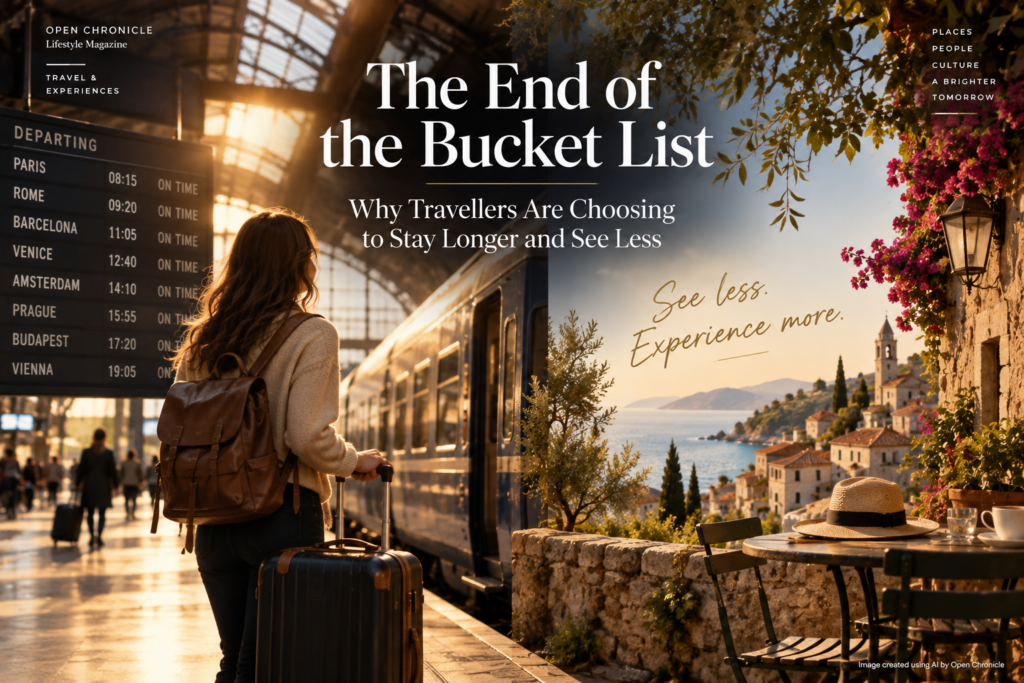
OPEN CHRONICLE LIFESTYLE MAGAZINE · TRAVEL & EXPERIENCES
For generations, travel was measured by how many places we could visit. Now, amid overtourism, digital exhaustion and a growing desire for deeper experiences, another philosophy is gaining ground: go fewer places, stay longer and allow yourself enough time to actually be there.
By Open Chronicle Lifestyle Magazine
There is a particular kind of holiday that begins before the traveller has even arrived.
The itinerary has been built.
The restaurants have been saved.
The museums have been ranked.
The photographs that must be taken have already been identified.
Three nights here.
Two nights there.
A morning train.
An afternoon flight.
A famous viewpoint at sunset.
Another city tomorrow.
By the end of the journey, the traveller may have crossed several borders, photographed dozens of landmarks and accumulated enough material to document an extraordinary adventure.
And yet there can be a strange feeling on the journey home.
We saw everything.
But did we experience anything?
For decades, one of the dominant fantasies of modern travel has been the bucket list.
Paris.
Venice.
New York.
Kyoto.
Santorini.
Machu Picchu.
The Maldives.
The Northern Lights.
The language itself suggests completion. Places become experiences to acquire, destinations to cross off and achievements to collect.
There is nothing inherently wrong with this.
The world contains extraordinary places, and wanting to see them is one of the most understandable forms of human curiosity.
But another philosophy of travel is becoming increasingly visible.
Stay longer.
Move less.
Return to the same café.
Learn the streets without opening a map.
Take the train instead of the flight.
Spend an afternoon doing almost nothing.
Visit somewhere because you are curious, not because an algorithm told you where to stand.
The movement is often described as slow travel.
But at its most interesting, it is not really about speed.
It is about depth.
1. When Travel Became a Checklist
Mass tourism transformed one of humanity’s oldest activities.
For most of history, long distance travel was expensive, difficult and often dangerous. Tourism existed, particularly among wealthy travellers, pilgrims and members of social elites, but international leisure travel on today’s scale was unimaginable.
Commercial aviation changed that.
Rising incomes, paid holidays, package tourism, budget airlines and online booking platforms progressively made international travel accessible to hundreds of millions of people.
The transformation has been extraordinary.
According to UN Tourism, international tourist arrivals recovered to approximately 1.4 billion in 2024, essentially returning global tourism to pre pandemic levels. The organisation subsequently reported continued growth during 2025.
This represents one of the great democratisations of modern life.
Experiences once available mainly to the wealthy became possible for far larger sections of society.
A weekend in Rome could become affordable.
Barcelona could be reached in a few hours.
A person could wake up in London and eat dinner in Lisbon.
But accessibility also changed the psychology of travel.
When destinations became easier to reach, it became easier to accumulate them.
Countries visited became numbers.
Cities became lists.
The question “Where have you been?” quietly acquired another meaning.
How much of the world have you completed?
2. The Age of Maximum Travel
The smartphone intensified this culture.
Before arriving in a city, we can already know what its most photographed restaurant looks like.
We know the hotel lobby.
We know the rooftop.
We know the viewpoint.
We know which street becomes beautiful at golden hour.
Travel has never been easier to research.
That is enormously useful.
But it also means that journeys can become strangely predetermined.
The traveller follows a trail created by millions of travellers before them.
Search.
Save.
Book.
Photograph.
Post.
Move on.
The destination risks becoming a sequence of confirmations.
Yes, the Trevi Fountain looks like the photographs.
Yes, the Santorini sunset is beautiful.
Yes, the Eiffel Tower appears at the end of that street.
The surprise of travel begins to compete with the efficiency of travel.
And efficiency can become seductive.
If we are flying across an ocean, why visit one city when we can visit four?
If Florence is only a train ride from Rome, why not add it?
And if Venice is only another train away, surely it would be wasteful not to go there too?
The itinerary expands.
The experience contracts.
Breakfast becomes departure.
Afternoons become check ins.
Evenings become research for tomorrow.
Travel begins to resemble project management.
3. What Slow Travel Actually Means
Slow travel is sometimes misunderstood as travelling for several months, abandoning air travel or possessing enough money and free time to live indefinitely in beautiful places.
For most people, that is unrealistic.
Holiday entitlement is limited.
Families have responsibilities.
Travel costs money.
A person with one week away from work cannot simply transform it into a three month exploration of Tuscany.
Slow travel is better understood as a philosophy rather than a duration.
It asks a different question.
Instead of “How much can I fit into this trip?”, it asks “How much do I need to remove before I can experience this place properly?”
Seven days could mean three cities.
Or one.
Neither choice is morally superior.
But they produce radically different journeys.
A slower traveller might stay in the same neighbourhood for a week.
The first morning, everything is unfamiliar.
By the third, the route to breakfast becomes obvious.
By the fifth, the person behind the counter may recognise them.
The supermarket no longer feels foreign.
A favourite bench appears.
A wrong turn becomes a useful discovery.
Nothing spectacular has happened.
And that is precisely the point.
The traveller has stopped consuming the destination and started temporarily inhabiting it.
4. Why Overtourism Is Changing the Conversation
The debate about travelling differently is not only philosophical.
Some destinations are struggling with the physical consequences of their own popularity.
Venice has introduced an access fee for certain day visitors on selected high pressure dates.
Amsterdam has adopted measures intended to manage tourism pressure and discourage forms of tourism considered particularly disruptive to residents.
Barcelona has pursued policies aimed at reducing the pressure associated with tourist accommodation.
Other destinations, from Mediterranean islands to historic European centres, are wrestling with similar questions.
Tourism brings enormous economic benefits.
It supports hotels, restaurants, guides, transport operators, museums, shops and countless small businesses.
In many communities, livelihoods depend on it.
The problem is concentration.
Too many people can arrive in the same neighbourhood, at the same landmark, during the same weeks of the year.
The European Commission has increasingly framed sustainable tourism around better management of visitor flows, environmental impacts and the relationship between tourism and local communities.
This is where slower travel offers an intriguing possibility.
A visitor staying seven nights instead of two does not automatically become a more sustainable traveller.
Longer stays still consume resources.
The person may still fly.
They may still contribute to housing pressure.
They may still spend most of their time in heavily visited areas.
But slower itineraries can create opportunities to distribute spending differently.
The traveller eats more meals locally.
They may explore beyond headline attractions.
They may use trains or public transport between places.
And crucially, they do not need to compress every famous experience into the same forty eight hours.
5. The Pleasure of the Second Morning
The first morning in a new place is intoxicating.
Everything demands attention.
The architecture is unfamiliar.
The language changes.
Even ordinary things become interesting.
A bakery.
A tram ticket.
The way people order coffee.
But there is another kind of pleasure that arrives later.
The second morning.
Then the third.
The city begins losing its status as spectacle.
It becomes a place.
This is where slower travel often becomes memorable.
You stop photographing every building.
You start noticing smaller details.
The elderly man who occupies the same café table every morning.
Children walking home from school.
The neighbourhood market closing for the afternoon.
The church bells that seemed romantic on the first day and wake you far too early on the fourth.
Reality enters the picture.
And reality is usually more interesting than perfection.
This is one reason returning to a destination can sometimes be more rewarding than visiting somewhere new.
The first journey asks, “What is here?”
The second can ask, “What did I miss?”
6. The Rise of the Longer Stay
Travel companies have begun noticing changes in the way some customers organise their journeys.
Accommodation platforms and travel industry surveys in recent years have repeatedly highlighted interest in longer stays, flexible travel and journeys that combine work with leisure.
Remote and hybrid work have expanded the possibilities for some professionals, although these opportunities are highly unequal and remain unavailable to large parts of the workforce.
A person who can work remotely may spend several weeks somewhere that would previously have been visited during a short holiday.
That changes the economics of the trip.
Renting an apartment for several weeks creates a different relationship with a destination than occupying a hotel for two nights.
Groceries replace some restaurant meals.
Laundry becomes necessary.
Public transport becomes familiar.
The traveller develops routines.
There is an important caveat.
Long stays are not automatically beneficial to local communities.
In cities with severe housing pressure, demand for short term accommodation can contribute to conflicts over housing availability and affordability.
Responsible slow travel therefore requires more than simply staying longer.
Where we stay matters.
How we spend matters.
When we travel matters.
Slow travel is not sustainable merely because it is slow.
7. The Journey Is Returning to Travel
For much of the modern tourism era, transport became something to minimise.
The ideal journey was the fastest one.
Airport.
Flight.
Taxi.
Hotel.
Destination achieved.
But Europe in particular is witnessing renewed interest in rail travel, including international daytime services and sleeper trains.
The reasons are varied.
Environmental concerns matter.
So does airport fatigue.
But there is also something emotional about travelling across landscapes rather than above them.
A train reveals distance.
Paris does not disappear and Rome suddenly appear.
France changes.
The Alps arrive.
Stations interrupt the journey.
Languages shift.
The destination approaches gradually.
This restores something that aviation largely removed from modern travel.
Transition.
Night trains make the contrast even stronger.
There is something almost improbable about falling asleep in one country and waking in another while the world has been moving outside the window.
Rail travel is not always cheaper.
It is not always faster.
Connections can be inconvenient and international booking remains unnecessarily complicated in parts of Europe.
But that inconvenience reveals something about slow travel.
Efficiency is not always the same thing as experience.
Sometimes the journey itself deserves part of the holiday.
8. What Happens When We Stop Photographing Everything?
Modern travel has created an extraordinary visual archive of the planet.
Billions of people can now document journeys that previous generations might have remembered only through a handful of photographs.
Photography can deepen travel.
It encourages observation.
It preserves memories.
It allows people to share landscapes, architecture and cultures with others.
But there is a moment when documentation begins competing with experience.
The meal cools while the photograph is arranged.
The sunset is watched through a screen.
The museum becomes a sequence of images captured for later.
A curious reversal occurs.
We travel in order to create memories, then spend the experience producing evidence that the memory happened.
Slow travel creates more space because not every moment carries the pressure of being unique.
If there will be six sunsets rather than one, perhaps tonight’s does not need to be photographed.
If the street can be revisited tomorrow, perhaps we can simply walk through it today.
This is a small freedom.
But increasingly, it feels luxurious.
9. Travel as a Relationship Rather Than a Collection
Some of the most passionate travellers return repeatedly to the same place.
This seems almost irrational within bucket list culture.
Why go back when there are so many places you have never seen?
Because familiarity can deepen rather than diminish curiosity.
The restaurant owner remembers you.
You recognise the station.
You know which beach becomes quiet after five.
You understand that the beautiful square is unbearable at midday but almost empty in the early morning.
A destination begins accumulating personal history.
There is the café where you sat during the rain.
The street where you became lost.
The hotel where your child learned to swim.
The village you visited with someone who is no longer alive.
Places become attached to biography.
At that point, travel becomes something more than discovery.
It becomes relationship.
And relationships are rarely improved by constantly searching for replacements.
10. The Privilege Behind Slow Travel
There is a danger in romanticising this new philosophy.
Time is a luxury.
Someone with thirty days of annual leave has choices unavailable to someone with five.
A remote professional can travel differently from a nurse, factory worker, teacher during term time or parent coordinating school holidays.
Money also complicates the picture.
Staying longer may reduce the daily cost of accommodation in some circumstances, but it can also require substantial financial flexibility.
Travelling outside peak season can be cheaper, but families with school age children may have little control over when they travel.
Slow travel should therefore never become another lifestyle ideal used to judge people.
A four day trip to Paris is not an inferior experience because someone else can spend a month there.
For many people, that short journey may represent years of saving.
The point is not duration.
It is attention.
A person can travel slowly during a weekend.
They can choose one neighbourhood instead of five.
One museum instead of three.
A long lunch instead of another attraction.
They can leave an afternoon deliberately empty.
The essential resource is not unlimited time.
It is the willingness to stop filling every available minute.
11. How to Travel Without Trying to Complete the World
The bucket list contains a beautiful idea.
Life is finite.
The world is enormous.
Go and see it while you can.
That impulse should not disappear.
There are mountains worth crossing oceans to see.
Cities capable of changing how we understand architecture, food, history or ourselves.
There are journeys we dream about for decades.
The problem begins when the list becomes more important than the experience.
Perhaps we do not need to eliminate the bucket list.
We need to change what goes on it.
Instead of:
Visit Italy.
Perhaps:
Spend a week learning one Italian town.
Instead of:
See the Northern Lights.
Perhaps:
Spend several winter nights beneath an Arctic sky, accepting that nature may not perform on schedule.
Instead of:
Do Japan.
Perhaps:
Return to Japan.
The language changes because the relationship changes.
Countries are not attractions.
Cities cannot be completed.
Cultures cannot be consumed during a weekend.
The world is not a checklist waiting for us to finish it.
12. The Places We Remember Are Not Always the Ones We Planned
Ask someone about a favourite journey years later and the answer is often surprising.
They may remember the monument.
But they also remember the rainstorm.
The terrible restaurant where everyone laughed.
The stranger who helped them find the train.
The morning when they woke before everyone else and walked through an empty city.
The beach discovered accidentally.
The conversation that lasted until midnight.
The day nothing happened.
These moments rarely appear on itineraries.
They cannot be booked.
They emerge from time, coincidence and attention.
That may be the deepest argument for travelling more slowly.
Not sustainability.
Not economics.
Not even relaxation.
Possibility.
When every hour has already been assigned, there is very little room for the unexpected.
And the unexpected is one of the reasons we travel in the first place.
13. The New Luxury of Going Nowhere
There is a moment during a slower journey when something unusual happens.
You wake up and realise there is nowhere you need to be.
No train.
No timed museum ticket.
No hotel checkout.
No landmark requiring proof of attendance.
Perhaps you walk.
Perhaps you read.
Perhaps you sit in the same café you visited yesterday.
From the perspective of traditional tourism, almost nothing has happened.
From another perspective, something important has.
For a few hours, you are no longer managing the trip.
You are living inside it.
This may become one of the defining luxuries of contemporary travel.
Not flying farther.
Not visiting more countries.
Not accessing increasingly exclusive destinations.
Having enough time to stop.
14. The End of the Bucket List?
The bucket list is probably not ending.
Nor should it.
Dreaming about distant places remains one of the great pleasures of travel.
But perhaps the list is becoming less important than what happens after we arrive.
The future of meaningful travel may involve fewer destinations and deeper encounters.
It may mean taking the train.
Returning somewhere familiar.
Travelling outside the busiest weeks when circumstances allow.
Supporting businesses rooted in the places we visit.
Leaving space in the itinerary.
Accepting that we will miss things.
Especially accepting that we will miss things.
Because the fear of missing out has produced one of modern travel’s strangest contradictions.
We travel thousands of kilometres to escape ordinary life, then rush through extraordinary places because we are afraid there will not be enough time.
There will never be enough time.
The world is too large.
Even one city is too large.
Spend a lifetime in Paris and there will still be a street you have never walked.
Perhaps that is liberating.
We do not need to complete the world.
We only need to experience some small part of it while we are there.
The most memorable journey may not be the one where we saw the most. It may be the one where, finally, we stopped long enough to notice where we were.
Open Chronicle Lifestyle Magazine · Travel & Experiences
Sources and Further Reading
Tourism data, European policy research and destination
management resources informing this exploration of
slow travel, longer stays, overtourism and the changing
ways we experience the places we visit.
01 | Global Tourism
UN Tourism
Official Tourism Data
World Tourism Barometer and International Tourism Results
Official global tourism data documenting the recovery
of international travel, including approximately
1.4 billion international tourist arrivals in 2024
and subsequent developments in global tourism demand.
02 | Sustainable Tourism Policy
European Commission
European Policy Framework
Transition Pathway for Tourism
European policy framework addressing the development
of more resilient, sustainable and digitally transformed
tourism, including destination management and the
environmental pressures associated with travel.
03 | Tourism & Environment
European Environment Agency
Environmental Research
Tourism and the Environment
Research and indicators examining tourism related
environmental pressures, transport, resource
consumption and the challenges associated with
developing more sustainable European tourism.
04 | Destination Management
City of Venice
Official Destination Information
Venice Access Fee
Official information concerning Venice’s access
fee for certain day visitors on designated dates,
introduced as part of the city’s broader management
of visitor pressure.
05 | Visitor Economy & Liveability
City of Amsterdam
Municipal Tourism Policy
Tourism Policy and Visitor Economy
Official municipal information covering Amsterdam’s
approach to tourism pressure, liveability and the
management of visitor behaviour.
06 | Traveller Sentiment
European Travel Commission
Travel Research
Monitoring Sentiment for Intra European Travel
Research examining European travel intentions,
destination choices, seasonality and changing
traveller preferences.
07 | Rail Travel
European Union
European Mobility Programme
DiscoverEU and European Rail Travel
European information illustrating the continuing
role of rail mobility in cross border European travel
and efforts to encourage greater use of train based
journeys.
Editorial Transparency
This feature combines official tourism statistics,
European policy research and original lifestyle
commentary. “Slow travel” does not have a single
universally accepted statistical definition, and
the article does not suggest that most travellers
have abandoned conventional short holidays or
bucket list tourism.
References to slower and longer journeys describe
a visible travel philosophy and related behavioural
trends rather than a universal shift. Longer stays
are also not automatically more sustainable, since
environmental and social impacts depend on transport,
accommodation, seasonality, destination pressures
and individual behaviour.
See less. Experience more.
Open Chronicle Lifestyle Magazine explores travel
through places, people and experiences that reveal
more when we give them time.
Discover More Lifestyle Stories
Explore inspiring stories about contemporary living, remarkable people, travel, style, wellbeing and the experiences that shape our everyday lives.
← Back to Open Chronicle Lifestyle