
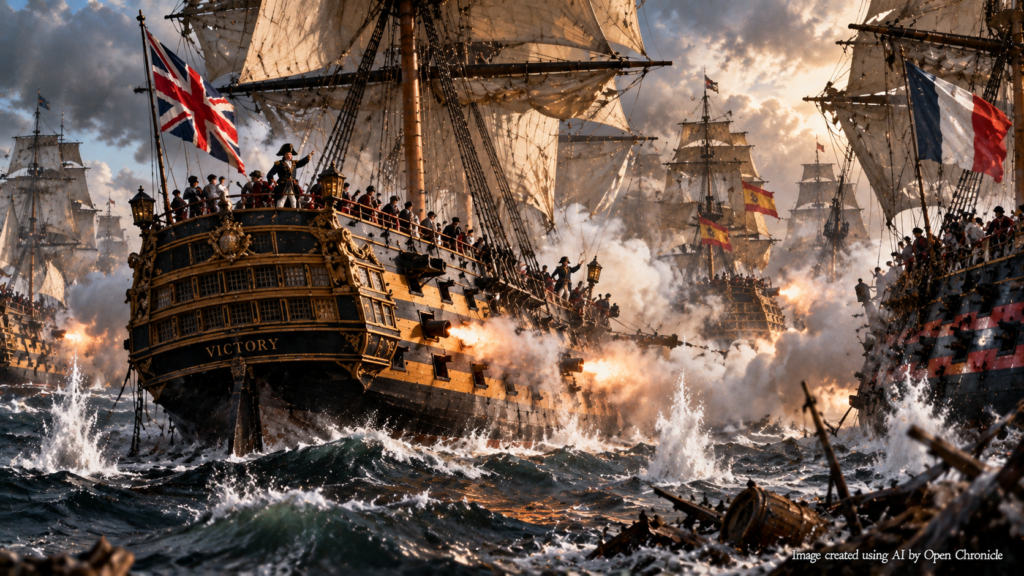
How Britain’s Royal Navy defeated the combined French and Spanish fleets off the coast of Spain, ending Napoleon’s immediate hopes of challenging British naval supremacy and creating one of the most enduring legends in maritime history.
By Open Chronicle History Desk
On the morning of October 21, 1805, two great fleets approached one another in the Atlantic waters off Cape Trafalgar, near the southwestern coast of Spain.
The sea was relatively calm.
The wind was light.
Across the horizon stood a line of French and Spanish warships, their towering masts and crowded decks silhouetted against the morning sky.
Advancing toward them were the ships of the British Royal Navy.
At the center of the British fleet was HMS Victory, a powerful first-rate ship of the line carrying more than one hundred guns.
On her quarterdeck stood Vice-Admiral Horatio Nelson.
He was forty-seven years old.
Already one of Britain’s most celebrated naval commanders, Nelson was preparing to execute a battle plan that challenged established naval conventions.
Instead of approaching the enemy in a parallel line and exchanging broadsides, he intended to drive his fleet directly through the Franco-Spanish formation.
The maneuver was dangerous.
British ships would have to approach under enemy fire while temporarily unable to bring many of their own guns to bear.
But Nelson believed that breaking the enemy’s line would create confusion, isolate sections of the opposing fleet and allow British crews to exploit their superior experience in close combat.
The consequences would be extraordinary.
By the end of the day, the combined French and Spanish fleet had suffered a devastating defeat.
Britain had won one of the most consequential naval victories in European history.
Nelson, however, would not live to celebrate it.
Mortally wounded during the battle, he died aboard HMS Victory as the fighting continued.
His death transformed an already remarkable military victory into a national legend.
The Battle of Trafalgar became a defining event in British maritime history.
It helped secure Britain’s naval position during the Napoleonic Wars and strengthened the strategic foundations of its expanding global power.
But Trafalgar was also a human catastrophe.
Thousands of sailors were killed, wounded or captured.
Ships were shattered by cannon fire.
Storms following the battle claimed additional lives.
French and Spanish officers and crews fought with determination, and their defeat reflected more than the brilliance of one British commander.
To understand Trafalgar is to understand a world in which the fate of empires depended on wooden warships, naval logistics, maritime trade and the ability to command the seas.
1. Europe Under Napoleon
In 1805, Napoleon Bonaparte dominated much of continental European politics.
Having risen to power after the French Revolution, he had crowned himself Emperor of the French in December 1804.
His armies were among the most formidable military forces in Europe.
France had defeated or intimidated several continental rivals.
But one major enemy remained beyond Napoleon’s reach.
Great Britain.
Protected by the English Channel and its powerful navy, Britain continued to resist French ambitions.
The struggle between the two powers extended across Europe, the Atlantic and the wider colonial world.
2. Britain and the Sea
British military strength depended heavily on naval power.
The Royal Navy protected merchant shipping, supported overseas possessions and maintained maritime connections with allies.
Britain’s economy relied on international trade.
Its ability to finance continental coalitions against France was linked to commercial wealth and access to global markets.
For Napoleon, British naval strength represented a major strategic obstacle.
He could defeat armies on land.
But invading Britain required control of the waters separating the two countries.
That was a much more difficult challenge.
3. Napoleon’s Invasion Plans
Napoleon assembled a large army near Boulogne, on the French coast.
The force was intended for a possible invasion of Britain.
Transport vessels were prepared.
Military formations trained for the operation.
But the invasion depended on creating a temporary period of naval superiority in the English Channel.
French and allied fleets would need to overcome or evade British naval forces.
Napoleon developed plans to draw British squadrons away from European waters.
If successful, French naval forces might concentrate in the Channel long enough to protect an invasion crossing.
The plan never achieved the necessary conditions.
4. The French Navy After the Revolution
The French Navy had suffered severe disruption during the revolutionary period.
Political upheaval affected the officer corps.
Experienced personnel were lost through emigration, dismissal and conflict.
The navy also faced problems of training, resources and operational readiness.
British blockades restricted opportunities for French fleets to operate freely at sea.
These disadvantages became increasingly important.
Naval warfare required coordination, seamanship and disciplined gunnery.
Such skills could not be developed instantly.
5. Spain Enters the Conflict
Spain was allied with Napoleonic France.
Its navy possessed important warships and experienced maritime traditions.
Spanish ports and fleets were valuable to French strategy.
But Spain’s involvement also reflected difficult diplomatic circumstances.
Spanish leaders faced pressure from Napoleon while attempting to preserve their country’s interests.
The combined French and Spanish naval forces were potentially powerful.
Yet differences in training, command and operational experience complicated cooperation.
6. The Third Coalition
In 1805, Britain joined a new coalition against Napoleon.
Austria and Russia were among the principal continental powers opposing France.
The conflict became known as the War of the Third Coalition.
Napoleon faced enemies on land while Britain continued the maritime struggle.
The resulting campaigns would produce two famous battles within weeks of each other.
Trafalgar, a decisive British naval victory in October.
And Austerlitz, a major French victory over Austrian and Russian forces in December.
Together, they demonstrated the different strengths of Britain and Napoleonic France.
7. Horatio Nelson
Horatio Nelson was born in Norfolk in 1758.
He entered the Royal Navy as a young boy.
Over decades of service, he developed a reputation for courage, initiative and aggressive leadership.
Nelson had been wounded repeatedly.
He lost the sight of his right eye after an injury at Calvi in 1794.
He lost most of his right arm following the unsuccessful British attack on Santa Cruz de Tenerife in 1797.
These injuries contributed to his public image as a commander who had sacrificed personally for his country.
But his reputation rested above all on naval victories.
8. The Battle of the Nile
In August 1798, Nelson commanded the British fleet at the Battle of the Nile, fought in Aboukir Bay off Egypt.
His forces attacked the French fleet supporting Napoleon’s Egyptian expedition.
The French suffered a devastating defeat.
The battle weakened Napoleon’s position in Egypt and demonstrated Nelson’s willingness to exploit tactical opportunities.
It also established him as one of Europe’s leading naval commanders.
His victory became an important precedent for Trafalgar.
9. The Battle of Copenhagen
In April 1801, Nelson played a central role in the Battle of Copenhagen.
British forces attacked the Danish fleet during a confrontation involving northern European naval powers.
The engagement reinforced Nelson’s reputation for aggressive tactics.
It also became associated with the famous story of his disregarding a signal to disengage by raising his telescope to his blind eye.
The precise details of that episode have been debated.
Nevertheless, the story contributed to his legend as a commander willing to exercise independent judgment.
10. Admiral Pierre-Charles Villeneuve
The commander of the combined French and Spanish fleet at Trafalgar was Vice-Admiral Pierre-Charles Villeneuve.
Villeneuve had survived the Battle of the Nile.
He was an experienced officer but operated under considerable pressure.
Napoleon expected his fleet to support wider strategic objectives.
Villeneuve had to coordinate ships from two different navies.
He also faced British blockades and difficult operational circumstances.
His decisions in the months before Trafalgar would shape the coming battle.
11. The Caribbean Maneuver
Earlier in 1805, Villeneuve sailed from Toulon and crossed the Atlantic toward the Caribbean.
The movement formed part of Napoleon’s wider naval strategy.
French planners hoped to draw British forces away from European waters.
Nelson pursued the French fleet across the Atlantic.
But the intended concentration of French naval strength did not materialize as Napoleon had hoped.
Villeneuve eventually returned toward Europe.
The campaign failed to establish the conditions necessary for a successful invasion of Britain.
12. The Battle of Cape Finisterre
On July 22, 1805, the combined fleet encountered a British force under Vice-Admiral Sir Robert Calder near Cape Finisterre.
The battle was inconclusive in strategic terms.
The British captured two Spanish ships.
Poor visibility and difficult conditions limited the engagement.
Villeneuve did not achieve the concentration of forces required by Napoleon’s plans.
The combined fleet eventually entered Cádiz.
There it remained under the watch of British naval forces.
13. Cádiz: The Fleet at Anchor
Cádiz was an important Spanish naval port.
By autumn 1805, the combined French and Spanish fleet was concentrated there.
British warships maintained surveillance and pressure offshore.
The combined fleet possessed substantial firepower.
But its crews had varying levels of experience.
Some ships had spent long periods in port.
Maintaining training and operational readiness under blockade was difficult.
Villeneuve faced the problem of deciding when and how to sail.
14. Nelson Takes Command
Nelson returned to the British fleet off Cádiz in late September 1805.
He took command aboard HMS Victory.
The British fleet included ships commanded by experienced officers.
Nelson enjoyed the confidence of many of his captains.
He encouraged initiative and mutual understanding.
His leadership emphasized the importance of allowing commanders to act decisively when circumstances changed.
This approach would prove essential during Trafalgar.
15. The Nelson Touch
Nelson’s tactical thinking became associated with what later generations called the “Nelson Touch.”
He wanted to avoid a conventional engagement in which two fleets sailed in parallel lines.
Such battles could produce damage without destroying the enemy’s fighting capacity.
Instead, Nelson intended to concentrate force against part of the opposing fleet.
He planned to break through its formation.
The resulting close-range fighting would favor British gunnery and ship-handling.
The strategy involved serious risks.
But it offered the possibility of a decisive result.
16. The Two Fleets
At Trafalgar, the combined French and Spanish fleet consisted of thirty-three ships of the line.
The British fleet had twenty-seven.
The opposing force therefore possessed a numerical advantage.
The combined fleet also included some exceptionally large vessels.
Among them was the Spanish Santísima Trinidad, one of the most famous warships of the age.
But numerical superiority did not automatically translate into tactical advantage.
Crew training, command coordination, gunnery and maneuverability were crucial.
17. Ships of the Line
Ships of the line were the principal capital warships of the sailing era.
They carried heavy cannon arranged along multiple gun decks.
Their purpose was to fight in organized formations and exchange powerful broadsides.
A first-rate ship could carry more than one hundred guns.
Smaller ships of the line generally carried fewer.
These vessels were complex machines made of timber, rope, canvas and iron.
They required large crews.
Their effectiveness depended on seamanship and disciplined teamwork.
18. HMS Victory
HMS Victory was Nelson’s flagship.
Launched in 1765, she was a first-rate ship of the line.
At Trafalgar, she carried 104 guns.
Her crew numbered more than eight hundred men.
The ship represented the immense resources required for eighteenth- and nineteenth-century naval warfare.
Her decks were crowded with sailors, marines, officers and gun crews.
Every part of the vessel had a specific function.
During battle, the ship became a coordinated system of movement, communication and destructive firepower.
19. The Spanish Santísima Trinidad
The Santísima Trinidad was one of the largest warships of her time.
She carried an exceptionally heavy armament.
Her size made her a powerful symbol of Spanish naval strength.
But large ships could also be difficult to maneuver.
During Trafalgar, the vessel became heavily engaged.
She suffered severe damage and was eventually captured.
She sank in the aftermath of the battle.
Her fate became one of the most dramatic episodes of the defeat.
20. October 20: The Fleets Move
On October 19 and 20, the combined fleet began leaving Cádiz.
Villeneuve intended to sail into the Mediterranean.
The movement brought the fleet into contact with British surveillance forces.
Nelson received reports of the enemy’s departure.
He prepared his ships for battle.
The two fleets approached one another off the southwestern coast of Spain.
By the morning of October 21, the confrontation was unavoidable.
21. Dawn at Cape Trafalgar
The battle took place near Cape Trafalgar, between Cádiz and the Strait of Gibraltar.
The morning was marked by light winds.
The combined fleet was sailing in an extended and somewhat irregular formation.
The British approached in two principal columns.
Nelson commanded the weather column aboard Victory.
Vice-Admiral Cuthbert Collingwood commanded the lee column aboard HMS Royal Sovereign.
The British plan depended on penetrating the enemy’s line.
22. Nelson’s Final Instructions
Before the battle, Nelson had explained his intentions to his captains.
He wanted them to understand the broader purpose rather than depend entirely on signals during combat.
Once the battle began, smoke, noise and damage could make communication difficult.
Captains would need to exercise judgment.
Nelson believed that the British fleet’s experience would allow it to exploit the confusion created by his attack.
The strategy placed considerable responsibility on individual commanders.
23. England Expects
Shortly before the battle, Nelson ordered a famous signal to be transmitted from Victory.
It read:
“England expects that every man will do his duty.”
The signal became one of the most recognizable phrases in British naval history.
It was intended to encourage the fleet before battle.
The wording reflected the communication system used by the Royal Navy.
It also became part of the national memory of Trafalgar.
Later generations would treat it as a defining expression of duty and sacrifice.
24. The British Advance
The British columns approached the enemy formation.
Because of the light winds, the advance was slow.
For a considerable period, leading British ships were exposed to enemy cannon fire.
Their forward-facing position limited their ability to respond with full broadsides.
This was one of the principal dangers of Nelson’s plan.
If the combined fleet maintained its formation and delivered effective fire, the British could suffer heavily before reaching the line.
But Nelson accepted the risk.
He believed that close combat would favor his fleet.
25. Collingwood Breaks the Line
HMS Royal Sovereign, commanded by Collingwood, was among the first British ships to penetrate the combined fleet.
She passed through the enemy formation and engaged at close range.
Her attack helped disrupt the Franco-Spanish line.
Other British ships followed.
The battle began to fragment into a series of fierce engagements.
Instead of a controlled exchange between two parallel fleets, ships fought in confused groups.
This was precisely the kind of battle Nelson had sought.
26. Victory Enters the Battle
HMS Victory approached the center of the enemy formation.
She came under heavy fire.
The ship suffered damage as she advanced.
Eventually, Victory passed close to the French flagship Bucentaure.
British guns fired into the enemy vessel at devastating range.
The attack inflicted severe casualties and damage.
Victory then became closely engaged with the French ship Redoutable.
The fighting was intense.
27. The Redoutable
The French ship Redoutable, commanded by Captain Jean-Jacques Étienne Lucas, fought with determination.
Her crew was prepared for close combat.
French sailors and marines attempted to exploit opportunities for boarding.
The engagement with Victory became one of the most famous duels of Trafalgar.
The ships were so close that small-arms fire could be directed between their decks.
It was during this fighting that Nelson was mortally wounded.
28. Nelson Is Shot
At approximately 1:15 in the afternoon, Nelson was struck by a musket ball fired from the French ship Redoutable.
The projectile entered his left shoulder area and passed through his body, causing a fatal injury.
Nelson collapsed on the quarterdeck of Victory.
He was carried below to the ship’s cockpit.
There, the medical staff attempted to relieve his suffering.
The injury was beyond treatment.
Nelson understood that he was dying.
29. The Battle Continues
Even as Nelson lay wounded, the battle continued around him.
British ships engaged French and Spanish vessels at close range.
Cannon fire tore through hulls and rigging.
Masts collapsed.
Ships caught fire.
Sailors struggled to control flooding and damage.
The noise and confusion made coordinated command increasingly difficult.
But British tactical advantages were becoming decisive.
The combined fleet was losing its ability to fight as an organized force.
30. Villeneuve Is Captured
The French flagship Bucentaure suffered heavy damage.
Villeneuve was eventually captured after his ship surrendered.
The loss of the commander further weakened the combined fleet’s position.
Other French and Spanish ships continued resisting.
Some attempted to escape.
Others were surrounded and overwhelmed.
The battle became a series of individual struggles for survival.
31. The Death of Nelson
Nelson died at approximately 4:30 in the afternoon.
He had been informed that the British were winning.
His final hours became the subject of numerous accounts.
One of the best-known phrases attributed to him was:
“Thank God I have done my duty.”
The precise wording of some reported final conversations has been discussed by historians.
But the central fact is certain.
Nelson died aboard Victory on October 21, 1805, as the Royal Navy secured a major victory.
He was forty-seven years old.
32. The Scale of the Victory
The British captured or destroyed twenty-two French and Spanish ships of the line during the battle.
The Royal Navy lost no ships of the line in the engagement itself.
The result was extraordinary.
The combined fleet suffered thousands of casualties.
Many sailors were killed or wounded.
Thousands more were captured.
British casualties were also substantial, with more than 1,600 men killed or wounded.
The victory came at a terrible human cost.
33. The Storm After the Battle
The fighting ended, but the danger did not.
A severe storm struck the area after Trafalgar.
Damaged ships struggled to remain afloat.
Some captured vessels were lost.
Others were abandoned or destroyed.
Rescue operations became extremely difficult.
Sailors who had survived the battle faced drowning, exposure and exhaustion.
The storm complicated the British effort to secure prizes.
It also increased the overall human cost of the campaign.
34. The Fate of the Captured Ships
Several French and Spanish ships captured during the battle were too badly damaged to be retained.
British crews attempted to tow or repair them.
The storm made these operations dangerous.
Some vessels sank.
Others were destroyed to prevent recapture or because they could not be saved.
The destruction of the combined fleet was therefore not limited to the hours of direct combat.
The aftermath contributed significantly to the final losses.
35. French and Spanish Courage
The traditional British narrative of Trafalgar has often emphasized Nelson’s genius and the Royal Navy’s superiority.
Those elements are important.
But they should not obscure the determination of French and Spanish crews.
Many fought under extremely difficult circumstances.
The Redoutable resisted fiercely.
Spanish ships endured prolonged engagements.
Officers and sailors attempted to maintain discipline amid catastrophic damage.
The defeat was not simply the result of cowardice or lack of courage.
It reflected a combination of tactical, operational and structural disadvantages.
36. Why the British Won
Several factors contributed to the British victory.
Nelson’s tactical plan disrupted the enemy formation.
British crews generally possessed extensive experience at sea.
Gunnery training and ship-handling were important advantages.
The British command structure encouraged initiative.
The combined fleet faced difficulties coordinating ships from two navies.
Many French and Spanish crews had fewer opportunities for sustained training because of blockade conditions.
The result emerged from these interacting factors rather than a single moment of brilliance.
37. Did Trafalgar End Napoleon’s Invasion Plans?
Trafalgar is often described as the battle that prevented Napoleon from invading Britain.
The reality is more nuanced.
Napoleon had already redirected his principal army toward continental Europe before the battle.
His immediate invasion plans had effectively been abandoned for that campaign.
Nevertheless, Trafalgar destroyed the combined fleet’s ability to challenge British naval power on the scale required for such an operation.
The battle reinforced the strategic obstacles facing any future invasion.
It made the prospect of establishing temporary naval superiority in the Channel even more remote.
38. Napoleon Wins at Austerlitz
Less than six weeks after Trafalgar, Napoleon won a major land victory at Austerlitz on December 2, 1805.
French forces defeated the armies of Austria and Russia.
The victory strengthened Napoleon’s position in continental Europe.
The contrast was striking.
Britain dominated at sea.
Napoleon remained formidable on land.
Neither victory immediately ended the broader struggle.
The Napoleonic Wars continued for another decade.
39. Britain’s Naval Supremacy
Trafalgar became a powerful symbol of British naval superiority.
The Royal Navy had already established important advantages before 1805.
The battle reinforced them.
Britain retained the ability to protect maritime trade, support overseas operations and maintain pressure on French-controlled territories.
Naval supremacy was not created in a single day.
It depended on shipbuilding, finance, logistics, bases and sustained military organization.
But Trafalgar became its most famous demonstration.
40. The Global Consequences
British naval strength had consequences far beyond Europe.
Control of maritime routes supported commercial expansion and military operations overseas.
The Royal Navy played a major role in protecting and extending British imperial interests.
The victory at Trafalgar helped sustain the maritime environment in which British global power expanded during the nineteenth century.
That expansion brought economic development and international connections.
It also involved colonial conquest, coercion and the subordination of peoples across different regions.
The legacy of British naval supremacy must therefore be understood within the wider history of empire.
41. Nelson’s Body Returns to Britain
Following the battle, Nelson’s body was preserved aboard HMS Victory for the return voyage.
His death caused widespread mourning.
He was already a national hero.
The circumstances of his final victory intensified public emotion.
The British government organized a state funeral.
Nelson’s body was eventually brought to London.
The ceremonies reflected the extraordinary importance attached to his achievements.
42. The Funeral of Nelson
Nelson’s funeral took place in January 1806.
He was buried in St Paul’s Cathedral in London.
The ceremonies were elaborate.
Thousands participated or watched.
The funeral helped establish Nelson as a central figure in British national memory.
His death became inseparable from the victory at Trafalgar.
The image of a commander sacrificing his life at the moment of triumph proved exceptionally powerful.
43. Trafalgar Square
In the nineteenth century, London commemorated Nelson through monumental architecture.
Trafalgar Square became one of the capital’s most recognizable public spaces.
Nelson’s Column was completed in the 1840s.
The monument celebrated the admiral and the naval victory.
It also reflected the political and cultural importance of maritime power in Victorian Britain.
The square remains a major landmark.
Its name ensures that the battle continues to occupy a visible place in public memory.
44. HMS Victory Today
HMS Victory survives as one of the most important historic warships in the world.
She is preserved at Portsmouth Historic Dockyard.
The vessel offers a direct connection to the age of sailing warships.
Visitors can explore aspects of naval life, ship construction and the conditions experienced by sailors.
The preservation of Victory reflects the enduring importance of Trafalgar.
It also allows historians and the public to examine the material realities behind the legend.
45. Trafalgar and Military Strategy
The battle remains an important subject in the study of naval warfare.
Nelson’s decision to attack in columns challenged conventional expectations.
His willingness to accept risk demonstrated the importance of tactical initiative.
The battle also illustrates the role of leadership, training and organizational culture.
But its lessons should not be reduced to a universal formula.
Nelson’s plan succeeded under particular circumstances.
The balance of forces, the wind, the enemy’s formation and the capabilities of British crews all mattered.
46. The Human Cost of Naval Warfare
Trafalgar is often remembered through paintings of ships, flags and heroic commanders.
But the experience of ordinary sailors was brutal.
Cannonballs shattered wooden hulls.
Flying splinters caused devastating injuries.
Men were crushed by falling rigging.
Gun decks filled with smoke.
Medical treatment was limited.
Survivors faced exhaustion, hunger and the danger of sinking.
The battle’s human cost extended across British, French and Spanish crews.
Understanding Trafalgar requires remembering those men as well as the admirals.
47. The Spanish Perspective
For Spain, Trafalgar was a major naval disaster.
The loss of ships and experienced personnel weakened the Spanish Navy.
The defeat occurred during a period of growing political and economic strain.
Spain’s alliance with Napoleon would later collapse.
In 1808, French intervention and occupation helped trigger the Peninsular War.
The events contributed to a profound crisis in Spanish political history.
Trafalgar was one element in the wider destabilization of the Spanish monarchy and empire.
48. The French Perspective
For France, Trafalgar represented a serious failure of naval strategy.
Napoleon’s fleet had not achieved the concentration required to challenge British control of the Channel.
The battle further weakened French naval capabilities.
Napoleon continued to dominate much of continental Europe.
But his ability to confront Britain directly at sea remained limited.
He increasingly relied on economic warfare, including the Continental System, in an attempt to weaken British trade.
The struggle between the two powers continued through different methods.
49. The Battle in Art and Literature
Trafalgar inspired paintings, poems, biographies and historical narratives.
Artists depicted Nelson on the quarterdeck of Victory.
Others portrayed the crowded battle scene, damaged ships and dramatic moments of combat.
The death of Nelson became a particularly popular subject.
These representations shaped how later generations imagined the battle.
But artistic works often emphasized heroism and symbolism over precise historical reconstruction.
They remain valuable evidence of historical memory as well as artistic achievement.
50. Why October 21 Matters
October 21, 1805 marks one of the most consequential naval victories of the Napoleonic era.
The Battle of Trafalgar shattered the combined French and Spanish fleet.
It reinforced Britain’s maritime advantage.
It weakened Napoleon’s ability to challenge British naval power.
It contributed to the strategic conditions that allowed Britain to sustain a prolonged struggle against France.
The battle also created one of the most enduring military legends in British history.
Nelson’s death transformed a naval victory into a story of sacrifice.
But Trafalgar should be remembered as more than the achievement of one commander.
It was the product of strategy, training, technology, institutional strength and the actions of thousands of sailors.
October 21, 1805: The Day the Seas Changed
Imagine the waters off Cape Trafalgar in the late afternoon.
The wind carries smoke across the sea.
Broken masts and shattered rigging rise above damaged ships.
Cannon fire gradually fades.
Sailors search for wounded comrades.
Boats move between vessels.
The combined French and Spanish fleet has suffered a devastating defeat.
Britain has won.
But aboard HMS Victory, the admiral who planned the battle is dead.
Horatio Nelson will never see the celebrations that follow.
He will not witness the state funeral or the monuments erected in his name.
He will not live to see the nineteenth-century expansion of British maritime power.
His final battle will become one of the defining episodes of his country’s history.
For Britain, Trafalgar becomes a symbol of naval strength.
For France and Spain, it marks a profound military defeat.
For the thousands of men who fought, it is a day of courage, suffering and loss.
And for the wider world, it helps shape the maritime balance of power during an era of imperial expansion.
On October 21, 1805, the Battle of Trafalgar secured one of the greatest victories in British naval history and claimed the life of its most celebrated admiral.
Historical Sources and Further Reading
Explore historical research, museum collections and original documents concerning the Battle of Trafalgar, the strategy of Admiral Horatio Nelson and the naval warfare of the Napoleonic era.
Trafalgar Day: The Battle of Trafalgar
An authoritative overview of the battle, including the strategic background, Nelson’s tactical plan, the engagement between the fleets and the consequences of the British victory.
The Battle of Trafalgar: Beginning of the Action
A museum collection record examining the deployment of the British, French and Spanish fleets, the breakthrough of Nelson’s columns and the naval tactics employed on October 21, 1805.
Explore the Museum Collection →
Nelson’s Memorandum on His Battle Plan, October 9, 1805
The British Library’s archival catalogue record for Nelson’s handwritten memorandum outlining his plan to engage the enemy fleet. The document provides direct evidence of his tactical thinking before Trafalgar.
HMS Victory: Historical Facts and Preservation
Historical information about Nelson’s flagship, including its construction, crew, casualties during Trafalgar and its preservation at Portsmouth Historic Dockyard.
The Battle of Trafalgar took place on October 21, 1805, off the southwestern coast of Spain. Twenty-seven British ships of the line confronted thirty-three French and Spanish ships. The battle ended in a decisive British victory, but Admiral Horatio Nelson was mortally wounded aboard HMS Victory. The widely repeated claim that Trafalgar alone prevented Napoleon’s invasion of Britain requires qualification, since Napoleon had already redirected his main invasion army toward continental operations. This article distinguishes the battle’s immediate military outcome from its wider strategic consequences and acknowledges the heavy human losses suffered by all three navies.