
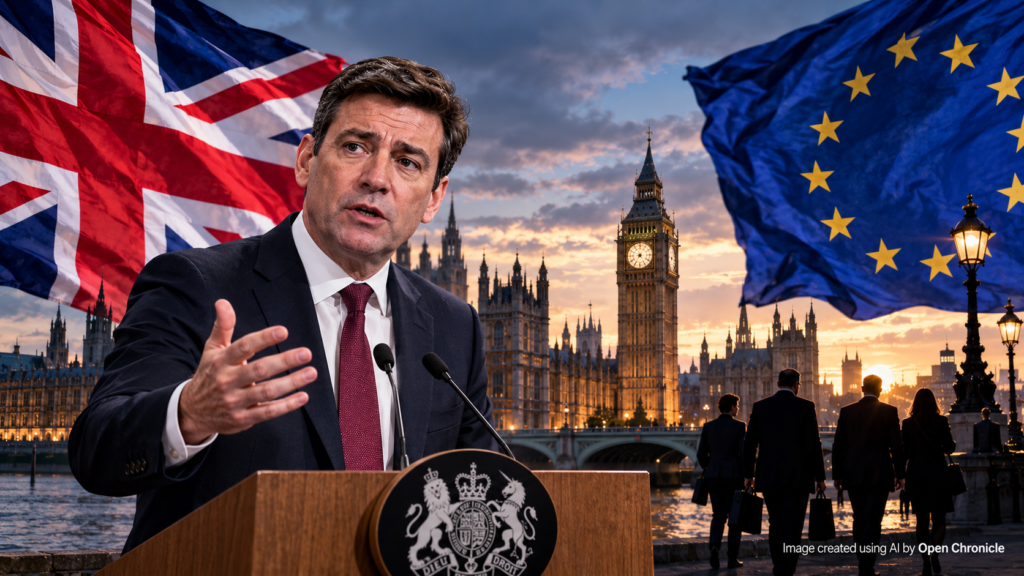
The British prime minister’s willingness to reconsider one of Brexit’s defining restrictions has revived a politically sensitive debate over immigration, economic cooperation and the United Kingdom’s future relationship with the European Union.
By Open Chronicle News Desk with Agencies
LONDON | October 25, 2026
British Prime Minister Andy Burnham has signalled that the United Kingdom could reconsider its post-Brexit approach to European Union freedom of movement as part of a broader effort to rebuild relations with Brussels, according to a report attributed to Reuters.
The reported remarks represent a potentially significant development in Britain’s continuing debate over its relationship with the European Union, nearly a decade after voters chose to leave the bloc in the June 2016 referendum.
Burnham expressed openness to discussing the rules governing the movement of people between Britain and EU member states, while acknowledging that earlier patterns of European labour migration had created challenges for some British communities.
The proposal has already drawn opposition from former Conservative Chancellor Jeremy Hunt, illustrating how politically divisive any reconsideration of Brexit’s central commitments remains.
Although Burnham’s comments suggest a willingness to revisit established policy, they do not amount to a formal decision to restore freedom of movement or a negotiated agreement with the European Union.
A New Debate Over Britain’s Relationship With Europe
The prime minister’s reported position forms part of a wider discussion about resetting relations between London and Brussels.
The areas under consideration include migration arrangements, labour mobility, data sharing and other forms of cooperation that have become increasingly important to businesses, public institutions and governments operating across European borders.
Freedom of movement was one of the fundamental principles of Britain’s membership of the European Union. It allowed eligible EU citizens to live and work in the United Kingdom, while British citizens enjoyed corresponding rights across the bloc.
Ending those arrangements became one of the most prominent objectives of the campaign to leave the EU.
Following Brexit, Britain introduced a new immigration framework under which EU citizens generally became subject to immigration requirements rather than enjoying automatic freedom of movement.
Reconsidering that framework would therefore carry consequences extending well beyond immigration administration. It would raise questions about labour markets, public services, political accountability and the wider terms of Britain’s economic relationship with Europe.
Burnham’s reported willingness to reopen the discussion suggests that the government sees room to reconsider some of the assumptions that have shaped British European policy since Brexit.
However, the precise form of any proposed arrangement remains unclear.
Burnham Acknowledges the Challenges of Earlier Migration Patterns
An important element of Burnham’s reported remarks was his recognition that the previous system of European labour mobility created domestic difficulties.
Before Brexit, immigration from EU countries became a central issue in British political debate.
Supporters of unrestricted labour mobility argued that it helped employers recruit workers, supported economic activity and allowed British citizens to pursue opportunities throughout Europe.
Critics maintained that rapid population changes could place additional pressure on housing, infrastructure and public services, particularly in communities already experiencing economic difficulties.
The political significance of those concerns became especially apparent during the 2016 referendum campaign.
By acknowledging the challenges associated with previous migration patterns while remaining open to renewed cooperation, Burnham appears to be seeking a distinction between restoring the former system unchanged and negotiating a different arrangement adapted to contemporary conditions.
Such an approach would nevertheless require detailed decisions about eligibility, employment rights, access to public services and the extent of reciprocal obligations between Britain and EU member states.
No specific legislative proposal or negotiating timetable was established in the information provided.
Jeremy Hunt Warns Against Reversing the Brexit Mandate
The possibility of reconsidering freedom of movement prompted immediate criticism from former Conservative Chancellor Jeremy Hunt.
According to the supplied account, Hunt argued that restoring the EU’s freedom of movement arrangements would undermine the democratic decision taken by British voters in the 2016 referendum.
His opposition reflects a longstanding argument among Brexit supporters that control over immigration policy was one of the principal reasons voters supported leaving the European Union.
From that perspective, returning to arrangements resembling those that existed before Brexit could be interpreted as reversing a central element of the referendum outcome.
The disagreement highlights the political difficulty facing any government seeking closer European integration.
Supporters of a reset may view new mobility arrangements as a practical response to economic and geopolitical circumstances. Opponents are likely to frame the same proposals as a retreat from national sovereignty and the commitments made during Brexit.
The distinction between limited mobility agreements and full freedom of movement could therefore become central to the debate.
Economic Pressures Strengthen the Case for Cooperation
The discussion comes amid changing economic conditions in Britain and across Europe.
The conflict involving the United States and Iran has added uncertainty to international energy markets, while the continuing war between Russia and Ukraine has reinforced concerns about European security, industrial resilience and economic stability.
At the same time, the Trump administration’s emphasis on American strategic and economic priorities has encouraged renewed debate in Europe about the importance of regional cooperation.
These developments provide a broader context for reconsidering the practical relationship between Britain and the European Union.
Closer cooperation on labour mobility could potentially benefit industries facing recruitment difficulties, while improved data-sharing arrangements might simplify certain forms of cross-border commercial and institutional activity.
However, the economic effects of any revised agreement would depend on its actual provisions.
More extensive labour mobility could create opportunities for employers and workers, but would also renew questions about housing availability, public-service capacity and domestic labour-market protections.
The government would need to demonstrate how any new arrangement addressed those concerns.
What Would Restoring Freedom of Movement Actually Mean?
The expression freedom of movement carries a specific legal and political meaning within the European Union.
Under the EU framework, it encompasses rights relating to residence, employment and movement across participating countries, subject to applicable conditions.
A British decision to pursue renewed mobility arrangements would not necessarily mean returning immediately to the full system that existed before Brexit.
Several possibilities could emerge from future negotiations, including more limited reciprocal agreements for particular groups of workers, expanded youth mobility arrangements or a broader framework covering employment and residence.
These are potential policy options rather than confirmed government proposals.
Any substantial change would also require engagement with the European Union, whose institutions and member states would have their own negotiating priorities.
The European Union has consistently treated freedom of movement as a fundamental element of its internal market, making the relationship between market access and mobility a potentially difficult subject in future negotiations.
For Britain, the challenge would be to identify arrangements that deliver practical benefits without reopening the political divisions that shaped the Brexit process.
A Political Test for the Prime Minister
Burnham’s reported position could become an important test of his government’s approach to European relations.
A successful reset would require balancing economic arguments for closer cooperation against public expectations surrounding immigration control and national decision-making.
It would also require clarity about whether the government is seeking targeted adjustments to the existing post-Brexit framework or a more fundamental change in Britain’s relationship with the European Union.
The distinction matters because the political consequences of each approach would be substantially different.
Limited agreements might attract broader support if they are presented as practical solutions to specific problems.
A proposal resembling the pre-Brexit freedom of movement system would almost certainly provoke a more extensive national debate about the meaning and continuing authority of the 2016 referendum.
For now, the reported comments have opened a discussion rather than established a new policy.
The Big Picture: Brexit’s Political Boundaries Are Being Tested
The significance of Burnham’s remarks lies not only in the prospect of changing migration rules, but also in the willingness to reconsider a policy that has remained central to Britain’s post-Brexit political identity.
For years, the end of freedom of movement has been treated by many British politicians as one of the defining outcomes of leaving the European Union.
The prime minister’s reported openness to discussing its future suggests that the boundaries of the national debate may be shifting.
Yet the political obstacles remain substantial.
The United Kingdom must weigh the potential benefits of closer European cooperation against concerns about sovereignty, immigration and the democratic mandate behind Brexit.
Whether those competing priorities can be reconciled will depend on the details of any future proposal, the response from Brussels and the willingness of British voters to reconsider arrangements that once stood at the centre of the country’s most consequential political decision in generations.
For now, Britain is not returning to EU freedom of movement. But the question of whether it should reconsider the rules is once again entering the political debate.
Tags: Brexit, United Kingdom, Andy Burnham, European Union, EU Freedom of Movement, UK Politics, Jeremy Hunt, Immigration Policy, Labour Mobility, UK-EU Relations, Brussels, British Economy, European Integration, Post-Brexit Britain, International Relations, Politics and Geopolitics, Open Chronicle
Sources and Further Reading
The central development is confirmed by reporting published on October 25, 2026. These sources also provide additional details on the government’s position, the November 20 UK-EU summit and opposition reactions.
UK’s Burnham Says He Is Open to Discussing EU Free Movement
Reporting on the British prime minister’s remarks and the debate over possible changes to post-Brexit freedom of movement arrangements.
Burnham Calls for an Honest Discussion on Freedom of Movement
Coverage of Burnham’s position on renewed European cooperation and the political implications of revisiting freedom of movement.
Ministers Discuss Options for Closer UK-EU Relations
Additional reporting on the government’s approach to negotiations with Brussels and the wider debate over the future UK-EU relationship.
The Political and Legal Obstacles to Restoring Freedom of Movement
European coverage examining the political debate, existing commitments and potential difficulties surrounding any return to EU freedom of movement rules.
Editorial Note
This article is an original Open Chronicle news synthesis based on the supplied information and reporting published on October 25, 2026. Burnham’s openness to discussing freedom of movement should not be interpreted as a decision to restore it. His government remains committed to Labour’s existing manifesto restrictions during the current parliament, and any fundamental change would require further political decisions and negotiations with the European Union.