
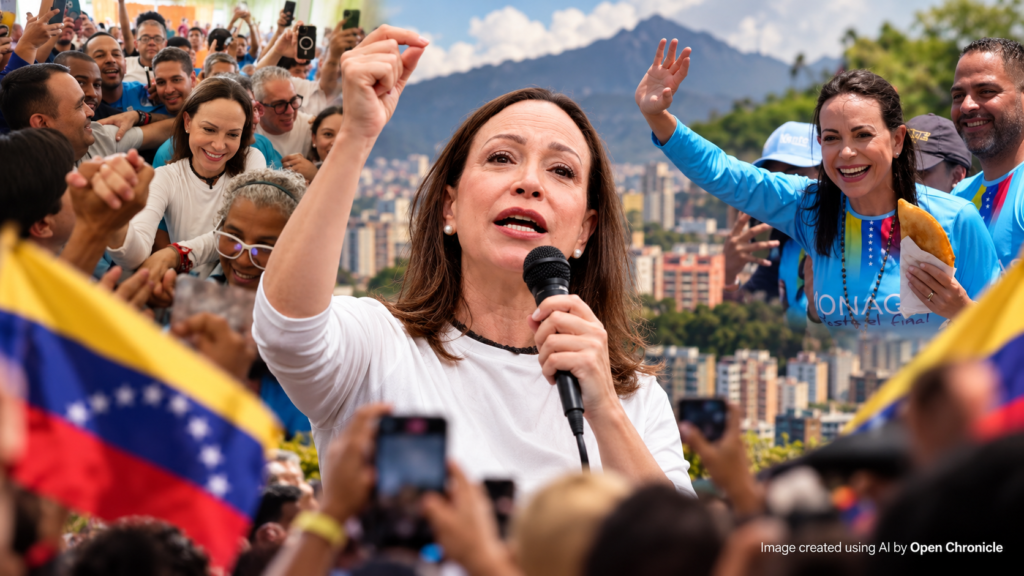
The Venezuelan opposition leader’s reported return after nearly a year abroad could reshape the country’s political transition, exposing competing visions for democratic elections, economic recovery and Washington’s relationship with acting President Delcy Rodríguez.
By Open Chronicle News Desk with Agencies
CARACAS | October 25, 2026
Venezuelan opposition leader and Nobel Peace Prize laureate María Corina Machado announced on Sunday that she had returned to Venezuela after spending nearly a year abroad, potentially opening a new chapter in the country’s political transition and its increasingly complicated relationship with the United States.
According to information attributed to Reuters, Machado signalled her return through a brief social media message, writing:
“I’m here. With you all.”
The announcement did not disclose her precise location, the circumstances of her journey or whether she had already resumed public political activities inside Venezuela.
Nevertheless, the message carried considerable political significance.
Machado has been one of the most prominent figures opposing Venezuela’s former president Nicolás Maduro, whose removal from power in January 2026 fundamentally altered the country’s political landscape.
Her return comes amid disagreements over the direction of Venezuela’s transition, particularly the timing of democratic elections and the role of the United States in supporting the country’s interim authorities.
At the centre of those differences is President Donald Trump’s support for acting President Delcy Rodríguez, a former senior official in Maduro’s government, whose administration has pursued economic agreements involving American companies.
For Machado, the question is whether Venezuela’s emerging political order will ultimately lead to a democratically elected government or consolidate a transitional arrangement that preserves significant elements of the previous administration.
A Return After Months of Exile and Political Uncertainty
Machado’s departure from Venezuela in late 2025 followed an extended period during which she had largely remained in hiding.
Her political activities had been severely restricted under Maduro’s government, and she faced significant obstacles to travelling abroad.
According to the supplied account, Machado eventually left the country to receive the Nobel Peace Prize, before expressing her intention to return and continue her political work.
Her absence came during a period of profound upheaval for Venezuela.
The removal of Maduro in January 2026 created expectations of political change but also raised difficult questions about the legitimacy, composition and duration of the transitional authorities.
Machado’s supporters have long regarded her as a central figure in the campaign for democratic change.
Her return could therefore become a rallying point for opposition groups seeking a clearer timetable for elections and institutional reform.
However, the immediate political consequences remain uncertain.
The information available does not establish whether Machado has received security guarantees, whether she has negotiated arrangements with the acting government or whether she intends to organize public demonstrations.
Humanitarian Concerns and the Decision to Return
Machado had previously expressed her determination to return to Venezuela in connection with the country’s humanitarian and reconstruction needs.
In June, she reportedly said she would do everything possible to return and contribute to recovery efforts following two devastating earthquakes that struck Venezuela that month.
According to figures attributed to Machado in the supplied account, the earthquakes caused at least 6,500 deaths, with thousands more people reported missing.
Those figures are presented here as claims attributed to Machado rather than independently established casualty totals.
The reported disasters added another dimension to Venezuela’s already complex economic and social challenges.
Large-scale reconstruction requires functioning public institutions, reliable infrastructure, financial resources and coordination between national authorities and local communities.
For Machado, humanitarian recovery and political reconstruction have been closely linked in her public arguments.
Her position has emphasized the need for credible institutions capable of attracting investment, restoring confidence and delivering essential services.
Whether her return will allow her to play a practical role in those efforts remains to be seen.
Washington’s Uneasy Relationship With Machado
One of the most significant questions surrounding Machado’s return concerns her relationship with the Trump administration.
Before Maduro’s removal, Machado had sought to strengthen ties with Washington and secure American support for Venezuela’s democratic opposition.
The political situation changed following the transition of power.
According to the supplied account, Reuters reported in June that American officials had asked Machado to postpone her return, reflecting concerns about the possible consequences for Venezuela’s fragile political environment.
The reasons behind those reported requests have not been fully established in the material provided.
However, the episode illustrates a potential divergence between Machado’s political priorities and Washington’s approach to managing Venezuela’s transition.
For the Trump administration, cooperation with the acting authorities appears to have become an important component of its policy toward Caracas.
For Machado, the priority remains the establishment of a government whose legitimacy rests on democratic institutions and elections.
These objectives are not necessarily incompatible, but they could become difficult to reconcile if Washington continues to favour stability and economic cooperation without supporting a clear electoral timetable.
Trump Backs Delcy Rodríguez and Economic Cooperation
President Trump has repeatedly expressed support for acting President Delcy Rodríguez, according to the supplied reports.
Rodríguez, who served as vice-president under Maduro, emerged as a central figure in the political arrangements established after his removal.
Trump has praised oil production agreements and commercial projects involving American companies operating in Venezuela.
The emphasis on energy and investment reflects Venezuela’s economic importance and the potential commercial opportunities associated with its substantial petroleum resources.
For Washington, renewed access to Venezuelan energy production and cooperation with the country’s authorities could offer strategic and economic benefits.
However, closer relations with officials associated with the previous administration raise political questions.
Opposition supporters may regard economic normalization without substantial democratic reforms as an incomplete transition.
The acting government, meanwhile, may argue that economic recovery and political stability must precede a broader electoral process.
The competing approaches reflect a fundamental disagreement about how Venezuela should move beyond the Maduro era.
The Dispute Over Democratic Elections
The timing of elections has emerged as a particularly sensitive issue.
According to the supplied account, Trump said in September that it was still too early to consider holding democratic elections in Venezuela.
Machado has advanced a different argument.
She has maintained that establishing a serious and democratic government is essential to creating the political stability and legal certainty required by investors.
Her position challenges the idea that economic recovery must necessarily precede democratic normalization.
Instead, Machado argues that political legitimacy, credible institutions and respect for democratic procedures are foundations for sustainable economic development.
The distinction has major implications for Venezuela’s future.
An extended transitional period without a clearly defined electoral process could deepen opposition concerns about the durability of the country’s political changes.
Conversely, an election organized before institutions and security conditions have stabilized could generate further disputes over legitimacy and participation.
The central challenge is therefore not simply deciding when elections should take place, but establishing conditions under which the results would be accepted as credible.
Can Machado Reunite the Venezuelan Opposition?
Machado’s return could also affect the internal balance of Venezuela’s opposition movement.
Her international recognition and longstanding opposition to Maduro give her considerable political visibility.
Yet rebuilding a coordinated opposition strategy after a major political transition presents substantial difficulties.
Different political groups may disagree over whether to cooperate with the acting authorities, demand immediate elections or prioritize institutional reforms.
Machado’s ability to influence those debates will depend partly on whether she can operate freely and safely inside Venezuela.
It will also depend on the extent to which opposition organizations can coordinate their activities and communicate a shared political programme.
Her return alone does not establish that a unified opposition strategy has emerged.
Nevertheless, her physical presence in the country could alter political calculations among supporters, government officials and international partners.
Venezuela’s Oil Industry and the Politics of Recovery
Economic recovery remains central to the country’s political future.
Venezuela possesses some of the world’s largest proven oil reserves, but its energy industry has experienced prolonged difficulties associated with underinvestment, infrastructure deterioration, sanctions and political instability.
Renewed agreements involving American companies could support investment and production, depending on their terms and implementation.
However, oil-sector recovery cannot by itself resolve the country’s broader economic challenges.
Sustainable growth also depends on legal certainty, public administration, financial stability, infrastructure and confidence in government institutions.
Machado’s argument that democratic governance is essential to attracting investment places institutional reform at the centre of the economic debate.
The Trump administration’s reported emphasis on commercial agreements suggests a different immediate priority: restoring economic activity through cooperation with the authorities currently exercising power.
The question is whether those approaches can eventually converge or whether they will become competing visions for Venezuela’s future.
What Happens Next?
Several questions remain unanswered following Machado’s announcement.
Her precise location has not been disclosed in the supplied information, and there is no confirmed account of the route she used to return.
It is also unclear whether she has established direct contact with acting President Rodríguez or whether she intends to seek immediate discussions with American officials.
The response of Venezuela’s security institutions will be particularly important.
Any restrictions on Machado’s political activities could intensify domestic tensions and attract international scrutiny.
Conversely, an environment in which she can operate openly could provide an opportunity for broader dialogue about elections and institutional reform.
Washington’s reaction will also be closely watched.
If American officials continue to prioritize cooperation with Rodríguez while discouraging a rapid electoral transition, Machado could find herself in a more complicated diplomatic position than during her earlier campaign against Maduro.
The Big Picture: Venezuela’s Transition Faces a New Political Test
María Corina Machado’s announced return is more than the homecoming of a prominent opposition leader.
It represents a potential turning point in Venezuela’s uncertain political transition.
The removal of Nicolás Maduro altered the country’s leadership, but it did not automatically resolve longstanding disagreements over democratic legitimacy, institutional reform and the future distribution of political power.
Those questions remain central to Venezuela’s relationship with the United States.
Trump’s support for Delcy Rodríguez and the expansion of economic cooperation suggest that Washington is pursuing a pragmatic relationship with the acting authorities.
Machado’s emphasis on democratic government and elections places political legitimacy at the centre of the transition.
Whether those positions can be reconciled will help determine the next stage of Venezuela’s recovery.
For now, Machado’s brief message has reopened a major political question: Will Venezuela’s transition culminate in a new democratic mandate, or will the pursuit of stability and economic recovery delay the electoral changes sought by the opposition?
The answer remains uncertain, but her reported return ensures that the debate is unlikely to disappear.
Editorial Note
This article is based on the information supplied concerning María Corina Machado’s reported announcement on October 25, 2026. The circumstances of her return, the reported communications with American officials and the earthquake casualty figures have not been independently verified for this article. Statements about political intentions and future elections are attributed to the individuals concerned. The article distinguishes reported developments from analysis of their possible consequences.