
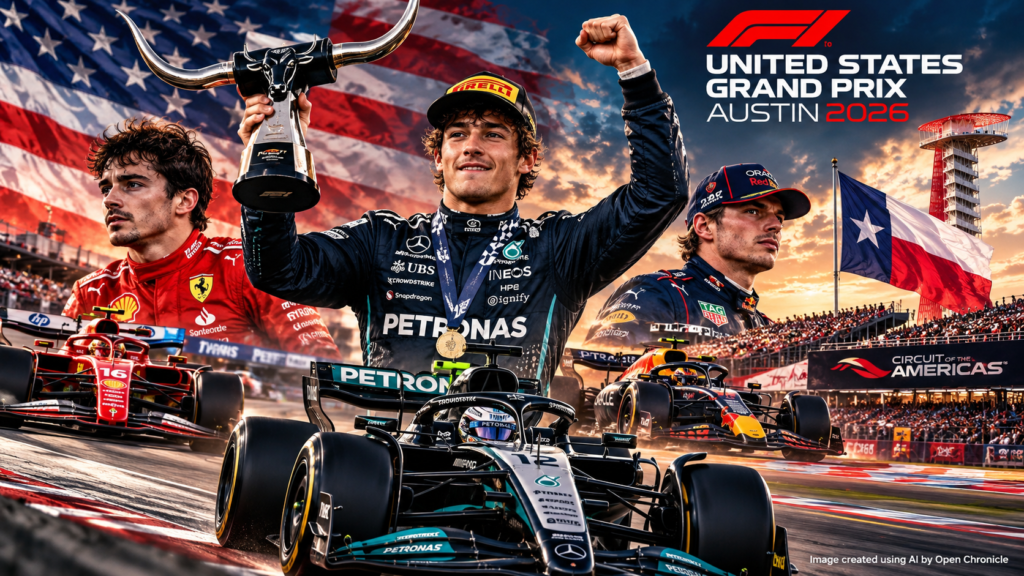
From Ferrari’s promising Friday pace to Kimi Antonelli’s Saturday pole position and commanding Sunday victory, the United States Grand Prix delivered a revealing three-day contest at the Circuit of the Americas. Open Chronicle Sports reviews the complete Austin weekend, the strategic battles, the standout performances and the championship implications.
By Open Chronicle Sports
25 October 2026 | Formula 1 | Round 18 | Grand Prix Weekend Review
Austin: a weekend with a championship on the line
The 2026 Formula 1 United States Grand Prix arrived at the Circuit of the Americas with one question dominating the championship narrative: could Kimi Antonelli secure the Drivers’ World Championship in Texas?
The Mercedes driver entered the eighteenth round with a substantial points advantage over his closest rivals and the mathematical possibility of ending the title contest before the championship reached Mexico.
But Austin was never likely to provide an uncomplicated weekend.
The 5.513-kilometre Circuit of the Americas combines a steep climb towards Turn 1, rapid directional changes, long straights, heavy braking zones and technical corners that place considerable demands on tyres and aerodynamic balance.
The circuit also presents opportunities for overtaking, particularly when cars have different tyre ages or strategic approaches.
Across three days, those characteristics became central to the competition.
Ferrari began strongly in practice. Mercedes improved as the weekend progressed. Red Bull remained competitive over a single lap, while McLaren struggled to translate its potential into a sustained challenge.
By Sunday evening, Antonelli had won the race, Leclerc had produced an impressive recovery to second place, and Verstappen had secured a difficult podium.
The championship, however, remained undecided.
Friday, 23 October: Ferrari sets the early benchmark
Free Practice 1 and 2
The first day of running suggested that Ferrari would be a serious contender in Austin.
Charles Leclerc topped both Friday practice sessions, demonstrating competitive pace as the teams began evaluating aerodynamic balance, tyre performance and race simulations.
For Ferrari, the opening day was encouraging.
The car appeared capable of producing strong lap times around a circuit that requires a compromise between straight-line efficiency and high-speed cornering stability.
However, Friday practice rarely provides a complete picture of the competitive order.
Teams run different fuel loads, tyre compounds and programmes, making direct comparisons difficult.
Mercedes used the opening sessions to refine its setup, while Red Bull continued working to extract performance from its package.
The most significant technical challenge was the difficulty of maintaining consistency across the circuit.
Track limits became an important concern, particularly through the faster sections where drivers attempted to maximise cornering speed.
Open Chronicle analysis
Ferrari’s Friday performance demonstrated genuine potential, but the weekend also illustrated the danger of interpreting practice results as a definitive ranking.
Mercedes continued developing its setup and ultimately produced the fastest qualifying lap.
The contrast between Friday and Saturday reinforced the importance of engineering development across a Grand Prix weekend.
Saturday morning: the final search for performance
Free Practice 3
The final practice session provided another indication that Ferrari could challenge for pole position.
Lewis Hamilton set the benchmark in FP3, continuing the team’s strong form after Leclerc’s Friday performances.
Ferrari had therefore led all three practice sessions.
That sequence was significant, but it did not guarantee success in qualifying.
Teams still needed to optimise tyre preparation, aerodynamic balance and their drivers’ confidence on a circuit where small mistakes could invalidate an entire lap.
Mercedes, meanwhile, continued refining the performance of Antonelli’s car.
The Italian entered qualifying with the opportunity to secure an important psychological and competitive advantage in the championship battle.
Red Bull also remained within striking distance.
The stage was set for a closely contested qualifying session.
Saturday qualifying: Antonelli delivers when it matters
Pole position — 1:34.035
Kimi Antonelli produced the decisive performance of Saturday afternoon.
The Mercedes driver recorded a lap of 1:34.035 in Q3 to secure pole position, beating Max Verstappen by 0.179 seconds.
Isack Hadjar qualified third, completing a strong session for Red Bull.
Charles Leclerc finished fourth for Ferrari, followed by Lewis Hamilton in fifth.
George Russell qualified sixth in the second Mercedes.
The result was particularly impressive because the margins among the leading drivers were relatively small.
Only 0.276 seconds separated Antonelli from Hamilton in fifth place.
Qualifying top ten
| Position | Driver | Team | Time / Gap |
|---|---|---|---|
| 1 | Kimi Antonelli | Mercedes | 1:34.035 |
| 2 | Max Verstappen | Red Bull | +0.179s |
| 3 | Isack Hadjar | Red Bull | +0.215s |
| 4 | Charles Leclerc | Ferrari | +0.232s |
| 5 | Lewis Hamilton | Ferrari | +0.276s |
| 6 | George Russell | Mercedes | +0.441s |
| 7 | Oscar Piastri | McLaren | +0.768s |
| 8 | Lando Norris | McLaren | +1.014s |
| 9 | Arvid Lindblad | Racing Bulls | +2.014s |
| 10 | Liam Lawson | Racing Bulls | No Q3 time |
The track-limits factor
Track limits became one of the defining issues of qualifying.
Lando Norris initially appeared capable of securing a stronger starting position, but his lap was deleted for exceeding the permitted track boundaries.
The penalty dropped him behind teammate Oscar Piastri.
The incident demonstrated the fine margins involved in modern Formula 1 qualifying.
A driver may possess the speed required for a competitive result, but that performance is irrelevant if the lap does not comply with the regulations.
The Red Bull challenge
Verstappen and Hadjar produced an impressive combined qualifying result.
Their second and third positions gave Red Bull a strong opportunity to challenge Mercedes at the start.
However, qualifying pace and race pace are not always equivalent.
The ability to manage tyre degradation and maintain balance over longer stints would prove decisive on Sunday.
Antonelli’s statement
For Antonelli, pole position was another demonstration of composure under pressure.
The Italian had entered the weekend facing questions about whether he could secure the championship in Austin.
Rather than allowing those expectations to disrupt his performance, he delivered the fastest lap when it mattered most.
Open Chronicle analysis
Antonelli’s pole position was the turning point of the weekend.
Ferrari had demonstrated superior pace during practice, but Mercedes converted its development work into the most important qualifying result.
The outcome also revealed the growing maturity of Antonelli as a championship contender.
He was not simply benefiting from a competitive car. He was consistently extracting its performance at decisive moments.
The midfield: penalties change the starting grid
Qualifying also produced important developments further down the order.
Gabriel Bortoleto qualified 13th for Audi, but penalties associated with power-unit component changes forced the Brazilian to start 21st.
The setback transformed his race objective.
Instead of beginning within reach of the points, Bortoleto faced the challenge of recovering through a large field.
Franco Colapinto and Arvid Lindblad were also affected by grid penalties.
The situation illustrated the importance of reliability and component management during a long Formula 1 season.
Even a competitive qualifying performance can be undermined by technical penalties.
For Audi, the priority became converting Bortoleto’s race pace into as many recovered positions as possible.
Sunday, 25 October: the race begins
Antonelli protects the lead
Antonelli made the start he needed.
The Mercedes driver maintained first position as the field climbed towards Turn 1.
Behind him, Leclerc and Verstappen became involved in an immediate battle for second place.
Leclerc briefly moved ahead before Verstappen recovered the position.
Hadjar lost ground from his third-place starting position, while Russell also experienced a difficult opening phase.
The fighting behind the leader allowed Antonelli to establish an early advantage.
A brief Virtual Safety Car on lap two interrupted the action, but Antonelli maintained control after racing resumed.
By lap ten, the Italian had extended his advantage to approximately 2.8 seconds.
His ability to establish clean air was crucial.
With fewer disturbances from the cars ahead, Antonelli could manage his tyres and control his pace more effectively.
Tyre strategy: the defining contest
The United States Grand Prix developed into a competition between different approaches to tyre management.
Antonelli started on medium tyres and extended his opening stint until lap 24.
He then switched to the hard compound, committing to a one-stop strategy.
Several rivals chose two-stop approaches, seeking greater performance from fresher tyres.
Verstappen made an early stop on lap 14, followed by Ferrari and McLaren drivers during the subsequent laps.
The Dutch driver eventually stopped again on lap 31.
Leclerc and Hamilton also completed second stops later in the race.
The strategic difference became increasingly significant as the field entered the second half of the Grand Prix.
Antonelli had fewer pit stops to complete, but he needed to preserve his tyres for a longer period.
His rivals possessed opportunities to attack on fresher rubber but had to recover the time lost in the pit lane.
Lap 32: the decisive overtake
After the first cycle of pit stops, Leclerc temporarily led the race.
Antonelli closed the gap and overtook the Ferrari on lap 32 to reclaim first position.
From that moment, the Mercedes driver controlled the contest.
His pace remained sufficiently strong to build a substantial advantage, despite the age of his tyres.
Open Chronicle analysis
The race demonstrated that the fastest strategy is not necessarily the one involving the newest tyres.
Mercedes successfully balanced tyre preservation, pit-stop timing and track position.
Antonelli executed the plan with consistency, avoiding the performance drop that might have forced an additional stop.
The result was a decisive strategic victory.
Ferrari’s recovery: Leclerc and Hamilton attack
Ferrari’s strongest moments came during the closing stages.
After their second pit stops, Leclerc and Hamilton used fresher tyres to recover positions.
Leclerc demonstrated particularly strong pace, recording increasingly competitive lap times as he approached the cars ahead.
The battle involving Norris, Verstappen and Leclerc became one of the most exciting sequences of the race.
Verstappen passed Norris for second place on lap 47.
Leclerc then overtook the McLaren driver before closing on Verstappen.
On lap 49, the Ferrari driver completed the pass for second place.
Hamilton also made progress.
He passed Hadjar before overtaking Norris on lap 51 to move into fourth.
The final result gave Ferrari second and fourth places, producing a combined 30 championship points.
Although the team could not challenge Antonelli for victory, its performance confirmed that the Ferrari package remained competitive.
Red Bull: podium pace, but persistent difficulties
Verstappen’s race was complicated by repeated concerns about the behaviour of his Red Bull.
The Dutch driver reported problems with gear changes and handling, while the team explored possible issues involving engine braking.
Despite those difficulties, Verstappen remained competitive.
His aggressive strategy allowed him to recover positions and challenge for second place.
However, Leclerc’s late-race pace proved too strong.
Verstappen finished third, narrowly ahead of Hamilton.
Hadjar completed the race in sixth place.
Open Chronicle analysis
Red Bull demonstrated strong qualifying performance but lacked the consistency needed to challenge Mercedes over the full race distance.
Verstappen’s podium was valuable, but the gap to Antonelli reflected the limitations of the car and the complications of the team’s strategy.
McLaren: a weekend of missed opportunities
McLaren’s weekend contained several frustrating moments.
Norris lost a stronger qualifying position because of track limits, while Piastri struggled to match the leading teams consistently.
During the race, McLaren authorised a position exchange between its drivers to maximise their opportunities.
However, neither driver ultimately secured a podium.
Norris finished fifth, while Piastri crossed the line in seventh.
Both drivers scored points, but the result was below the level required to challenge Mercedes and Ferrari at the front.
The closing stages were particularly difficult for Norris, whose older tyres left him vulnerable to attacks from Verstappen, Leclerc and Hamilton.
Gabriel Bortoleto: a determined recovery
Gabriel Bortoleto produced one of the weekend’s most noteworthy recovery drives.
After qualifying 13th and starting 21st because of a power-unit penalty, the Audi driver began advancing through the field.
He passed Bottas, Colapinto, Pérez and Sainz during the opening laps.
Further overtakes allowed him to move into contention for a stronger midfield result.
Bortoleto passed Fernando Alonso on lap 42 and Esteban Ocon on lap 45.
At that stage, he had reached 12th place.
However, a second pit stop on lap 50 cost him positions.
He eventually recovered to 13th, gaining eight places from his starting position.
Although he finished outside the points, his race demonstrated determination and competitive pace.
Nico Hülkenberg finished 11th for Audi, narrowly missing the top ten.
The closing laps: Antonelli remains untouchable
The final phase of the Grand Prix included another Virtual Safety Car.
Valtteri Bottas stopped his Cadillac near Turns 10 and 11 on lap 51, requiring the recovery of the stranded car.
Racing resumed on lap 53.
Antonelli retained a comfortable advantage and completed the remaining laps without difficulty.
After 56 laps, he crossed the finish line in 1:35:16.650.
Leclerc finished second, 13.078 seconds behind.
Verstappen completed the podium, followed by Hamilton and Norris.
Antonelli’s victory was the culmination of a weekend in which Mercedes improved progressively and delivered its strongest performance when the result mattered most.
The final classification
| Pos. | Driver | Team | Result |
|---|---|---|---|
| 1 | Kimi Antonelli | Mercedes | Winner |
| 2 | Charles Leclerc | Ferrari | +13.078s |
| 3 | Max Verstappen | Red Bull | +17.485s |
| 4 | Lewis Hamilton | Ferrari | +18.515s |
| 5 | Lando Norris | McLaren | +30.521s |
| 6 | Isack Hadjar | Red Bull | +34.373s |
| 7 | Oscar Piastri | McLaren | +52.674s |
| 8 | George Russell | Mercedes | +54.303s |
| 9 | Liam Lawson | Racing Bulls | +79.183s |
| 10 | Pierre Gasly | Alpine | +87.516s |
| 11 | Nico Hülkenberg | Audi | +94.945s |
| 12 | Arvid Lindblad | Racing Bulls | +1 lap |
| 13 | Gabriel Bortoleto | Audi | +1 lap |
| 14 | Esteban Ocon | Haas | +1 lap |
| 15 | Lance Stroll | Aston Martin | +1 lap |
| 16 | Fernando Alonso | Aston Martin | +1 lap |
| 17 | Alexander Albon | Williams | +1 lap |
| 18 | Carlos Sainz | Williams | +1 lap |
| 19 | Sergio Pérez | Cadillac | +1 lap |
| DNF | Valtteri Bottas | Cadillac | Retired |
| DNF | Franco Colapinto | Alpine | Retired |
| DNF | Oliver Bearman | Haas | Retired |
The weekend in numbers
| Indicator | Result |
|---|---|
| Championship round | 18 |
| Grand Prix dates | 23–25 October 2026 |
| Circuit | Circuit of the Americas |
| Circuit length | 5.513 km |
| Race laps | 56 |
| Pole position | Kimi Antonelli |
| Pole lap | 1:34.035 |
| Margin to second in qualifying | 0.179 seconds |
| Race winner | Kimi Antonelli |
| Winning margin | 13.078 seconds |
| Antonelli’s victories in 2026 | 9 |
| Ferrari’s combined race points | 30 |
| Bortoleto’s net positions gained | 8 |
| Retirements | 3 |
Championship implications: the title remains within reach
Antonelli arrived in Austin with the possibility of securing the Drivers’ World Championship.
His victory strengthened his position considerably.
However, Russell’s eighth-place finish kept the title mathematically undecided.
The championship will therefore continue to Mexico.
Antonelli’s ninth victory of the season represents a major achievement and further evidence of his consistency throughout 2026.
Nevertheless, the title will only be confirmed once the mathematical conditions are fulfilled.
For the chasing drivers, the remaining races represent increasingly limited opportunities to reverse the championship situation.
For Mercedes, the challenge is to maintain its competitive advantage while avoiding unnecessary mistakes.
Open Chronicle analysis: what Austin revealed
1. Antonelli is combining speed with maturity
His qualifying performance demonstrated outright pace.
His race performance demonstrated tyre management, strategic discipline and control under pressure.
That combination is characteristic of a driver capable of sustaining a championship challenge.
2. Ferrari remains a serious competitive force
Leclerc and Hamilton produced strong performances, particularly during the closing stages.
The team’s ability to recover positions suggests that its race pace remains competitive.
3. Red Bull faces a balance problem
Verstappen’s podium demonstrated resilience, but the handling difficulties reported during the race prevented a sustained challenge for victory.
4. McLaren needs stronger race execution
Both drivers scored points, but the team was unable to defend its positions against rivals with fresher tyres.
5. Audi’s potential is not yet reflected in points
Bortoleto and Hülkenberg showed competitive midfield pace, but qualifying setbacks and strategic complications limited the final result.
The next chapter: Mexico
The Formula 1 World Championship now moves to Mexico, where Antonelli will have another opportunity to secure the Drivers’ title.
Mercedes will arrive with confidence after a weekend that demonstrated the strength of its technical package and race execution.
Ferrari will seek to maintain the momentum generated by its strong Austin performance.
Red Bull and McLaren must respond if they are to challenge more effectively during the final stages of the season.
For Antonelli, the objective is increasingly clear.
The Italian no longer needs to prove that he can win races.
He must now complete the championship campaign.
Final verdict: a weekend that belonged to Antonelli
The 2026 United States Grand Prix was a three-day demonstration of how a championship contender can turn preparation into results.
Ferrari began with the strongest practice performances.
Red Bull challenged in qualifying.
McLaren remained competitive in the midfield battles.
But Mercedes and Antonelli delivered when it mattered.
Pole position on Saturday was followed by a controlled and strategically accomplished victory on Sunday.
Leclerc’s recovery, Verstappen’s difficult podium, Hamilton’s fourth place and Bortoleto’s determined drive added depth to a memorable weekend.
The championship celebration did not arrive in Austin.
But the United States Grand Prix brought Kimi Antonelli another decisive step closer to the greatest achievement of his Formula 1 career.
Austin did not decide the championship. It made the direction of the title race clearer than ever.
Sources and Further Reading
United States Grand Prix 2026 ·
Grand Prix Weekend Review ·
23–25 October 2026
United States Grand Prix 2026 Official Event Centre
Official event information covering the weekend
schedule, free practice sessions, qualifying,
race results and Grand Prix classifications.
Antonelli Takes Pole for the United States Grand Prix
Official qualifying report and classification,
documenting Antonelli’s pole position, the
competitive order and the performance of the
leading teams at the Circuit of the Americas.
Antonelli Seizes Pole Position Ahead of Verstappen
Qualifying analysis covering Antonelli’s decisive
lap, team performance, competitive margins and
track-limits incidents during Saturday’s session.
Antonelli Surges to Dominant Victory in Austin
Official race report documenting Antonelli’s
victory, the podium classification, race strategy,
key incidents and championship implications.
United States Grand Prix Weekend Coverage
Independent motorsport reporting, practice analysis,
qualifying updates and paddock developments
throughout the United States Grand Prix weekend.
Editorial Note
This article is an independent Grand Prix weekend
review by Open Chronicle Sports. It combines official
Formula 1 and FIA records, contemporary motorsport
reporting and editorial interpretation of the
competitive developments at the Circuit of the
Americas between 23 and 25 October 2026. The analysis
of team performance, tyre strategy and championship
momentum represents the editorial assessment of
Open Chronicle Sports and should not be interpreted
as official Formula 1 commentary or a prediction
of future results.