
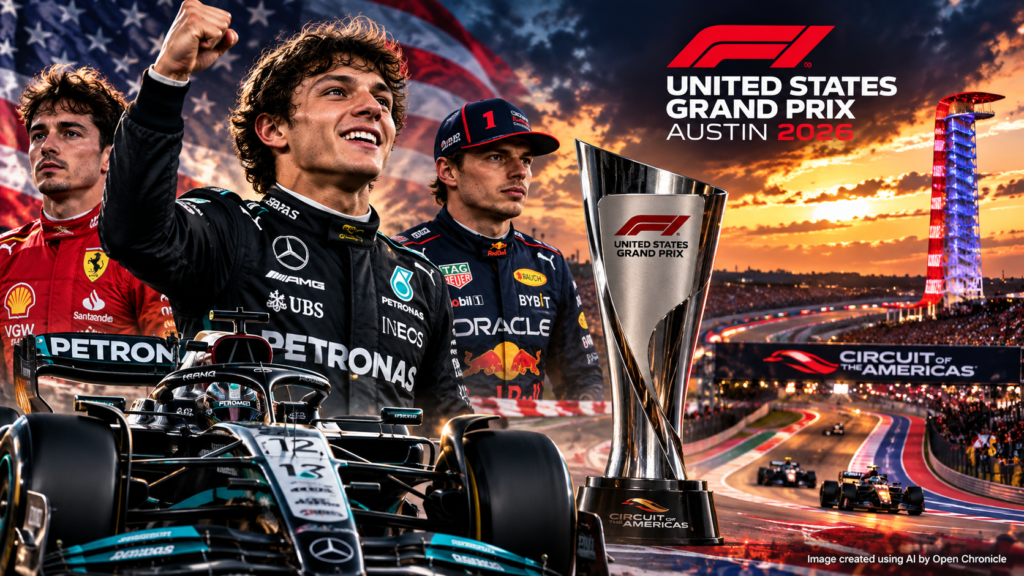
The Mercedes driver controlled the race at the Circuit of the Americas to claim his ninth victory of the 2026 season. Charles Leclerc secured second place for Ferrari, Max Verstappen completed the podium, and Gabriel Bortoleto recovered from 21st on the grid to finish 13th.
By Open Chronicle Sports
25 October 2026 | Formula 1 | United States Grand Prix | Race Report
A commanding victory, but the championship must wait
Kimi Antonelli delivered another statement performance in the 2026 Formula 1 World Championship, winning the United States Grand Prix at the Circuit of the Americas in Austin on Sunday, 25 October.
Starting from pole position, the Mercedes driver controlled the decisive phases of the 56-lap race, managed his tyres effectively and crossed the finish line 13.078 seconds ahead of Ferrari’s Charles Leclerc.
Max Verstappen finished third for Red Bull, 17.485 seconds behind the winner, while Lewis Hamilton completed a strong afternoon for Ferrari in fourth place.
Lando Norris finished fifth for McLaren, ahead of Isack Hadjar, Oscar Piastri and George Russell.
For Antonelli, the result represented his ninth victory of the season and another significant step towards the Drivers’ World Championship.
Yet the celebrations remained on hold.
The Italian arrived in Austin with a substantial championship advantage and the mathematical possibility of securing the title. However, Russell’s eighth-place finish ensured that the contest would continue into the Mexican Grand Prix.
The race was also notable for the recovery of Brazilian driver Gabriel Bortoleto, who started 21st following a power-unit penalty and finished 13th for Audi.
Although the result brought no championship points, Bortoleto gained eight positions and demonstrated competitive race pace in challenging circumstances.
1. The start: Antonelli takes control
The race began with Antonelli defending his pole position as the field accelerated towards the opening sequence of corners.
Behind him, the battle for second place immediately intensified.
Charles Leclerc challenged Max Verstappen and briefly moved ahead, but the Red Bull driver responded to recover the position.
Isack Hadjar, who had qualified third, lost ground during the opening exchanges, while George Russell also found himself behind his expected position.
Antonelli used the confusion behind him to establish an early advantage.
A Virtual Safety Car on the second lap briefly interrupted the race, but the Mercedes driver maintained control after racing resumed.
By lap ten, he had built a lead of approximately 2.8 seconds.
The early advantage was particularly important because the teams had selected different tyre strategies.
Antonelli, Russell, Norris and Piastri started on medium tyres, while several rivals chose the softer compound.
With track temperatures high and tyre degradation an important consideration, the opening stint was already shaping the strategic contest.
Antonelli’s ability to preserve his tyres while maintaining competitive lap times would become one of the decisive elements of the afternoon.
2. Different strategies create a changing race
The first significant strategic move among the leaders came on lap 14.
Verstappen, who had complained about difficulties with his Red Bull’s gear changes, entered the pits earlier than his main rivals.
The Dutch driver returned to the track in eighth position, beginning a recovery through the field on fresher tyres.
Ferrari responded shortly afterwards.
Hamilton made his first stop on lap 15, followed by Leclerc on lap 16.
McLaren also committed to its tyre strategy, with Piastri stopping on lap 16 and Norris on lap 17.
Earlier, McLaren had instructed its drivers to exchange positions after Norris reported that Piastri was affecting his pace.
The British driver moved ahead on lap eight.
Meanwhile, Russell’s afternoon became more complicated when he received a five-second penalty for leaving the track and gaining an advantage at Turn 13.
The penalty added to the difficulties of a driver who had arrived in Austin as Antonelli’s closest championship rival.
At the front, Antonelli continued to manage the race without being drawn into the same sequence of early stops.
The Mercedes driver remained on track until lap 24, when he switched to hard tyres.
It was a decision that would prove decisive.
3. Mercedes wins the strategic battle
Antonelli’s victory was not simply the product of superior qualifying pace.
It was built on a carefully executed one-stop strategy.
By extending his first stint to lap 24 and switching to hard tyres, Mercedes positioned its driver to complete the race without another scheduled stop.
Several rivals adopted two-stop approaches, seeking greater performance from fresher tyres.
The contrast became increasingly important as the race progressed.
Verstappen made his second stop on lap 31 after reporting further handling difficulties, including problems potentially connected to engine braking.
Leclerc temporarily inherited the lead during the pit-stop sequence, but Antonelli soon closed the gap.
On lap 32, the Mercedes driver drew alongside the Ferrari and completed the overtake to regain first place.
From that moment, he began to build a substantial advantage.
His hard tyres continued to provide sufficient performance, while the drivers behind him were involved in battles that consumed time and tyre life.
Open Chronicle analysis
The most impressive element of Antonelli’s race was the balance between pace and tyre management.
A one-stop strategy is only effective when the driver can maintain competitive lap times without excessively degrading the tyres.
Antonelli achieved precisely that.
His performance allowed Mercedes to avoid the time loss associated with a second stop while retaining enough speed to respond to the changing race situation.
The result illustrated how race management can be just as important as outright speed in modern Formula 1.
4. Leclerc transforms Ferrari’s afternoon
Charles Leclerc delivered one of the strongest recovery performances of the race.
The Ferrari driver was involved in the early battle with Verstappen before committing to an aggressive strategic approach.
After his second pit stop on lap 39, Leclerc began reducing the gap to the cars ahead.
He recorded increasingly competitive lap times, including a 1:37.976 on lap 42.
The closing stages became a battle involving Leclerc, Verstappen and Norris.
On lap 47, Verstappen passed Norris to take second place.
Leclerc also attacked the McLaren driver, moving into third after an intense sequence of corners.
The Ferrari then closed rapidly on Verstappen.
On lap 49, Leclerc completed the decisive overtake to move into second place.
Although Antonelli was already too far ahead to be realistically challenged, Leclerc secured an important result for Ferrari.
His second-place finish reflected the effectiveness of the team’s late-race strategy and his ability to capitalise on fresher tyres.
Open Chronicle analysis
Leclerc’s performance demonstrated Ferrari’s potential when the team combines strong race pace with effective strategic execution.
The two-stop approach did not produce a victory, but it helped Leclerc secure second place against rivals struggling with tyre performance and car balance.
It also gave Ferrari valuable momentum heading into the final stages of the championship.
5. Verstappen struggles but saves the podium
Max Verstappen experienced a more complicated race than his third-place result might suggest.
The Red Bull driver remained competitive during the opening stages but repeatedly reported difficulties with the behaviour of his car.
An early pit stop placed him on an alternative strategy.
He recovered positions and eventually moved back into contention for second place.
However, the problems with his Red Bull continued.
The second stop on lap 31 provided fresher tyres but also required another recovery through the field.
Verstappen eventually passed Norris for second on lap 47, only to lose the position to Leclerc two laps later.
In the final stages, he came under pressure from Hamilton.
The Dutch driver managed to preserve third place, finishing just 1.030 seconds ahead of the Ferrari.
Open Chronicle analysis
Verstappen’s podium represented a successful limitation of the damage on a difficult afternoon.
Red Bull retained enough performance to compete near the front, but the car’s handling problems and strategic complications prevented Verstappen from challenging Antonelli for victory.
The contrast between Mercedes’ controlled race and Red Bull’s repeated adjustments was particularly revealing.
6. Hamilton delivers another strong Ferrari result
Lewis Hamilton finished fourth, narrowly missing a podium position.
The seven-time world champion adopted a two-stop strategy and recovered strongly during the second half of the race.
After his second stop, Hamilton found himself behind Hadjar.
He passed the Red Bull driver on lap 42 to move into fifth.
As Norris began struggling with tyre performance, Hamilton continued to close the gap.
On lap 51, he overtook the McLaren driver to take fourth place.
He then approached Verstappen but ran out of laps to complete another pass.
The result left Ferrari with second and fourth places, a combined 30 championship points.
Open Chronicle analysis
Ferrari’s performance in Austin was encouraging.
Both drivers demonstrated competitive race pace, particularly during the final stint.
Although the team could not match Antonelli’s overall race execution, it converted its strategy into a substantial points haul.
The result reinforced Ferrari’s ability to challenge Red Bull and McLaren in direct competition.
7. McLaren: a difficult afternoon despite two points finishes
McLaren entered the race with Norris and Piastri hoping to challenge the leading teams.
However, neither driver ultimately secured a podium.
Norris finished fifth after losing positions during the closing stages.
Piastri crossed the line in seventh.
The team’s decision to exchange positions early in the race demonstrated its attempt to maximise overall performance, but the final result highlighted the limitations of its race pace relative to Mercedes and Ferrari.
Norris was particularly vulnerable during the closing stages, when rivals on fresher tyres were able to attack.
Open Chronicle analysis
McLaren’s result was respectable in terms of points, but disappointing in competitive terms.
Both cars finished in the top seven, yet neither could maintain a sustained challenge for the podium.
The race exposed the importance of tyre strategy and the difficulty of defending against cars with a significant performance advantage late in a stint.
8. George Russell: a race that keeps the championship alive
George Russell’s eighth-place finish carried consequences beyond the four points he collected.
The Mercedes driver had entered the weekend as Antonelli’s closest championship rival.
His race began poorly, with lost positions during the opening stages.
A five-second penalty for gaining an advantage outside the track limits further complicated his afternoon.
Although Russell recovered to eighth, he was unable to challenge the leading group.
Nevertheless, the points he scored ensured that Antonelli could not mathematically secure the Drivers’ Championship in Austin.
Open Chronicle analysis
Russell’s result demonstrated the contrasting fortunes within Mercedes.
Antonelli delivered a dominant victory, while Russell struggled to recover from a difficult opening phase.
The championship remains mathematically open, but the balance of momentum is firmly with Antonelli.
9. Gabriel Bortoleto: eight places gained in a demanding recovery
One of the most interesting performances outside the points came from Gabriel Bortoleto.
The Brazilian driver qualified 13th but was required to start 21st following a penalty for exceeding the permitted allocation of power-unit components.
That left him facing a difficult recovery through a crowded midfield.
Bortoleto immediately began making progress.
He passed Valtteri Bottas on the opening lap and Franco Colapinto on lap two.
Further overtakes against Sergio Pérez and Carlos Sainz moved him towards the midfield.
The Audi driver was investigated for a possible advantage gained by leaving the track at Turn 11, but the stewards decided that no penalty was necessary.
Bortoleto continued advancing and eventually passed Alexander Albon.
He then targeted Fernando Alonso, completing the move on lap 42 to reach 13th position.
Three laps later, he overtook Esteban Ocon to move into 12th.
However, a second pit stop on lap 50 cost him positions.
Bortoleto returned to the track in 14th before recovering one place with a late overtake on Ocon.
He finished 13th, one lap behind Antonelli.
Open Chronicle analysis
Bortoleto’s performance deserves recognition despite the absence of championship points.
Starting 21st, he gained eight places and completed several overtakes under racing conditions.
His recovery also demonstrated the potential of Audi’s race pace, although the team ultimately failed to convert that performance into a top-ten result.
The additional pit stop prevented Bortoleto from retaining the 12th position he had reached.
The broader lesson is that qualifying position and strategic decisions can significantly affect the final outcome, even when a driver produces a competitive performance.
10. Audi: competitive pace without points
Audi left Austin without championship points.
Nico Hülkenberg finished 11th, narrowly missing the top ten.
The German driver experienced a difficult start, losing several positions before recovering during the middle stages.
He eventually moved into 11th on lap 40 and maintained the position to the finish.
Bortoleto finished two places behind.
Together, the results suggested that Audi possessed sufficient pace to compete in the midfield but lacked the overall race execution necessary to secure points.
Open Chronicle analysis
Audi’s afternoon was neither a complete disappointment nor a breakthrough.
Both drivers recovered positions, demonstrating that the car had competitive potential.
However, the team will need stronger qualifying results and more effective strategic execution to turn that pace into consistent championship points.
11. The final Virtual Safety Car
The closing stages were briefly interrupted when Valtteri Bottas stopped his Cadillac near Turns 10 and 11 on lap 51.
Race control deployed the Virtual Safety Car while the stranded car was recovered.
The neutralisation reduced the opportunity for further attacks, particularly in the battle for the podium.
Green-flag racing resumed on lap 53.
Antonelli remained firmly in control.
Although his advantage had been reduced from its earlier peak, he maintained a comfortable margin and completed the final laps without difficulty.
He crossed the line after 56 laps to claim victory in a total time of 1:35:16.650.
Leclerc followed 13.078 seconds later, with Verstappen third.
12. United States Grand Prix 2026 — Complete Race Classification
| Pos. | Driver | Team | Gap |
|---|---|---|---|
| 1 | Kimi Antonelli | Mercedes | 1:35:16.650 |
| 2 | Charles Leclerc | Ferrari | +13.078s |
| 3 | Max Verstappen | Red Bull | +17.485s |
| 4 | Lewis Hamilton | Ferrari | +18.515s |
| 5 | Lando Norris | McLaren | +30.521s |
| 6 | Isack Hadjar | Red Bull | +34.373s |
| 7 | Oscar Piastri | McLaren | +52.674s |
| 8 | George Russell | Mercedes | +54.303s |
| 9 | Liam Lawson | Racing Bulls | +79.183s |
| 10 | Pierre Gasly | Alpine | +87.516s |
| 11 | Nico Hülkenberg | Audi | +94.945s |
| 12 | Arvid Lindblad | Racing Bulls | +1 lap |
| 13 | Gabriel Bortoleto | Audi | +1 lap |
| 14 | Esteban Ocon | Haas | +1 lap |
| 15 | Lance Stroll | Aston Martin | +1 lap |
| 16 | Fernando Alonso | Aston Martin | +1 lap |
| 17 | Alexander Albon | Williams | +1 lap |
| 18 | Carlos Sainz | Williams | +1 lap |
| 19 | Sergio Pérez | Cadillac | +1 lap |
| DNF | Valtteri Bottas | Cadillac | Retired |
| DNF | Franco Colapinto | Alpine | Retired |
| DNF | Oliver Bearman | Haas | Retired |
13. The race in numbers
| Indicator | Result |
|---|---|
| Championship round | 18 |
| Circuit | Circuit of the Americas, Austin |
| Race distance | 56 laps |
| Race winner | Kimi Antonelli |
| Winning time | 1:35:16.650 |
| Victory margin | 13.078 seconds |
| Antonelli’s 2026 victories | 9 |
| Ferrari finishing positions | 2nd and 4th |
| Ferrari points scored | 30 |
| Bortoleto starting position | 21st |
| Bortoleto finishing position | 13th |
| Bortoleto net positions gained | 8 |
| Retirements | 3 |
14. The championship: Antonelli moves closer to history
The United States Grand Prix was an important moment in the 2026 Drivers’ Championship.
Antonelli arrived in Austin with a commanding advantage over Russell and the possibility of securing the title with several races remaining.
His victory delivered the maximum 25 points available for finishing first.
However, Russell’s eighth-place result kept the championship mathematically open.
The title battle therefore continues to the Mexican Grand Prix.
For Antonelli, the situation is increasingly favourable.
His ninth victory of the season demonstrates both the competitiveness of the Mercedes package and his ability to perform consistently under championship pressure.
Nevertheless, the title is not secured until the mathematical conditions are fulfilled.
Reliability, race incidents and strategic decisions remain relevant factors, even when a driver holds a substantial points advantage.
15. What Austin revealed about the leading teams
Mercedes — The benchmark
Antonelli’s victory demonstrated the team’s strength in race management, strategic decision-making and tyre preservation.
Russell’s difficult afternoon showed that even the leading car is not immune to mistakes and complications.
Ferrari — Stronger in the closing stages
Leclerc and Hamilton delivered competitive performances, particularly on fresher tyres.
Ferrari’s two-stop approach produced second and fourth places, making the team one of the main beneficiaries of the race.
Red Bull — Competitive but inconsistent
Verstappen secured another podium, but his complaints about the car’s handling suggested that Red Bull still faces technical challenges.
Hadjar finished sixth after starting third.
McLaren — Points without a podium
Norris and Piastri collected points but lacked the late-race performance needed to resist Ferrari’s recovery.
Audi — Progress without reward
Hülkenberg and Bortoleto both showed recovery pace, but neither finished in the points.
16. Next stop: Mexico
The Formula 1 championship now moves to Mexico for another potentially decisive weekend.
Antonelli will arrive with the opportunity to secure his first Drivers’ World Championship.
For Mercedes, the objective will be to maintain the consistency and strategic effectiveness demonstrated in Austin.
Ferrari will seek to build on its strong result, while Red Bull and McLaren will aim to recover competitiveness.
The championship battle remains mathematically alive, but the pressure is increasingly concentrated on Antonelli’s remaining rivals.
Open Chronicle Sports verdict
The 2026 United States Grand Prix was a demonstration of controlled racing from Kimi Antonelli.
He started from pole position, managed his tyres, executed an effective one-stop strategy and responded decisively when the lead changed during the pit-stop sequence.
His victory was comprehensive rather than accidental.
Behind him, Leclerc produced an excellent recovery to secure second place, while Verstappen preserved a podium despite technical difficulties.
Hamilton’s fourth place strengthened Ferrari’s afternoon, while Norris and Piastri were unable to convert McLaren’s potential into a podium finish.
Further back, Gabriel Bortoleto’s recovery from 21st to 13th was one of the race’s noteworthy midfield performances.
Austin did not crown the 2026 world champion.
But it brought Kimi Antonelli another significant step closer.
The victory belonged to Antonelli. The championship celebration will have to wait.
Sources and Further Reading
United States Grand Prix 2026 · Circuit of the Americas ·
25 October 2026
Official United States Grand Prix 2026 Race Report
Official account of Antonelli’s victory, the race
strategy, podium battle and championship implications.
United States Grand Prix 2026 Race Classification
Official race results, finishing positions, time gaps
and championship points.
United States Grand Prix Race Analysis and Results
Independent motorsport reporting and strategic
information covering the United States Grand Prix.
Antonelli Wins United States Grand Prix as
Bortoleto Finishes 13th
Detailed Portuguese-language reporting on the race,
including Gabriel Bortoleto’s recovery from 21st
on the grid to 13th at the finish.
Editorial Note
This article is an independent race report by Open
Chronicle Sports, based on published race results,
official Formula 1 information and contemporary
motorsport reporting. The narrative combines
documented race events with editorial interpretation
of team strategies, driver performances and
championship implications. Analytical assessments
are not official Formula 1 statements or predictions.
Information reflects the United States Grand Prix
held on 25 October 2026.