
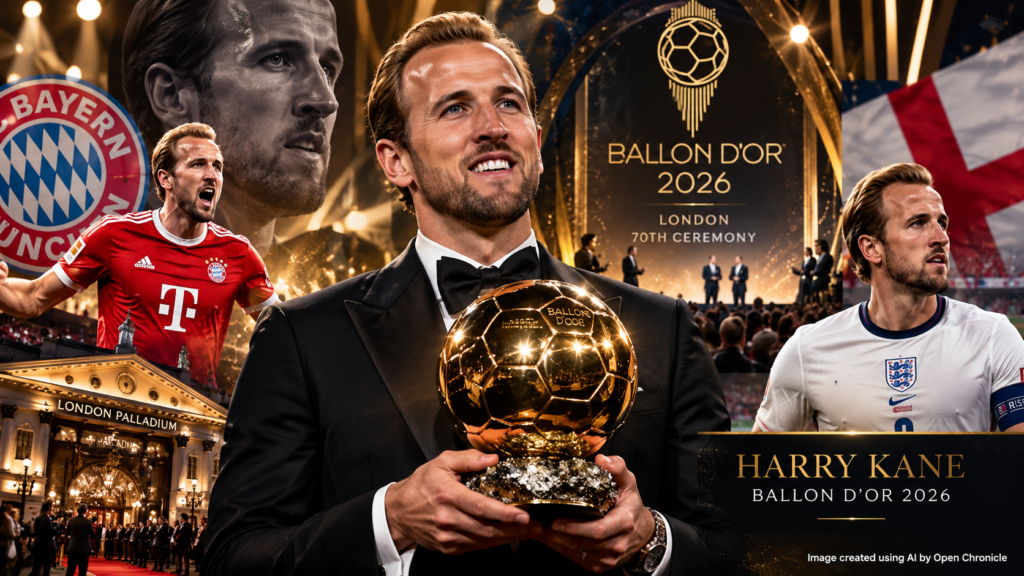
After years of individual brilliance without football’s greatest personal honour, the Bayern Munich striker has finally reached the summit. Seventy-three goals, a historic campaign in Germany and another influential World Cup have made Harry Kane the 2026 Ballon d’Or winner.
By Open Chronicle Sports
27 October 2026 | Football | Ballon d’Or 2026 | Special Report
A historic night for Harry Kane and English football
Harry Kane has been crowned the winner of the 2026 Men’s Ballon d’Or, becoming the first English footballer to receive the prestigious award since Michael Owen in 2001.
The 33-year-old Bayern Munich striker was honoured on Monday, 26 October, during the 70th edition of the Ballon d’Or ceremony, held at the London Palladium.
The location carried particular historical significance.
For the first time, the ceremony took place in London, paying tribute to Sir Stanley Matthews, the inaugural winner of the award in 1956.
Seventy years after Matthews received the first Ballon d’Or, another English footballer stood at the centre of the celebrations.
Kane finished ahead of Real Madrid’s Kylian Mbappé and Barcelona’s Lamine Yamal in the final voting.
His victory followed an extraordinary 2025/26 campaign in which he scored 73 goals for Bayern Munich and England, helped the German club secure major domestic honours and captained his national team during the 2026 FIFA World Cup.
For a player whose career has frequently been defined by exceptional goalscoring statistics and the pursuit of major trophies, the Ballon d’Or represents a defining personal achievement.
It also completes an important chapter in the history of English football.
1. Seventy-three goals: the numbers behind the Golden Ball
The statistical foundation of Kane’s victory was extraordinary.
Across the 2025/26 campaign, the England captain scored 73 goals in 65 appearances for club and country.
Of those goals, 61 came for Bayern Munich in 51 competitive matches, while another 12 were scored for England.
His club campaign included 36 Bundesliga goals, enough to secure the German league’s scoring title for the third consecutive season.
In European competition, Kane scored 14 times in the UEFA Champions League as Bayern advanced to the semi-finals.
These figures illustrate a level of consistency rarely achieved across domestic, European and international football in the same campaign.
Harry Kane’s 2025/26 season in numbers
| Category | Performance |
|---|---|
| Total goals for club and country | 73 |
| Total appearances | 65 |
| Bayern Munich goals | 61 |
| Bayern Munich appearances | 51 |
| England goals | 12 |
| Bundesliga goals | 36 |
| Champions League goals | 14 |
| Bundesliga top-scorer awards in succession | 3 |
| Ballon d’Or final position | 1st |
The numbers were remarkable not only for their volume but also for their distribution.
Kane delivered across multiple competitions, different tactical environments and matches carrying considerable pressure.
He remained Bayern’s primary attacking reference while continuing to lead England’s forward line.
Open Chronicle analysis
Seventy-three goals represent far more than a prolific scoring season.
They demonstrate sustained performance across an extended calendar in which physical demands, tactical preparation and defensive opposition vary significantly.
Kane’s achievement reflects exceptional finishing ability, but also the movement, anticipation and decision-making required to create scoring opportunities consistently.
His 2026 Ballon d’Or was built on an entire season of elite-level productivity rather than a single tournament or memorable performance.
2. Bayern Munich: the move that transformed Kane’s legacy
When Harry Kane left Tottenham Hotspur for Bayern Munich in 2023, the transfer represented one of the most significant decisions of his career.
He had established himself as one of the Premier League’s outstanding goalscorers, but major team honours had remained elusive.
At Bayern, the expectations were different.
The German club measures success not only through domestic dominance but also through its performances in European competition.
Kane arrived in Munich with the responsibility of leading one of Europe’s most ambitious attacking teams.
His development at Bayern has been about more than scoring goals.
He has become a central figure in the team’s attacking structure, combining traditional centre-forward qualities with creative movement, intelligent passing and the ability to connect midfield and attack.
During the 2025/26 campaign, Bayern won the Bundesliga and DFB-Pokal, while also claiming the Franz Beckenbauer Supercup.
Under Vincent Kompany, the team combined domestic success with a run to the Champions League semi-finals.
Kane’s 61 goals in 51 Bayern appearances were central to that success.
More than a traditional number nine
Kane’s influence cannot be measured entirely through his scoring statistics.
He is capable of dropping into deeper positions, receiving possession between the lines and creating space for teammates.
His passing range allows Bayern to progress the ball quickly into attacking areas.
His movement forces defenders to make difficult decisions: follow him away from the penalty area or allow him time and space to distribute the ball.
This tactical versatility has become one of the defining characteristics of his career.
At Bayern, it has helped create opportunities for other attacking players while allowing Kane to maintain extraordinary goalscoring numbers.
Open Chronicle analysis
Kane’s Ballon d’Or victory illustrates how the combination of individual excellence and collective success can reshape a player’s historical standing.
His goals had already established his reputation.
Winning major trophies with Bayern strengthened the case that his performances were not merely statistically exceptional but decisive within a successful team.
3. England’s World Cup campaign adds international significance
Kane’s influence extended beyond club football.
As England captain, he played an important role during the 2026 FIFA World Cup in the United States, Canada and Mexico.
England finished third, achieving their best World Cup result since winning the tournament in 1966.
Kane scored six goals during the competition and continued to demonstrate his importance to the national team.
The tournament reinforced his standing as one of England’s most influential modern footballers.
Although England did not win the World Cup, the campaign contributed to the broader assessment of Kane’s season.
His performances demonstrated that his goalscoring form was not limited to Bayern Munich.
He remained a decisive attacking figure in international competition.
The significance of international performance
Major international tournaments can influence the perception of individual footballers because they provide a different competitive environment.
Players have limited preparation time with national teams, tactical systems are often less familiar, and the pressure associated with knockout matches can be considerable.
Kane’s six World Cup goals strengthened an already compelling Ballon d’Or candidacy.
However, his award should not be attributed exclusively to the tournament.
It was the combination of domestic, European and international performances that distinguished his season.
4. Twenty-five years after Michael Owen
Kane’s victory also carries historical significance for English football.
Before 2026, only four English players had won the Men’s Ballon d’Or.
Kane now becomes the fifth.
England’s Ballon d’Or winners
| Player | Year |
|---|---|
| Sir Stanley Matthews | 1956 |
| Sir Bobby Charlton | 1966 |
| Kevin Keegan | 1978 |
| Kevin Keegan | 1979 |
| Michael Owen | 2001 |
| Harry Kane | 2026 |
The previous English winner, Michael Owen, received the award in 2001 following an outstanding season with Liverpool.
Since then, England has produced several internationally recognised players, but none had managed to win football’s most prestigious individual distinction.
Kane’s success ends that 25-year period.
It also connects two important moments in the award’s history.
Stanley Matthews won the inaugural Ballon d’Or in 1956.
Kane received the award during its 70th-anniversary ceremony in London.
The historical symbolism was difficult to overlook.
5. A remarkable moment for Bayern Munich
Kane’s victory also represents a major achievement for Bayern Munich.
He becomes the club’s first Ballon d’Or winner since Karl-Heinz Rummenigge in 1981.
The 45-year interval illustrates how difficult the award has been to secure, even for a club with Bayern’s European history.
Bayern has produced and developed numerous world-class players during that period.
Yet the Ballon d’Or has frequently been dominated by footballers associated with other major European clubs.
Kane’s success places him within an elite historical group associated with Bayern’s greatest individual achievements.
It is also significant for German football more broadly.
He is the first Bundesliga player to win the award since Matthias Sammer of Borussia Dortmund in 1996.
For Bayern, the recognition strengthens the international standing of a player who has become central to the club’s sporting ambitions.
6. Mbappé and Yamal: the competition for the award
The 2026 Ballon d’Or was contested by several of the world’s most prominent footballers.
Kylian Mbappé finished second, while Lamine Yamal placed third.
Both players entered the competition with strong reputations and significant individual achievements.
Mbappé remained one of the defining attacking players of his generation, combining explosive pace, finishing ability and influence in major matches.
Yamal represented a different story: the emergence of a young footballer already capable of competing among the world’s elite.
The final result therefore brought together three distinct career narratives.
Kane represented sustained excellence and the culmination of a long career.
Mbappé represented an established global superstar still pursuing further individual recognition.
Yamal represented the next generation of elite football.
Ballon d’Or 2026 — Men’s Top 10
| Rank | Player | Club |
|---|---|---|
| 1 | Harry Kane | Bayern Munich |
| 2 | Kylian Mbappé | Real Madrid |
| 3 | Lamine Yamal | Barcelona |
| 4 | Rodri | Manchester City / Barcelona |
| 5 | Lionel Messi | Inter Miami |
| 6 | Khvicha Kvaratskhelia | Paris Saint-Germain |
| 7 | Ousmane Dembélé | Paris Saint-Germain |
| 8 | Erling Haaland | Manchester City |
| 9 | Michael Olise | Bayern Munich |
| 10 | Fabián Ruiz | Paris Saint-Germain |
Open Chronicle analysis
The result highlights the different criteria involved in evaluating football’s leading players.
Individual production, team success, influence in major competitions and consistency all contribute to the debate.
Kane’s candidacy combined an exceptional goalscoring record with significant domestic trophies and a strong international tournament.
That combination provided a compelling case for the award.
7. The Gerd Müller Trophy: recognition for an extraordinary scorer
Kane’s evening brought another major individual honour.
He also received the Gerd Müller Trophy, recognising the leading men’s striker of the year.
The award was particularly appropriate given his 73-goal campaign.
It was the second time Kane had received the distinction, having previously shared it with Kylian Mbappé in 2024.
The combination of the Ballon d’Or and the Gerd Müller Trophy underlined the scale of his achievements.
One award recognised his overall standing in world football.
The other acknowledged the exceptional goalscoring record that helped define his season.
8. Tottenham Hotspur: the foundations of a remarkable career
Despite the celebrations surrounding his achievements with Bayern Munich, Kane did not forget the club where his career developed.
During his acceptance speech, he paid tribute to Tottenham Hotspur.
Kane joined Tottenham’s youth system at the age of 11 and developed into one of the most productive strikers in Premier League history.
His journey was not straightforward.
Loan spells and periods of uncertainty formed part of his early development.
Over time, however, he established himself as Tottenham’s leading attacking player and one of England’s most reliable goalscorers.
By the time he departed for Bayern in 2023, Kane had become Tottenham’s all-time leading scorer.
His Ballon d’Or victory therefore represents a moment of recognition not only for his years in Germany but also for the development and persistence that shaped his career in England.
A different route to the summit
Many footballers who win the Ballon d’Or are recognised as exceptional talents from a very young age.
Kane’s development followed a less direct path.
He progressed through loans, competition for playing time and gradual improvement before becoming an established elite striker.
That journey adds another dimension to his achievement.
His success demonstrates how long-term development and sustained performance can ultimately lead to the highest individual recognition.
9. The London ceremony: football history returns to its origins
The 2026 ceremony took place at the London Palladium, marking the first time the Ballon d’Or had been staged in the British capital.
The venue was chosen during the award’s 70th-anniversary year.
The historical connection to Stanley Matthews provided a fitting backdrop for Kane’s victory.
The evening also recognised outstanding performances across women’s football, coaching, goalkeeping and emerging talent.
Other major winners
| Award | Winner |
|---|---|
| Women’s Ballon d’Or | Alexia Putellas |
| Men’s Young Talent | Lamine Yamal |
| Women’s Young Talent | Vicky López |
| Men’s Goalkeeper | Unai Simón |
| Women’s Goalkeeper | Cata Coll |
| Men’s Coach | Luis de la Fuente |
| Women’s Coach | Pere Romeu |
| Men’s Club | Paris Saint-Germain |
| Women’s Club | Barcelona |
| Men’s Striker | Harry Kane |
| Women’s Striker | Charlyn Corral |
| Sócrates Award | Bukayo Saka |
Alexia Putellas received the Women’s Ballon d’Or for the third time, adding another significant distinction to her career.
Lamine Yamal received the men’s young talent award, while Unai Simón was recognised as the leading men’s goalkeeper.
Bukayo Saka received the Sócrates Award for his humanitarian and social initiatives.
The ceremony therefore celebrated a broad range of achievements across international football.
10. What the Ballon d’Or means for Kane’s legacy
Individual awards do not provide a complete measure of a footballer’s career.
Team achievements, tactical influence, longevity and performances in major matches are all important elements of historical assessment.
Nevertheless, the Ballon d’Or occupies a unique position in the sport.
For Kane, the award changes the way his career will be remembered.
He is no longer simply one of the most prolific strikers of his generation.
He is a Ballon d’Or winner.
His achievement places him within a historical group that includes many of football’s most influential players.
The recognition is especially significant because it arrived at the age of 33, following years of sustained excellence.
Rather than emerging from a single extraordinary season early in his career, Kane reached the summit after building a substantial body of work.
His development at Tottenham, his transformation at Bayern and his leadership of England all contributed to the journey.
Open Chronicle Sports analysis: why Kane deserved the 2026 Ballon d’Or
There are three principal reasons why Kane’s victory stands out.
First, his goalscoring record was exceptional.
Seventy-three goals across club and international football represent a remarkable level of productivity.
Second, his performances contributed directly to collective success.
Bayern Munich won major domestic trophies, while England achieved a third-place finish at the World Cup.
Third, his influence extended beyond finishing opportunities.
Kane’s passing, movement and ability to connect attacking phases made him more than a conventional penalty-area striker.
His success was therefore based on both statistical output and tactical importance.
The Ballon d’Or vote remains an assessment rather than an objective mathematical formula.
Other candidates possessed legitimate arguments based on their own performances and achievements.
But Kane’s combination of consistency, goals and team success made him a persuasive winner.
Conclusion: a Golden Ball built over an entire career
Harry Kane’s 2026 Ballon d’Or victory represents one of the defining moments of his career.
The England captain has reached football’s highest individual summit after years of extraordinary goalscoring and sustained performances at the elite level.
His 73-goal season provided the statistical foundation.
Bayern Munich’s domestic success strengthened his candidacy.
England’s World Cup campaign added international significance.
And the ceremony in London gave the occasion a historical dimension that extended back to Stanley Matthews in 1956.
For English football, the 25-year wait is over.
For Bayern Munich, the recognition ends a 45-year absence from the Ballon d’Or winners’ list.
For Harry Kane, it is the culmination of a journey that began in Tottenham’s youth academy and continued through years of persistence, development and elite performance.
Harry Kane is the 2026 Ballon d’Or winner — and his place among football’s greatest modern strikers is now accompanied by the sport’s most prestigious individual award.
Sources and Further Reading
Harry Kane · Ballon d’Or 2026 · 26 October 2026
Harry Kane Wins the 2026 Men’s Ballon d’Or
Official confirmation, final rankings, individual awards
and historical context surrounding the 2026 Ballon d’Or.
Harry Kane Wins the 2026 Ballon d’Or
Official England coverage, international statistics,
Kane’s comments and the significance of his achievement
for English football.
Bayern Congratulates Harry Kane on the Ballon d’Or
Official club reaction, historical context and the
importance of Kane’s achievement for Bayern Munich.
Bayern Munich’s Harry Kane Wins the 2026 Ballon d’Or
Detailed analysis of Kane’s goalscoring season,
individual performances and achievements in German football.
England and Bayern Forward Kane Crowned 2026 Ballon d’Or Winner
Independent reporting on the awards ceremony,
the voting results and the principal individual
honours presented during the event.
Harry Kane Wins Ballon d’Or as Premier League Stars Learn Rankings
Coverage of Kane’s Tottenham Hotspur legacy,
the voting context and English football’s
representation in the Ballon d’Or rankings.
Editorial Note
This article is an independent editorial feature by Open Chronicle Sports, based on official announcements from UEFA, the Football Association, Bayern Munich and the Bundesliga, supplemented by reporting from Reuters and the Premier League. Statistical information reflects the 2025/26 season and the Ballon d’Or ceremony held on 26 October 2026. Historical comparisons, assessments of Kane’s legacy and interpretations of the award’s significance are independent editorial analysis rather than official statements by the award organisers.