
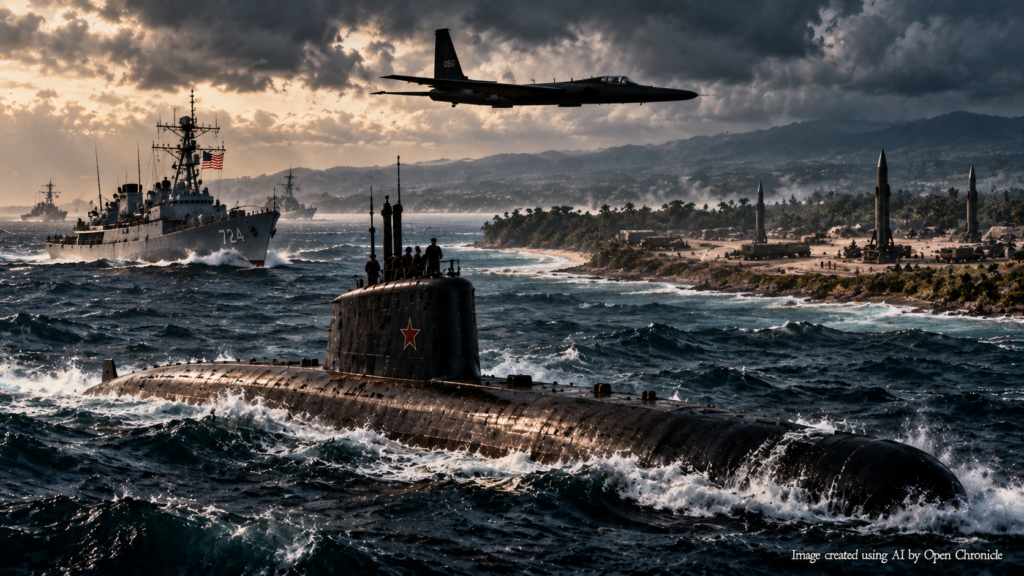
How a reconnaissance aircraft was shot down over Cuba, a Soviet submarine faced an escalating confrontation at sea, and Washington and Moscow struggled to prevent the Cold War from becoming a nuclear catastrophe.
By Open Chronicle History Desk
On October 27, 1962, the world stood closer to nuclear war than at almost any other moment in modern history.
In Washington, President John F. Kennedy and his advisers confronted a rapidly deteriorating crisis.
In Moscow, Soviet leader Nikita Khrushchev weighed the consequences of a confrontation that threatened the survival of both superpowers.
In Cuba, Soviet military personnel operated nuclear-capable missile installations while American reconnaissance aircraft continued to monitor the island.
Across the Caribbean, naval forces searched for Soviet vessels.
The United States had imposed a naval quarantine around Cuba.
The Soviet Union had deployed medium-range and intermediate-range ballistic missiles to the island.
Both sides understood that a direct military clash could trigger an escalation beyond anyone’s control.
But on October 27, several dangerous incidents occurred within hours of one another.
An American U-2 reconnaissance aircraft was shot down over Cuba.
Its pilot, Major Rudolf Anderson Jr., was killed.
Another U-2 aircraft strayed into Soviet airspace near the Arctic, creating fears of a wider confrontation.
In the Caribbean, American destroyers used practice depth charges to signal a submerged Soviet submarine.
The submarine’s crew faced extreme pressure, uncertain about the intentions of the American ships above them.
Meanwhile, Kennedy’s advisers debated whether the United States should launch air strikes against Soviet missile sites.
Some officials believed military action might soon become unavoidable.
Others warned that attacking Cuba could provoke Soviet retaliation in Berlin or elsewhere.
The crisis had become a test not only of military strength but also of political judgment, communication and restraint.
The following day, Washington and Moscow would reach an agreement that began to resolve the confrontation.
But on October 27, that outcome was far from certain.
The events of Black Saturday reveal how nuclear war can become possible without either side deliberately choosing it.
Miscommunication, technical failures, local military decisions and political pressure can combine to produce consequences far beyond the intentions of national leaders.
The day remains one of the most important case studies in the history of international security.
1. The Cold War World
By 1962, the United States and the Soviet Union had spent more than fifteen years competing for global influence.
Their rivalry involved military alliances, nuclear weapons, political ideology, intelligence operations and regional conflicts.
The United States led NATO.
The Soviet Union dominated the Warsaw Pact.
Both powers possessed nuclear arsenals capable of causing catastrophic destruction.
The confrontation was global.
Europe, Asia, Latin America and the Middle East were all affected.
Cuba became one of the most dangerous flashpoints.
2. The Cuban Revolution
In January 1959, Fidel Castro’s revolutionary movement overthrew the government of Fulgencio Batista.
The revolution transformed Cuban politics.
Castro’s government introduced sweeping economic and social changes.
Relations with the United States deteriorated.
American officials became increasingly concerned about Cuba’s alignment with the Soviet Union.
The island’s proximity to the United States made the issue especially sensitive.
Cuba lay only about ninety miles from Florida at its nearest point.
3. The Bay of Pigs Invasion
In April 1961, a force of Cuban exiles supported by the United States attempted to overthrow Castro.
The invasion took place at the Bay of Pigs.
It failed.
The operation embarrassed the Kennedy administration and strengthened Castro’s determination to resist American intervention.
Cuba moved closer to the Soviet Union.
For Khrushchev, the failed invasion reinforced the belief that Cuba faced a continuing threat.
The Soviet leadership began considering ways to strengthen the island’s defenses.
4. Operation Mongoose
After the Bay of Pigs failure, the United States pursued covert operations against Castro’s government.
These activities became associated with Operation Mongoose.
They included sabotage planning, intelligence operations and efforts to destabilize the Cuban regime.
The campaign intensified Cuban fears of another American invasion.
Soviet officials were aware of the threat.
Their interpretation of American intentions became an important factor in the missile deployment decision.
5. Soviet Nuclear Strategy
In the early 1960s, the Soviet Union faced strategic disadvantages relative to the United States in some categories of nuclear delivery systems.
The United States possessed powerful bomber forces and an expanding missile arsenal.
It also had nuclear-capable missiles stationed in allied countries.
American Jupiter missiles were deployed in Turkey and Italy.
Khrushchev saw an opportunity to change the strategic balance by placing Soviet missiles in Cuba.
The deployment would also help deter an American attack on the island.
6. Operation Anadyr
The Soviet plan to deploy military forces and nuclear weapons to Cuba was known as Operation Anadyr.
The operation was conducted in secrecy.
Soviet ships transported personnel, equipment and missiles across the Atlantic.
The deployment included ballistic missiles, air-defense systems and other military capabilities.
The Soviet Union intended to establish a substantial military presence before the United States discovered the full extent of the operation.
But American intelligence eventually identified the missile sites.
7. October 14: The Discovery
On October 14, 1962, an American U-2 reconnaissance aircraft photographed Soviet missile installations under construction in Cuba.
The photographs provided evidence of the deployment.
Analysts examined the images.
They identified equipment and facilities associated with ballistic missiles.
The discovery transformed American assessments of the situation.
The Soviet presence in Cuba was no longer limited to conventional military assistance.
It included weapons capable of striking targets in the United States.
8. October 16: Kennedy Is Informed
On October 16, Kennedy was briefed on the photographic evidence.
The president assembled a group of senior advisers.
The group became known as the Executive Committee of the National Security Council, or ExComm.
Its members considered possible responses.
Options included diplomatic pressure, naval action, air strikes and invasion.
The discussions were intense.
Kennedy understood that military action against Cuba could provoke Soviet retaliation.
9. The Problem of Nuclear Missiles in Cuba
The Soviet missiles threatened to alter the military and political balance.
Medium-range missiles could reach significant portions of the United States.
Intermediate-range systems under construction would extend the potential range.
The deployment challenged American security assumptions.
It also raised questions about credibility.
Kennedy had publicly warned against offensive weapons in Cuba.
Failure to respond could damage his political standing and the credibility of American commitments.
But an excessive response could trigger war.
10. The Naval Quarantine
Kennedy chose a naval quarantine rather than immediate air strikes.
The measure was designed to prevent further delivery of offensive military equipment to Cuba.
The administration avoided using the term blockade, which could carry more direct implications of war.
American naval forces established an interception zone.
The quarantine began on October 24.
It created a dangerous confrontation between American and Soviet vessels.
But it also allowed time for negotiations.
11. Kennedy Addresses the Nation
On October 22, Kennedy delivered a televised address explaining the discovery of Soviet missiles.
He announced the quarantine.
He demanded the removal of offensive weapons from Cuba.
He warned that a nuclear missile launched from Cuba against a Western Hemisphere nation would be treated as an attack by the Soviet Union on the United States.
The speech made the crisis public.
Millions of people became aware of the danger.
Fear of nuclear war spread across the world.
12. Khrushchev’s Dilemma
Khrushchev faced difficult choices.
Removing the missiles could appear to be a humiliating retreat.
Maintaining them risked military confrontation.
The Soviet leader wanted to protect Cuba and strengthen his strategic position.
But he also understood the destructive potential of nuclear war.
His communications with Kennedy reflected both determination and concern.
The crisis became a struggle to find a solution that each side could accept.
13. The World Waits
During the following days, the international community watched events unfold.
Governments feared that the confrontation could escalate.
European allies were particularly concerned about possible Soviet action against West Berlin.
Latin American governments followed developments closely.
The United Nations became an important diplomatic forum.
Secretary-General U Thant sought to encourage restraint and negotiation.
The crisis extended far beyond Cuba.
14. October 26: A Possible Opening
On October 26, Khrushchev sent Kennedy a lengthy message.
It suggested that the Soviet Union might remove its missiles from Cuba in exchange for assurances that the United States would not invade the island.
The proposal offered a possible path toward resolution.
But the following day brought new complications.
A second Soviet message introduced the issue of American Jupiter missiles in Turkey.
The diplomatic situation became more difficult.
At the same time, military events threatened to overwhelm negotiations.
15. October 27: Black Saturday
October 27 became known as Black Saturday.
It was the most dangerous day of the crisis.
Several incidents occurred that could have triggered escalation.
The destruction of an American reconnaissance aircraft created pressure for retaliation.
Another aircraft entered Soviet airspace.
A Soviet submarine faced an intense confrontation with American naval forces.
Washington and Moscow exchanged urgent communications.
The possibility of nuclear war became terrifyingly immediate.
16. The U-2 Mission Over Cuba
Major Rudolf Anderson Jr. was an experienced American Air Force pilot.
On October 27, he flew a U-2 reconnaissance mission over Cuba.
The aircraft was designed to operate at high altitude.
Its mission was to collect intelligence about Soviet military installations.
The U-2 was not intended for combat.
Its survival depended on altitude and the difficulty of interception.
But Soviet air-defense systems in Cuba posed a serious threat.
17. The Soviet Surface-to-Air Missile
Soviet forces in Cuba operated SA-2 surface-to-air missile systems.
These weapons were capable of engaging high-altitude aircraft.
On October 27, Soviet air-defense personnel launched missiles against Anderson’s U-2.
The aircraft was hit.
Anderson was killed.
The incident marked the first American combat death directly associated with the Cuban Missile Crisis.
It was a dramatic escalation.
18. Who Ordered the Shootdown?
The decision to fire on Anderson’s aircraft has been examined extensively by historians.
The shootdown was carried out by Soviet military personnel in Cuba.
Evidence indicates that local Soviet commanders acted without explicit authorization from Khrushchev.
The incident illustrated a central danger of nuclear crises.
Political leaders may intend to control escalation.
But military personnel operating under pressure can make decisions that create wider consequences.
The Soviet leadership had not necessarily intended to provoke a direct American military response that day.
19. Washington Receives the News
When American officials learned that the U-2 had been shot down, the crisis intensified.
Some advisers argued that the United States should retaliate.
Air strikes against Soviet missile sites had already been considered.
The death of an American pilot increased pressure for military action.
Kennedy faced a difficult decision.
Retaliation could demonstrate resolve.
But it could also initiate a chain of attacks and counterattacks.
The president resisted an immediate military response.
20. The Risk of an Air Strike
An American air strike against Cuba carried enormous risks.
Soviet military personnel were present on the island.
Attacking missile installations could kill Soviet soldiers.
Moscow might respond against American forces or allies.
The Soviet Union could also retaliate in Berlin.
Furthermore, American intelligence could not guarantee that all nuclear-capable missiles would be destroyed.
A failed strike might leave weapons available for retaliation.
21. Tactical Nuclear Weapons in Cuba
One of the most important later revelations concerned Soviet tactical nuclear weapons.
The Soviet deployment included nuclear warheads intended for shorter-range military systems.
American officials did not fully understand the extent of these capabilities during the crisis.
An invasion of Cuba could therefore have encountered nuclear weapons on the battlefield.
The danger was greater than many decision-makers realized.
This has become one of the most significant lessons drawn from declassified records and later historical research.
22. The Second U-2 Incident
On the same day, another American U-2 aircraft became lost during a mission near the Arctic.
The aircraft entered Soviet airspace.
Soviet fighter aircraft were dispatched.
American fighters also became involved in efforts to protect or recover the aircraft.
The incident occurred far from Cuba.
But it risked creating a confrontation in another region.
The pilot eventually returned safely.
The episode demonstrated how a technical or navigational error could become strategically dangerous during a crisis.
23. The Submarine B-59
In the Caribbean, Soviet submarine B-59 was operating under difficult conditions.
The submarine was part of a group deployed toward Cuba.
American naval forces were attempting to locate and track Soviet submarines.
B-59 had been submerged for an extended period.
Its crew faced heat, fatigue and communication difficulties.
The submarine carried a nuclear-armed torpedo.
This fact was not known to the American ships confronting it.
24. American Depth Charges
American destroyers used small practice depth charges as signals intended to make the submarine surface.
The charges were not designed as destructive attacks.
But the Soviet crew did not necessarily understand their purpose.
Explosions near a submerged submarine could be interpreted as hostile action.
The crew was operating with limited information about the wider crisis.
The situation became extremely dangerous.
25. Vasily Arkhipov
Vasily Arkhipov was a senior Soviet naval officer aboard B-59.
He played an important role in the submarine’s command discussions.
Later accounts describe disagreement over how to respond to the American naval actions.
Arkhipov argued against an extreme response and supported surfacing.
His role became central to historical accounts of the incident.
He is frequently credited with helping prevent the possible use of a nuclear torpedo.
The precise sequence of decisions remains a subject of historical examination.
26. The Nuclear Torpedo Question
B-59 carried a nuclear torpedo.
The submarine’s officers faced the possibility that war had already begun.
Accounts of the incident differ in detail.
Some later narratives have simplified the command procedures and portrayed Arkhipov as the sole individual who prevented a launch.
The historical evidence supports his important role in opposing escalation.
But the decision-making process was more complex than a single dramatic veto.
The episode remains a powerful illustration of the dangers of uncertainty in nuclear operations.
27. The Submarine Surfaces
B-59 eventually surfaced.
The immediate confrontation ended without the use of nuclear weapons.
American forces did not know how close the situation had come to a potentially catastrophic misunderstanding.
The submarine incident remained largely unknown to the public for decades.
Later testimony and archival research brought it into the historical record.
It transformed understanding of the crisis.
The danger had not been confined to presidential offices.
It had extended to individual military crews operating under extreme pressure.
28. The ExComm Debates
In Washington, ExComm continued debating possible responses.
Some officials favored military action.
Others argued for diplomacy.
The Soviet demand concerning missiles in Turkey complicated the negotiations.
Kennedy had to consider the consequences for NATO.
He also needed to preserve American credibility.
But the president increasingly recognized that the crisis required a negotiated solution.
Military escalation could produce consequences that neither side could control.
29. The Turkish Missile Issue
The United States had deployed Jupiter nuclear missiles in Turkey.
These missiles were considered vulnerable and were already becoming obsolete.
Khrushchev wanted their removal.
The Soviet leader linked the issue to the removal of Soviet missiles from Cuba.
Kennedy faced a political problem.
An open exchange could appear to reward Soviet pressure and undermine NATO confidence.
But privately, the administration considered the possibility of removing the missiles as part of a broader settlement.
30. Robert Kennedy and Anatoly Dobrynin
On the evening of October 27, Attorney General Robert F. Kennedy met Soviet Ambassador Anatoly Dobrynin.
The meeting became a critical diplomatic moment.
Robert Kennedy conveyed the American position.
The United States wanted the Soviet missiles removed from Cuba.
In return, Washington would provide assurances against invading Cuba.
The discussion also addressed the Jupiter missiles in Turkey.
The administration indicated that their removal could occur later, but not as a publicly announced direct trade.
31. The Secret Understanding
The eventual settlement included a private understanding concerning the Jupiter missiles.
The United States would remove them from Turkey within a period of months.
The arrangement was not publicly presented as an explicit exchange for the Soviet withdrawal from Cuba.
The secrecy was politically important.
Kennedy wanted to avoid appearing to negotiate under nuclear pressure.
Khrushchev wanted an outcome he could present as protecting Soviet interests.
The agreement helped resolve the crisis.
32. Kennedy’s Decision
Kennedy chose not to retaliate immediately for the destruction of Anderson’s aircraft.
He also pursued a diplomatic response to Khrushchev’s communications.
The administration decided to answer the more conciliatory October 26 message publicly.
The Turkish missile issue was handled privately.
This approach helped create a path toward agreement.
It was a decision shaped by caution as much as determination.
Kennedy understood that the consequences of a military confrontation could be irreversible.
33. Khrushchev’s Decision
Khrushchev also faced immense pressure.
The Soviet Union had deployed missiles to Cuba secretly.
Their discovery had produced a direct confrontation with the United States.
Maintaining the deployment risked war.
Removing the missiles risked political humiliation.
The Soviet leader ultimately accepted a settlement.
His decision reflected an understanding that nuclear conflict would be catastrophic.
The agreement did not resolve the Cold War.
But it prevented the immediate crisis from becoming a military disaster.
34. October 28: The Announcement
On October 28, Khrushchev announced that the Soviet Union would dismantle and remove its offensive missiles from Cuba.
The announcement marked the decisive breakthrough.
The United States agreed not to invade Cuba, subject to the broader terms of the settlement.
The naval quarantine remained temporarily in place while implementation was verified.
The immediate danger began to recede.
But the crisis was not fully resolved overnight.
Verification, withdrawal and further negotiations continued.
35. Castro’s Position
Fidel Castro was not a direct participant in the final Kennedy-Khrushchev negotiations.
He was angered by aspects of the settlement.
Cuba had faced the threat of invasion.
Its territory had become the center of a superpower confrontation.
Yet the principal decisions were made in Washington and Moscow.
Castro opposed international inspection arrangements that infringed on Cuban sovereignty.
The episode revealed the unequal influence of smaller states during Cold War crises.
36. The Removal of the Missiles
Soviet personnel dismantled the ballistic missile installations.
The missiles were prepared for removal.
American reconnaissance monitored the process.
The withdrawal took time.
The United States also pressed for the removal of Soviet IL-28 bombers.
The quarantine was eventually lifted on November 20, 1962.
The immediate confrontation ended.
But the strategic and political consequences continued.
37. The Human Cost
The Cuban Missile Crisis did not produce a general war.
But it was not entirely bloodless.
Major Rudolf Anderson Jr. was killed.
Military personnel on both sides faced dangerous conditions.
Cuban civilians lived under the threat of invasion and nuclear attack.
The crisis created widespread fear.
Families around the world worried that nuclear war might begin.
The psychological consequences were significant.
38. The Nuclear Balance
The crisis revealed the dangers of nuclear deterrence.
Both superpowers possessed weapons capable of inflicting catastrophic destruction.
The threat of retaliation was intended to prevent war.
But the same weapons created the possibility of escalation through accident, misunderstanding or miscalculation.
The Cuban Missile Crisis demonstrated that nuclear stability depended on more than military capability.
It required communication, political judgment and control over military operations.
39. The Washington-Moscow Hotline
One important consequence was the establishment of a direct communications link between Washington and Moscow.
The agreement was reached in 1963.
The system became popularly known as the hotline.
Its purpose was to allow rapid communication during future crises.
The original system was not a red telephone.
It used written communications.
The hotline became a symbol of the effort to reduce the risk of nuclear misunderstanding.
40. The Limited Test Ban Treaty
In August 1963, the United States, Soviet Union and United Kingdom signed the Limited Test Ban Treaty.
The treaty prohibited nuclear weapons tests in the atmosphere, outer space and underwater.
It did not ban underground nuclear testing.
Nevertheless, it represented an important step in arms control.
The Cuban Missile Crisis helped demonstrate the urgency of reducing nuclear dangers.
The treaty reflected a limited but meaningful willingness to cooperate.
41. The Crisis and Kennedy’s Legacy
The Cuban Missile Crisis became one of the defining episodes of Kennedy’s presidency.
His handling of the confrontation has often been praised as an example of measured leadership.
But historians have also examined the risks created by American policies before and during the crisis.
The Bay of Pigs invasion, covert operations against Cuba and nuclear deployments in Europe all formed part of the background.
Kennedy’s decisions during Black Saturday were important.
They should be understood within the broader strategic and political context.
42. The Crisis and Khrushchev’s Legacy
Khrushchev’s decision to deploy missiles to Cuba remains controversial.
Supporters of his reasoning emphasize the need to protect Cuba and address the strategic imbalance.
Critics argue that the secret deployment created an unnecessary risk of nuclear war.
His decision to withdraw the missiles prevented immediate escalation.
But the crisis damaged his political standing.
Khrushchev was removed from power in 1964.
The Cuban Missile Crisis was one factor in the wider assessment of his leadership.
43. The Role of Intelligence
Intelligence gathering played a central role throughout the crisis.
U-2 reconnaissance photographs revealed the missile sites.
Analysts identified the installations.
Signals intelligence and other sources helped policymakers assess Soviet movements.
But intelligence had important limitations.
American officials did not fully understand the extent of Soviet tactical nuclear weapons in Cuba.
Nor did they know all the details of submarine deployments.
The crisis demonstrated both the value and the limits of intelligence.
44. The Problem of Command and Control
One of the most important lessons concerned military command and control.
National leaders may establish policies.
But military personnel operate under local conditions.
They face incomplete information.
They may be unable to communicate with higher authorities.
They must make decisions under pressure.
The U-2 shootdown and submarine confrontation showed how dangerous these circumstances could become.
Nuclear weapons magnified the consequences of any error.
45. The Role of Miscalculation
Neither Kennedy nor Khrushchev wanted a nuclear war.
But their intentions did not guarantee safety.
The crisis involved multiple military organizations.
Communications were imperfect.
Political pressures were intense.
Each side interpreted the other’s actions through assumptions shaped by the Cold War.
A single incident could have been misunderstood as the beginning of a larger attack.
Black Saturday demonstrated how easily escalation could escape political control.
46. The Historical Debate
Historians continue to debate the Cuban Missile Crisis.
Questions concern Soviet motives, American intelligence, military planning and the role of Cuba.
The importance of the secret Turkish missile understanding has been reassessed through archival evidence.
The submarine incident has also received increasing attention.
Declassified documents and testimony have complicated earlier narratives.
The crisis was not simply a contest in which one leader forced another to surrender.
It was a dangerous confrontation resolved through a combination of pressure, negotiation and compromise.
47. The Myth of a Simple American Victory
For many years, popular accounts portrayed the crisis as an unequivocal American victory.
Kennedy had demanded the removal of Soviet missiles.
Khrushchev had agreed.
But the settlement involved reciprocal commitments.
The United States pledged not to invade Cuba.
It also privately agreed to remove Jupiter missiles from Turkey.
The agreement reflected compromise.
Understanding this does not diminish the importance of Kennedy’s decisions.
It provides a more accurate account of how the crisis ended.
48. The Myth of Perfect Control
Another common misconception is that the crisis was carefully controlled by the two leaders.
The events of October 27 show otherwise.
The U-2 shootdown was not part of a coordinated decision by Khrushchev to begin war.
The Arctic navigation incident created unexpected danger.
The submarine confrontation unfolded under conditions of uncertainty.
These events demonstrated the limits of centralized control.
The crisis could have escalated through actions neither leader intended.
49. The Legacy for Nuclear Security
The Cuban Missile Crisis became a foundational case study in nuclear strategy.
It influenced thinking about deterrence, escalation and crisis management.
It encouraged improvements in communication.
It contributed to arms-control efforts.
It also highlighted the need for reliable command systems and safeguards against unauthorized nuclear use.
The lessons remain relevant.
Nuclear weapons continue to shape international security.
The possibility of miscalculation has not disappeared.
50. Why October 27 Matters
October 27, 1962 was the most dangerous day of the Cuban Missile Crisis.
An American reconnaissance aircraft was destroyed.
A Soviet submarine faced an escalating confrontation.
Another American aircraft entered Soviet airspace.
Military leaders considered possible attacks.
Diplomats struggled to create a settlement.
The events demonstrated that nuclear war could emerge from a series of decisions and misunderstandings rather than a deliberate choice for catastrophe.
The crisis was resolved.
But its dangers remain a warning.
October 27, 1962: The Day the World Almost Crossed the Nuclear Threshold
Imagine the final hours of October 27.
In Washington, Kennedy and his advisers continue debating the next move.
In Moscow, Khrushchev confronts the consequences of his decision to place missiles in Cuba.
In the Caribbean, military forces remain on alert.
An American pilot is dead.
A Soviet submarine has survived a dangerous confrontation.
The world does not yet know whether the following day will bring peace or war.
There is no guarantee of a peaceful outcome.
No certainty that either leader can control every military action.
No assurance that a mistake will remain a local incident.
But diplomacy continues.
Messages are exchanged.
Compromises are considered.
The next day, the Soviet Union announces that it will remove its missiles from Cuba.
The immediate danger begins to pass.
The world survives the crisis.
Yet the lesson of Black Saturday is not simply that Kennedy and Khrushchev found a solution.
It is that nuclear war came dangerously close despite the fact that neither leader wanted it.
The events of October 27 revealed the fragility of international security in the nuclear age.
They showed how quickly military incidents could threaten global catastrophe.
And they demonstrated the importance of restraint when the consequences of escalation are irreversible.
On October 27, 1962, the world came close to nuclear war. The fact that it did not happen remains one of the most consequential outcomes in modern history.
Historical Sources and Further Reading
Explore official diplomatic records, declassified intelligence documents and historical research examining the Cuban Missile Crisis, the events of Black Saturday and the decisions that prevented nuclear escalation in October 1962.
The Cuban Missile Crisis, October 1962
An official diplomatic history of the crisis, covering the discovery of Soviet missiles, the American naval quarantine, negotiations between Kennedy and Khrushchev and the eventual settlement.
The Cuban Missile Crisis: Declassified Documents
A research collection containing declassified documents and historical analysis of the crisis, including Soviet military operations, nuclear weapons deployments and the risks of escalation.
Explore the National Security Archive →
Cuban Missile Crisis
Presidential historical resources covering Kennedy’s response to the discovery of Soviet missiles, the Executive Committee deliberations and the political decisions that shaped the outcome.
Explore the Presidential History →
One Minute to Midnight: Kennedy, Khrushchev, and Castro on the Brink of Nuclear War
Michael Dobbs’s detailed historical reconstruction of the Cuban Missile Crisis, drawing on archival records, interviews and evidence concerning the dangerous military incidents of October 1962.
October 27, 1962, is widely remembered as Black Saturday, the most dangerous day of the Cuban Missile Crisis. The destruction of Major Rudolf Anderson Jr.’s U-2 aircraft, a separate reconnaissance incident near Soviet airspace and the confrontation involving Soviet submarine B-59 created serious risks of military escalation. Later archival research revealed that Soviet forces in Cuba possessed tactical nuclear weapons and that the final settlement involved a private understanding concerning American Jupiter missiles in Turkey. Accounts of the B-59 incident, particularly the precise command procedures and Vasily Arkhipov’s role, vary in detail and should not be reduced to an unsupported claim that one individual alone prevented nuclear war. This article distinguishes documented events from retrospective interpretations and recognizes the wider political and military circumstances that brought the superpowers into confrontation.