
Reuters/Ipsos poll shows a modest recovery in the president’s approval rating, but Democrats maintain a significant advantage in congressional voting preferences as inflation and living costs dominate voter concerns.
By Open Chronicle with agencies
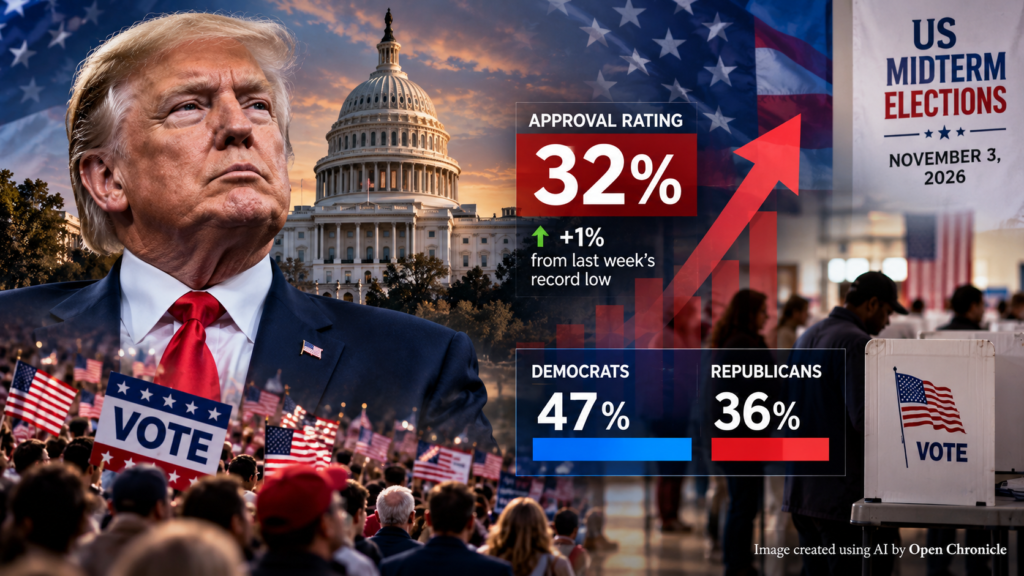
WASHINGTON, October 27, 2026 — US President Donald Trump’s public approval rating has edged higher to 32%, recovering slightly from a record low recorded the previous week, according to a Reuters/Ipsos poll completed on Monday, as Republicans prepare for closely contested midterm elections that will determine control of Congress.
The five-day nationwide survey found that Trump’s approval rating had increased by one percentage point, although public dissatisfaction with the administration remains substantial ahead of the November 3 vote.
Republicans are seeking to defend their majorities in both the House of Representatives and the Senate, while Democrats hope to capitalise on concerns over inflation, economic uncertainty and the rising cost of living.
The latest findings suggest that Democrats retain a clear advantage in national voting preferences, although the battle for congressional control remains complicated by the electoral geography of individual states and districts.
Democrats Lead Republicans in Congressional Voting Preferences
The Reuters/Ipsos survey found that 47% of registered voters would support Democratic candidates for Congress, compared with 36% who would choose Republicans.
Another 11% said they remained undecided.
The 11-percentage-point Democratic advantage was slightly narrower than the gap recorded in the previous Reuters/Ipsos survey, which concluded on October 19.
When undecided voters were asked which party they were leaning toward, the Democratic lead narrowed to nine percentage points, with 50% favouring Democrats and 41% supporting Republicans.
The results suggest that Democrats continue to benefit from dissatisfaction with the administration, although the difference between the parties could become more competitive as undecided voters make their choices.
The national congressional voting question, commonly known as the generic ballot, measures which political party respondents would prefer to control Congress rather than asking them to choose between specific candidates.
Although widely used as an indicator of national political sentiment, it does not directly predict the outcome of individual congressional races.
The composition of electoral districts, local candidates, turnout patterns and state-level political dynamics can all influence the final distribution of seats.
Republicans Face Risk of Losing Congressional Control
The November 3 midterm elections represent a major political test for Trump as he approaches the final two years of his second presidential term.
Republicans currently control both chambers of Congress, allowing the administration to pursue its legislative priorities with support from party lawmakers.
Losing either chamber could significantly complicate the president’s domestic agenda.
A Democratic majority in the House would give the opposition greater influence over federal spending, legislation, congressional investigations and oversight of the executive branch.
Control of the Senate would carry additional implications for presidential appointments, judicial confirmations and the legislative process.
Political analysts generally consider the House of Representatives the more attainable target for Democrats.
The Senate presents a more difficult challenge because of the distribution of seats being contested and the political characteristics of the states holding elections.
Even a substantial Democratic advantage in national polling would not necessarily translate into a Senate majority.
Likely Voters Continue to Favour Democrats
One of the central uncertainties surrounding the election is whether the preferences recorded in opinion polls will be reflected in actual turnout.
Among respondents identified as the most likely to vote, Democrats maintained a nine-percentage-point lead.
The survey found that 53% of likely voters supported Democratic congressional candidates, compared with 44% who favoured Republicans.
The result indicates that the Democratic advantage is not limited to respondents who may be less inclined to participate in the election.
Nevertheless, turnout remains difficult to predict, particularly in midterm contests where participation can vary significantly across demographic groups and geographical regions.
The final outcome will depend not only on which party attracts more supporters nationally, but also on whether those voters participate in the competitive districts and states that determine congressional control.
Inflation and Cost of Living Dominate Voter Concerns
Economic dissatisfaction appears to be one of the most important factors shaping the election.
According to the Reuters/Ipsos poll, 73% of voters said the cost of living in the United States was moving in the wrong direction.
The findings come amid continued inflationary pressure and higher gasoline prices following the US military strikes against Iran in February.
The conflict contributed to increased energy costs, placing additional pressure on household budgets and complicating the administration’s economic message.
The cost of food, transportation, housing and other essential expenses remains a major concern for American households.
Economic conditions have historically played an important role in midterm elections, particularly when voters assess the performance of the party controlling the White House.
The latest survey suggests that public frustration over everyday expenses is creating political difficulties for Republicans.
Democrats Gain Ground on Economic Management
The poll also indicates a shift in public perceptions of which party is better equipped to manage the US economy.
Before the conflict with Iran began, Reuters/Ipsos surveys generally showed Republicans holding an advantage over Democrats on economic stewardship.
The latest findings suggest that advantage has weakened.
Some 37% of voters said Democrats had a better approach to managing the economy, compared with 33% who preferred Republicans.
Although the difference is relatively narrow, it represents an important change in an area traditionally central to Republican electoral messaging.
The shift may reflect dissatisfaction with inflation, energy prices and broader economic uncertainty.
For Democrats, the challenge will be translating that dissatisfaction into support for individual congressional candidates.
For Republicans, the priority will be persuading voters that the administration’s economic policies can deliver greater stability and improvements in household purchasing power.
Democratic Voters Show Greater Election Enthusiasm
Beyond voting preferences, the survey identified a notable difference in enthusiasm between supporters of the two major parties.
Among Democratic respondents, 46% said they were very enthusiastic about voting in the midterm elections.
The corresponding figure among Republicans was 30%.
The 16-percentage-point gap suggests that Democratic voters may be more motivated to participate.
Enthusiasm can be particularly important in midterm elections, when turnout is often lower than during presidential contests.
A highly motivated electorate can influence closely contested races, especially in districts where relatively small changes in participation may determine the winner.
However, expressions of enthusiasm do not guarantee that respondents will vote.
Republican campaigns will therefore be focused on mobilising supporters, while Democrats will seek to convert their apparent enthusiasm advantage into actual ballots.
Trump’s Approval Recovers Slightly but Remains Low
The increase in Trump’s approval rating from 31% to 32% represents a modest improvement following the previous week’s record low.
The change is small and falls within the survey’s reported margin of error, meaning it should not be interpreted as conclusive evidence of a sustained recovery in public support.
Nevertheless, the president’s standing remains an important factor in the midterm campaign.
Presidential approval ratings can influence congressional elections because voters often use them to express satisfaction or dissatisfaction with the administration’s performance.
For Republicans, Trump’s low approval rating presents a challenge in competitive districts where candidates must appeal to voters beyond the party’s core supporters.
At the same time, the president remains an important figure in Republican mobilisation, particularly among voters who strongly support his policies.
The election will test whether that support is sufficient to offset broader dissatisfaction among independent and opposition voters.
What the Poll Reveals About the Midterm Contest
The latest Reuters/Ipsos findings point to several important features of the approaching election.
Democrats hold a significant advantage in national congressional voting preferences, including among respondents considered most likely to vote.
The party also benefits from greater reported enthusiasm and an improvement in perceptions of its economic management.
Republicans, meanwhile, face public dissatisfaction over the cost of living and a president whose approval rating remains near its lowest recorded level.
However, the structure of American congressional elections means that national polling advantages do not automatically translate into control of Congress.
The House is decided through individual district elections, while Senate control depends on statewide contests involving different political environments.
The Republicans’ structural advantages in some of those races could limit the impact of a national Democratic lead.
As a result, the possibility remains that Democrats could win the House while Republicans retain the Senate.
Such an outcome would produce divided control of Congress and potentially increase political confrontation during the remainder of Trump’s presidency.
Poll Methodology
The Reuters/Ipsos survey was conducted online over five days and completed on Monday, October 26.
It collected responses from 1,679 adults across the United States, including 1,280 registered voters.
The reported margin of error was approximately two percentage points for the full adult sample and three percentage points for registered voters.
These margins mean that small differences between survey results should be interpreted cautiously.
The poll provides a national snapshot of public opinion rather than a definitive forecast of congressional election results.
A Defining Test for Trump’s Second Term
With the November 3 midterm elections approaching, the political stakes are increasingly clear.
Trump’s approval rating has recovered slightly, but the broader electoral environment remains challenging for Republicans.
Democrats enter the final days of the campaign with advantages in national voting preferences, voter enthusiasm and perceptions of economic management.
For the administration, retaining congressional majorities would preserve important opportunities to advance its legislative agenda.
For Democrats, winning control of at least one chamber would provide new powers to influence legislation and scrutinise the administration.
The final outcome will depend on voter turnout, competitive local races and whether national dissatisfaction with economic conditions translates into electoral gains for the opposition.
The Reuters/Ipsos poll suggests that Democrats are entering the closing stage of the campaign in a stronger national position, but the question of who will control Congress remains unresolved.
Editorial Note
This article is based on the Reuters/Ipsos national opinion poll completed on October 26, 2026, and the election-related information supplied for publication. Polling figures represent respondents’ stated preferences at the time of the survey and should not be interpreted as predictions of election results. Small changes in approval ratings may fall within the margin of error. The article distinguishes national voting preferences from the individual congressional contests that determine control of the House of Representatives and Senate.