
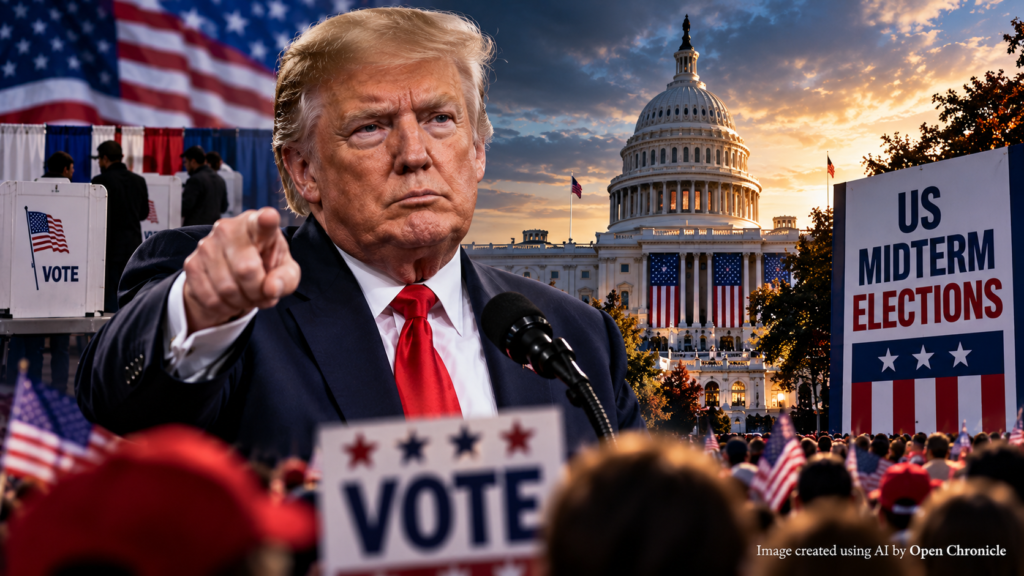
The US president raises fresh concerns about election integrity ahead of the November 3 vote, while signalling a willingness to negotiate with Democrats if Republicans lose control of Congress.
By Open Chronicle with agencies
WASHINGTON, October 27, 2026 — US President Donald Trump said he would respect the results of next week’s midterm elections only if he considered them honest, adding uncertainty to an already tense political campaign as Republicans fight to retain control of Congress.
Speaking to reporters before departing for a campaign trip to Texas, Trump was asked whether he would accept the outcome of the November 3 elections, which will determine control of the House of Representatives and Senate.
“I will, if they’re honest elections,” the president replied.
The remarks come as Trump intensifies his warnings about alleged electoral fraud, repeating claims that have featured prominently in his political messaging since his defeat in the 2020 presidential election.
His comments also arrive at a politically sensitive moment, with opinion polls suggesting that Democrats could make significant gains in Congress amid public dissatisfaction over inflation and the rising cost of living.
The president, 80, has been campaigning extensively across the United States in an effort to mobilise Republican voters and prevent a Democratic takeover of either chamber.
Trump Leaves Open Possibility of Working With Democrats
Despite his warnings about election integrity, Trump indicated that his administration could negotiate with Democrats if Republicans lose their congressional majorities.
Speaking at Joint Base Andrews, near Washington, the president acknowledged that previous administrations had operated with opposition-controlled chambers of Congress.
“We’ll figure a way. Look, I have strong veto. I hope that that won’t be the case, but if it is, that’s happened before with many presidents,” Trump said.
“You have strong veto, and you end up working on deals.”
The remarks suggested that Trump recognises the possibility of divided government during the final two years of his second presidential term.
If Democrats gain control of the House of Representatives, they would acquire greater influence over federal spending, legislative priorities and congressional oversight of the administration.
A Democratic majority in the Senate would also complicate the president’s ability to secure legislative approval and confirm certain government appointments.
However, the president would retain important constitutional powers, including the authority to veto legislation passed by Congress.
Overriding a presidential veto requires a two-thirds majority in both chambers, a threshold that can be difficult to achieve in a closely divided political environment.
Trump’s comments indicate that negotiations could become necessary if Republicans lose their current congressional advantage.
Republicans Face Growing Concerns Over Democratic Gains
Republican strategists are increasingly concerned about the possibility of substantial Democratic gains in the midterm elections.
The opposition party has sought to turn public dissatisfaction with economic conditions into support for its congressional candidates.
Inflation has emerged as a central campaign issue, particularly following the increase in international oil prices associated with the US military campaign against Iran, launched in February.
Higher energy prices have placed additional pressure on American households, contributing to broader concerns about the cost of transportation, food and other essential goods.
The economic environment has complicated Republican efforts to present the administration’s policies as successful.
Recent opinion polling has suggested that Democrats hold an advantage in national congressional voting preferences, although the outcome of individual House and Senate races remains uncertain.
The structure of the American electoral system means that a national lead does not necessarily translate into control of Congress.
Individual congressional districts and statewide Senate contests will ultimately determine the balance of power.
Texas Becomes a Major Republican Campaign Priority
Trump’s latest campaign trip to Texas reflects growing Republican concern about a potentially competitive Senate contest in a state that has traditionally been a stronghold for the party.
The visit marks the president’s third trip to Texas in approximately one month.
Republicans have dominated statewide elections in Texas for more than three decades, making the prospect of a closely contested Senate race particularly significant.
Trump has held near-daily campaign rallies across the country in recent weeks, seeking to increase participation among supporters of his Make America Great Again movement.
The president has repeatedly argued that his personal involvement is essential to maintaining Republican control of Congress.
His campaign strategy places considerable emphasis on mobilising voters who strongly support his administration and may be less enthusiastic about Republican candidates running without him on the ballot.
For Democrats, a competitive race in Texas would represent an opportunity to challenge the Republican Party in one of its most important electoral strongholds.
However, strong Republican organisation and the state’s historical voting patterns remain significant advantages for the party.
Marco Rubio Joins Campaign Effort
Secretary of State Marco Rubio is expected to accompany Trump during the Texas campaign trip, marking an unusual appearance on the campaign trail for the country’s chief diplomat.
Rubio, a prominent Republican figure with extensive experience in foreign policy, has played an important role in the administration’s approach to Latin America.
His participation comes amid speculation about potential Republican candidates for the 2028 presidential election.
Although no formal campaign announcement has been made, Rubio is widely discussed as a possible contender for the party’s future presidential nomination.
His appearance alongside Trump could increase his visibility among Republican voters and party activists.
The visit also reflects the administration’s efforts to connect foreign policy developments with domestic political messaging ahead of the midterms.
Trump Announces Expected Venezuelan Oil Shipment
During his remarks, Trump said the United States would receive what he described as a gift from Venezuela in the form of a tanker carrying one million barrels of oil.
The announcement follows the US military operation in January that removed Venezuelan leader Nicolás Maduro from power.
Trump did not provide detailed information about the arrangement, including the shipment’s ownership, commercial conditions or intended destination.
The reported delivery comes amid continued volatility in international energy markets and growing political attention to gasoline prices in the United States.
Energy costs have become a major electoral issue, particularly as the administration faces criticism over the economic consequences of its military operations against Iran.
The president’s announcement could be intended to demonstrate efforts to improve energy supplies and reduce pressure on domestic fuel prices.
However, the economic significance of the shipment would depend on its actual delivery, commercial arrangements and relationship to broader US oil consumption.
Election Fraud Allegations Return to Centre of Political Debate
Trump has increasingly focused on allegations of voter fraud during the closing stages of the campaign.
The president has repeatedly questioned the reliability of American elections, continuing a pattern of claims that became central to his political messaging following the 2020 presidential contest.
Trump lost that election to Democrat Joe Biden but refused to accept the outcome, alleging widespread irregularities.
Courts, election officials and investigations did not establish evidence of widespread fraud sufficient to overturn the result.
The dispute culminated in the January 6, 2021, attack on the US Capitol, when Trump supporters attempted to disrupt the congressional certification of Biden’s victory.
The events became one of the most consequential political crises in modern American history.
Trump’s renewed emphasis on electoral fraud has prompted concerns among critics that he could challenge the legitimacy of the November 3 results if Republicans suffer significant losses.
Those concerns remain speculative, however, and his latest remarks do not establish that any formal challenge to the election results will occur.
President Offers $1 Million Reward for Voter Fraud Information
As part of his renewed focus on election integrity, Trump announced a reward of $1 million for information leading to convictions involving voter fraud.
The announcement represents an unusual effort by a sitting president to encourage the identification and prosecution of alleged election-related offences.
Trump has presented electoral fraud as a major concern, although the source material does not identify evidence establishing widespread fraudulent voting in the upcoming midterm elections.
Election-related crimes can be investigated and prosecuted under existing federal and state laws.
However, allegations of irregularities require evidence and must be assessed through established legal procedures.
The president’s reward announcement adds another dimension to the debate over public confidence in the electoral process.
It also raises questions about how allegations made during a highly polarised campaign could influence perceptions of the election’s legitimacy.
What Happens if Republicans Lose Congress?
The November 3 elections could significantly alter the political environment in Washington.
Republicans currently hold majorities in both the House of Representatives and the Senate, providing the administration with an important legislative advantage.
If Democrats capture the House, they would gain control of its committees and could initiate additional investigations into government policies and administration officials.
They would also acquire greater influence over budget negotiations and the passage of legislation.
A Democratic Senate majority would introduce further obstacles to the president’s legislative agenda and certain appointments.
Divided government would not prevent Trump from exercising executive authority, but it could require more extensive negotiations with opposition lawmakers.
The president’s reference to his veto power suggests that he would be prepared to use constitutional mechanisms to influence legislation passed by a Democratic-controlled Congress.
At the same time, any major bipartisan agreement would require compromise between the White House and congressional leaders.
The extent of cooperation would depend on the election outcome and the political priorities of both parties.
Election Integrity and Public Confidence
Trump’s conditional statement about accepting the results has renewed attention to the importance of public confidence in democratic institutions.
In the United States, elections are administered primarily by state and local authorities under a framework of federal and state laws.
Results are subject to established procedures involving vote counting, canvassing, certification and, where applicable, recounts or judicial review.
Candidates and political parties may challenge alleged irregularities through legal processes.
However, claims of electoral misconduct require supporting evidence, and the existence of a political dispute does not by itself demonstrate that an election was improperly conducted.
The distinction is particularly important during a closely contested election, when narrow margins can lead to increased scrutiny of voting procedures.
Trump’s remarks suggest that the legitimacy of the outcome could become a major political issue if Republicans lose control of Congress.
For election administrators, the challenge will be conducting the vote transparently while addressing legitimate complaints through established legal channels.
A Critical Moment for Trump’s Second Presidency
The approaching midterm elections represent one of the most important political tests of Trump’s second term.
The president faces a difficult electoral environment, with Republicans defending their congressional majorities amid economic dissatisfaction and heightened political polarisation.
His intensive campaign schedule reflects the importance of turnout among Republican supporters, particularly in states where races have become unexpectedly competitive.
At the same time, his renewed allegations of electoral fraud have raised questions about how he will respond to an unfavourable result.
Trump has indicated that he would be prepared to negotiate with Democrats if necessary, while emphasising that his acceptance of the election outcome depends on whether he considers the vote honest.
The combination of those positions illustrates the uncertainty surrounding the political landscape after November 3.
For Republicans, the immediate objective is to preserve control of Congress and maintain the administration’s legislative advantage.
For Democrats, the election offers an opportunity to gain institutional influence and challenge the president’s domestic and foreign policy agenda.
Ultimately, the results will be determined by voters across the country’s congressional districts and states.
How the administration and both major parties respond to those results will help shape the final two years of Trump’s presidency.
Editorial Note
This article is based on the statements and election-related information supplied for October 27, 2026. It distinguishes the president’s public comments from the allegations and political interpretations surrounding them. Claims of widespread voter fraud are not presented as established facts without supporting evidence. Election results remain subject to official counting, certification and applicable legal procedures. References to potential congressional outcomes and future political developments are analytical possibilities rather than confirmed events.