
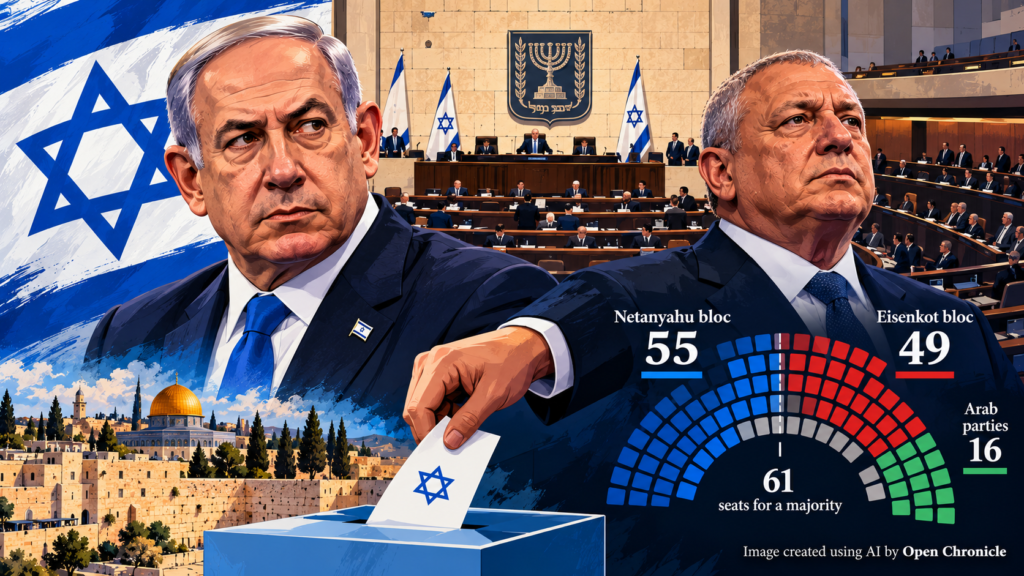
With neither major political bloc projected to secure a parliamentary majority, Israel faces difficult coalition negotiations as Prime Minister Benjamin Netanyahu calls for a strong right-wing government and rejects reliance on Arab parties.
By Open Chronicle with agencies
JERUSALEM, October 28, 2026 — Israel’s parliamentary election remains without a clear winner as partial results show Prime Minister Benjamin Netanyahu’s political bloc holding a narrow advantage over the opposition led by former military chief Gadi Eisenkot, while neither side appears capable of securing a majority without additional parliamentary support.
With approximately 57% of votes counted early Wednesday, projections reported by The Times of Israel indicated that Netanyahu’s bloc could win 55 seats in the 120-member Knesset, compared with 49 seats for the main opposition bloc led by Eisenkot.
Arab political parties were projected to secure a combined 16 seats, potentially giving them a decisive role in determining the composition of Israel’s next government.
A parliamentary majority requires at least 61 seats.
Although Netanyahu’s bloc has gained ground as counting progressed, the results continue to suggest that Israel could face a prolonged period of coalition negotiations, with neither major political alliance possessing sufficient seats to govern independently.
The prime minister has already ruled out forming a government dependent on Arab political parties, arguing that Israel requires a strong right-wing administration capable of addressing its national security challenges.
Netanyahu’s Bloc Gains Ground as Vote Counting Continues
The latest projections represent a shift from the preliminary results released shortly after polls closed on Tuesday.
Early exit polls suggested a near deadlock between Netanyahu’s political alliance and the opposition bloc associated with Eisenkot, raising the possibility of a particularly difficult parliamentary outcome.
However, as more ballots were counted, the balance moved in Netanyahu’s favour.
By approximately 7 a.m. Lisbon time on Wednesday, with 57% of votes counted, the prime minister’s bloc was projected to hold 55 seats, six more than the opposition’s estimated 49.
Despite the improvement, Netanyahu remained six seats short of the 61 required for an absolute parliamentary majority.
The opposition was also well below the threshold.
The projections indicate that neither side can form a government solely on the basis of its principal electoral alliance.
The final distribution of seats may change as additional votes are counted and official results are confirmed.
Israel’s proportional representation system frequently produces fragmented parliaments, requiring political parties to negotiate coalition agreements before a government can take office.
The current election appears likely to continue that pattern.
Netanyahu Calls for a Strong Right-Wing Government
Addressing supporters at Likud’s campaign headquarters in Jerusalem, Netanyahu called for the formation of a strong right-wing government without dependence on Arab political parties.
“The Likud is the largest party in Israel,” he declared to applause.
His remarks followed television projections suggesting that neither his political bloc nor Eisenkot’s opposition alliance had secured a decisive victory.
Netanyahu urged supporters to await the final results while making clear that he believed the country’s next government should be formed by parties sharing a Jewish and Zionist political outlook.
“The Jewish and Zionist majority must regroup and unite,” he said.
The prime minister argued that the election demonstrated continued support for right-wing policies among Israel’s Jewish electorate, even though the overall parliamentary projections did not yet give his alliance a governing majority.
He also presented his leadership as essential to maintaining national security during a period of regional instability.
The speech reflected Netanyahu’s determination to remain in office despite the uncertainty surrounding the final parliamentary arithmetic.
Prime Minister Rejects Dependence on Arab Parties
Netanyahu’s strongest remarks concerned the possibility that Arab political parties could influence the formation of the next government.
He rejected any coalition arrangement that would depend on parties he described as anti-Zionist.
According to the remarks reported in the supplied material, Netanyahu said it would be unthinkable to “put Israel in danger and form a government that depends on anti-Zionist Arab parties.”
He accused those parties of opposing Israel’s existence and of holding positions hostile to the country’s armed forces.
Netanyahu also claimed that some of the parties regarded Hamas favourably and accused Israeli soldiers of war crimes.
These were political accusations made by the prime minister, rather than findings established by the election results.
His comments underline the ideological divisions surrounding the participation of Arab parties in Israeli national politics.
Arab political parties represent constituencies that include members of Israel’s Arab minority, whose political priorities range from civil rights and social equality to Palestinian national issues and differing positions on the Israeli state.
Their participation in parliamentary politics has long been a subject of debate among Israel’s major parties.
Netanyahu’s refusal to rely on them could significantly restrict his coalition options if the final election results remain close to current projections.
Arab Parties Could Hold the Balance of Power
The projected 16 seats for Arab parties may prove one of the election’s most consequential outcomes.
The parties identified in the reports include Ra’am and the Joint List.
Their combined parliamentary strength could become crucial in a Knesset where neither Netanyahu’s bloc nor Eisenkot’s opposition has secured an outright majority.
The arithmetic is particularly important.
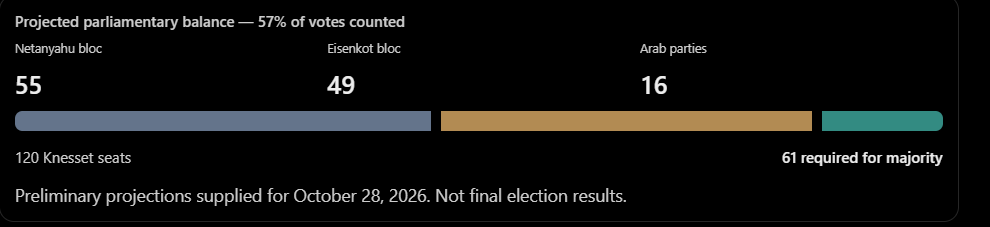
If the projected seat distribution remains unchanged, Netanyahu would need support from at least six additional lawmakers to reach a majority.
Eisenkot’s bloc would require at least 12 more seats.
Although the Arab parties could potentially provide that numerical advantage to the opposition, their support would not necessarily translate into a formal coalition agreement.
The parties have different political programmes and priorities, and any arrangement would depend on negotiations over policy, parliamentary cooperation and government formation.
Netanyahu’s categorical rejection of such an arrangement further complicates the political calculations.
The eventual outcome could depend on whether smaller parties are willing to cooperate across established ideological divisions.
Eisenkot Emerges as Netanyahu’s Principal Challenger
Gadi Eisenkot, a former chief of staff of the Israel Defense Forces and leader of the Yashar! party, has emerged as Netanyahu’s main political challenger in the election.
His opposition bloc was projected to secure 49 seats with 57% of votes counted.
Although trailing Netanyahu’s alliance in the latest projections, Eisenkot remains a potential candidate to form a government if he can assemble sufficient parliamentary support.
His political position reflects the broader contest over Israel’s future leadership, national security strategy and the direction of the country’s institutions.
The election has taken place against a backdrop of prolonged regional conflict, domestic political disagreements and growing scrutiny of the government’s decisions.
Eisenkot’s military background has made national security a central element of his political profile.
However, his ability to replace Netanyahu will depend less on the relative strength of their individual parties than on the willingness of other parliamentary groups to support an alternative government.
The opposition may therefore need to explore arrangements involving parties with significantly different political positions.
Such negotiations could prove difficult, particularly given disagreements over relations with Arab parties and the future direction of Israeli policy.
Iran and Hamas Feature Prominently in Netanyahu’s Speech
Netanyahu used his election-night address to highlight what he described as Israel’s military achievements in conflicts involving Hamas and Iran.
The prime minister presented his government’s record on national security as a central justification for continuing his leadership.
He argued that Israel had demonstrated its capacity to confront regional adversaries and would remain capable of doing so.
“We have succeeded in defeating our enemies, and we will continue to do so in the future,” Netanyahu said, according to the supplied account.
His comments were made as Israel continues to face significant regional security challenges and diplomatic pressure over its military operations.
Netanyahu also linked Israel’s strategic outlook to its relationship with the United States.
The prime minister suggested that cooperation with US President Donald Trump could create an opportunity to address what he described as the Iranian threat.
He characterised the current relationship with Washington as a potentially historic strategic opening.
The remarks reflect the importance Netanyahu places on American political and military support, particularly amid continuing confrontation with Iran.
However, the future direction of Israeli security policy will also depend on the composition and stability of the next government.
Relations With Trump Remain Central to Netanyahu’s Strategy
Netanyahu’s references to Trump reinforced the importance of US-Israeli relations in the election campaign.
The Israeli prime minister has portrayed cooperation with Washington as essential to maintaining Israel’s regional military advantage and confronting threats from Iran.
His speech suggested that continued political alignment with the Trump administration could influence Israel’s future strategic decisions.
The relationship is particularly important because of the ongoing regional confrontation involving Iran and the wider diplomatic implications of military escalation.
For Netanyahu, the argument also serves a domestic political purpose.
By emphasising his relationship with the American president, he seeks to present himself as a leader capable of securing international support during a period of uncertainty.
However, Israel’s next government will need to address not only external security concerns but also domestic divisions and the political consequences of the election.
What Happens Next in Israel?
The immediate priority is the completion of the vote count and confirmation of the final distribution of seats.
The current projections do not provide either major bloc with the 61 seats necessary to command a parliamentary majority.
Once the results are finalised, attention will shift to consultations over which political leader has the strongest prospect of assembling a governing coalition.
Israel’s president plays a formal role in this process by consulting parliamentary parties before assigning a candidate the task of forming a government.
The candidate must then negotiate sufficient support to establish a viable administration.
Several outcomes remain possible, including a coalition led by Netanyahu, an alternative arrangement led by Eisenkot, or extended negotiations if neither side can secure a majority.
The influence of Arab political parties may prove decisive, particularly if the final results closely resemble the current projections.
Netanyahu’s rejection of a government dependent on Arab parties has already narrowed the range of arrangements he is prepared to consider.
The opposition faces its own challenge in bringing together parties with different ideological priorities.
For now, Israel remains in a period of political uncertainty.
The election has demonstrated the continuing strength of Netanyahu’s political movement, but it has not yet established whether he can form the next government.
The decisive question is no longer simply which bloc wins the most seats, but which leader can assemble the parliamentary majority required to govern.
Editorial Note
This article is based on partial Israeli election results and public statements attributed to Prime Minister Benjamin Netanyahu, as reported on October 28, 2026. The parliamentary figures reflect projections with approximately 57% of votes counted and should not be interpreted as final results. Statements concerning Arab political parties, Hamas, Iran and Israel’s national security are attributed to Netanyahu and do not constitute independent editorial conclusions. The formation of Israel’s next government will depend on certified election results and subsequent coalition negotiations.