
OPEN CHRONICLE ENCYCLOPEDIA | ANCIENT HISTORY | MESOPOTAMIA
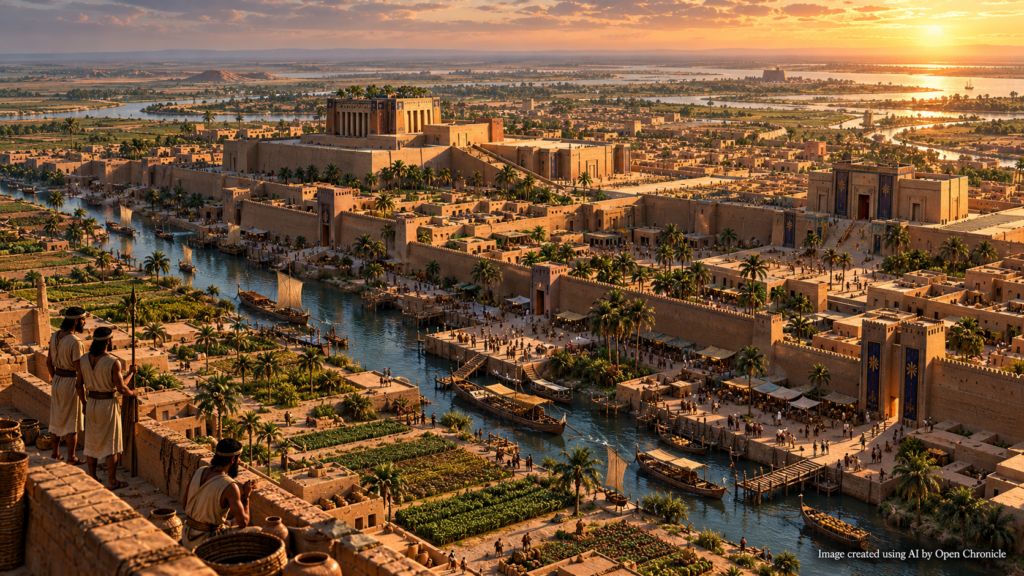
One of the great early urban centres of southern Mesopotamia, Uruk played a central role in the emergence of cities, monumental architecture, administrative systems and the earliest writing.
Its importance extends far beyond its size. Uruk was associated with the emergence of large-scale urban organization, complex religious institutions, specialized labour, long-distance exchange, administrative accounting and the earliest known stages of writing in southern Mesopotamia.
The city also occupies an extraordinary place in literature. According to Mesopotamian tradition, Uruk was the kingdom of Gilgamesh, whose adventures became the subject of the Epic of Gilgamesh, one of the world’s oldest surviving literary traditions.
Uruk was not the world’s first human settlement, nor can every early urban innovation be attributed to it alone. Nevertheless, its archaeological remains offer one of the clearest records of the transformation from agricultural communities into complex urban societies.
For historians and archaeologists, Uruk is a landmark in the history of civilization: a place where the city became a new form of human organization.
Quick Facts
| Field | Information |
|---|---|
| Name | Uruk |
| Sumerian name | Unug |
| Biblical name | Erech |
| Location | Warka, Al Muthanna Governorate, southern Iraq |
| Historical region | Sumer, southern Mesopotamia |
| Earliest occupation | Fifth millennium BCE, with earlier phases debated |
| Period of greatest early expansion | Approximately 4000–3100 BCE |
| Civilization | Sumerian and later Mesopotamian cultures |
| Major deities | Inanna and Anu |
| Notable ruler | Gilgamesh, traditionally associated with Uruk |
| Major archaeological areas | Eanna precinct and Anu district |
| Historical significance | Early urbanization, administration, monumental building and proto-cuneiform writing |
| Modern status | Archaeological site within Iraq’s UNESCO-listed Ahwar of Southern Iraq property |
1. Geography and the Mesopotamian World
Uruk developed in southern Mesopotamia, a region shaped by the Tigris and Euphrates river systems and their changing branches, channels and floodplains.
The environment was both productive and demanding.
Agriculture depended on access to water, the management of irrigation and the organization of labour. Fertile alluvial soils supported the cultivation of barley and other crops, while wetlands and waterways supplied fish, reeds, transport routes and additional resources.
Southern Mesopotamia lacked abundant local supplies of timber, building stone and metal ores. Communities therefore depended partly on exchange with distant regions for materials unavailable in the alluvial plain.
These conditions helped shape the distinctive character of Mesopotamian civilization.
Agricultural production required coordination. Water management demanded cooperation and sometimes competition. The distribution of resources encouraged accounting and administration. Exchange networks connected southern settlements to territories far beyond the river valleys.
Uruk emerged within this interconnected landscape.
Its ancient waterways did not correspond exactly to the modern geography of southern Iraq. Over thousands of years, river courses shifted, canals changed and environmental conditions transformed the surrounding countryside.
The modern archaeological site therefore preserves the remains of a city that once occupied a very different landscape.
2. Before the Great City: The Ubaid Background
Uruk did not emerge suddenly from an empty landscape.
Its development was preceded by centuries of settlement growth and social change during the Ubaid period, broadly dated to the sixth and fifth millennia BCE in southern Mesopotamia.
Ubaid communities established agricultural settlements, constructed substantial buildings, developed distinctive pottery traditions and participated in regional exchange networks.
Some settlements already contained buildings interpreted as communal or religious structures.
These developments laid important foundations for later urban society.
The transition from Ubaid to Uruk was not a single revolution occurring on a particular date. It was a prolonged process involving changing settlement patterns, architecture, production, administration and social organization.
By the fourth millennium BCE, however, the scale of change became extraordinary.
Uruk expanded into a settlement whose size and institutional complexity distinguished it from many earlier communities.
3. The Uruk Period: An Urban Transformation
The Uruk period, conventionally dated to approximately 4000–3100 BCE, takes its name from the city because its archaeological remains became central to defining this phase of Mesopotamian prehistory.
During this period, southern Mesopotamia experienced major developments in urban settlement, production, administration and symbolic communication.
Uruk became one of the largest known centres of the age.
Estimates of its population vary considerably, partly because archaeological evidence cannot establish precisely how densely every part of the settlement was occupied at a given time.
Some reconstructions suggest a population in the tens of thousands during its major expansion. Such estimates should be treated cautiously rather than as exact census figures.
What matters historically is the unprecedented concentration of people, buildings and activities.
Uruk was no longer simply an agricultural village enlarged through population growth.
It represented a different type of society.
3.1 The rise of urban institutions
A large settlement required systems capable of coordinating food production, labour, construction and distribution.
Archaeological evidence indicates that Uruk possessed substantial institutional complexes and administrative practices.
These institutions could organize activities on a scale far beyond individual households.
The resulting social structure included agricultural workers, craftspeople, administrators and religious personnel, although the precise distribution of authority remains debated.
3.2 Specialization of labour
As urban institutions expanded, not everyone needed to work directly in agricultural production.
Specialized crafts became increasingly important.
Pottery, textiles, stoneworking, metalworking and the manufacture of administrative objects all formed part of the broader economic environment.
The growth of specialized production was closely connected to the emergence of complex institutions capable of obtaining, storing and redistributing resources.
3.3 A changing relationship between city and countryside
Uruk depended on surrounding agricultural communities.
The city required food, raw materials and labour.
In return, it could provide manufactured goods, institutional services and access to wider networks of exchange.
This relationship between a large urban centre and its surrounding territory became one of the defining characteristics of later Mesopotamian civilization.
4. The Architecture of Uruk
Uruk’s monumental architecture is among its most important archaeological achievements.
Large buildings, carefully planned spaces, decorated facades and elevated platforms indicate substantial investment in construction and organized labour.
Two principal monumental areas dominate the archaeological record of the early city:
-
The Eanna precinct, associated in later traditions with the goddess Inanna.
-
The Anu district, containing the elevated platform and the famous White Temple.
These complexes were repeatedly rebuilt and transformed over centuries.
4.1 The Eanna precinct
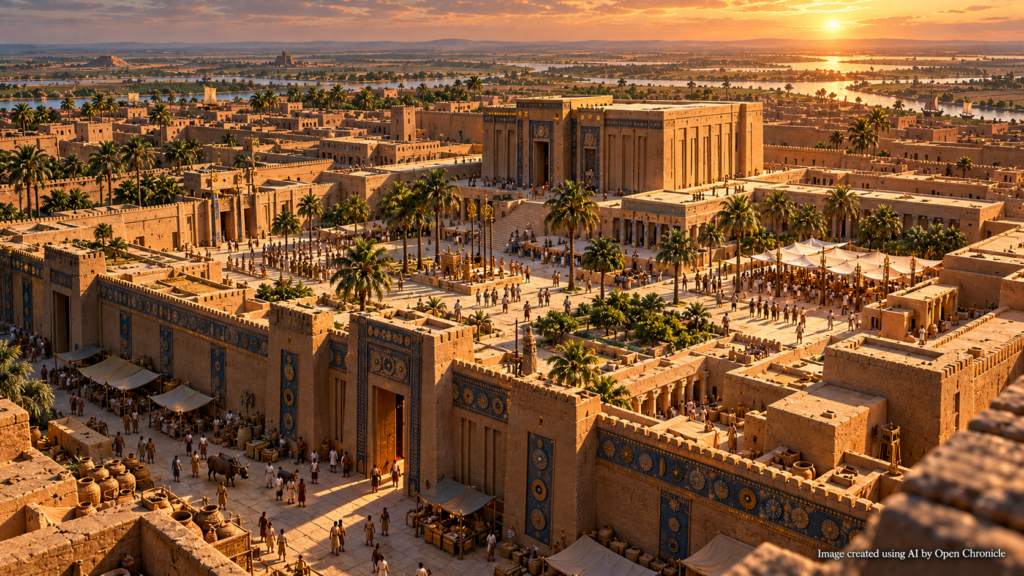
Eanna became one of Uruk’s most significant sacred and institutional areas.
The name is commonly interpreted as House of Heaven.
Excavations revealed sequences of monumental buildings, courtyards and architectural arrangements extending through multiple construction phases.
Some structures employed distinctive decorative techniques, including coloured clay cones inserted into wall surfaces to create geometric patterns.
The buildings traditionally described as temples may have served religious, administrative or other institutional functions.
Their precise purposes cannot always be established from architecture alone.
Nevertheless, their scale demonstrates that Uruk possessed institutions capable of mobilizing considerable resources.
4.2 The Anu district and White Temple
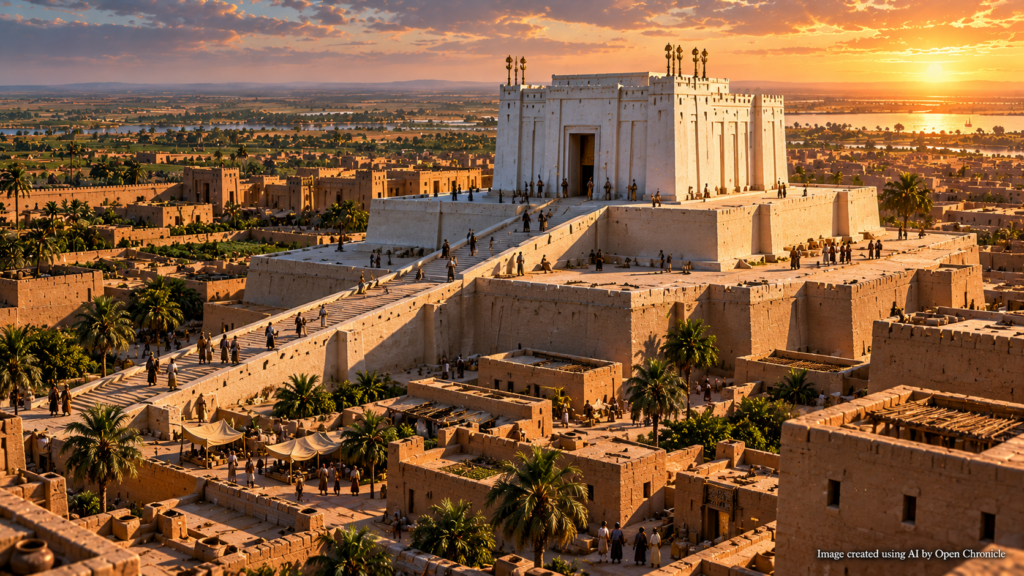
The Anu district was dominated by a substantial elevated platform.
One of its best-known structures is the White Temple, generally associated with the late fourth millennium BCE.
The building stood above the surrounding settlement and was approached through an architectural arrangement emphasizing its elevated position.
Its white-plastered surfaces would have made it visually prominent.
The White Temple illustrates an important development in Mesopotamian sacred architecture: the creation of monumental structures designed to dominate the urban landscape.
It should not be confused with the later fully developed ziggurats of historical Mesopotamia, although the elevated platform tradition contributed to the longer history of monumental temple construction.
4.3 Monumental architecture and social organization
Such buildings required materials, planning, skilled workers and organized labour.
Their construction therefore provides evidence not only of architectural achievement but also of institutional capacity.
The monuments of Uruk were expressions of collective organization and, potentially, political and religious authority.
5. The Emergence of Writing
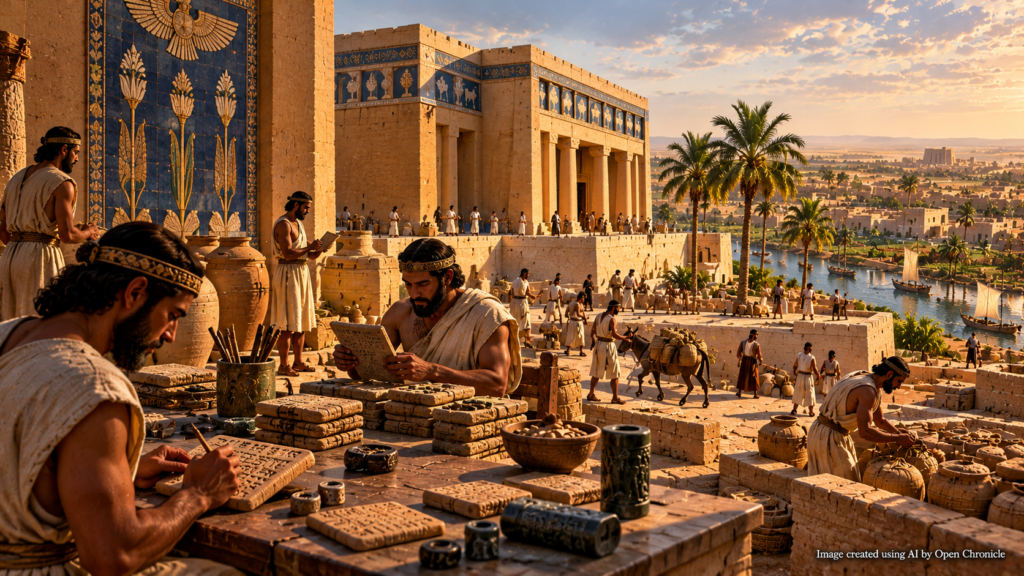
One of Uruk’s greatest contributions to world history is its association with the earliest known stages of the Mesopotamian writing tradition.
Late fourth millennium BCE tablets from Uruk contain signs belonging to what scholars call proto-cuneiform.
These texts represent an early system of graphic notation that developed into cuneiform writing.
The earliest surviving tablets are overwhelmingly administrative in character.
They record quantities, commodities, personnel and institutional transactions.
Their appearance reflects the increasing complexity of urban administration.
5.1 From counting to written records
Before fully developed writing, Mesopotamian communities used various methods of accounting.
Clay tokens, sealings, numerical impressions and other administrative devices helped record quantities and transactions.
The precise evolutionary relationship between these practices and proto-cuneiform remains an area of scholarly discussion.
Nevertheless, the broader pattern is clear: increasingly complex economic and institutional activities encouraged more sophisticated systems of recordkeeping.
5.2 Proto-cuneiform
Early signs were impressed or drawn onto clay tablets.
Some signs resembled objects, while others were abstract or conventional.
The system was not identical to the later cuneiform script used for writing Sumerian and Akkadian.
Many early tablets remain difficult to interpret because their signs and numerical systems are not always fully understood.
It is also important not to assume that every proto-cuneiform tablet records spoken language in the same way as later written texts.
5.3 Why writing mattered
Writing allowed information to be preserved beyond immediate speech and memory.
It supported accounting, institutional continuity and the management of resources.
Over time, Mesopotamian writing expanded into legal documents, royal inscriptions, religious compositions, scientific texts and literature.
The tablets from Uruk thus represent an early stage in a transformation that would eventually change the transmission of knowledge across much of the ancient Near East.
6. Administration and the Urban Economy
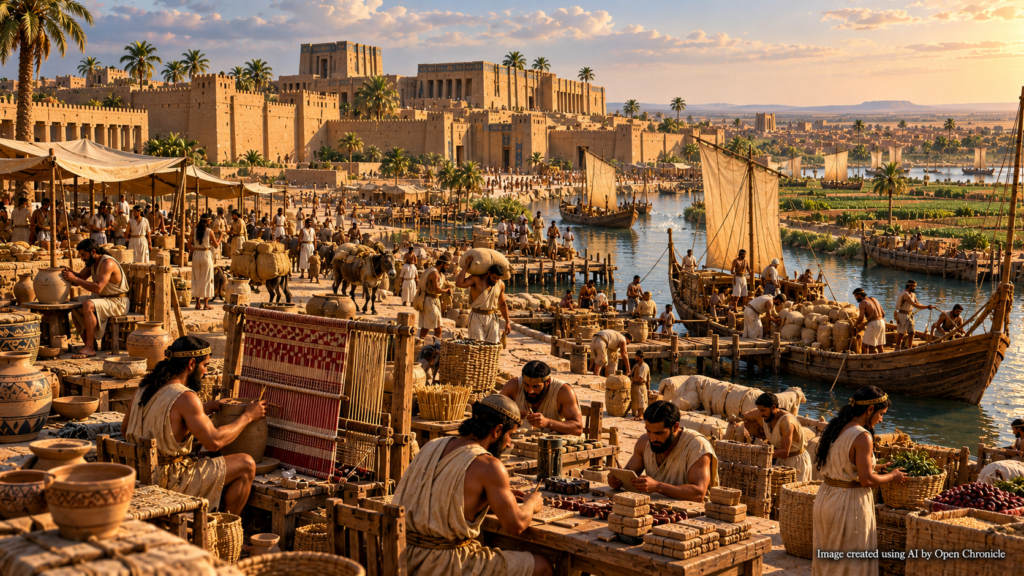
The development of writing was closely connected to the administrative needs of large institutions.
Uruk’s economy involved agricultural production, storage, labour organization and specialized manufacturing.
Administrative tablets suggest that institutions monitored goods and personnel.
But the precise structure of Uruk’s early economy remains debated.
It is tempting to imagine a single centralized authority controlling every aspect of urban life. Archaeological evidence does not justify such a simple model.
Different households, institutions and social groups may have exercised varying degrees of economic independence.
6.1 Agriculture and surplus
Barley was a major agricultural crop in southern Mesopotamia.
The production and management of food surplus supported populations engaged in activities other than farming.
Irrigation and agricultural scheduling were important to the wider economy, although the organization of individual irrigation systems varied across time and place.
6.2 Craft production
Uruk-period archaeological assemblages include pottery, stone vessels, seals and other manufactured objects.
The scale and standardization of some products suggest organized production.
This did not necessarily mean that all craftspeople worked under identical conditions or belonged to a single institutional system.
6.3 Bevel-rim bowls
Among the most characteristic objects of the Uruk period are bevel-rim bowls.
These thick-walled, roughly standardized ceramic vessels were produced in large quantities.
Their exact function remains debated.
Some scholars have connected them to food distribution or institutional rations. Others have proposed alternative uses, including food preparation or production activities.
Their significance lies partly in their abundance and standardized manufacture, which provide evidence for changing patterns of production and consumption.
7. Seals, Ownership and Administrative Control
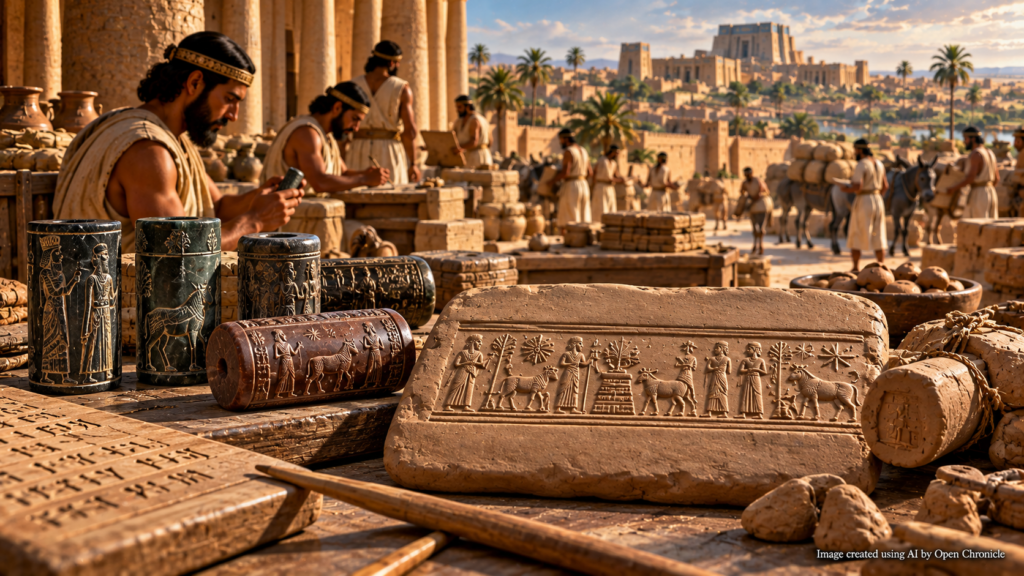
Cylinder seals became important instruments of administration and visual communication in Mesopotamia.
A cylinder seal was a small engraved object that could be rolled across wet clay, leaving a continuous impression.
Seal impressions could identify participants, mark containers or authenticate administrative actions.
Their imagery included animals, human figures and scenes of production or ritual.
The development of sealing practices helped institutions manage goods and establish recognizable forms of authority.
Cylinder seals also became important artistic objects.
Their miniature compositions preserve valuable evidence of Mesopotamian beliefs, economic activities and visual conventions.
8. The Uruk Expansion
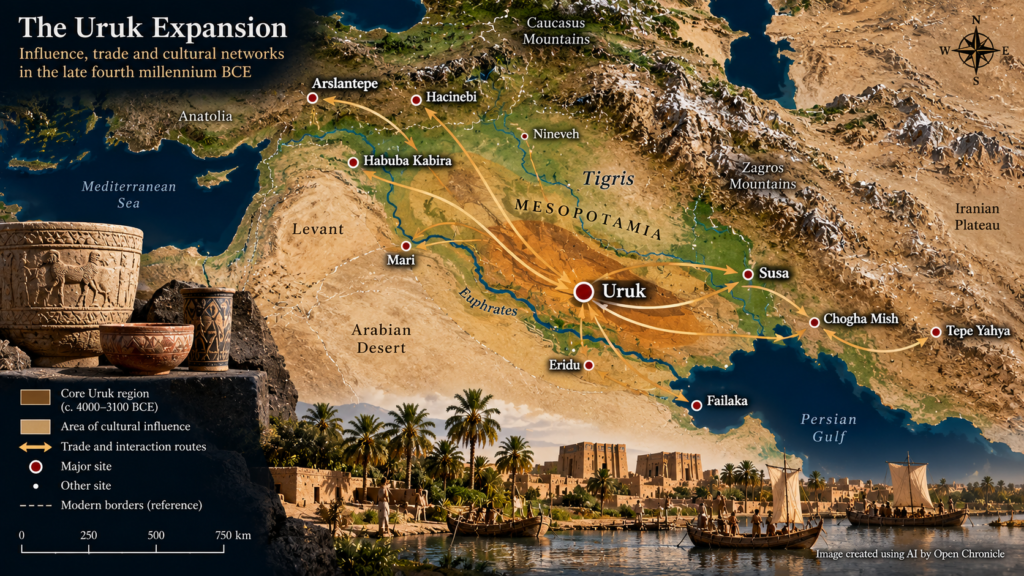
During the fourth millennium BCE, material culture associated with southern Mesopotamia appeared across a broad geographical area extending into northern Mesopotamia and parts of neighbouring regions.
Archaeologists sometimes describe this phenomenon as the Uruk expansion.
Sites such as Habuba Kabira in modern Syria have been especially important in discussions of the spread of Uruk-related urban practices.
The causes and character of this expansion remain debated.
Possible explanations include migration, trade, resource acquisition, cultural interaction and the establishment of settlements linked to southern Mesopotamian institutions.
Not every site containing Uruk-style material was necessarily a colony controlled directly by Uruk.
The term describes a complex pattern of interaction rather than a proven empire governed from one city.
8.1 Exchange networks
Southern Mesopotamia depended on external supplies of certain raw materials.
Connections with other regions helped provide access to stone, metals and timber.
Such exchanges may have encouraged the movement of merchants, craftspeople and administrative practices.
8.2 Cultural interaction
Uruk-related pottery, architecture and administrative objects appeared outside southern Mesopotamia.
However, local communities did not simply abandon their own traditions.
Archaeological evidence often reveals mixtures of regional and southern Mesopotamian practices.
This interaction is one reason the Uruk period occupies such an important place in discussions of early globalization and cultural exchange.
9. Religion and the Sacred City
Religion was deeply embedded in Mesopotamian urban life.
Uruk became particularly associated with Inanna, a major goddess connected with love, sexuality, warfare and political power, and with Anu, a sky deity.
Their significance developed over long periods.
The city’s sacred geography was shaped by monumental buildings, ritual traditions and institutional authority.
Yet caution is necessary when interpreting the earliest archaeological phases.
Later written traditions provide extensive information about Uruk’s deities and temples, but they cannot always be projected unchanged into the fourth millennium BCE.
Religious practices evolved.
So did the relationship between temples, rulers and urban communities.
10. Uruk and the Origins of Kingship
Uruk occupies an important place in later Mesopotamian traditions concerning early kingship.
The Sumerian King List, compiled long after the earliest Uruk period, associates the city with a sequence of rulers.
Among them are Enmerkar, Lugalbanda and Gilgamesh.
These figures belong to a mixture of historical memory, political tradition and legend.
Their appearances in literary and king-list traditions do not establish every event attributed to them as historical fact.
Nevertheless, the traditions reveal how later Mesopotamians understood Uruk’s antiquity and prestige.
The city was remembered as a place of exceptional political and cultural importance.
11. Gilgamesh: Uruk’s Legendary King
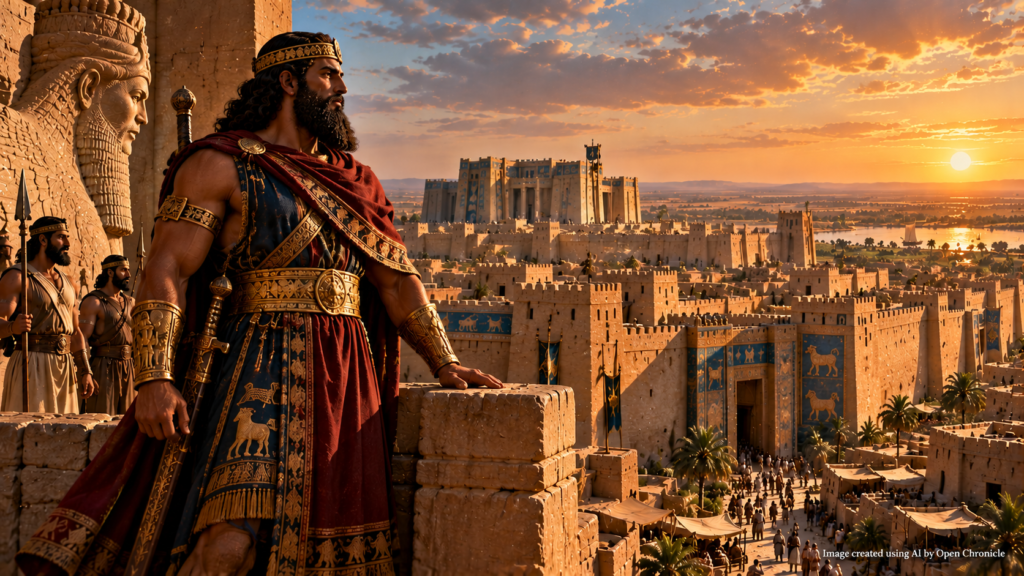
In Mesopotamian literary tradition, Gilgamesh was the powerful ruler of Uruk.
His adventures were preserved in several Sumerian compositions and later Akkadian versions of the Epic of Gilgamesh.
The epic explores kingship, friendship, human mortality, grief and the limits of power.
Gilgamesh’s relationship with Enkidu forms one of its central narratives.
Following Enkidu’s death, Gilgamesh searches for a means of escaping mortality.
His journey ultimately confronts him with the human condition.
11.1 History and legend
Whether Gilgamesh was based on an actual ruler remains uncertain.
The possibility of a historical figure behind the tradition cannot be excluded, but the surviving literary accounts are not straightforward contemporary biographies.
They were shaped through centuries of transmission and reinterpretation.
11.2 The walls of Uruk
The epic famously associates Gilgamesh with the monumental walls of Uruk.
This literary connection emphasizes the city’s grandeur and the lasting achievements of kingship.
Archaeological remains confirm that Uruk possessed substantial defensive walls during its long history, but individual construction phases cannot simply be assigned to Gilgamesh on the authority of the epic.
11.3 The literary importance of Uruk
Through the Gilgamesh tradition, Uruk became more than an archaeological city.
It became a literary symbol of civilization itself.
Its walls, temples and streets represented the human capacity to create enduring institutions, even while individual lives remained temporary.
12. The Warka Vase
Dating to the late fourth millennium BCE, it is a carved stone vessel decorated with registers of figures and symbolic imagery.
The relief includes plants, animals, human participants and a scene commonly interpreted in relation to ritual offerings and the goddess Inanna.
Its arrangement has attracted extensive scholarly discussion.
The Warka Vase is especially important because it demonstrates the sophistication of early Mesopotamian visual storytelling.
Its images connect the natural world, agricultural production, human activity and religious symbolism within a structured composition.
Interpretations of its precise ritual meaning remain open to debate.
13. The Warka Mask
Dating to the late fourth millennium BCE, the carved marble face is among the most remarkable surviving examples of early Mesopotamian sculpture.
Its carefully rendered facial features demonstrate considerable artistic skill.
The original object likely formed part of a larger composite figure, possibly incorporating additional materials for hair and eyes.
Its precise identity and original function remain uncertain.
The mask has often been associated with a female divine figure, but this interpretation should not be treated as definitively established.
14. Urban Planning and the City Walls
Uruk’s physical organization changed repeatedly throughout its long history.
Monumental precincts, residential areas, streets, open spaces and defensive structures developed through successive periods.
The city was surrounded by substantial walls during later phases of its history.
These walls became central to Uruk’s identity.
However, the urban form visible at one archaeological level cannot be assumed to represent the city during every earlier period.
The history of Uruk is a history of continual rebuilding.
Buildings were demolished, replaced or constructed over earlier foundations.
As a result, archaeological excavation often reveals layers of occupation rather than a single preserved city plan.
15. The Transition to the Early Dynastic Period
The end of the Uruk period did not mean the disappearance of the city.
Around the transition from the fourth to the third millennium BCE, Mesopotamian settlement patterns and political structures changed.
The period conventionally called Jemdet Nasr was followed by the Early Dynastic era.
During the third millennium BCE, southern Mesopotamia contained numerous competing city-states.
Uruk remained one of the major centres of this political landscape.
Its rulers and institutions participated in the changing relationships among Sumerian cities.
The development of kingship, military competition and territorial claims became increasingly visible in later written evidence.
16. Uruk in the Third Millennium BCE
During the Early Dynastic period, Uruk continued to possess religious and political importance.
Its name appears in later historical traditions concerning rulers, dynasties and conflicts.
The city was associated with important figures in Sumerian political memory.
Yet reconstructing its exact political history remains difficult because the surviving evidence is incomplete and uneven.
By the middle and later third millennium BCE, southern Mesopotamia experienced the emergence of larger territorial states.
The rise of the Akkadian Empire under Sargon and his successors transformed the political landscape.
Uruk became part of broader imperial systems while retaining its historical and religious significance.
17. Uruk Under Later Mesopotamian Kingdoms
Uruk survived the decline of the early Sumerian city-state system.
During the Ur III period and subsequent centuries, it remained a significant urban and religious centre.
Its institutions participated in the political and economic structures of successive Mesopotamian states.
The city continued to be occupied under Babylonian and later imperial rule.
Its long history is important because Uruk was not merely a prehistoric experiment that vanished after the invention of writing.
It remained part of Mesopotamian civilization for thousands of years.
18. Uruk in the First Millennium BCE
During the first millennium BCE, Uruk retained considerable religious and scholarly importance.
Under Neo-Babylonian, Achaemenid and later Seleucid rule, the city continued to support major temple institutions.
Its religious life was especially associated with the cults of Anu and other Mesopotamian deities.
The city also became an important centre of scholarly activity.
Cuneiform texts from late Uruk preserve traditions of astronomy, mathematics, ritual knowledge and learned commentary.
These materials demonstrate the extraordinary continuity of Mesopotamian intellectual culture.
Even after political power shifted to other cities and empires, Uruk remained a place where ancient traditions were studied, copied and developed.
19. Astronomy and Scholarship in Late Uruk
One of the less familiar aspects of Uruk’s history is its contribution to the preservation and development of Mesopotamian scholarship.
During the first millennium BCE and Hellenistic period, scholars associated with temple institutions produced and copied astronomical, mathematical and religious texts.
Babylonian astronomy became one of the most sophisticated observational and computational traditions of the ancient world.
Uruk participated in this wider intellectual environment.
Astronomical diaries, mathematical procedures and scholarly commentaries formed part of a culture in which knowledge was transmitted through specialist scribal education.
The surviving evidence also illustrates an important distinction:
Uruk’s historical significance did not end when it ceased to dominate the urban landscape of southern Mesopotamia.
Its later contribution was increasingly intellectual and religious.
20. Decline and Abandonment
Uruk’s decline was gradual rather than the result of a single catastrophic event.
Political changes, environmental transformations, shifting trade networks and alterations in settlement patterns all affected the region over time.
The city continued to show evidence of occupation into the early centuries CE, although the chronology of its final abandonment remains a subject of archaeological investigation.
Eventually, the great urban centre became an archaeological landscape.
Its buildings collapsed or were buried.
Its canals and waterways changed.
The city that had once helped define urban civilization disappeared from the inhabited landscape, while its name survived in ancient texts and historical traditions.
21. Rediscovery and Archaeological Excavation
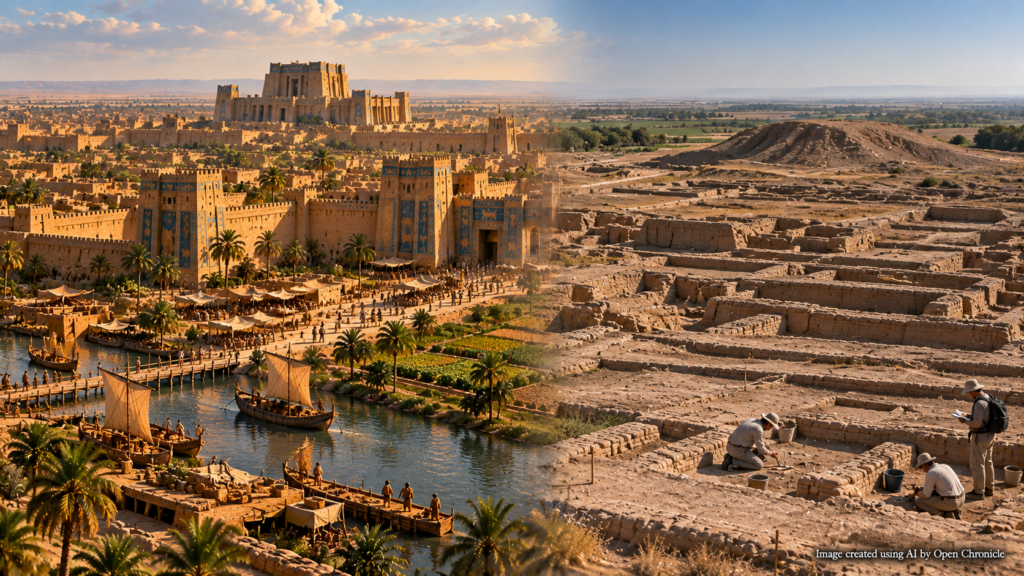
Uruk became a major subject of modern archaeological investigation during the nineteenth and twentieth centuries.
The site was identified with ancient Uruk, and systematic excavations revealed monumental buildings, administrative tablets, sculptures and extensive architectural remains.
German archaeological expeditions played a particularly important role in the site’s investigation.
Excavations beginning in the early twentieth century helped establish the archaeological sequence that gave the Uruk period its name.
Researchers uncovered evidence of the city’s long occupation, including the Eanna precinct and Anu district.
The archaeological work was interrupted repeatedly by war, political instability and changing conditions in Iraq.
Modern research combines excavation, archaeological survey, architectural analysis, specialist study of artefacts and the reassessment of earlier discoveries.
21.1 Challenges of interpretation
Excavating Uruk is especially complex because the site contains occupation layers accumulated over thousands of years.
Later buildings often disturbed earlier structures.
Administrative tablets may survive without complete information about the original institutions that produced them.
Artefacts discovered in older excavations may also lack the contextual documentation expected by modern archaeological standards.
Consequently, interpretations continue to evolve.
22. Uruk and the Archaeology of the First Cities
Uruk occupies a central place in debates about the origins of urbanism.
Scholars have long asked what distinguishes a city from a large village.
Population size is important, but it is not sufficient.
Other possible characteristics include occupational specialization, monumental architecture, administrative institutions, social differentiation, regional exchange and centralized forms of organization.
Uruk provides evidence for many of these developments.
However, the city should not be understood as the sole birthplace of urban civilization.
Other regions developed complex settlements and urban traditions through different historical processes.
Even within Mesopotamia, Uruk emerged as part of a wider landscape of social and economic change.
Its importance lies in the exceptional scale and archaeological visibility of that transformation.
23. Was Uruk the World’s First City?
The description of Uruk as the world’s first city is common in popular accounts.
It captures something important about the settlement’s extraordinary early development.
But it also requires qualification.
Archaeologists do not universally agree on a single definition of a city.
Earlier settlements such as Çatalhöyük and Jericho possessed large populations or substantial architecture, although their social organization differed from that of later Mesopotamian cities.
Other ancient settlements also contributed to the emergence of urban life.
Uruk is therefore more accurately described as one of the earliest and most influential large urban centres in the world, rather than an unquestionably established first city.
This distinction does not diminish its importance.
It places Uruk within the broader, complex history of human settlement and urban development.
24. The Historical Legacy of Uruk
Uruk’s legacy can be understood through several interconnected developments.
Urban scale: The city demonstrated how large populations could be concentrated within complex settlement systems.
Institutional organization: Monumental complexes and administrative records reveal sophisticated coordination of resources and labour.
Writing: Proto-cuneiform tablets from Uruk preserve a crucial early stage in the development of Mesopotamian writing.
Art and architecture: Monumental buildings, sculpture and decorated vessels testify to important innovations in visual culture.
Religion: Uruk became a major centre of Mesopotamian sacred tradition.
Literature: Its association with Gilgamesh gave the city an enduring place in world literature.
Scholarship: Later Uruk preserved important traditions of astronomy, mathematics and cuneiform learning.
Together, these achievements make Uruk one of the most consequential archaeological sites for understanding the development of complex societies.
25. Chronology of Uruk
| Period | Approximate dates | Major developments |
|---|---|---|
| Ubaid background | Before c. 4000 BCE | Early agricultural settlement and institutional development |
| Early Uruk | c. 4000–3500 BCE | Expansion of settlement and regional cultural changes |
| Middle and Late Uruk | c. 3500–3100 BCE | Major urban growth, monumental architecture and administrative innovation |
| Late fourth millennium BCE | c. 3400–3000 BCE | Emergence of proto-cuneiform records |
| Jemdet Nasr transition | c. 3100–2900 BCE | Changing administrative and cultural traditions |
| Early Dynastic period | c. 2900–2350 BCE | Uruk as an important Sumerian city-state |
| Akkadian and Ur III periods | c. 2350–2000 BCE | Incorporation into larger territorial states |
| Second millennium BCE | c. 2000–1000 BCE | Continued religious and urban importance |
| First millennium BCE | c. 1000–331 BCE | Temple institutions and scholarly activity |
| Hellenistic period | After 331 BCE | Continued cuneiform scholarship and religious traditions |
| Early centuries CE | Dates uncertain | Gradual decline and eventual abandonment |
| Modern archaeology | Nineteenth century onward | Identification, excavation and interpretation of the site |
Dates are approximate. Archaeological chronologies vary by region and by scholarly convention.
26. Uruk Compared with Other Early Urban Centres
| Settlement | Region | Historical significance |
|---|---|---|
| Uruk | Southern Mesopotamia | Early large-scale urbanism, monumental architecture and proto-cuneiform writing |
| Ur | Southern Mesopotamia | Major Sumerian city, royal cemetery and later ziggurat |
| Eridu | Southern Mesopotamia | Early settlement and long religious tradition |
| Nippur | Southern Mesopotamia | Major religious centre associated with Enlil |
| Susa | Southwestern Iran | Important centre of early complex society and interaction with Mesopotamia |
| Habuba Kabira | Northern Syria | Settlement associated with the wider Uruk expansion |
| Çatalhöyük | Anatolia | Large earlier Neolithic settlement with a different social and architectural pattern |
The comparison illustrates why early urban history cannot be reduced to a single location or developmental pathway.
Did You Know?
Open Chronicle Perspective
The City as a Turning Point in Human History
Uruk matters because it represents more than the construction of buildings on a larger scale.
It marks an important stage in the development of a new relationship between people, institutions and information.
In smaller communities, many social relationships could be maintained through direct personal contact.
In a city of tens of thousands, organization increasingly required systems extending beyond individual memory and face-to-face relationships.
Resources had to be counted. Labour had to be coordinated. Buildings had to be maintained. Goods had to move between producers, institutions and consumers.
These demands encouraged new forms of administration and recordkeeping.
The earliest tablets from Uruk reveal this transformation with unusual clarity.
They remind us that one of the great revolutions in human history was not initially the writing of poetry or philosophy, but the attempt to organize increasingly complex collective life.
Yet Uruk also demonstrates that urban civilization was never exclusively economic.
Its monumental architecture, religious traditions, artistic achievements and literary legacy reveal a society in which practical administration and symbolic meaning developed together.
The city became a place where human communities organized resources, expressed beliefs, preserved information and imagined their own place in history.
Uruk’s enduring significance lies in this convergence: the emergence of the city as an economic system, a political environment, a sacred landscape and a centre of human memory.
Sources and Further Reading
The following selected works and institutional resources provide further historical and archaeological context for the study of Uruk, the emergence of urban civilization in Mesopotamia, the development of early writing systems and the preservation of the region’s cultural heritage.
01 | URBAN HISTORY
Uruk: The First City
Mario Liverani
A scholarly study of the emergence of Uruk as an early urban centre, examining the formation of the city, its institutions, economic organization and the social transformations that shaped the development of complex urban society in ancient Mesopotamia.
02 | ARCHAEOLOGY AND EXPANSION
The Uruk World System: The Dynamics of Expansion of Early Mesopotamian Civilization
Guillermo Algaze
An important archaeological study of the expansion of Uruk-related cultural and economic practices beyond southern Mesopotamia. The work explores regional interaction, exchange networks and the relationships between early Mesopotamian urban centres and neighbouring territories.
03 | ORIGINS OF WRITING
Before Writing: From Counting to Cuneiform
Denise Schmandt-Besserat
An influential investigation into early accounting systems, numerical notation and the development of writing in ancient Mesopotamia. The work examines the relationship between methods of recording quantities and the emergence of increasingly sophisticated systems of written communication.
04 | MESOPOTAMIAN CITIES
Mesopotamia: The Invention of the City
Gwendolyn Leick
A historical examination of the development of cities in ancient Mesopotamia. The book places Uruk within the wider emergence of urban civilization, exploring the religious, political, economic and cultural significance of the region’s major settlements.
05 | CULTURAL HERITAGE
The Ahwar of Southern Iraq
UNESCO World Heritage Centre
Official World Heritage documentation concerning the archaeological sites of Uruk, Ur and Eridu, together with the wider landscape of southern Iraq. The resource provides information about the cultural significance, historical context and international recognition of these ancient Mesopotamian sites.
06 | ENCYCLOPEDIC REFERENCE
Uruk
Encyclopaedia Britannica
An encyclopedic overview of Uruk, including its geographical location, archaeological importance, historical development and role in the emergence of early Mesopotamian urban civilization.
EDITORIAL NOTE
This article presents Uruk through archaeological evidence, historical scholarship and Mesopotamian literary traditions. Dates and population estimates are approximate, and interpretations of early institutions, writing systems and political authority remain subject to scholarly debate. Legendary traditions associated with Gilgamesh are distinguished from independently established historical evidence. The bibliography provides selected resources for further study rather than a claim that every work has been individually consulted for this draft.
Explore this subject
Continue exploring related Open Chronicle Encyclopedia entries through the categories associated with this article.

Staff Writers at Open Chronicle produce trusted journalism, strategic analysis and authoritative reference content across global affairs, geopolitics, defense, science, history, technology, business, culture and sport. Their work combines accurate reporting with historical perspective and analytical depth, helping readers understand not only what is happening, but why it matters. Beyond daily news coverage, Staff Writers contribute to the Open Chronicle Encyclopedia, investigative features, original research projects and long-form reports, building a comprehensive knowledge platform designed to inform, educate and preserve reliable information for a global audience.