
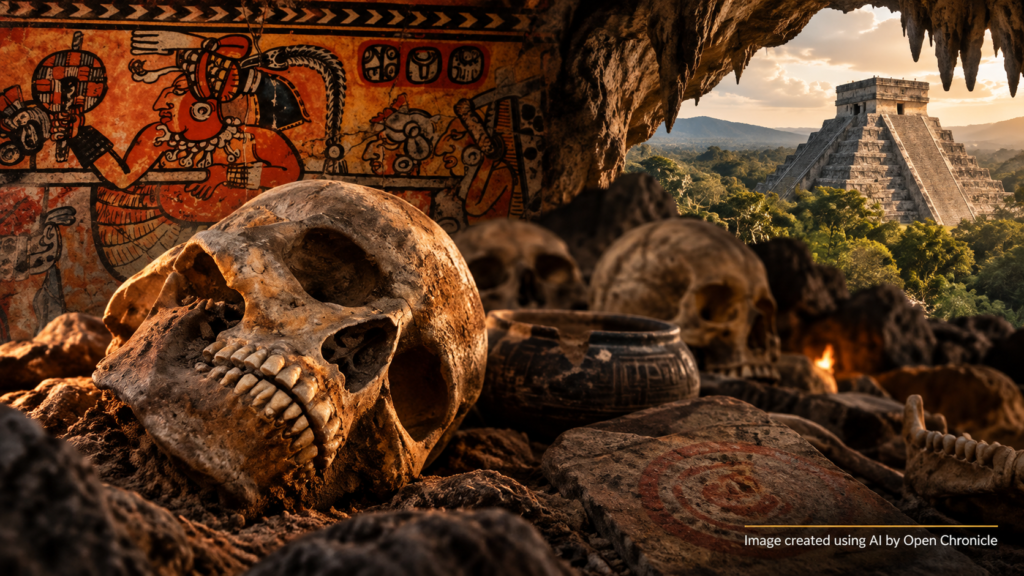
Fourteen years after 165 human skulls were discovered inside a cave in southern Mexico, a new archaeological assessment is challenging simplified interpretations of ancient Maya rituals and revealing a ceremonial landscape in which women, men and children may all have played significant roles.
By Open Chronicle History Desk
CHIAPAS, Mexico — October 29, 2026 — Deep inside a cave near Frontera Comalapa, in the southern Mexican state of Chiapas, archaeologists are reconstructing the history of an extraordinary collection of human remains that may once have formed part of a ceremonial skull altar.
The assemblage, discovered in 2012, contains 165 human skulls. New findings released by Mexico’s National Institute of Anthropology and History (INAH) on October 28, 2026, have revealed that 83 of the skulls were classified as female, 79 as male, while three could not be classified because of fragmentation.
The difference is small, but its significance extends beyond the numbers.
The presence of women and children among the remains, together with evidence of deliberate modifications to the skulls, possible exposure to heat and repeated handling of human bones, is prompting researchers to reconsider the activities that took place inside the cave.
The site has been interpreted as a possible tzompantli, a Mesoamerican structure or arrangement associated with the display of human skulls.
Yet the Frontera Comalapa assemblage differs in important ways from the monumental skull displays associated with the later Mexica, or Aztec, civilization.
Its archaeological context points instead toward the ritual traditions of Maya communities in southern Mexico.
The new research offers an opportunity to examine not only how human remains were treated, but also how ancient societies understood sacred places, death, identity and the continuing relationship between the living and the dead.
A Discovery That Began in 2012
The cave’s unusual concentration of human remains was first documented in 2012.
Investigators encountered numerous skulls without the complete skeletons normally associated with individual burials.
The arrangement immediately raised questions.
Were the remains part of a collective burial? Had the skulls been deliberately separated from the rest of the bodies? Or had they once been displayed on a structure that subsequently collapsed?
Evidence recorded at the time included traces of aligned wooden elements, which led researchers to propose that the cave may have contained a skull-display installation.
The interpretation was complicated by the absence of the characteristic perforations found in some better-known Mesoamerican skull racks.
At the Huei Tzompantli of Tenochtitlan, for example, skulls could be pierced and mounted on horizontal supports.
The Frontera Comalapa skulls did not show that same pattern.
Researchers therefore considered the possibility that a different type of wooden structure had supported or arranged the skulls without requiring them to be pierced.
Because wood can decay over centuries, the original configuration is difficult to reconstruct.
The term tzompantli remains useful for describing the proposed ritual context, but it should not be understood as proof that the cave contained an architectural structure identical to those used elsewhere in Mesoamerica.
The Women Among the Remains
One of the most important findings concerns the biological characteristics of the individuals represented in the collection.
According to the latest INAH assessment, 83 skulls were classified as female and 79 as male.
The remaining three could not be classified because they were too fragmented.
The analysis was carried out by researchers Cristell Delesma Pérez and Abigail Reyes López, building on earlier investigations by physical anthropologist Javier Montes de Paz.
Determining sex from archaeological skeletal remains is not always straightforward.
The pelvis generally provides some of the most informative anatomical characteristics, but the Frontera Comalapa collection consists predominantly of skulls rather than complete skeletons.
Researchers therefore examined cranial features, including the shape of the lower jaw and the region above the eye sockets.
Such features can support estimates of biological sex, although they are subject to variation and do not provide certainty in every individual case.
The results suggest a broadly balanced representation of individuals classified as female and male.
That balance is important because popular representations of Mesoamerican skull displays have frequently emphasized warfare, male captives and human sacrifice.
The Frontera Comalapa evidence does not fit neatly into an exclusively male interpretation.
However, the findings do not establish why each person was selected, how each individual died or whether all the remains were deposited through the same ceremonial process.
Nor can the skeletal evidence, by itself, establish the social identities or ritual responsibilities of the people represented.
The significance of the female representation lies in the questions it raises rather than in any single definitive explanation.
Children and Older Adults in the Cave
The collection also includes 15 skulls identified as belonging to children.
These are part of the total of 165, not an additional group.
Most of the adult individuals appear to have died between approximately 25 and 35 years of age.
Two individuals, however, were estimated to have reached ages between 55 and 70.
Their presence is notable within the assemblage, although such ages should not be interpreted as impossible or exceptionally rare in every ancient population.
Average life expectancy in prehistoric societies was strongly affected by childhood mortality and does not represent a fixed maximum lifespan.
The range of ages at Frontera Comalapa suggests that the individuals were not drawn exclusively from a single narrow demographic category.
Nevertheless, the archaeological evidence does not yet explain whether they belonged to one community, came from different settlements or were deposited over an extended period.
Those questions would require further chronological and biological investigation.
Evidence of Complex Treatment of Human Remains
Beyond the demographic findings, the bones themselves preserve evidence of unusual treatment.
INAH researchers identified cut marks on remains associated with three individuals.
They also reported indications of heating or cooking affecting some of the bones.
Many skulls are missing their lower jaws, while teeth have been removed from the upper jaws in numerous cases.
These characteristics suggest that the remains underwent deliberate handling.
Such practices may have occurred during preparation of the bodies, during ceremonies or after an initial period of deposition.
The evidence is consistent with a complex sequence of actions rather than a simple process in which bodies were buried and left undisturbed.
Researchers have proposed that bones may have been removed, rearranged or reintroduced into the ritual setting.
However, the available findings do not establish the complete sequence of events.
Cut marks, for example, can result from different forms of postmortem treatment. Their presence does not independently establish the cause of death.
Similarly, evidence of heating requires careful interpretation.
It may reflect direct treatment of the remains or activities involving fire in the surrounding ritual environment.
The distinction is crucial when reconstructing ancient practices from incomplete archaeological evidence.
A Cave Illuminated by Fire
The cave itself may be central to understanding the discovery.
Historical photographic documentation records soot on the ceiling, suggesting that fire was used inside the natural chamber.
Researchers have proposed that people entered the cave carrying torches and performed ceremonies within it.
The site may have functioned as a place of pilgrimage for nearby Maya communities.
Among the possibilities considered by INAH specialists are rituals connected with requests for rainfall.
Such an interpretation would be consistent with the wider importance of caves, water and sacred landscapes in many Maya traditions.
Caves could be understood as places of connection between different parts of the cosmos, including the world inhabited by the living and realms associated with supernatural forces.
Their darkness, geological formations and relationship with underground water made them powerful locations within particular religious traditions.
Nevertheless, the precise ceremonies performed at Frontera Comalapa have not been reconstructed.
The soot indicates the use of fire, while the human remains provide evidence of ritualized treatment.
The suggestion that the site was associated with rainfall ceremonies remains an archaeological interpretation rather than a directly demonstrated fact.
Why the Skull Was So Important
The human head held profound symbolic significance in several ancient Mesoamerican traditions.
It could be associated with personal identity, vitality, ancestral presence and relationships with supernatural beings.
The meaning of a skull display, however, depended on its cultural and historical context.
Some installations were associated with political power and the public display of captives.
Others may have served ceremonial functions connected with sacred spaces, offerings or the treatment of ancestral remains.
INAH archaeologist Josuhé Lozada Toledo has suggested that the accumulation of skulls at Frontera Comalapa may be understood within beliefs concerning the spiritual essence of individuals.
In discussing broader Mesoamerican concepts, researchers have drawn attention to traditions in which different parts of the body were associated with vital or spiritual forces.
These concepts should not be treated as identical across all Mesoamerican societies.
Maya communities and the later Mexica developed distinct religious systems, even where certain ideas or practices shared regional similarities.
At Frontera Comalapa, the cave’s natural setting may have contributed to the significance of the remains.
Rather than interpreting the skulls exclusively as trophies or evidence of punishment, researchers are examining whether their arrangement formed part of repeated ceremonial activities.
This possibility does not exclude violence or sacrifice, but neither does the present evidence establish that every individual was a sacrificial victim.
An Older Tradition Than the Great Skull Displays of Tenochtitlan
The Frontera Comalapa remains have been associated with the Early Postclassic period, approximately AD 900–1200.
That places the proposed ritual context before the monumental skull displays of the Mexica capital, Tenochtitlan, which belong to a later phase of Mesoamerican history.
The comparison is valuable, but the differences are equally important.
Tenochtitlan’s Huei Tzompantli formed part of a monumental ceremonial complex associated with state power and religious practice.
The Frontera Comalapa assemblage, by contrast, was found inside a cave.
The absence of pierced skulls, the evidence of possible wooden supports and the natural setting point toward a different arrangement.
It would therefore be misleading to describe the discovery simply as an Aztec skull rack.
The evidence belongs to the archaeology of Maya communities in Chiapas.
Understanding the relationship between different Mesoamerican traditions requires attention to chronology, geography and cultural variation.
Similar ritual forms do not necessarily imply identical beliefs or purposes.
Skulls Shaped During Childhood
Some of the remains also preserve evidence of intentional cranial modification.
Researchers identified a form known as erect tabular modification, in which the developing skull was shaped during childhood through sustained pressure.
Such practices are documented in different ancient societies and were particularly significant in parts of Mesoamerica.
They could express aspects of identity, aesthetics, cultural belonging or social distinction.
The presence of modified skulls at Frontera Comalapa therefore offers information about practices that occurred during the individuals’ lives, long before their remains were placed inside the cave.
The findings may eventually help researchers compare the assemblage with other Maya populations.
However, cranial modification alone cannot establish an individual’s precise community of origin or social position.
Its interpretation depends on broader archaeological and comparative evidence.
Remarkable Preservation After Centuries
Despite their age, many of the remains are in relatively good condition.
The collection is currently preserved at the Physical Anthropology Laboratory of the INAH Chiapas Centre.
Researchers have documented 165 skulls and 51 long bones.
One particularly unusual detail concerns the preservation of a malleus, one of the tiny bones of the middle ear.
Measuring only several millimetres, this delicate structure is rarely recovered intact in archaeological contexts.
Its survival illustrates the exceptional preservation of at least some material from the cave.
Such preservation can support detailed osteological study and potentially provide opportunities for future investigation.
The remains may help researchers examine age, anatomical variation, skeletal modification and patterns of treatment after death.
Whether additional scientific methods can establish more precise dates or biological relationships will depend on the condition of the material and the research undertaken.
Archaeology Beyond the Spectacle of Human Skulls
Discoveries involving large numbers of human skulls often attract attention because of their disturbing appearance.
Yet the scientific importance of Frontera Comalapa lies in the information preserved by the remains and their archaeological context.
The collection offers evidence about the treatment of the dead, the organization of ritual activity and the relationship between sacred landscapes and human communities.
The inclusion of women, men and children complicates explanations focused exclusively on male warriors.
The missing jaws and teeth suggest that the bones were subjected to deliberate interventions.
The evidence of fire raises questions about ceremonies performed inside the cave.
The possible wooden structure offers a further clue about how the remains may once have been arranged.
Taken together, these details suggest a ritual environment whose significance cannot be reduced to a single act of violence or sacrifice.
The research also demonstrates how archaeological discoveries can change meaning as new methods are applied.
What began in 2012 as an unusual collection of human remains has become a long-term investigation into the lives and beliefs of ancient Maya communities.
Reconstructing a Sacred Landscape
Fourteen years after the discovery, the Frontera Comalapa cave continues to raise questions.
Who were the individuals whose remains were deposited there?
Did they belong to one community or several?
Were the skulls accumulated over generations?
What ceremonies took place inside the cave, and how did those practices relate to the surrounding settlements?
The latest osteological assessment does not answer all these questions.
Instead, it provides a more detailed foundation for investigating them.
The nearly balanced representation of female and male individuals is especially important because it challenges assumptions that skull-display contexts necessarily consisted overwhelmingly of men.
At the same time, the findings reinforce the need to distinguish archaeological evidence from interpretations about ritual purpose.
The remains cannot speak directly about the beliefs of the people who deposited them.
But their physical characteristics, preservation and arrangement offer clues that can be examined through scientific research.
In the mountains of Chiapas, a cave that once held a carefully arranged collection of human skulls is gradually revealing a more complicated history.
It is a history not simply of death, but of how ancient communities may have understood the continuing significance of the human body within their sacred world.
Editorial Note
This article examines the latest findings released by Mexico’s National Institute of Anthropology and History (INAH) on October 28, 2026, concerning human remains discovered in 2012 inside a cave at Frontera Comalapa, Chiapas. The classification of 83 skulls as female and 79 as male represents a small numerical difference rather than a substantial female majority. Estimates of biological sex were based on cranial characteristics and remain subject to the limitations of osteological analysis. Interpretations concerning pilgrimage, rainfall ceremonies, skull-display structures and the spiritual significance of the remains are presented as archaeological hypotheses rather than established facts. The evidence does not independently determine the cause of death of each individual or demonstrate that all were victims of human sacrifice.
Historical Sources and Further Reading
The primary source for this article is the official statement issued by Mexico’s National Institute of Anthropology and History (INAH) on October 28, 2026, supplemented by earlier documentation from the same institution and specialist archaeological reporting. The following sources provide the scientific findings, historical background, and archaeological interpretations discussed in the article.
01. INAH — Tzompantli de Frontera Comalapa revela mayor presencia femenina y nuevas pistas de su simbolismo
October 28, 2026 · Official Archaeological Report
The primary archaeological report provides the classification of the human skulls, osteological examination methods, evidence of skeletal modifications, interpretations of ritual practices, and statements from the researchers involved in the investigation.
inah.gob.mx
02. INAH — Cueva de Comalapa: un altar prehispánico de cráneos
January 8, 2025 · Archaeological Background
This earlier archaeological documentation examines the evidence supporting the hypothesis that the cave contained a tzompantli, or ceremonial skull-display structure. It also explains the differences between the Comalapa assemblage and the skull racks associated with the Mexica civilization.
Read Archaeological Background →
inah.gob.mx
03. Secretaría de Cultura de México — Teorizan que existió un tzompantli en la Cueva de Comalapa
Official Historical Research Communication
This official communication documents the initial archaeological interpretation of the site, including evidence of wooden structural elements, the absence of characteristic skull perforations, and the proposed chronological framework for the ceremonial assemblage.
gob.mx
04. HeritageDaily — Tzompantli Skull Rack Reveals Unexpected Female Majority and Mysterious Rituals
October 28, 2026 · Specialist Archaeology Coverage
Specialist archaeological coverage of the newly released findings, examining the representation of female individuals within the skull assemblage and the possible implications for understanding ancient Maya ceremonial practices and beliefs surrounding death.
heritagedaily.com