
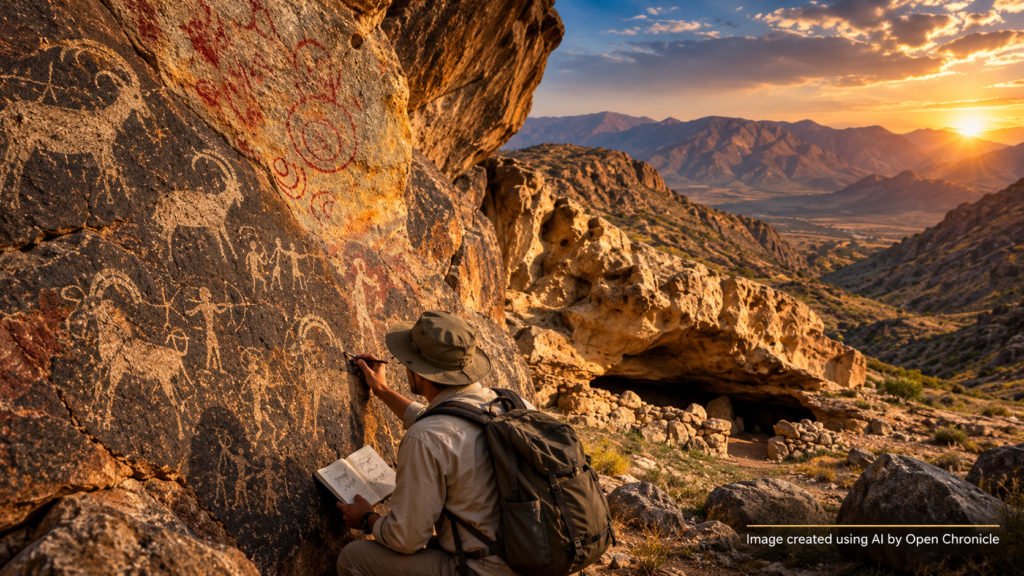
Archaeologists working in the mountains of central Uzbekistan have uncovered prehistoric paintings made with natural ochre and evidence of a Bronze Age settlement, offering new clues to how ancient communities inhabited and moved through one of Central Asia’s historically important landscapes.
By Open Chronicle History Desk
SAMARKAND, Uzbekistan — October 29, 2026 — Archaeologists exploring the Nurata mountain range in central Uzbekistan have discovered prehistoric rock paintings and the remains of a Bronze Age settlement, adding new evidence to the region’s long and complex history of human occupation.
The discoveries were made during archaeological fieldwork in October 2026 in the mountainous and foothill areas of Kushrabat district, in the Samarkand region.
Researchers from the Samarkand Institute of Archaeology named after Yahyo Gulyamov identified paintings made with natural ochre on the walls and ceilings of rock shelters, along with pottery fragments and other remains associated with a separate Bronze Age settlement.
The findings suggest that different parts of the Nurata landscape were used by human communities over a considerable period, potentially extending from the Mesolithic and Neolithic eras into the Bronze Age.
Although the discoveries remain at an early stage of investigation, they could help archaeologists reconstruct patterns of settlement, mobility and cultural interaction in a region connecting the mountains and plains of Central Asia.
Prehistoric Paintings Hidden in Mountain Rock Shelters
The rock paintings were identified at several locations within the Oqchobsay area, including Egrijarsay, Khojasay, also known as Badimin, Galajinsay and Sumbulsay.
According to the archaeological reports, the images were produced using natural ochre, a mineral pigment widely employed by prehistoric societies.
Unlike engravings carved directly into stone, painted rock art depends on the survival of pigment applied to a rock surface. Its preservation can provide valuable evidence of prehistoric artistic practices, although determining the age of such images is often difficult.
Researchers have provisionally associated the paintings with the Mesolithic and Neolithic periods.
That proposed chronology remains preliminary.
The Mesolithic generally refers to a transitional phase between earlier hunter-gatherer societies and later Neolithic developments, although its dates and characteristics vary considerably between regions.
The Neolithic is associated with important changes in human technology, subsistence and settlement patterns, but those changes did not occur simultaneously or uniformly across Central Asia.
For the Nurata discoveries, the most important question is not simply how old the paintings are, but what they reveal about the people who created them.
Their placement on the walls and ceilings of shelters raises questions about how these locations were used and whether the images held social, practical or symbolic significance.
The available reports do not establish the subjects represented in the paintings or their intended meanings.
Interpreting those questions will require detailed documentation, comparisons with other archaeological sites and, where possible, scientific analysis of the pigments and associated deposits.
A Bronze Age Settlement Beneath the Mountain Landscape
A second discovery was made in the Pangat area, where archaeologists identified Bronze Age pottery fragments at three separate locations.
One of the sites, approximately 700 to 800 metres east of Qumoloqli village, was selected for a preliminary excavation.
Researchers opened a small test trench measuring two metres by one metre.
Beneath the surface, they identified an archaeological deposit approximately 60 centimetres thick.
The deposit contained numerous pottery fragments and bone remains.
Together, these materials provided evidence of a Bronze Age settlement at the location.
The discovery is significant because pottery, animal bones and accumulated occupation deposits can help archaeologists investigate the everyday activities of ancient communities.
Pottery fragments may eventually provide information about vessel manufacture, storage, food preparation and regional technological traditions.
Animal remains, if their species and archaeological contexts can be established, may offer clues about diet, livestock management, hunting or other activities.
The thickness of the archaeological layer also suggests that material accumulated at the site over time.
However, it does not by itself establish how long the settlement was occupied or whether habitation was continuous.
Those questions remain open.
The preliminary excavation covered only a small area, and researchers have emphasized the need for broader investigations.
Why the Nurata Mountains Matter
The Nurata range occupies an important position within the geography of central Uzbekistan.
Mountain valleys, foothills and nearby plains offer different environmental resources and potential routes of movement.
For prehistoric populations, such landscapes could provide access to water, stone suitable for tools, seasonal vegetation and animals.
Their archaeological importance lies partly in the possibility of examining how communities adapted to different environments.
Rather than treating the mountains as an isolated region, archaeologists can investigate their connections with neighbouring territories.
Earlier research has already demonstrated the presence of prehistoric activity in the Nurata mountain system.
Field surveys conducted in 2023 identified Neolithic sites known as Kablyati, Chorvoqsoy and Koktonli.
A subsequent academic study described a worked green flint arrowhead from Koktonli and compared it with artefacts associated with other prehistoric cultures across Central Asia.
Those comparisons suggested possible cultural connections between communities occupying mountain environments and populations living in surrounding plains.
The newly reported rock paintings and Bronze Age settlement may provide additional evidence for examining such relationships.
They do not, however, establish that the same communities occupied the region continuously from the Mesolithic through the Bronze Age.
That distinction is essential.
Archaeological landscapes often preserve evidence from populations separated by hundreds or thousands of years.
Understanding the relationship between different sites requires careful chronological investigation.
Rock Art as a Record of Prehistoric Life
Rock art is among the most distinctive forms of surviving evidence from prehistoric societies.
Across Central Asia, painted and engraved images have been documented in mountain valleys, rock shelters and other landscapes.
They can depict animals, human figures, hunting activities, geometric forms and subjects whose meanings are uncertain.
Such images can provide evidence of artistic traditions and changing relationships between communities and their environments.
Yet rock art is also difficult to interpret.
An animal representation, for example, might relate to hunting, beliefs, identity or another aspect of social life. Without additional evidence, no single explanation can be assumed.
Dating presents another challenge.
Images on the same rock surface may have been produced during different periods, while weathering and later human activity can alter their appearance.
Archaeologists therefore rely on combinations of evidence, including artistic comparisons, archaeological context, pigment analysis and associated deposits.
In Uzbekistan, previous research has documented rock art at several locations, including sites in the Nurata range.
The latest discoveries expand the material available for comparison and may help researchers distinguish regional artistic traditions.
They could also contribute to understanding whether particular valleys were repeatedly visited or occupied during different prehistoric periods.
The Importance of the Bronze Age Evidence
The Bronze Age was a period of major technological, economic and social developments across much of Eurasia.
In Central Asia, different communities adopted and adapted metalworking, pottery production, agriculture and pastoralism in ways shaped by local conditions.
The region’s prehistoric history cannot be reduced to a single pattern of development.
Some communities lived in more permanent settlements, while others maintained mobile or seasonally mobile ways of life.
Trade, migration and contact between populations contributed to the movement of objects, technologies and ideas.
Against this background, the Nurata settlement offers a potentially valuable opportunity to study everyday life in a mountain environment.
Its pottery and bone remains could eventually reveal whether the inhabitants depended primarily on domesticated animals, cultivated resources, hunting or a combination of activities.
Detailed examination of the ceramics may also help identify connections with archaeological traditions elsewhere in Uzbekistan and neighbouring regions.
At present, the reported evidence is insufficient to establish the settlement’s precise date, population size or economic organization.
The discovery is therefore the beginning of a research process rather than the conclusion of one.
Archaeologists Plan Further Excavations
The October fieldwork was carried out by researchers A. Kholmatov and T. Ruziboev as part of the Samarkand Institute of Archaeology’s 2026 research programme.
Their initial work combined archaeological survey with a limited test excavation.
The next stage will require more extensive investigation of the Bronze Age site and detailed documentation of the painted shelters.
Further excavation could reveal structures, hearths, tools or other archaeological features, although none of those additional discoveries has yet been confirmed in the available reports.
Researchers also intend to compare the newly recovered materials with evidence from other regions.
Such comparisons may help establish how ancient populations occupied the Nurata mountains and interacted with communities elsewhere in Central Asia.
Scientific dating and environmental analysis could eventually strengthen the proposed chronology.
The preservation of the sites will also be important.
Rock paintings are vulnerable to natural erosion, changes in surface conditions and human interference. Excavated archaeological deposits likewise require careful recording to preserve information about their original contexts.
A New Chapter in Central Asia’s Prehistory
The Nurata discoveries are important not because they reveal a previously unknown civilization, but because they add evidence to a complex archaeological record.
The paintings suggest prehistoric artistic activity in several mountain shelters.
The Bronze Age pottery, bones and occupation deposit provide evidence of settlement in another part of the same landscape.
Together, they offer researchers an opportunity to investigate how human activity changed across different periods.
The discoveries also underline the continuing importance of archaeological field surveys.
Even in regions where prehistoric sites have been documented for decades, systematic exploration can identify previously unrecorded evidence.
For Uzbekistan, the findings may contribute to a fuller understanding of the country’s prehistoric heritage.
For Central Asian archaeology more broadly, they offer another opportunity to examine the relationships between mountain communities, neighbouring plains and the wider networks through which people and ideas moved.
Much remains unknown.
The paintings still require secure dating, the settlement needs more extensive excavation, and the relationship between the discoveries has yet to be established.
But the initial findings have opened a new area of investigation into the people who inhabited the Nurata mountains long before the emergence of the region’s better-known historical civilizations.
Historical Sources and Further Reading
As fontes seguintes sustentam a notícia e o contexto arqueológico. A comunicação local de 26 de outubro identifica os investigadores e descreve os achados; as publicações seguintes corroboram os principais detalhes.
01. Oyina — New Archaeological Sites Identified in the Nurata Mountains
26 October 2026 · Uzbek
Informação atribuída ao Instituto de Arqueologia de Samarcanda, com identificação dos investigadores, locais das pinturas, dimensões da sondagem e características dos materiais encontrados.
oyina.uz
02. Yuz.uz — New Archaeological Sites Discovered in the Nurata Mountain Range
28 October 2026 · English
Cobertura da descoberta em inglês, com os principais detalhes da campanha arqueológica.
yuz.uz
03. Podrobno.uz — Rock Paintings and Ancient Settlement in Nurata
27 October 2026 · Russian
Reportagem regional sobre as pinturas, a cerâmica da Idade do Bronze e a necessidade de escavações adicionais.
podrobno.uz
04. New Neolithic Find in the South-Eastern Region of Nurata Mountains
Academic Research · Archaeological Context
Estudo sobre descobertas neolíticas anteriores, incluindo uma ponta de seta em sílex encontrada em Koktonli e comparações com outras tradições pré-históricas da Ásia Central.
Read Academic Research (PDF) →
api.scienceweb.uz
Editorial Note
This article is based on archaeological findings reported in Uzbekistan between October 26 and 28, 2026, together with previously published research on prehistoric occupation in the Nurata mountain range. The proposed Mesolithic and Neolithic dates for the rock paintings are preliminary, and the Bronze Age settlement has so far been investigated through limited excavation. The article distinguishes confirmed reported finds from archaeological interpretations and possible future research outcomes. No direct chronological or cultural connection between the rock paintings and the Bronze Age settlement has yet been established.