
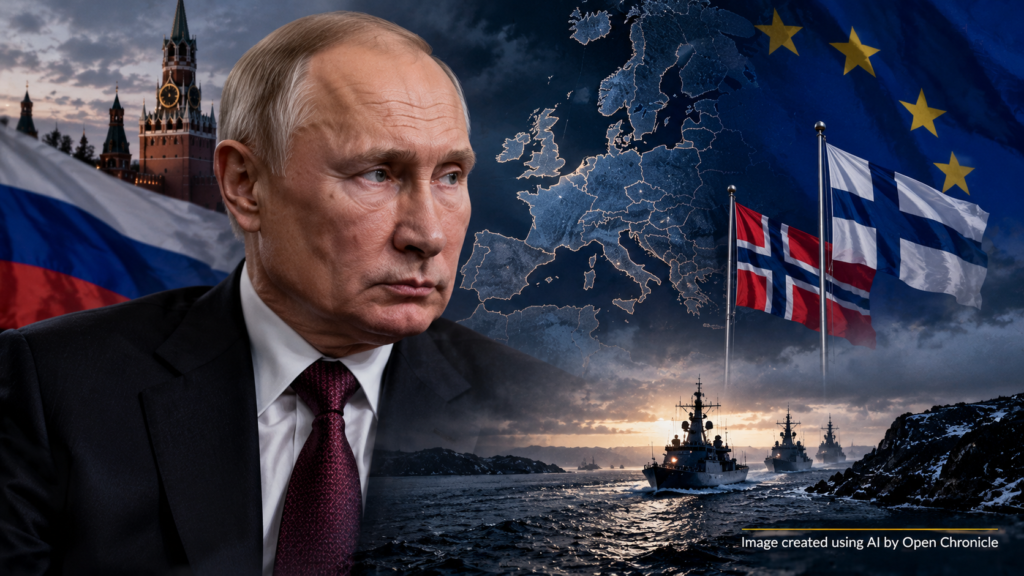
The Russian president says Moscow is open to restoring diplomatic relations with European countries, while warning against military escalation and restrictions on navigation in the Baltic Sea.
By Open Chronicle with agencies
MOSCOW, Russia — October 29, 2026
Russian President Vladimir Putin said Thursday that Moscow supports efforts to restore relations with European countries, but warned that a wider military confrontation would leave no winners.
Speaking to reporters after hosting a summit with African leaders, Putin said Russia remained prepared for a potential conflict with Europe while insisting that Moscow did not seek such an outcome.
His comments followed telephone conversations earlier this week with Finnish President Alexander Stubb and Norwegian Prime Minister Jonas Gahr Støre, contacts that Putin welcomed despite reported criticism from some European capitals.
“We support any steps…we support any actions aimed at restoring full-fledged and complete relations with European countries,” Putin said.
The remarks combined an offer of renewed diplomatic engagement with a warning about the consequences of further military escalation.
Moscow Signals Openness to Renewed European Dialogue
Putin described the recent telephone contacts with Finland and Norway as constructive steps toward restoring communication between Russia and European governments.
He said Stubb and Støre had been right to initiate contact, despite criticism that the conversations risked breaking European diplomatic ranks.
The Russian president argued that maintaining channels of communication was preferable to allowing tensions to develop without direct dialogue.
His statements suggested that Moscow remains interested in rebuilding at least some diplomatic relationships with European countries, even as disagreements over European security continue.
However, Putin did not announce a new diplomatic initiative, provide a timetable for negotiations or outline specific conditions for restoring relations.
The comments therefore represent a statement of Russia’s position rather than evidence of an agreed diplomatic breakthrough.
Putin Warns Against Military Escalation
Alongside his appeal for renewed dialogue, Putin delivered a warning about the consequences of a possible confrontation between Russia and European countries.
“First of all, we are ready, but we want no war with Europe,” he said.
He argued that countries seeking to confront Russia had failed to achieve what he described as their objective of inflicting a strategic defeat on Moscow.
Putin then warned that further escalation could produce consequences extending beyond the interests of any individual government.
“And if things go too far, there will be no winners at all. Let no one forget that,” he said.
The remarks underscored the tension between Moscow’s stated willingness to engage diplomatically and its continued emphasis on military readiness.
Putin’s reference to a strategic defeat reflects the Russian government’s characterization of its confrontation with Western countries. It should not be understood as an independently established description of European governments’ collective objectives.
Finland and Norway Become Channels of Communication
The telephone conversations with the leaders of Finland and Norway were a central element of Putin’s remarks.
Both countries occupy important positions in northern European security.
Finland shares a long land border with Russia, while Norway borders Russia in the Arctic region and has longstanding interests in regional maritime security.
Their relationships with Moscow are therefore closely connected to questions of border stability, military activity and security arrangements in northern Europe.
According to Putin, the decision by Stubb and Støre to engage directly with him was appropriate despite objections reportedly expressed elsewhere in Europe.
The conversations also highlighted the continuing debate over how European governments should manage diplomatic communication with Russia during periods of heightened tension.
Some governments regard direct contacts as necessary for crisis management and reducing the risk of miscalculation. Others have expressed concerns that separate diplomatic initiatives could weaken coordination over European security policy.
The information available about the calls does not establish that Finland, Norway and Russia reached any new agreements.
Baltic Sea Navigation Emerges as a Major Concern
Putin also addressed maritime security in the Baltic Sea, warning against measures that could restrict navigation or create additional confrontation.
He said Russia did not want obstacles to shipping in the region and suggested that restrictions could lead to a dangerous escalation.
The Baltic Sea is a strategically important maritime corridor connecting Russia, northern European countries and major international trade routes.
Commercial shipping, energy transportation, port operations and military activity all contribute to the region’s security significance.
Disruptions to navigation could have consequences for trade and regional stability, particularly if maritime incidents became part of a wider political or military confrontation.
Putin said Moscow wanted to avoid such developments but would respond to challenges affecting its interests.
“We don’t want that, but we will respond to any challenge,” he said.
He did not specify which measures Russia might take or identify a particular maritime restriction that would trigger a response.
Putin Draws Comparison With the Strait of Hormuz
The Russian president compared the potential consequences of tensions in the Baltic Sea with disruptions affecting the Strait of Hormuz following the outbreak of the U.S.-Iranian conflict in February 2026.
“Does someone want the same situation in the Baltic as in the Gulf or the Strait of Hormuz?” Putin asked.
The comparison was intended to emphasize the risks associated with confrontation in strategically important maritime corridors.
The Strait of Hormuz is one of the world’s most important energy transportation routes, linking the Persian Gulf with international markets.
The Baltic Sea serves a different commercial and geographic role, but it is similarly important to the countries whose shipping routes and economic activities depend on access to its waters.
Putin’s comments raised the possibility that disputes over maritime access could become another source of confrontation between Russia and European governments.
His remarks did not establish that a comparable disruption was imminent in the Baltic Sea.
Diplomacy and Deterrence in Russia’s European Policy
Putin’s statements presented two elements of Moscow’s approach to relations with Europe.
The first was an expressed willingness to restore diplomatic communication and improve relations with European governments.
The second was an insistence that Russia remained prepared to respond to military or maritime challenges.
These positions are not necessarily incompatible from Moscow’s perspective, but they illustrate the difficulty of rebuilding confidence while security tensions remain unresolved.
The Russian president’s comments also placed renewed attention on the role of direct communication between national leaders.
Diplomatic engagement can provide opportunities to clarify intentions, address incidents and explore possible areas of agreement. However, the restoration of broader relations would require substantive negotiations and reciprocal decisions.
No such process was announced during Putin’s remarks.
No Diplomatic Breakthrough Announced
Putin’s comments came at a time when European security, maritime access and relations with Moscow remain subjects of significant international concern.
His endorsement of the telephone contacts with Finland and Norway indicated support for maintaining communication with European governments.
At the same time, his warnings about military escalation and the Baltic Sea demonstrated that substantial disagreements persist.
The statements did not include a formal proposal for negotiations, a change in Russia’s military posture or an agreement with European leaders.
For now, the immediate significance of Putin’s remarks lies in the contrast between his stated desire for improved relations and his warning that a wider confrontation could produce consequences for all sides.
Whether the recent diplomatic contacts lead to further discussions will depend on decisions taken by Moscow and European governments in the coming weeks.
Sources and Further Reading
The following sources support Putin’s statements, the diplomatic contacts with Finland and Norway, and the wider European security context.
01. Reuters — Putin Says Moscow Seeks Better European Ties After Call With Nordic Leaders
October 29, 2026 · International News Reporting
Reporting on Putin’s statements about restoring relations with European countries, military escalation and Baltic Sea navigation.
Reuters · International
02. Reuters — Two Nordic Leaders Urge Putin to End Ukraine War in Rare Direct Contact
October 27, 2026 · International Diplomacy
Details the 90-minute conversation and the positions expressed by the Finnish and Norwegian leaders.
Reuters · reuters.com
03. Reuters — Norway’s Premier Says Call With Putin Was Effort to Present European Views
October 28, 2026 · European Security and Diplomacy
Explains the diplomatic initiative and reactions from other European governments.
Reuters · via MarketScreener
04. Associated Press — Nordic Leaders Speak With Putin Amid Ukraine Peace Efforts
October 27, 2026 · International News Reporting
Provides context on the war in Ukraine, diplomatic discussions and continuing hostilities.
Read Associated Press Report →
Associated Press · apnews.com
05. The Guardian — Europe’s Rift Over Whether to Reopen Dialogue With Putin
October 29, 2026 · European Political Analysis
Examines differing European positions on direct communication with Moscow.
The Guardian · theguardian.com
Editorial Note
This article is based on statements made by Russian President Vladimir Putin on October 29, 2026, following a summit with African leaders in Moscow, together with independent reporting on his recent telephone conversations with Finnish President Alexander Stubb and Norwegian Prime Minister Jonas Gahr Støre. Putin’s descriptions of Russia’s intentions, European military objectives and the consequences of escalation are attributed to him and should not be interpreted as independently verified assessments. The article distinguishes diplomatic contacts from formal negotiations or agreements. No new agreement to end the war in Ukraine or restore Russia’s relations with European countries was announced.