
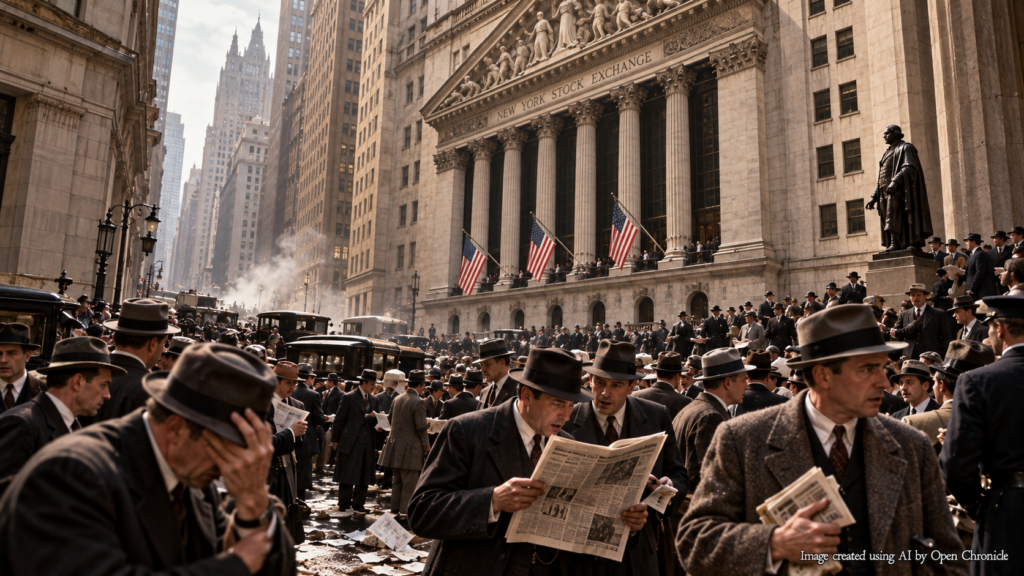
How a historic wave of selling on the New York Stock Exchange shattered confidence in America’s economic prosperity, accelerated a financial collapse and became an enduring symbol of the Great Depression.
By Open Chronicle History Desk
On the morning of October 29, 1929, thousands of investors waited anxiously for the opening of the New York Stock Exchange.
The previous week had already brought extraordinary turmoil.
Stock prices had fallen sharply.
Banks and financial institutions had attempted to restore confidence.
Newspapers reported growing panic.
Across the United States, ordinary people who had invested their savings in the stock market watched their financial security disappear.
But the worst was not over.
When trading began on Tuesday, October 29, selling pressure overwhelmed the market.
Investors rushed to dispose of their shares.
Buyers became increasingly difficult to find at previously accepted prices.
The market’s downward movement accelerated.
By the end of the session, approximately 16.4 million shares had changed hands, an extraordinary volume for the time.
The Dow Jones Industrial Average fell nearly 12 percent that day.
The event became known as Black Tuesday.
It was one of the most dramatic episodes in American financial history.
Yet the significance of October 29 extended far beyond Wall Street.
The crash exposed weaknesses that had developed during a decade of rapid economic expansion.
Speculative investment, heavy borrowing, uneven prosperity and fragile financial institutions had created conditions in which a collapse in confidence could have devastating consequences.
The crash did not single-handedly cause the Great Depression.
The economic disaster that followed resulted from several interacting forces, including banking failures, monetary contraction, declining demand, debt burdens and international financial instability.
But Black Tuesday became the most recognizable symbol of the transition from the optimism of the Roaring Twenties to the hardship of the 1930s.
It marked a profound change in how Americans understood financial markets, economic security and the responsibilities of government.
The events of October 29 also raised questions that remain relevant today.
How can financial speculation become detached from economic reality?
Why do investors sometimes act collectively in ways that intensify a crisis?
What happens when confidence disappears from a financial system built on credit?
And how should governments and central banks respond when markets begin to collapse?
To understand Black Tuesday, it is necessary to examine the economic world that existed before the crash, the events that unfolded during October 1929 and the long consequences that followed.
1. America in the Roaring Twenties
The United States experienced significant economic expansion during much of the 1920s.
Industrial production increased.
Consumer goods became more widely available.
Automobiles, radios and electrical appliances transformed everyday life.
New manufacturing techniques increased productivity.
Advertising encouraged consumption.
For many Americans, the decade appeared to represent an era of unprecedented opportunity.
The stock market became a symbol of that prosperity.
2. The Rise of Mass Consumer Culture
The expansion of consumer credit helped reshape American society.
Families increasingly purchased automobiles, furniture and household appliances through installment payments.
Advertising promoted new lifestyles.
Radio broadcasting connected millions of households.
Mass production reduced the cost of many products.
The economy appeared increasingly modern and dynamic.
But growing dependence on credit also created vulnerabilities.
Consumers and businesses could become exposed when income or confidence declined.
3. The Stock Market Becomes a National Obsession
During the 1920s, participation in the stock market expanded.
Newspapers devoted considerable attention to share prices.
Financial success stories encouraged speculation.
Some investors believed that rising prices reflected a permanent transformation of the American economy.
Others entered the market because they feared missing an opportunity.
The expectation of continuing gains became a powerful influence on investment decisions.
4. The Promise of Easy Wealth
Stock prices rose dramatically during the second half of the decade.
Investors who purchased shares early in the boom sometimes made substantial profits.
Their success attracted others.
The belief that stocks would continue rising became increasingly widespread.
Speculative enthusiasm spread beyond experienced investors.
But rising prices did not guarantee that underlying corporate earnings or economic conditions could support every valuation.
The market became vulnerable to a reversal in expectations.
5. Buying Stocks on Margin
Many investors purchased stocks using borrowed money.
This practice was known as buying on margin.
An investor could pay only part of the purchase price and borrow the remainder.
If the stock rose, the investor could achieve a large return relative to the initial investment.
But if the price fell, losses could be magnified.
Brokers could demand additional funds.
Investors unable to meet those demands might be forced to sell.
Margin borrowing therefore increased the danger of a self-reinforcing market decline.
6. The Expansion of Broker Loans
The financial boom encouraged a substantial expansion of credit connected to securities markets.
Banks and other lenders provided funds that supported speculative positions.
The availability of credit helped sustain rising prices.
But it also created links between financial institutions and market conditions.
A sudden collapse in share prices could threaten borrowers and lenders simultaneously.
The stock market was not isolated from the wider economy.
7. Uneven Prosperity
The economic expansion of the 1920s did not benefit every American equally.
Many industrial workers experienced improvements in living standards.
But farmers had struggled with low prices and debt for much of the decade.
Some industries faced overcapacity.
Income and wealth were distributed unevenly.
These problems did not make a depression inevitable.
They did, however, complicate the picture of universal prosperity.
8. The Agricultural Crisis
American farmers faced serious difficulties before the stock market crash.
During the First World War, agricultural production had expanded to meet strong demand.
After the war, prices declined.
Many farmers remained burdened by debt.
Rural banks were exposed to agricultural weakness.
The problems of farming communities demonstrated that parts of the economy were already under pressure.
The prosperity of Wall Street did not represent the condition of the entire country.
9. The Federal Reserve
The Federal Reserve had been established in 1913.
By 1929, it was responsible for important aspects of American monetary and banking policy.
Officials faced a difficult problem.
They were concerned about speculative activity in the stock market.
But measures intended to restrain speculation could also affect legitimate economic activity.
Monetary policy became part of the broader debate about the boom.
The Federal Reserve’s decisions before and during the Depression remain subjects of historical analysis.
10. Warning Signs in 1929
The American economy showed signs of weakening before the October crash.
Industrial production began to decline.
Some sectors experienced reduced demand.
The stock market nevertheless continued to attract speculative interest.
The contrast between weakening economic indicators and elevated share prices increased the risk of a sudden correction.
Investors did not all recognize the danger.
Others believed that any decline would be temporary.
11. September 1929: The Market Peak
The Dow Jones Industrial Average reached its pre-crash closing peak on September 3, 1929.
The index closed at approximately 381 points.
It had risen dramatically over previous years.
The peak later became an important reference point for measuring the collapse.
At the time, however, few investors knew that the market had entered a prolonged downturn.
The belief in continuing prosperity remained influential.
12. Confidence Begins to Erode
During September and October, share prices became increasingly unstable.
Selling pressure appeared.
Investors began questioning valuations.
Financial commentators offered conflicting interpretations.
Some argued that the market was experiencing a healthy correction.
Others warned of excessive speculation.
Uncertainty gradually undermined confidence.
As prices fell, leveraged investors became more vulnerable.
13. October 24: Black Thursday
On Thursday, October 24, 1929, the market experienced a major wave of selling.
The day became known as Black Thursday.
Trading volume was extraordinarily high.
Prices fell sharply during the session.
A group of prominent bankers intervened in an effort to restore confidence.
Their actions helped stabilize parts of the market temporarily.
But the underlying problems remained.
14. The Bankers’ Intervention
Leading financial institutions attempted to calm investors.
Representatives of major banks organized purchases of selected shares.
The intervention was intended to demonstrate confidence in the market.
For a brief period, it appeared to work.
But the strategy could not eliminate the scale of speculative borrowing or the uncertainty surrounding stock valuations.
The market remained fragile.
15. The Weekend of Anxiety
After Black Thursday, investors spent the weekend assessing their losses.
Newspapers reported dramatic market developments.
Rumors circulated.
Some investors hoped that prices would recover.
Others feared further declines.
The psychological atmosphere became increasingly tense.
The market’s stability depended heavily on whether buyers would return.
16. October 28: Black Monday
On Monday, October 28, the market suffered another severe decline.
The Dow Jones Industrial Average fell approximately 12.8 percent.
The scale of the fall was extraordinary.
Confidence deteriorated further.
Investors who had expected a recovery began reconsidering their positions.
The decline intensified the pressure on those who had borrowed money to purchase shares.
The following day would bring another historic sell-off.
17. October 29: Black Tuesday
On Tuesday, October 29, selling pressure continued.
The New York Stock Exchange experienced an overwhelming volume of orders.
Investors attempted to sell shares as prices declined.
The imbalance between sellers and buyers created severe downward pressure.
Market participants struggled to process the scale of trading.
The session became one of the most famous days in financial history.
18. The Trading Volume
Approximately 16.4 million shares changed hands on October 29.
For the period, the figure was unprecedented.
The trading volume reflected the extraordinary pressure on the market.
Communication and transaction-processing systems were far less advanced than modern electronic exchanges.
The flood of orders created delays.
Investors often struggled to obtain timely information about prices and transactions.
19. The Dow Jones Collapse
The Dow Jones Industrial Average fell approximately 11.7 percent on Black Tuesday.
The index closed at 230.07.
The decline followed the even larger percentage fall of the previous day.
Together, the two sessions represented a devastating loss of market value.
The collapse shocked investors.
It also demonstrated how quickly confidence could disappear from a speculative market.
20. The Mechanics of Panic
Financial panics can become self-reinforcing.
Falling prices encourage investors to sell.
Selling places additional pressure on prices.
Lower prices create new losses.
Borrowers may face margin calls.
Forced selling can intensify the decline.
This process helps explain why market crashes can become much more severe than ordinary corrections.
Black Tuesday demonstrated the destructive potential of such dynamics.
21. The Human Experience
For individual investors, the crash could be financially devastating.
Some lost savings accumulated over many years.
Others faced debts they could no longer repay.
Families that had believed themselves financially secure confronted sudden uncertainty.
The emotional impact was profound.
But the popular image of virtually every American owning stocks is inaccurate.
Direct stock ownership was concentrated in a minority of households.
The wider economic consequences would eventually reach far beyond those investors.
22. The Myth of Mass Suicides
Popular accounts sometimes suggest that large numbers of ruined investors immediately jumped from Wall Street buildings.
This image became part of the mythology surrounding the crash.
Historical research does not support the idea of a widespread wave of suicides on Black Tuesday.
Some suicides were associated with financial distress during the period.
But sensational stories often exaggerated their frequency and circumstances.
The distinction matters because the real suffering caused by the Depression requires no embellishment.
23. The Crash Was Not the Entire Depression
Black Tuesday is frequently described as the event that caused the Great Depression.
The relationship was more complicated.
The American economy had already begun weakening before October 1929.
The stock market collapse damaged confidence and wealth.
But the prolonged Depression developed through additional financial and economic mechanisms.
Banking crises, monetary contraction, declining spending and international disturbances all played major roles.
The crash was a major turning point, not a complete explanation.
24. Falling Consumer Confidence
The collapse undermined expectations about future prosperity.
Households became more cautious.
Some reduced spending.
Businesses reconsidered investment plans.
The loss of confidence affected economic activity.
Lower demand could reduce production.
Reduced production could lead to unemployment.
Unemployment, in turn, weakened spending further.
The economy entered a dangerous downward cycle.
25. Business Investment Declines
Businesses faced an increasingly uncertain economic environment.
Share prices had fallen.
Financing conditions became more difficult.
Demand weakened.
Companies postponed expansion.
Some reduced production.
Others cut employment.
The contraction in investment contributed to the broader economic downturn.
The crash was therefore linked to real economic consequences through multiple channels.
26. The Banking System
The American banking system was fragmented.
Thousands of banks operated across the country.
Many were relatively small.
Bank failures had occurred even during the 1920s.
As economic conditions deteriorated, banks faced growing pressure.
Borrowers struggled to repay loans.
Depositors became anxious.
The financial system’s weaknesses would become increasingly apparent.
27. The Banking Panics
Between 1930 and 1933, the United States experienced successive banking crises.
Depositors withdrew funds from institutions they feared might fail.
Some banks lacked sufficient liquidity to meet sudden demands.
Failures destroyed deposits and reduced access to credit.
The banking panics deepened the economic contraction.
They were central to the severity of the Great Depression.
28. The Money Supply Contracts
The American money supply contracted sharply during the early 1930s.
Bank failures and declining lending contributed to the contraction.
Deflation increased the real burden of debt.
Falling prices did not automatically restore prosperity.
Instead, declining incomes and debt pressures reinforced the downturn.
Economists have debated the precise relative importance of monetary, financial and real economic factors.
But monetary contraction is widely recognized as a major element of the Depression.
29. The Federal Reserve’s Response
The Federal Reserve has faced extensive historical criticism for its response to the Depression.
Its actions did not prevent severe banking failures or the contraction of money and credit.
Institutional constraints, competing economic ideas and the international monetary system influenced policy.
Later research emphasized the importance of the Federal Reserve’s failures during the banking crises.
The experience fundamentally shaped modern thinking about central banking.
30. The Gold Standard
The international gold standard linked currencies to gold at established rates.
It constrained monetary policy.
Countries attempting to defend their exchange rates could face pressure to raise interest rates or restrict credit.
During the Depression, these constraints contributed to the international transmission of deflationary pressures.
Countries that abandoned gold earlier often gained greater freedom to pursue recovery policies.
The gold standard became a major subject of economic historical research.
31. The Crisis Spreads Internationally
The Depression became a global economic catastrophe.
International trade contracted.
Financial flows were disrupted.
Countries faced declining production and employment.
The effects differed across national economies.
But the interconnected financial system transmitted shocks.
The crisis demonstrated that economic instability could spread far beyond the country where a major financial disturbance first became visible.
32. Germany’s Economic Crisis
Germany was particularly vulnerable to international financial instability.
Its economy depended partly on foreign lending.
The withdrawal of credit and the broader downturn contributed to severe economic difficulties.
Unemployment rose dramatically.
Political tensions intensified.
The Depression weakened confidence in democratic institutions.
Economic hardship became one factor in the rise of extremist political movements.
33. The Rise of Political Extremism
The Great Depression contributed to political instability in several countries.
Mass unemployment and declining living standards undermined confidence in established political systems.
Extremist parties exploited fear and resentment.
In Germany, the Nazi movement gained support during the economic and political crisis.
The Depression did not make the rise of Adolf Hitler inevitable.
But it created conditions that helped destabilize the Weimar Republic.
34. The Collapse of International Trade
World trade contracted sharply during the Depression.
Falling demand reduced imports and exports.
Governments introduced protectionist measures.
International financial problems made trade more difficult.
The decline harmed producers and workers in many countries.
The global economy became increasingly fragmented.
Economic nationalism intensified.
35. The Smoot-Hawley Tariff
In 1930, the United States enacted the Smoot-Hawley Tariff Act.
The legislation increased tariffs on many imported goods.
Other countries responded with their own trade restrictions.
The tariff contributed to international trade tensions.
But historians and economists generally do not regard it as the sole or primary cause of the Great Depression.
Its significance lies in the broader movement toward protectionism during a period of collapsing international demand.
36. Herbert Hoover
Herbert Hoover became President of the United States in March 1929.
He entered office during a period of apparent prosperity.
The economic crisis transformed his presidency.
Hoover initially emphasized cooperation between government and business.
His administration later adopted measures including public works initiatives and financial support mechanisms.
But the Depression deepened.
Public dissatisfaction increased.
Hoover became closely associated with the economic disaster.
37. The Human Cost of Unemployment
Unemployment rose dramatically during the Depression.
By 1933, approximately one-quarter of the American labor force was unemployed, according to commonly cited historical estimates.
Millions of families faced poverty.
Many lost homes.
Others depended on charitable assistance.
The crisis affected health, education and family life.
Its consequences were not limited to financial markets.
They reshaped American society.
38. Breadlines and Soup Kitchens
Breadlines became enduring images of the Depression.
Unemployed workers waited for food assistance.
Charitable organizations attempted to respond to growing need.
Soup kitchens provided meals.
But private charity could not meet the scale of economic hardship.
The crisis intensified debate over the responsibilities of government.
It also exposed the limitations of existing social protections.
39. Hoovervilles
Informal settlements appeared in American cities.
Many were built from scrap materials.
They became known as Hoovervilles, reflecting public criticism of President Hoover.
The settlements symbolized the housing insecurity created by the Depression.
Their residents included people who had lost employment, income and homes.
The name became part of the political language of the era.
40. The Election of 1932
The economic crisis transformed American politics.
In the presidential election of 1932, Franklin D. Roosevelt defeated Herbert Hoover.
Roosevelt promised a New Deal for the American people.
His victory reflected widespread dissatisfaction with existing economic conditions.
The election marked a major political turning point.
It opened the way for a significant expansion of federal economic intervention.
41. Franklin D. Roosevelt and the New Deal
Roosevelt took office in March 1933.
His administration introduced a wide range of emergency and reform measures.
These included banking stabilization, employment programs, financial regulation and public works.
The New Deal did not immediately end the Depression.
But it changed the relationship between the federal government and the economy.
It also created institutions that would shape American life for generations.
42. The Banking Holiday
Shortly after taking office, Roosevelt declared a national banking holiday.
The temporary closure was intended to stabilize the banking system.
Congress passed emergency banking legislation.
Authorities reviewed banks before permitting them to reopen.
Roosevelt used radio broadcasts to explain the measures to the public.
The intervention helped restore confidence in parts of the banking system.
43. The Securities Act of 1933
The Securities Act of 1933 introduced new federal requirements for securities offerings.
Its purpose included improving disclosure and reducing fraud.
The legislation reflected growing recognition that financial markets required stronger oversight.
Investors needed reliable information.
The law became an important foundation of modern American securities regulation.
44. The Securities Exchange Act of 1934
The Securities Exchange Act of 1934 created the Securities and Exchange Commission.
The SEC became responsible for overseeing important aspects of securities markets.
The legislation established a stronger federal regulatory framework.
It aimed to improve market integrity and investor protection.
The reforms were part of the broader institutional response to the financial failures exposed by the crash and Depression.
45. Deposit Insurance
The Banking Act of 1933 established the Federal Deposit Insurance Corporation.
Deposit insurance was intended to protect eligible bank depositors and reduce the incentive for destructive bank runs.
The system began operating in 1934.
It became a central feature of American financial stability.
The creation of deposit insurance reflected lessons learned from the banking panics.
46. The Market’s Long Recovery
The Dow Jones Industrial Average continued falling long after October 1929.
It reached its Depression-era low in July 1932.
The index had lost approximately 89 percent of its value from the September 1929 peak.
The Dow did not return to its 1929 nominal peak until November 1954.
This long interval illustrates the depth of the market collapse.
It also reminds us that financial recovery and broader economic recovery are not identical.
47. The Great Depression and the Second World War
The American economy experienced periods of recovery during the 1930s.
But unemployment remained high.
A renewed downturn occurred in 1937–1938.
The massive mobilization associated with the Second World War eventually transformed production and employment.
Wartime demand brought the United States to full employment.
The Depression’s economic and political legacy nevertheless endured.
48. The Crash in Historical Memory
Black Tuesday became a symbol of financial disaster.
Photographs of crowded streets and worried investors entered popular culture.
Newspapers, documentaries and textbooks presented October 29 as a decisive turning point.
The date became shorthand for the end of the Roaring Twenties.
But historical memory sometimes compresses a complex economic collapse into a single dramatic day.
The broader story is more important than the symbolism alone.
49. Lessons for Modern Financial Markets
The crash of 1929 continues to influence financial regulation and economic policy.
It demonstrated the risks of excessive leverage.
It revealed the danger of speculative expectations.
It showed how financial instability could damage the real economy.
The Depression also highlighted the importance of banking stability and monetary policy.
Modern financial systems differ greatly from those of 1929.
But questions about confidence, credit and systemic risk remain central.
50. Why October 29 Matters
October 29, 1929 marks one of the most famous stock market collapses in history.
Black Tuesday shattered confidence in the American financial boom.
It accelerated a market decline that had already begun.
It became closely associated with the onset of the Great Depression.
The economic catastrophe that followed reshaped American politics, international relations and financial regulation.
Its consequences extended far beyond Wall Street.
The date remains a warning about the vulnerability of financial systems when speculation, debt and uncertainty interact.
October 29, 1929: The Day Confidence Collapsed
Imagine New York at the end of Black Tuesday.
The trading floor has emptied.
The last orders have been processed.
Financial clerks are still working through the extraordinary volume of transactions.
Investors gather outside brokerage offices.
Some are stunned.
Others are angry.
Many cannot yet comprehend the scale of their losses.
The optimism that had defined the decade is giving way to fear.
But the people standing on Wall Street do not know what the next four years will bring.
They do not know that thousands of banks will fail.
They do not know that unemployment will reach catastrophic levels.
They do not know that the economic crisis will destabilize governments across the world.
They do not know that the financial system will eventually be transformed by new institutions and regulations.
They know only that the market has collapsed.
The events of October 29 became a defining moment because they revealed how fragile confidence can be.
A decade of optimism had encouraged millions to believe in continuing prosperity.
The crash destroyed that assumption.
The Great Depression would demonstrate that economic crises are not confined to stock exchanges.
They affect workers, families, communities and political institutions.
They can reshape the course of history.
On October 29, 1929, Wall Street experienced Black Tuesday. The collapse did not by itself cause the Great Depression, but it became the most enduring symbol of an economic disaster that transformed the modern world.