
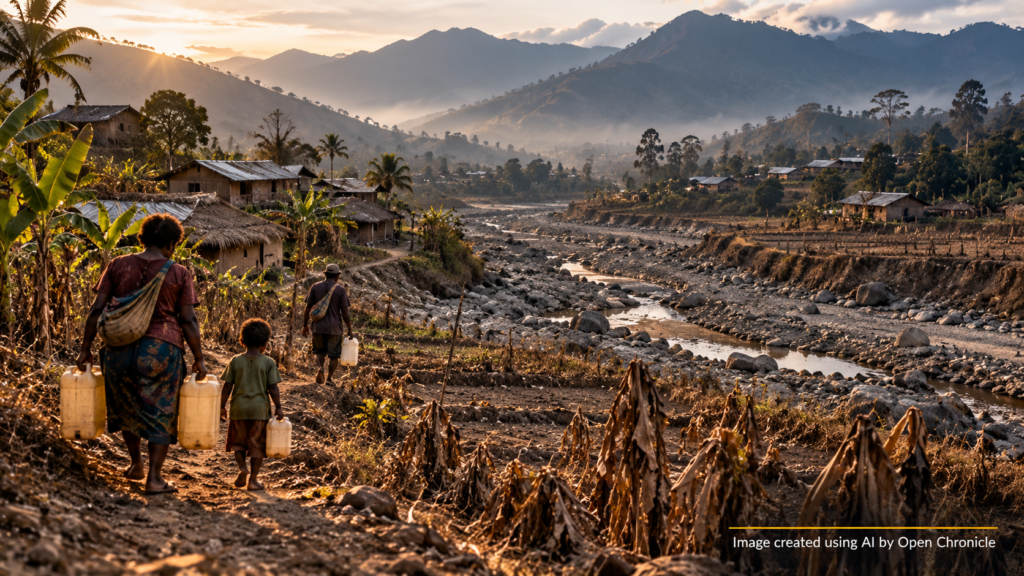
Water sources are disappearing, crops are failing and remote communities are struggling to survive as one of the Pacific’s most serious climate emergencies unfolds far from international headlines.
By Open Chronicle
PORT MORESBY, Papua New Guinea | October 30, 2026
In the remote mountains and scattered island communities of Papua New Guinea, a humanitarian emergency is unfolding with little of the international attention normally associated with a disaster affecting millions of people.
Rivers are shrinking. Village wells and water tanks are running dry. Food gardens that sustain families throughout the year are failing under prolonged heat and unusually dry conditions.
In parts of the Highlands, frost has compounded the damage, destroying crops already weakened by drought.
For communities that depend on subsistence agriculture, the consequences extend far beyond reduced harvests. Food shortages, contaminated drinking water, interrupted schooling and rising health risks are placing growing pressure on households with few alternatives.
The government has identified more than 5.5 million people as affected, exposed or at high risk from the drought, although officials caution that the figure remains provisional because provincial assessments use different methods.
In Southern Highlands province alone, approximately 300,000 people reportedly lack reliable access to safe drinking water.
The emergency is associated with an exceptionally strong El Niño event that has disrupted rainfall patterns across the Pacific.
But the crisis is also exposing deeper vulnerabilities in Papua New Guinea, where difficult terrain, limited transport infrastructure and dependence on local food production can turn prolonged dry weather into a threat to entire communities.
A National Emergency Hidden in Remote Communities
Papua New Guinea is geographically complex.
Its population is distributed across mountainous interior regions, river valleys, coastal settlements and hundreds of islands.
Many rural communities depend on gardens for food, nearby streams for water and difficult transport routes for access to markets and medical care.
When rainfall declines, these systems can deteriorate simultaneously.
In October, Health and National Disaster Services Minister Dr Billy Joseph described the drought as a national humanitarian emergency.
Government assessments identified severe conditions across numerous provinces, including parts of the Highlands, the National Capital District, Western Province and several coastal and island regions.
The assessments documented declining water availability, crop losses, disruption to schools and pressure on health facilities.
Some of the most vulnerable communities are also among the hardest to reach.
For families living several hours or days from major roads, obtaining emergency supplies may require difficult journeys or expensive transport.
This geographical isolation makes early intervention particularly important.
By the time widespread food shortages become visible in national statistics, individual villages may already have exhausted their local reserves.
When Food Gardens Stop Producing
Agriculture is central to life in rural Papua New Guinea.
Sweet potatoes, taro, bananas, vegetables and other crops provide food and income for many households.
The system offers a degree of independence from commercial food markets, but it also creates vulnerability when rainfall becomes unreliable.
In Southern Highlands province, government assessments reported reductions of approximately 60 to 75 percent in sweet potato yields.
Frost damage has added to agricultural losses in parts of the Highlands.
In September, Australia’s ABC documented communities where freezing nights followed by intense daytime sunshine had devastated food gardens.
Residents described the destruction of crops that would normally sustain families through subsequent months.
The consequences of failed harvests are not always immediate.
A household may initially survive on stored food, smaller harvests or assistance from relatives.
As reserves diminish and replacement crops fail to mature, food insecurity can intensify.
This creates a delayed humanitarian risk: even if rainfall returns, damaged gardens may take months to recover.
Water Is Becoming the Most Urgent Problem
Food shortages are only one dimension of the emergency.
Access to safe drinking water is increasingly difficult in affected areas.
Government reports describe rivers, springs, wells and storage tanks drying up.
In Southern Highlands, an estimated 300,000 people lack reliable access to safe water.
Water shortages have also affected urban supplies, including reservoirs serving the National Capital District.
In remote settlements, families may have to travel farther to collect water, increasing the burden on women, children and elderly residents.
When safe supplies disappear, communities may resort to contaminated rivers or other unreliable sources.
Health authorities have warned of heightened risks of diarrhoeal disease, dysentery, typhoid, skin infections and malnutrition.
The effects are especially serious for young children, pregnant women and people with existing medical conditions.
A shortage of water can also reduce the ability of health facilities to maintain sanitation and provide essential services.
Schools and Health Facilities Under Pressure
The drought is disrupting institutions that communities depend on for stability.
In Southern Highlands, government assessments indicated that more than 95 percent of schools had experienced some form of impact.
Elsewhere, some schools have suspended classes because of water shortages.
Teachers and families may also struggle to maintain regular attendance when obtaining food and water becomes a daily priority.
The consequences can persist beyond the immediate emergency.
Extended school interruptions affect educational progress, while worsening household hardship can make it difficult for children to return to normal routines.
Health facilities face parallel pressures.
Reduced water availability complicates sanitation, while drought-related illness can increase demand for medical treatment.
The government has identified emergency water supplies, water infrastructure repairs and the continued operation of schools and healthcare facilities as priorities.
The Unexpected Threat of Frost
One of the most striking aspects of Papua New Guinea’s drought is the interaction between prolonged dry conditions and freezing temperatures in high-altitude areas.
Although the country lies in the tropics, some mountain communities experience cold nights.
Dry atmospheric conditions can contribute to sharp overnight temperature drops.
In affected locations, frost has damaged crops already struggling with limited moisture.
The combination can be particularly destructive.
Plants weakened by water shortages may be unable to recover after frost damage, leaving families without an expected harvest.
Reports from Central Province and Southern Highlands describe losses involving sweet potatoes, taro, bananas and sugar cane.
The phenomenon illustrates why the drought cannot be understood simply as a period of hot weather.
Its effects vary substantially according to altitude, geography and local agricultural conditions.
Bushfires Add Another Layer of Destruction
Prolonged dry weather has also increased the risk of vegetation fires.
In Simbu province, local reporting has described fires spreading through dry grass and vegetation, destroying homes and agricultural areas.
National Broadcasting Corporation Papua New Guinea reported that families in Chuave district had lost homes and stored food to fires during October.
Such losses can be devastating for households already struggling with poor harvests.
A family that loses its house, food reserves and agricultural equipment may have few resources available for recovery.
Fire damage can also destroy coffee gardens, livestock shelters and other sources of income.
Local officials have called for emergency assistance, including temporary shelter, food, clean water and medicines.
The Government’s Response
The national government began preparing for the developing El Niño event in June.
Prime Minister James Marape instructed provincial and district authorities to identify vulnerable communities, water sources and food security risks.
The response was designed to operate through existing disaster management structures, with local authorities responsible for adapting measures to their circumstances.
In October, officials emphasized the immediate provision of water, food and healthcare assistance.
Government assessments have also informed discussions with international development and humanitarian partners.
However, the scale and geographical complexity of the emergency create substantial challenges.
Delivering supplies to remote mountain settlements and isolated islands is costly.
In some areas, declining river levels can also affect transportation, limiting the movement of people and goods.
The effectiveness of the response will depend not only on available funding but also on whether assistance reaches vulnerable communities before their food and water reserves are exhausted.
International Organizations Warn of Worsening Conditions
The United Nations Food and Agriculture Organization has been working with Papua New Guinea’s authorities to strengthen drought preparedness and agricultural resilience.
In August, government officials and humanitarian partners reviewed a national agricultural drought action plan covering 2026 and 2027.
The plan addresses preparedness, anticipatory action, emergency response and recovery.
In October, the FAO highlighted the importance of translating climate warnings into practical assistance for farmers.
A new Agricultural Drought Action Platform, developed with the National Weather Service, is intended to provide monitoring and early warning information across all 22 provinces.
The technology could help authorities identify emerging risks and prioritize interventions.
But information alone cannot prevent hunger.
Warnings must be accompanied by practical measures, including reliable water supplies, agricultural support, transport access and assistance to households already experiencing shortages.
Why El Niño Matters
El Niño is a naturally occurring climate pattern associated with unusually warm sea surface temperatures in the central and eastern tropical Pacific Ocean.
It can alter rainfall and atmospheric circulation across large parts of the world.
For Papua New Guinea, El Niño conditions are often associated with below-average rainfall, prolonged dry periods and increased agricultural stress.
The country’s National Weather Service declared El Niño conditions in June 2026.
By October, international and regional monitoring indicated that the event was exceptionally strong.
United Nations reporting warned that the most severe consequences for agriculture and food security could emerge in the following months.
However, it is important to distinguish El Niño from long-term climate change.
El Niño is a natural climate phenomenon, while human-driven global warming is changing the background conditions in which extreme weather occurs.
Scientists continue to investigate how climate change influences the intensity, frequency and regional effects of El Niño events.
The current emergency cannot be attributed entirely to climate change without specific scientific analysis.
Nevertheless, it demonstrates how climatic extremes can interact with existing social and economic vulnerabilities.
The Risk of a Longer Humanitarian Crisis
One of the greatest dangers is that the drought’s most serious consequences may occur after the immediate period of unusually dry weather.
Food production requires time to recover.
Damaged crops cannot simply be restored by a few days of rain.
Households may need seeds, planting materials, tools and sufficient food supplies to survive until the next successful harvest.
Water infrastructure may also require repairs or replacement.
Communities affected by bushfires face additional reconstruction costs.
If these needs are not addressed, a temporary climate shock can develop into a prolonged humanitarian crisis.
This risk is particularly significant in remote communities where access to commercial markets, healthcare and government assistance is limited.
A Crisis the World Cannot Afford to Ignore
Papua New Guinea’s drought is a reminder that humanitarian emergencies do not always begin with a sudden catastrophic event.
Some develop gradually, as water sources decline, crops fail and household reserves disappear.
Their effects may be dispersed across thousands of communities rather than concentrated in a single disaster zone.
That makes them harder to document and easier for international audiences to overlook.
Yet the scale of the current emergency is substantial.
Millions of people are living in areas affected by or vulnerable to prolonged drought, while hundreds of thousands face serious challenges accessing safe water and sufficient food.
The coming months will test the capacity of national authorities, local communities and international partners to prevent further deterioration.
The most important measure of success will not be the number of emergency meetings held or plans announced.
It will be whether vulnerable families receive water, food, healthcare and agricultural support before their remaining resources are exhausted.
For communities already living through failed harvests and disappearing water supplies, the crisis is not a future possibility.
It is happening now.
Sources and Further Reading
The following institutional, governmental and journalistic sources provide the research foundation for this article. They document the developing drought emergency in Papua New Guinea, its humanitarian consequences, agricultural impacts and the response of national authorities and international organizations.
01. Papua New Guinea National Disaster Centre | Drought Emergency Assessments
October 7, 2026 | Government Assessment Reporting
Government findings reported by The National, including provincial emergency classifications, provisional population estimates, water shortages, agricultural losses and disruptions to essential public services.
Read the Government Assessment Coverage →
The National | thenational.com.pg
02. FAO | Papua New Guinea El Niño Agricultural Drought Plan of Action
August 10, 2026 | Institutional Documentation
Official documentation from the Food and Agriculture Organization covering national drought preparedness, humanitarian coordination, agricultural vulnerabilities and the development of an action plan for the 2026 and 2027 period.
Food and Agriculture Organization | fao.org
03. ABC News Australia | Frost and Dry Conditions Create Food Shortages
September 16, 2026 | Field Reporting
Reporting from rural communities on crop failures, frost damage, water shortages and the consequences of prolonged dry conditions for households dependent on subsistence agriculture.
ABC News Australia | abc.net.au
04. NBC Papua New Guinea | Prolonged Dry Season Escalates to National Humanitarian Concern
October 25, 2026 | Local News Reporting
Local reporting on food shortages, declining water supplies, drought-related health risks and destructive bushfires affecting communities in Simbu province and other vulnerable areas.
National Broadcasting Corporation PNG | nbc.com.pg
05. FAO | Papua New Guinea Marks World Food Day as El Niño Strengthens
October 16, 2026 | Agricultural Early Warning
Institutional information on agricultural drought monitoring, the ADAPt early warning platform, food security priorities and the importance of anticipatory action to protect vulnerable farming communities.
Food and Agriculture Organization | fao.org
06. United Nations | From Drought to Deluge: Super El Niño’s Expanding Reach
October 6, 2026 | International Climate Assessment
International assessment of the developing El Niño event, its potential effects on rainfall patterns and the humanitarian consequences of prolonged drought conditions in Papua New Guinea.
Read the United Nations Report →
United Nations Sustainable Development | un.org
07. Government of Papua New Guinea | Prime Minister Directs Nationwide El Niño Preparedness
June 22, 2026 | Official Government Statement
Official statement outlining the government’s early response to the developing El Niño event, including preparedness measures and responsibilities assigned to provincial and district authorities.
Read the Official Government Statement →
Government of Papua New Guinea | pmnec.gov.pg
Editorial Note
This article is based on official government statements, reporting from Papua New Guinea and Australia, and publications from United Nations agencies available as of October 30, 2026.
The figure of more than 5.5 million people refers to those reported as affected, exposed or at high risk, not exclusively to individuals already experiencing severe food insecurity. Government authorities have indicated that population estimates and provincial assessments remain subject to verification.
Reported agricultural losses, water shortages and disruptions to public services vary by province and locality. The article distinguishes observed drought impacts from projections of further deterioration.
The relationship between El Niño and the current drought is supported by national meteorological declarations and institutional reporting. Any specific attribution of the event’s severity to human-driven climate change requires additional scientific assessment.
Open Chronicle will continue to review official assessments, humanitarian developments and scientific findings as the situation evolves.