
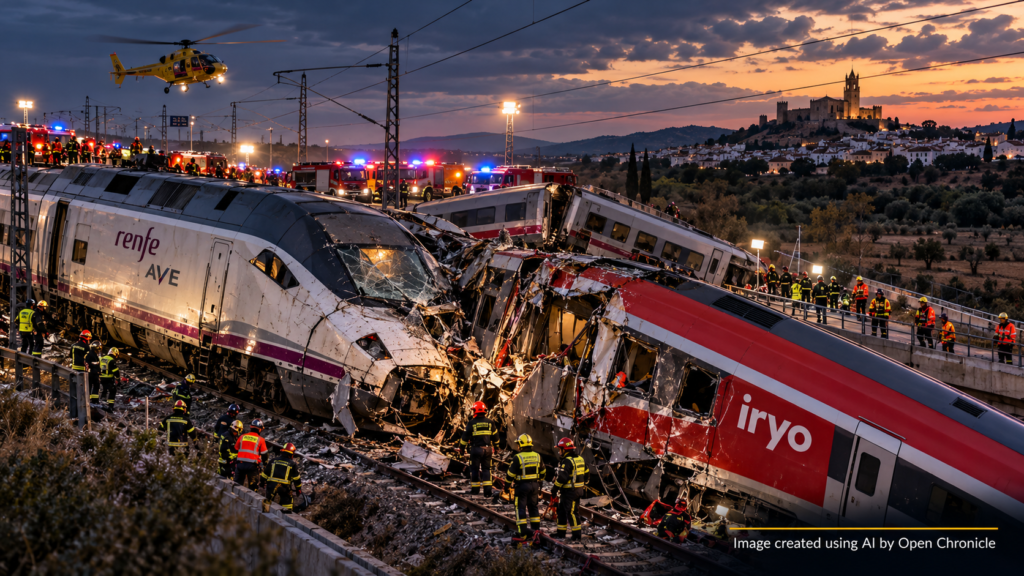
At least 69 people were killed when a Renfe high-speed train struck a stationary Iryo service near Toledo. A preliminary investigation points to a breakdown in railway safety systems followed by a sequence of operational decisions that failed to prevent the collision. The disaster has raised urgent questions about control procedures, aging technology and the safety of Europe’s largest high-speed rail network.
By Open Chronicle
MADRID, Spain | October 30, 2026
Spain is confronting one of the deadliest railway disasters in its recent history after two high-speed trains collided near the town of Urda, in Toledo province, killing at least 69 people and injuring more than 200.
The accident occurred on Wednesday, October 28, on the Madrid to Seville high-speed railway, one of the country’s most important transportation corridors.
A Renfe AVE train struck the rear of an Iryo service that had stopped on the same track following a failure of the railway’s automatic safety system.
The collision occurred at approximately 8:53 a.m., just 22 minutes after the first reported technical malfunction.
According to a preliminary investigation published by Spain’s independent transport accident investigation authority, AITAT, the Renfe train was traveling at an estimated speed of between 160 and 200 kilometers per hour when it struck the stationary train.
The precise speed has not yet been established because investigators have not completed the examination of the trains’ onboard recording devices.
The investigation has identified a sequence of technical failures, instructions and operational decisions that preceded the crash. However, the authority has emphasized that it is too early to determine the definitive causes or assign responsibility.
The tragedy has reopened a national debate about the reliability of Spain’s railway safety systems, the management of emergency operating conditions and whether existing safeguards are sufficient when automatic protection systems fail.
A Catastrophic Collision Near Toledo
The accident occurred at kilometer marker 118.8 of the Madrid to Seville high-speed line, near the approach to Urda station.
The two trains involved were an Iryo 6076 service and a Renfe AVE 2080 service, both traveling toward Seville.
The Iryo train had been unable to continue its journey following technical difficulties associated with the railway signaling system.
The Renfe train, which was traveling behind it, had initially been stopped by the same disruption.
However, the AVE subsequently received authorization from the railway control center in Madrid to resume its journey.
Approximately 17 minutes after that authorization, it collided with the rear of the stationary Iryo train.
The force of the impact caused severe damage to both trains.
The leading carriage of the Renfe service struck the final carriage of the Iryo train, with parts of the vehicles overturning and falling down an embankment.
Several carriages derailed, while the collision left passengers trapped inside damaged railway vehicles.
Emergency responders, firefighters, police officers and medical teams were dispatched to the scene.
The rescue operation was complicated by the extent of the destruction and the difficulty of accessing some sections of the wreckage.
Authorities have warned that the number of fatalities may change as identification procedures continue.
The 17 Minutes That Investigators Are Examining
The investigation has concentrated on a short period between the decision to restart the Renfe train and the collision.
Communication records, operational logs and preliminary technical findings have allowed investigators to reconstruct the sequence of events.
October 28, 2026 | Reconstructed Timeline
The sequence of events preceding the collision near Urda, Spain.
Automatic Protection System Fails
A technical malfunction affects the LZB safety system along approximately 63 kilometers of the Madrid to Seville line. Several trains stop or experience restrictions.
Renfe Train Authorized to Continue
The control center at Madrid’s Atocha station instructs the AVE driver to resume movement under an alternative signaling arrangement.
Iryo Train Reports Continuing Difficulties
The Iryo driver communicates with the control center about problems preventing the train from continuing normally.
Stationary Train Remains Unable to Restart
The Iryo driver again reports that the train remains stopped. Investigators are examining what information controllers had about the positions of both trains.
Renfe AVE Strikes the Stationary Iryo Train
The Renfe AVE strikes the stationary Iryo train near Urda at an estimated speed of between 160 and 200 kilometers per hour.
Timeline Note
The timeline is based on preliminary investigative findings and reported recordings of communications between drivers and the control center. It is subject to revision.
The reconstruction raises a central question: why was the Renfe train permitted to continue at normal operating speed when the primary safety system was unavailable and another train remained stopped ahead?
The answer will depend on a detailed examination of communications, operational instructions, signaling information and the decisions made by those managing traffic.
What Happened to the LZB Safety System?
At the center of the investigation is the LZB, a railway protection system used to monitor train movements and maintain safe operating conditions.
The system continuously communicates information between trackside infrastructure and trains.
It provides drivers with information about permitted speeds and can initiate automatic braking when necessary.
On high-speed railways, such systems are particularly important because trains operating at elevated speeds require substantial distances to stop safely.
When the LZB system failed near Urda, several trains were automatically brought to a halt.
The malfunction reportedly affected a section of approximately 63 kilometers.
The disruption required railway controllers to manage traffic using an alternative system known as Bloqueo de Señalización Lateral, or BSL.
Under these degraded operating conditions, communication between the control center and train drivers became especially important.
The failure of an automatic protection system does not necessarily mean that a railway becomes unsafe.
Railway networks are designed to operate under alternative procedures when technical systems become unavailable.
However, those procedures depend on the correct identification of train positions, accurate communication and appropriate restrictions on movement.
Investigators must now establish why those safeguards did not prevent the collision.
The Decision to Resume Normal Speed
One of the most significant elements of the investigation concerns the instructions issued by the railway control center at Madrid’s Atocha station.
According to communication recordings reported by Spanish media, the Renfe driver was authorized to continue under conditions that allowed the train to operate at normal speed.
Transport Minister Óscar Puente has questioned that decision.
He has argued that the train should instead have been required to operate under a more restrictive procedure known as marcha a la vista, or driving on sight.
Under this procedure, drivers must travel at a speed that allows them to stop before reaching an obstacle.
Reporting on the relevant railway protocol indicates that a maximum speed of 40 kilometers per hour would have applied in the circumstances described by the minister.
The difference is substantial.
A train moving at 40 kilometers per hour travels approximately 11 meters each second.
At 160 kilometers per hour, it travels approximately 44 meters each second.
At 200 kilometers per hour, that distance increases to approximately 56 meters each second.
The higher the speed, the greater the distance generally required to bring a train to a halt.
However, speed alone does not establish the cause of the disaster.
Investigators must determine whether the instructions were appropriate under the applicable regulations, whether the control center had accurate information about the stationary train and whether additional safeguards should have prevented the collision.
Why the Preliminary Investigation Rejects a Simple Explanation
The initial public discussion of the disaster focused heavily on the possibility of human error.
However, AITAT’s preliminary findings indicate that the accident may have resulted from a wider sequence of failures.
The authority has identified technical malfunctions, instructions and operational actions that together created the circumstances in which the collision occurred.
Its investigation will examine not only the immediate decisions made before the crash but also the organizational and procedural environment in which those decisions occurred.
This distinction matters because major transportation accidents rarely result from a single isolated event.
Modern railway safety depends on multiple protective measures.
If one system fails, another should ideally prevent the failure from escalating into a catastrophe.
These protective measures may include automatic train protection, signaling restrictions, control center procedures, communication protocols and operational supervision.
The investigation will seek to understand why the available defenses did not prevent the two trains from occupying the same section of track under dangerous conditions.
The authority has emphasized that all possible contributing factors remain under consideration.
A Railway Network Under Growing Pressure
Spain operates one of the world’s most extensive high-speed railway networks and the largest in Europe.
Its modern rail infrastructure has been an important part of the country’s transportation policy for decades.
High-speed services connect Madrid with major cities including Barcelona, Seville, Valencia and Málaga.
The network has expanded significantly since the first high-speed line opened between Madrid and Seville in 1992.
Competition has also increased following the introduction of additional operators alongside Renfe.
Companies such as Iryo and Ouigo have expanded passenger choice and introduced new services on major routes.
However, the growth of traffic has increased the importance of infrastructure maintenance, operational coordination and investment in modern signaling technology.
Railway unions have warned about staffing pressures, demanding working conditions and the reliability of aging systems.
These concerns do not establish that organizational problems caused the Urda disaster.
They do, however, form part of the broader operating environment that investigators may examine.
An Aging Safety System Scheduled for Replacement
The LZB system used on the affected railway line dates from the early development of Spain’s high-speed network.
It has provided automatic train protection for decades.
However, the technology is being progressively replaced by more modern European signaling systems.
The European Rail Traffic Management System, known as ERTMS, is intended to improve interoperability and support standardized train control across European railway networks.
Modern systems can provide continuous supervision of train movements and reduce reliance on incompatible national technologies.
Nevertheless, replacing a signaling system is a complex undertaking.
It requires infrastructure modifications, onboard equipment, testing, certification and coordination between operators and infrastructure managers.
The presence of older technology does not automatically make a railway unsafe.
The central issue is whether the system was properly maintained, whether known weaknesses were adequately managed and whether alternative procedures remained effective when failures occurred.
Reports that the LZB system experienced repeated interruptions during 2026 will also require careful examination.
Investigators must determine whether previous malfunctions were relevant to the October 28 collision or involved unrelated technical circumstances.
Spain’s Second Major High-Speed Rail Tragedy of 2026
The Urda disaster follows another fatal railway accident earlier in the year.
In January 2026, a collision near Adamuz, in Córdoba province, killed 46 people.
The two disasters have intensified public concern about the safety of the national high-speed rail network.
However, the incidents should not be assumed to have the same causes.
Each accident requires a separate technical investigation.
The circumstances surrounding the earlier crash cannot be used as evidence of the cause of the Urda collision without a demonstrated connection.
Nevertheless, two major disasters within a single year are likely to increase pressure for a comprehensive review of railway safety arrangements.
Such a review could examine infrastructure maintenance, signaling modernization, emergency procedures, staff training and the supervision of traffic management.
The Human Cost of the Disaster
Behind the technical investigation is an enormous human tragedy.
The collision killed at least 69 people and left more than 200 injured, according to preliminary figures.
Authorities have been conducting identification procedures and contacting relatives of passengers.
The condition of the wreckage has complicated the recovery and identification of victims.
Prime Minister Pedro Sánchez expressed condolences to the families and emphasized the scale of the national tragedy.
The disaster has affected people from different regions and countries, reflecting the international nature of travel on Spain’s major railway routes.
Hospitals have treated injured passengers, while emergency services and support organizations have assisted survivors and relatives.
The psychological consequences are also likely to be substantial for passengers, railway employees, emergency responders and families.
As the investigation proceeds, relatives of those killed will be seeking not only explanations but also assurances that measures will be taken to prevent similar accidents.
Could the Disaster Have Been Prevented?
Whether the Urda collision could have been prevented is the central question facing investigators.
The initial findings suggest that the railway’s automatic protection system failed before the crash and that subsequent operating instructions allowed a train to continue toward another service that remained stationary.
But identifying the sequence of events is not the same as establishing why the accident occurred.
The investigation must determine whether the applicable procedures were followed, whether controllers received accurate information and whether additional technical or operational safeguards should have intervened.
It must also establish whether the signaling malfunction was an isolated event or part of a wider pattern of reliability problems.
Any conclusion about preventability will require a complete examination of the evidence.
Two Parallel Investigations
The disaster is being examined through both technical and judicial proceedings.
AITAT is responsible for the independent technical investigation, whose purpose is to identify causes and recommend measures to prevent future accidents.
The judicial investigation is being conducted under the authority of a court in Orgaz, Toledo province.
Investigators have secured evidence from the crash site, including recordings, operational logs and onboard data recorders.
The trains’ black boxes are under the custody of the Guardia Civil.
The information they contain will be important in determining the precise speed of the Renfe train, the instructions received by the drivers and the sequence of events immediately before the collision.
Investigators also intend to examine maintenance records, signaling equipment, control center procedures and relevant organizational factors.
The technical investigation may take up to a year, with the possibility of an extension if necessary.
Until that work is completed, responsibility cannot be conclusively assigned to an individual, organization or technical system.
A National Test of Railway Safety
The Urda collision has placed Spain’s railway system under intense scrutiny.
For decades, the country’s high-speed network has represented a major investment in modern transportation and connectivity.
Its development has helped transform travel between Spanish cities and contributed to the expansion of European high-speed rail.
The latest disaster does not, by itself, establish that the network as a whole is unsafe.
It does, however, demonstrate the potentially catastrophic consequences when several protective measures fail to prevent a collision.
The investigation will need to establish not only what happened during the final 17 minutes, but also whether the systems and procedures governing railway operations were capable of managing the initial technical failure safely.
For the families of those killed, the immediate priority remains the identification of victims, care for survivors and a full explanation of the tragedy.
For railway authorities, operators and policymakers, the challenge will be translating the investigation’s findings into effective measures that reduce the risk of another disaster.
The unanswered questions extend beyond a single train, a single controller or a single malfunction.
They concern the reliability of the safeguards that passengers depend on every time they board a high-speed train.
Sources and Further Reading
The following sources were consulted in preparing this investigation. They include international news agencies, Spanish and European reporting, and coverage of the preliminary technical investigation into the railway collision near Urda.
01. Reuters | Spanish Train Was Travelling at 160 kph When It Smashed Into Second One, Report Finds
October 30, 2026 | International Reporting
Reporting on the provisional casualty figures, estimated collision speed, the two trains involved and the principal findings of the ongoing investigation.
Reuters | internazionale.it
02. Euronews | First Technical Report Points to a Chain of Failures
October 30, 2026 | Technical Investigation
Coverage of the preliminary findings attributed to Spain’s independent transport accident investigation authority, the operation of the LZB railway safety system and the technical and organizational factors under examination.
Read the Technical Investigation Coverage →
Euronews | es.euronews.com
03. Euronews | What Happened in the 17 Minutes Before the Collision?
October 29, 2026 | Timeline and Communications
Reconstruction of the instructions issued by the railway control center and the communications between train drivers and controllers in the minutes preceding the collision.
Read the Reconstructed Timeline →
Euronews | euronews.com
04. El País | First Technical Report Estimates Collision Speed
October 29, 2026 | Spanish National Reporting
Reporting on the preliminary assessment of the collision speed, estimated at between 160 and 200 kilometers per hour, and the need to examine onboard recording devices before establishing definitive technical conclusions.
El País | elpais.com
05. Cadena SER | Investigators Recover the Trains’ Black Boxes
October 29, 2026 | Judicial and Technical Investigation
Reporting on the recovery of the trains’ onboard recording devices and their custody by the authorities as investigators seek to establish the precise sequence of events leading to the accident.
Cadena SER | cadenaser.com
06. Associated Press | Spain’s Deadly Train Crash Puts Safety Failures Under Scrutiny
October 30, 2026 | International Investigation
Examination of railway safety concerns, issues raised by railway unions and the need to determine whether organizational or operational weaknesses contributed to the disaster.
Read the Associated Press Investigation →
Associated Press | apnews.com
Editorial Note
This article is based on information available on October 30, 2026, including preliminary findings from Spain’s independent transport accident investigation authority, reporting by Reuters and the Associated Press, and coverage from Spanish and European news organizations.
The reported death toll, number of injuries and technical findings remain subject to revision as investigations continue. The estimated collision speed of 160 to 200 kilometers per hour has not yet been confirmed through analysis of the trains’ onboard recorders.
Statements concerning possible operational errors are attributed to the relevant officials and reporting sources. The preliminary investigation has not established definitive causes or individual responsibility.
Open Chronicle will continue to distinguish verified facts, preliminary technical findings and interpretations of the evidence as further information becomes available.