
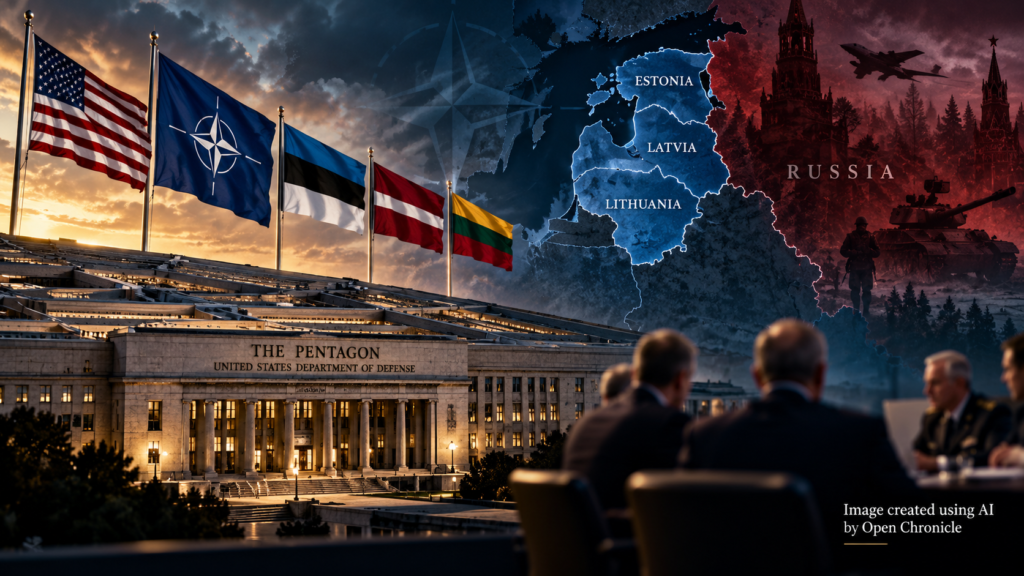
Washington’s reported private messages to Baltic governments highlight a delicate debate within NATO over deterrence, diplomatic language and the future of European security.
WARFARE JOURNAL | NATO & DEFENCE STRATEGY
30 October 2026 | By Open Chronicle Warfare Journal
Washington’s message to its European allies
The United States Department of Defense has reportedly urged several NATO allies to moderate their public statements about Russia, exposing differences within the transatlantic alliance over how Moscow’s military and security threats should be communicated.
According to an investigation published by Reuters on 30 October, American defence officials delivered the message during private bilateral meetings with representatives of several European governments, including Lithuania, Latvia and Estonia.
Four individuals familiar with the discussions, including three European officials and one American official, described the exchanges to the news agency on condition of anonymity.
The reported intervention comes at a particularly sensitive moment for European security. Russia’s war against Ukraine continues, NATO is reinforcing its eastern defences, and Washington is reassessing the distribution of military responsibilities between the United States and its European partners.
Although the reported American requests were not described as confrontational, they raise important questions about the relationship between military deterrence, diplomatic communication and alliance cohesion.
The Pentagon has neither publicly confirmed nor explicitly denied the substance of the reported conversations.
Elbridge Colby and the debate over confronting Moscow
One of the American officials reportedly involved was Elbridge Colby, the Under Secretary of Defense for Policy, who has played an important role in discussions about the future deployment of American forces in Europe.
According to Reuters, Colby advised a Baltic representative against unnecessarily provocative descriptions of Russia’s strategic position.
The concern reportedly centred on public comments portraying the Kremlin as increasingly desperate or politically cornered by its difficulties in Ukraine.
In late September, Estonian Prime Minister Kristen Michal had used an analogy describing Vladimir Putin as a cornered rat, suggesting that Russian operations against European countries reflected mounting frustration with the course of the war.
Reuters could not establish whether Colby was specifically referring to Michal’s remarks.
The distinction matters because the Pentagon’s reported intervention does not necessarily indicate disagreement with European assessments of Russian military capabilities.
Instead, it may reflect a different judgement about how those assessments should be communicated publicly.
For Washington, restrained language could reduce the risk of rhetorical escalation and preserve diplomatic flexibility.
For governments bordering Russia, however, direct warnings can serve a different purpose: preparing populations, sustaining defence investment and demonstrating political resolve.
Why the Baltic states see Russia differently
Estonia, Latvia and Lithuania occupy a distinctive position within NATO’s security architecture.
Their geographical proximity to Russia and Belarus, combined with their historical experiences under Soviet rule, has contributed to a particularly strong emphasis on national defence and collective security.
All three countries joined NATO in 2004 and have subsequently become central to the alliance’s eastern defence posture.
Since Russia’s full-scale invasion of Ukraine in February 2022, NATO has expanded its military readiness and strengthened multinational deployments across Eastern Europe.
The Baltic region is especially sensitive because of its strategic geography.
Estonia and Latvia share borders with Russia, while Lithuania borders Belarus and Russia’s Kaliningrad exclave.
Kaliningrad’s military installations and its location on the Baltic Sea give the region considerable strategic importance.
The Baltic governments therefore have strong incentives to communicate openly about military risks, including conventional threats, cyber operations, sabotage and interference with critical infrastructure.
Their public warnings are not necessarily predictions of an imminent Russian invasion.
Rather, they frequently reflect an assessment that credible deterrence requires both military preparedness and clear political communication.
A disagreement over rhetoric, not necessarily defence commitments
The reported American intervention should not automatically be interpreted as a reduction in NATO’s collective defence guarantees.
Article 5 of the North Atlantic Treaty establishes that an armed attack against one member is considered an attack against all members.
The provision remains the foundation of NATO’s security architecture.
At the July 2026 Ankara Summit, allied leaders reaffirmed their commitment to collective defence and identified Russia as a long-term challenge to Euro-Atlantic security.
NATO has also continued strengthening its eastern flank through multinational forces, air policing, missile defence and military readiness measures.
The present disagreement appears to concern the political presentation of the Russian threat rather than a formally announced change in the alliance’s defensive obligations.
Nevertheless, political language matters.
Deterrence depends not only on military capabilities but also on the credibility of the political decisions that would authorise their use.
If allies communicate substantially different assessments of the same threat, uncertainty can emerge about their intentions, priorities and willingness to act.
Such uncertainty may influence both domestic perceptions and the calculations of potential adversaries.
The American strategic calculation
The Pentagon’s reported requests coincide with broader American efforts to rebalance global military commitments.
Washington faces competing strategic demands in Europe, the Middle East and the Indo-Pacific.
The United States has repeatedly called for European NATO members to assume greater responsibility for their own conventional defence.
American defence planners are also reviewing the future distribution of US forces in Europe, although the outcome of that process remains uncertain.
These considerations create a complex strategic environment.
Washington may wish to maintain credible deterrence against Russia while preserving sufficient diplomatic flexibility to pursue negotiations over Ukraine.
At the same time, European governments are being encouraged to increase military readiness and reduce their dependence on American capabilities.
The potential tension is evident.
European allies are being asked to strengthen their defence posture while, according to Reuters, some are also being encouraged to moderate the language used to explain why such investments are necessary.
This does not necessarily represent an irreconcilable contradiction.
However, it illustrates the difficulties of coordinating security policy among allies whose geographical exposure and strategic priorities differ.
Ukraine and the search for a negotiated settlement
The reported exchanges also take place against the background of renewed American diplomatic efforts to bring Russia’s war against Ukraine to an end.
According to Reuters, the Trump administration has been exploring a combination of diplomatic incentives and pressure designed to encourage negotiations.
The possibility of sanctions relief for Russia and American pressure on Ukraine to restrict attacks against Russian energy infrastructure have featured in the agency’s reporting.
These efforts create additional sensitivities for European governments.
Countries closest to Russia have generally emphasised that any settlement must avoid leaving Ukraine vulnerable to renewed aggression.
They also recognise that the eventual outcome of the war could influence Europe’s security environment for years to come.
A negotiated settlement that reduces hostilities without resolving underlying security disputes could leave NATO facing continuing military and political challenges along its eastern frontier.
Conversely, successful negotiations accompanied by credible security arrangements could reduce immediate escalation risks.
Neither outcome can presently be assumed.
The debate over public messaging must therefore be understood within the wider uncertainty surrounding the war and possible diplomatic settlements.
Hybrid warfare complicates the discussion
One reason the disagreement is particularly significant is the growing importance of threats below the threshold of conventional armed conflict.
NATO has identified cyberattacks, sabotage, electronic interference, disinformation and other hostile activities as challenges to allied security.
These activities can create disruption without necessarily triggering the collective defence mechanisms associated with a conventional military attack.
At the beginning of October, NATO Secretary General Mark Rutte stated that the alliance saw no imminent military attack against its territory, while warning that hostile Russian activities could continue.
During a joint appearance with Estonia’s prime minister on 14 October, Rutte again emphasised the absence of an imminent conventional threat while reaffirming NATO’s readiness to defend allied territory.
These assessments demonstrate that recognising Russia as a serious security challenge does not require predicting an immediate invasion.
For European governments, the communication challenge is therefore unusually difficult.
Warnings that are too dramatic may increase public anxiety or exaggerate the immediacy of a threat.
Warnings that are too restrained may leave citizens inadequately informed about the reasons for increased military spending and civil preparedness.
Effective strategic communication requires distinguishing between long-term military capabilities, immediate operational intentions and ongoing hostile activities.
The credibility of NATO’s eastern flank
From a military perspective, the central question is whether disagreements over political language could eventually affect practical defence cooperation.
NATO’s deterrence posture depends on multiple interconnected capabilities.
These include forward-deployed forces, reinforcement planning, integrated air and missile defence, intelligence sharing, logistics and the ability to mobilise military resources rapidly.
Political cohesion supports those capabilities by demonstrating that allied governments are prepared to act collectively.
The Baltic states occupy an important position in this structure because any major crisis involving their territory would immediately raise questions about NATO’s response.
For this reason, disagreements between Washington and Baltic capitals attract attention beyond the countries directly involved.
They may influence broader European debates about defence autonomy, military procurement and the future role of American forces on the continent.
However, the available reporting does not establish that the private exchanges have altered NATO operational plans, force deployments or formal defence commitments.
Any such conclusion would require additional evidence.
Strategic analysis: Three implications for European security
First, NATO faces a growing challenge in coordinating its strategic messaging.
Alliance members may agree that Russia presents a serious long-term security threat while disagreeing about the language most appropriate for communicating that threat.
Maintaining a distinction between intelligence assessments, political warnings and deterrent signalling will become increasingly important.
Second, European defence responsibilities are likely to remain a central source of transatlantic negotiation.
If Washington continues pressing European governments to expand their military capabilities, those governments will need to explain the financial and political consequences to their populations.
Public discussion of the Russian threat will inevitably form part of that process.
Third, the relationship between diplomacy and deterrence remains unresolved.
Efforts to negotiate an end to the war in Ukraine may encourage more cautious diplomatic language.
Yet NATO must simultaneously demonstrate that its defensive commitments remain credible regardless of the progress or failure of those negotiations.
Balancing these objectives will require sustained coordination between Washington and European capitals.
Conclusion: A debate about words with strategic consequences
The Pentagon’s reported requests to European allies illustrate how strategic communication has become an important element of NATO’s broader security challenges.
The controversy is not simply about whether governments should speak more cautiously about Russia.
It concerns the relationship between political language, military preparedness, diplomatic negotiations and the credibility of collective defence.
For the Baltic states, warnings about Russian behaviour are closely connected to their national security priorities.
For Washington, diplomatic restraint may be viewed as a way to manage escalation risks while maintaining room for negotiation.
Both approaches reflect identifiable strategic considerations, but their effectiveness depends on whether NATO can maintain a coherent collective position.
The alliance’s central challenge is to reconcile these different perspectives without weakening either its deterrent credibility or its capacity for diplomacy.
As the war in Ukraine continues and the United States reviews its military posture in Europe, that challenge is likely to remain a significant issue in transatlantic security relations.
Sources and Further Reading
The following journalistic and institutional references provide the factual and strategic foundation for this article.
Pentagon Tells Europeans to Cool Their Rhetoric on Russia, Sources Say
Published 30 October 2026. Original investigation based on four individuals familiar with private discussions between American defence officials and European NATO representatives.
The Ankara Summit Declaration
8 July 2026. Official declaration reaffirming collective defence commitments, transatlantic unity and the alliance’s assessment of long-term security threats.
Strengthening NATO’s Eastern Flank
Updated 29 September 2026. Official explanation of allied military readiness, forward defence arrangements and security developments along NATO’s eastern frontier.
Joint Press Conference with the Secretary General and the Prime Minister of Estonia
14 October 2026. Official transcript addressing Russian threats, NATO readiness and collective defence.
Collective Defence and Article 5
Official explanation of NATO’s collective defence obligations and the legal and strategic foundations of allied security.
This article was prepared by Open Chronicle Warfare Journal using reporting published by Reuters on 30 October 2026 and official NATO documentation. The account of private discussions between Pentagon officials and European representatives is attributed to Reuters and has not been independently confirmed by Open Chronicle. The Pentagon declined to comment on the substance of the reported conversations. Strategic interpretations are identified as analysis and should not be understood as confirmed government policy or evidence of changes to NATO’s collective defence commitments.