
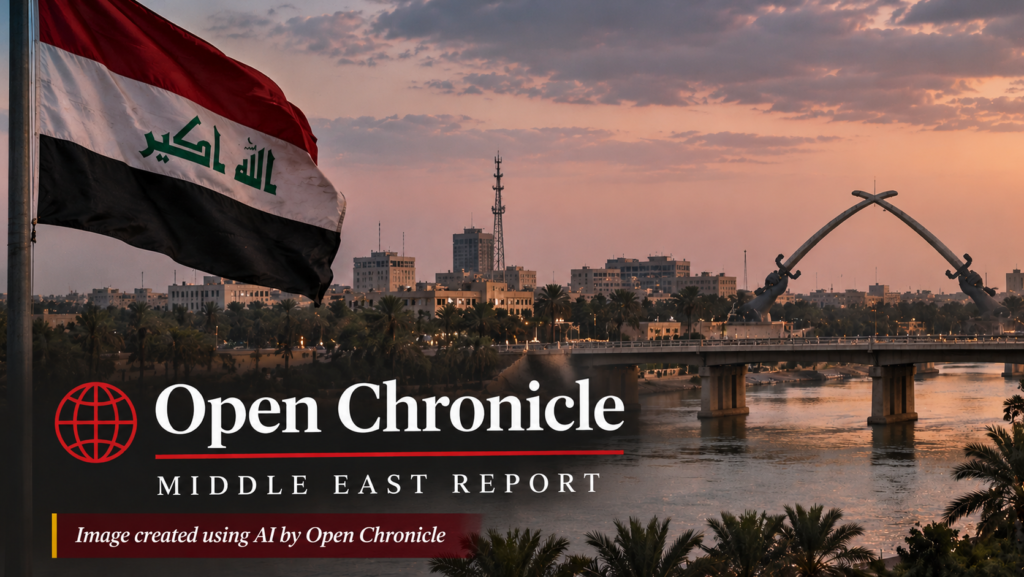
Prime Minister Ali al-Zaidi’s decision to dismiss Iraq’s intelligence chief and assume direct control of the agency has reopened questions about political power sharing, national security and the independence of state institutions.
By Open Chronicle
BAGHDAD, Iraq | October 31, 2026
Iraq’s intelligence establishment is facing a new test of its institutional independence after Prime Minister Ali al-Zaidi reportedly dismissed the head of the country’s intelligence agency and assumed direct responsibility for its leadership, a decision that has intensified debate over the distribution of sensitive security positions among Iraq’s political factions.
The move follows the removal of intelligence chief Hamid al-Shatri, who had been appointed in December 2024 under former Prime Minister Mohammed Shia al-Sudani.
According to reporting by Asharq Al-Awsat, al-Zaidi took control of the agency on Thursday evening, three days after dismissing al-Shatri. The government presented the decision as part of efforts to strengthen Iraqi sovereignty and address regional security challenges, without specifying the threats involved or indicating how long the prime minister would remain in charge.
Beyond the immediate leadership change, the decision has exposed longstanding tensions between efforts to professionalize Iraq’s security institutions and the political arrangements that have shaped senior appointments since 2003.
At the centre of the dispute is whether the country’s intelligence service can operate independently of partisan and sectarian competition while remaining accountable to elected civilian leadership.
A leadership change with wider political consequences
Al-Zaidi has publicly argued that the intelligence agency belongs to all Iraqis and should not be governed by political, factional or sectarian quotas.
His decision to assume direct control rather than immediately appoint a successor has nevertheless introduced a new dimension to Iraq’s established system of political bargaining.
Under informal power sharing arrangements, senior government and security positions have frequently been distributed through negotiations among political blocs.
These arrangements are not necessarily defined by formal legislation, but they have played a significant role in determining who occupies influential state offices.
Political sources cited by Asharq Al-Awsat said the intelligence agency’s leadership had been expected to fall within the share of senior positions allocated to Sunni Arab political representatives.
No Sunni candidate had been appointed to the position before the prime minister intervened.
The decision has therefore raised two competing interpretations.
One is that the prime minister is seeking to protect a sensitive national security institution from political competition during a period of regional instability.
The other is that direct control by the head of government could concentrate additional authority within the prime minister’s office without resolving the underlying disputes over institutional independence.
Neither interpretation establishes the government’s motives, which have not been fully explained publicly.
Security restructuring amid regional instability
The intelligence leadership dispute comes against a background of security concerns involving Iraq’s position between competing regional powers.
The country has repeatedly faced pressure from tensions involving Iran, the United States and armed groups operating within or across its borders.
In March 2026, a drone reportedly struck the vicinity of the intelligence agency’s headquarters in Baghdad’s Mansour district, killing an officer and damaging part of the compound.
Unofficial security assessments attributed the incident to armed factions operating outside government authority, although responsibility was not conclusively established in the reporting provided.
The attack illustrated the potential vulnerability of security institutions to violence associated with wider regional confrontations.
Sources familiar with the political discussions told Asharq Al-Awsat that al-Zaidi’s restructuring plans were encountering resistance from factions seeking influence over the agency.
They suggested that the prime minister’s temporary assumption of the leadership position could prevent competing groups from turning the appointment process into a prolonged political confrontation.
That possibility is particularly significant because intelligence agencies depend on continuity, confidentiality and operational coordination.
A contested leadership appointment could create uncertainty over internal authority, personnel decisions and relations with other security bodies.
However, the degree to which the reported restructuring will change the agency’s actual operations remains unclear.
Sunni representation and Iraq’s political quota system
The controversy has also revived questions about Sunni Arab representation within Iraq’s senior security institutions.
Since the political transition following the United States-led invasion in 2003, Iraq’s political system has relied heavily on negotiations among Shiite, Sunni Arab and Kurdish political representatives.
Although the constitutional framework does not prescribe a comprehensive sectarian allocation of every senior position, informal political agreements have frequently shaped appointments.
The intelligence agency has generally been headed by officials associated with Shiite political circles, apart from a period under former officer Mohammed Abdullah al-Shahwani.
Sunni Arab officials have occupied senior operational positions, including the deputy directorship for operations.
According to the original reporting, some officials in these positions have faced campaigns of criticism and pressure from Iran-aligned factions.
A Sunni politician who spoke anonymously to Asharq Al-Awsat argued that the intelligence leadership position should have been included in the Sunni Arab allocation of senior government offices.
The politician said Sunni representatives had frequently been disadvantaged by the quota system, particularly in sensitive security appointments.
He also questioned the gap between official calls for equal citizenship and the continuing influence of political affiliation on access to senior positions.
Nevertheless, the same politician distinguished between the dismissal of al-Shatri and the prime minister’s decision to take charge personally.
In his assessment, temporary leadership by the prime minister could prevent the dispute from escalating into an open contest among political factions.
The argument reflects a broader dilemma within Iraq’s political system: removing a position from factional bargaining may reduce immediate competition, but it does not automatically establish a transparent and independent appointment process.
The struggle between political influence and professional independence
The current dispute is part of a wider institutional challenge that has affected Iraq’s public administration and security establishment for more than two decades.
Political parties have frequently sought influence over ministries, regulatory bodies and senior security positions.
Such arrangements can provide representation for competing political constituencies, but critics argue that they may also weaken institutional continuity and make appointments dependent on partisan negotiations rather than professional qualifications.
Political researcher Abbas Abboud told Asharq Al-Awsat that the overlap between administrative responsibilities and political interests had contributed to the erosion of institutional independence.
According to Abboud, competition for control of state institutions has extended from ordinary administrative offices to sensitive intelligence and security agencies.
The intelligence agency has consequently become another arena in which competing political interests intersect with national security responsibilities.
The central challenge is not simply determining which political group should appoint the agency’s next director.
It is establishing whether the institution can maintain operational autonomy, professional standards and accountability regardless of changes in government.
That distinction is particularly important for intelligence services, whose responsibilities include assessing threats, gathering sensitive information and supporting national security decisions.
If intelligence appointments become instruments of political competition, the risks may extend beyond internal administrative disputes.
They can also affect information sharing, interagency coordination and confidence in the neutrality of security assessments.
Centralizing security authority under the prime minister
The reported restructuring includes the creation of an Office of the Commander-in-Chief of the Armed Forces, headed by former Interior Minister Lieutenant General Abdul Amir al-Shammari.
The arrangement has been presented as part of an effort to strengthen central oversight of Iraq’s security establishment.
Under Iraq’s constitutional system, the prime minister serves as commander-in-chief of the armed forces.
The creation of additional coordination structures could therefore be intended to reinforce the government’s ability to direct security policy and respond to threats.
However, greater centralization does not necessarily produce greater institutional independence.
An intelligence agency may be protected from competing political factions while becoming more directly dependent on the executive leadership.
The distinction depends on the rules governing appointments, operational decisions, oversight and accountability.
A professional intelligence system requires a clear division between political responsibility for national security policy and the technical responsibilities of intelligence officers.
It also requires mechanisms to prevent sensitive information from being used for partisan purposes.
Whether the new arrangements will strengthen these safeguards remains an open question.
Intelligence capabilities and Iraq’s regional position
Iraq’s intelligence services operate in a particularly complex strategic environment.
The country shares borders with Iran, Türkiye, Syria, Jordan, Saudi Arabia and Kuwait, placing it at the intersection of several regional security challenges.
Its security institutions must address threats involving armed groups, cross-border movements, terrorism, organized crime and the consequences of regional military confrontations.
Political science professor Talib Mohammed Karim of Al-Mustansiriya University told Asharq Al-Awsat that Iraq needs an intelligence agency capable of understanding regional and international developments before they become direct threats to national security.
Karim emphasized the importance of strategic assessment, anticipation of changes in conflicts and coordination among security, diplomatic and economic institutions.
Such capabilities are especially important for a country whose economic stability depends heavily on energy exports and whose foreign relations involve competing regional and international interests.
Intelligence assessments can influence decisions about border security, military readiness, diplomatic engagement and the protection of critical infrastructure.
Their effectiveness depends not only on technical resources but also on the credibility and independence of the institutions producing them.
Karim argued that the agency’s leadership should operate according to national interests rather than the calculations of competing political groups.
That position reflects a central principle of professional intelligence administration: elected governments determine national security priorities, while intelligence institutions must provide assessments grounded in evidence rather than political preference.
What happens next?
Several questions remain unresolved following the reported leadership change.
The first concerns the duration of the prime minister’s direct control. The government has not provided a timetable for appointing a permanent intelligence chief.
The second concerns the selection process for the next director.
If the position returns to political negotiations among governing factions, the same disputes that preceded the intervention could reappear.
If the government introduces a more formal appointment process based on professional qualifications and institutional oversight, the restructuring could have implications beyond the intelligence agency itself.
A third question concerns the relationship between the agency and the broader security establishment.
The new central coordination arrangements may change reporting structures, operational priorities and the balance of authority among security institutions.
For Iraq’s political leadership, the immediate challenge is maintaining the continuity of intelligence operations while addressing competing demands for political representation and institutional reform.
For the intelligence agency, the more enduring question is whether its leadership and operations can be insulated from factional rivalries without weakening democratic accountability.
A broader test for the Iraqi state
The dispute over Iraq’s intelligence leadership reflects a longstanding tension within the country’s political system.
Governments have repeatedly pledged to strengthen national institutions, reduce sectarian divisions and improve the effectiveness of the security establishment.
Yet the distribution of senior positions remains closely connected to political negotiations among competing factions.
Al-Zaidi’s reported intervention may temporarily remove the intelligence agency from those negotiations, but its longer-term significance will depend on what follows.
The appointment of a permanent director, the transparency of the selection process and the practical limits placed on political interference will provide important indications of the government’s intentions.
Ultimately, the issue extends beyond the identity of the agency’s next chief.
It concerns whether Iraq can develop security institutions that remain professionally independent, politically accountable and capable of responding to regional threats without becoming instruments of factional competition.
Sources and Further Reading
The following sources support the principal developments described in this article.
01. Asharq Al-Awsat | Iraq’s Intelligence Agency Faces Test of Political Rivalries
October 31, 2026 | Primary Reporting
Primary reporting by Hamza Mustafa, including political sources, analysis of the quota system and interviews with Iraqi researchers.
english.aawsat.com
02. The National | Iraqi Prime Minister Takes Direct Control of Intelligence Service
October 30, 2026 | Independent Reporting
Independent reporting on the prime minister’s assumption of the agency’s leadership and the government’s explanation.
thenationalnews.com
03. 964media | Zaidi Removes Iraqi Intelligence Chief Hamid al-Shatri
October 26, 2026 | Government and Security
Reporting on the executive order dismissing al-Shatri and the absence of an immediately appointed successor.
en.964media.com
04. 964media | Intelligence Service Must Stay Outside Party and Sectarian Quotas
October 29, 2026 | Institutional Independence
Coverage of the prime minister’s statements during his visit to the intelligence agency, including his position on partisan and sectarian quotas.
en.964media.com
05. Iraqi News Agency | Termination of Hamid al-Shatri’s Assignment
October 26, 2026 | Official Iraqi Information
Official confirmation of the termination of Hamid al-Shatri’s assignment as head of the Iraqi National Intelligence Service.
video-agencyia.iq
Editorial Note
This article was prepared on October 31, 2026, using reporting from Asharq Al-Awsat, additional regional news coverage and official Iraqi information.
The dismissal of Hamid al-Shatri and Prime Minister Ali al-Zaidi’s assumption of direct responsibility for the Iraqi National Intelligence Service were corroborated through multiple reports.
Claims concerning informal political allocations, factional influence and the motivations behind the restructuring are attributed to the political sources and analysts who expressed them. Responsibility for the reported March 2026 drone attack has not been independently established.
The article distinguishes documented government actions from political interpretations and considers the institutional implications of the leadership change without treating competing explanations as established facts.